
















Section 1: Introduction
The rules of tennis are governed by the International Tennis Federation (ITF), the world governing body of tennis, founded in 1913. The authoritative source for all rules cited in this document is the ITF Rules of Tennis 2026, published by the ITF and effective January 1, 2026. The ITF Rules of Tennis are reviewed annually; any amendments are approved at the ITF Annual General Meeting and take effect on January 1 of the following year.
Tennis is played as a singles contest (one player per side) or a doubles contest (two players per side). The object of the game is to win points by playing the ball into the opponent's court in such a way that the opponent is unable to make a valid return. A match consists of sets, each set consists of games, and each game consists of points, as detailed in the Scoring section.
The ITF Rules of Tennis apply to all levels of the game, from recreational play to Grand Slam tournaments. The four Grand Slam tournaments — the Australian Open, Roland Garros (French Open), The Championships Wimbledon, and the US Open — are conducted in accordance with ITF Rules, with supplementary regulations applied by each tournament organiser.
These rules are also used as the basis for the Olympic tennis competition, governed jointly by the ITF and the International Olympic Committee (IOC).
Section 2: Equipment
The Ball (ITF Rules of Tennis 2026, Rule 3)
The ball shall have a uniform outer surface and shall be white or yellow in colour. If there are any seams, they shall be stitchless.
- Diameter: More than 6.35 cm (2.500 inches) and less than 6.67 cm (2.625 inches)
- Mass: More than 56.0 g (1.975 oz) and less than 59.4 g (2.095 oz)
- Bounce: When dropped onto a concrete base from a height of 254 cm (100 inches), the ball shall rebound more than 134.62 cm (53 inches) and less than 147.32 cm (58 inches)
- Deformation (forward): More than 0.495 cm (0.195 inches) and less than 0.737 cm (0.290 inches)
- Deformation (return): More than 0.368 cm (0.145 inches) and less than 0.508 cm (0.200 inches)
The ITF specifies four types of balls for different playing conditions: Type 1 (fast-pace balls, for use on slower surfaces), Type 2 (medium-pace balls, the standard), Type 3 (slow-pace balls, for use on fast surfaces or at high altitude), and High Altitude balls (for use above 1,219 m / 4,000 feet). The choice of ball type is specified by the tournament or match organiser before play begins.
The Racket (ITF Rules of Tennis 2026, Rule 4)
Rackets not conforming to the specifications in Appendix II of the ITF Rules of Tennis 2026 may not be used in play approved or sanctioned by the ITF, the Grand Slam tournaments, the ITF Pro Circuit, or national associations. Key specifications include:
- Frame length: The hitting surface shall not exceed 39.37 cm (15.5 inches) in overall length, and the overall length of the frame shall not exceed 73.66 cm (29 inches)
- Frame width: The hitting surface shall not exceed 29.21 cm (11.5 inches) in overall width
- Stringing: The racket shall be strung with a pattern of crossed strings connected to a frame and alternately interlaced or bonded where they cross. The stringing pattern shall be generally uniform and in particular not less dense in the centre than in any other area. The strings shall be free of attached objects and protrusions other than those utilised solely and specifically to limit or prevent wear and tear, or vibration, and which are reasonable in size and placement for such purposes.
- Power assist / embedded devices: The frame and stringing shall not provide any electrical, electronic, or mechanical assistance to the player. No energy source that could affect the flight of a ball shall be incorporated into the racket.
Approved Equipment Lists
The ITF maintains an approved ball list (updated quarterly) and an approved racket specifications register. Tournament organisers must use balls from the approved list. Players competing on the ITF Pro Circuit must use rackets that comply with Appendix II specifications, though racket frames are not individually pre-approved.
Section 3: Playing Area
Court Dimensions (ITF Rules of Tennis 2026, Rule 1)
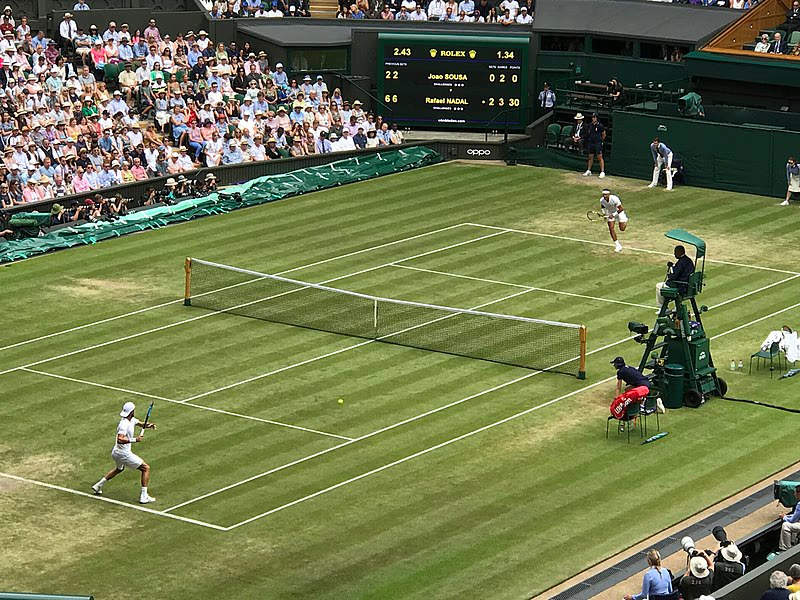
The court is a rectangle, longer than it is wide. Official dimensions are:
- Length: 23.77 m (78 feet)
- Width (singles): 8.23 m (27 feet)
- Width (doubles): 10.97 m (36 feet)
The court is divided across its width by a net suspended from a cord or metal cable of a maximum diameter of 0.8 cm (one-third of an inch), the ends of which shall be attached to, or pass over, the tops of two net posts. The net shall be extended fully so that it fills completely the space between the two net posts.
The Net (ITF Rules of Tennis 2026, Rule 2)
- Net height at posts: 1.07 m (3 feet 6 inches)
- Net height at centre: 0.914 m (3 feet), held down by a strap
- Net posts height: 1.07 m (3 feet 6 inches)
- Net posts position (singles): 0.914 m (3 feet) outside each singles sideline
- Net posts position (doubles): At each doubles sideline
- Centre strap width: Maximum 5 cm (2 inches), white
- Net band (top): 5 cm to 6.35 cm (2–2.5 inches) wide, white
- Net mesh: Shall be sufficiently small to prevent the ball passing through it
Court Lines (ITF Rules of Tennis 2026, Rule 1)
Lines at the ends of the court are called baselines. Lines at the sides of the court are called sidelines (there are singles sidelines and doubles sidelines). On each side of the net, at a distance of 6.40 m (21 feet) measured parallel to and on each side of the net, are the service lines. The area between a sideline and the service line on each side and extending from the net is divided into two equal parts by the centre service line, which is 5 cm (2 inches) wide and parallel to the singles sidelines; this creates the service boxes (right service box and left service box).
Each baseline is bisected by an imaginary continuation of the centre service line; a short mark called the centre mark is drawn inside the court, perpendicular to and touching the baseline, with a length of 10 cm (4 inches).
- Baseline width: Up to 10 cm (4 inches)
- Other lines width: Between 2.5 cm (1 inch) and 5 cm (2 inches), except the centre service line and centre mark which shall be 5 cm (2 inches)
- All lines are part of the court areas they define (i.e., a ball landing on any line is considered "in")
Court Surfaces
The ITF Rules do not prescribe a specific surface material, but the ITF publishes a Court Pace Classification (CPC) system. Courts are classified on a scale of 1 (Slow) to 5 (Fast) based on the ITF's laboratory pace rating. Grand Slam surfaces: Australian Open (Plexicushion Prestige, pace 4), Roland Garros (clay, pace 2), Wimbledon (grass, pace 5), US Open (DecoTurf, pace 4).
Section 4: Players & Officials
Players
Per ITF Rules of Tennis 2026, Rule 28 (Player Analysis), a match is played between two players (singles) or two teams of two players each (doubles). In doubles, each team is referred to as a "pair." One player on each side must serve at the start of each game, alternating between the members of the pair according to the rules of service rotation (Rule 14).
Players must be ready to play within the time limits set by the ITF or tournament referee. If a player is not ready to play within a reasonable time, the player may forfeit the match at the discretion of the referee.
The Chair Umpire
The chair umpire has overall responsibility for the conduct of the match and is the final authority on all matters of fact during play (ITF Rules of Tennis 2026, Appendix V). The chair umpire calls the score, calls lets, foot faults (when no line umpires are present), net cord, and all violations. The chair umpire may overrule a line umpire's call immediately if they are certain the call was incorrect (Rule 30, Case 3).
Line Umpires
Line umpires are assigned to monitor specific lines and make calls on balls landing in or out of their assigned lines. Their calls are final on matters of fact unless overruled by the chair umpire. In professional events using Electronic Line Calling (ELC) technology (e.g., Hawk-Eye Live), line umpires may not be present and all calls are generated electronically (ITF Rules of Tennis 2026, Appendix VI).
Foot Fault Judge
A foot fault judge may be appointed to monitor foot faults. In the absence of a foot fault judge, the chair umpire may call foot faults (Rule 18, Note).
The Referee
The tournament referee supervises the overall conduct of the tournament, has authority over scheduling and order of play, and may be consulted on questions of law (as opposed to questions of fact, which are determined by the chair umpire). The referee may remove a chair umpire during a match in exceptional circumstances.
Electronic Line Calling (ITF Rules 2026, Appendix VI)
The ITF has formally incorporated Electronic Line Calling Live (ELC Live) into the Rules as of 2023, with refinements in 2025 and 2026. Where ELC is operational, all line calls are made electronically and are final (no challenges or reviews permitted). The chair umpire retains authority over all other matters. If ELC malfunctions, the match reverts to traditional officiating.
Challenges (Hawk-Eye Review, Rule 30 & Appendix VI)
In tournaments not using ELC Live, electronic review (challenge) systems may be used. Each player receives three incorrect challenges per set (plus one additional incorrect challenge if a set goes to a tiebreak). A challenge is forfeited only if the call is confirmed as correct (i.e., the original call stands). If the challenge results in a reversal of the original call, the player retains the challenge.
Section 5: Rules of Play
The Service (ITF Rules of Tennis 2026, Rules 16–19)
Rule 16 – Choice of Ends and Service: The choice of ends and the right to be server or receiver in the first game shall be decided by toss before the warm-up starts. The player winning the toss may choose to serve, receive, or start at a particular end. The opponent shall then exercise their remaining choices.
Rule 17 – Service Action: The server shall stand behind the baseline, between the centre mark and the sideline. The server shall then release the ball (from the hand that is not holding the racket) and hit it with the racket before the ball hits the ground. The service is completed at the moment of impact with the racket. The server's feet may not touch the baseline or the court inside the baseline before the ball is struck (foot fault, Rule 18).
Rule 18 – Foot Fault: During the service, the server shall not:
- Change position by walking or running, although slight movements of the feet are permitted
- Touch, with either foot, any area other than that behind the baseline within the imaginary extensions of the centre mark and sideline
Rule 19 – Service in/out: The served ball must land in the diagonally opposite service box (right service box when serving from the right, left service box when serving from the left). The ball must pass over the net; if it touches the net cord and lands correctly in the service box, it is a let (Rule 22) and the serve is replayed. A service that does not land in the correct service box is a fault.
The server has two attempts to serve correctly per point. The first unsuccessful serve is a fault; the second is a double fault, and the receiver wins the point.
The Return of Service and General Play (Rules 20–27)
Rule 20 – Server wins the point: The server wins the point if:
- The served ball, not being a let, touches the receiver or anything they wear or carry before it hits the ground
- The receiver fails to return the service
Rule 21 – Receiver wins the point: The receiver wins the point if the server commits a double fault, or if the server fails to make a valid service action.
Rule 24 – A player loses the point: A player loses the point if:
- The player fails to return the ball before it bounces twice on their side (Rule 24a)
- The player returns the ball so that it hits the ground, a permanent fixture, or other object outside the correct court (Rule 24b)
- The player volleys the ball before it has passed the net (Rule 24c)
- The player deliberately carries or catches the ball on the racket or deliberately touches it with the racket more than once (Rule 24d)
- The player or their racket (whether in hand or not) or anything that the player wears or carries touches the net, net posts, cord or metal cable, strap, or band or the opponent's court at any time during play of a point (Rule 24e/f)
- The player hits the ball before it has passed the net (Rule 24g)
- The ball in play touches the player or anything they wear or carry, except the racket (Rule 24h)
- The ball in play touches the racket when the player is not holding it (Rule 24i)
- The player deliberately and materially changes the shape of the racket during play (Rule 24j)
Rule 25 – A good return: It is a good return if:
- The ball touches the net, net posts/singles sticks, cord, metal cable, strap, or band and passes over them and hits the ground within the correct court
- The ball, served or returned, hits the ground within the correct court and bounces back over the net; the player may then reach over the net to play the ball provided they do not touch the net or the opponent's court
- A player's racket passes over the net after hitting the ball on their own side of the net and the ball lands in the correct court
- A player manages to return a ball that has struck another ball lying in the court
Rule 26 – Interference: If a player is hindered in making a stroke by anything not under the player's control, except a permanent fixture of the court, a let shall be played. If a player is hindered by something under their own control, no let is allowed.
Service Rotation (Doubles, Rule 14)
In doubles, the pair that serves in the first game of each set shall decide which partner shall serve. Similarly, the opposing pair shall decide which partner shall serve in the second game. Partners shall serve alternately throughout the set. The order of serving may not be changed during a set but may be changed at the beginning of each set. The same order of service shall apply during a match tiebreak.
Changing Ends (Rule 5)
Players change ends at the end of the first, third, and every subsequent odd game of each set. Players also change ends at the end of each set unless the total number of games in that set is even, in which case the change of ends shall take place at the end of the first game of the next set.
Section 6: Scoring
Points within a Game (ITF Rules of Tennis 2026, Rule 6)
The score within a game is called using specific terminology. Starting from zero, the points are:
- 0 points: "Love"
- 1st point won: "15"
- 2nd point won: "30"
- 3rd point won: "40"
- 4th point won: Game won (if opponent has not reached 40)
If both players reach 40 points each ("40–all"), the score is called Deuce. From deuce, a player must win two consecutive points to win the game. The point won after deuce is called the Advantage for the player who won it. If the player with the advantage wins the next point, they win the game. If they lose it, the score returns to deuce. This continues until one player wins two consecutive points from deuce.
No-Ad scoring: As an approved alternative (Rule 6, Note 1), a single deciding point may be played at deuce; in this case, the receiver chooses from which side of the court the service is delivered.
Games within a Set (Rule 7)
The first player to win six games wins a set, provided there is a margin of two games over the opponent (e.g., 6–4 or 6–0). If the score reaches 6 games all, the set is decided by a tiebreak game (Rule 9), unless the competition format specifies a different procedure (e.g., advantage set, used at some Grand Slams in the final set — see below).
The Tiebreak Game (Rule 9)
In a tiebreak game, points are scored as 1, 2, 3, etc. The first player to reach 7 points wins the tiebreak game and the set (e.g., 7–6), provided there is a margin of two points. If the score reaches 6 points all, the tiebreak continues until one player leads by two points. The player whose turn it was to serve first in the tiebreak game serves the first point from the right service box. The opponent then serves the next two points (starting from the left). Thereafter, each player alternately serves for two consecutive points until the tiebreak is won.
Players change ends after every six points in the tiebreak, and at the end of the tiebreak. The player who served first in the tiebreak shall receive service in the first game of the following set.
Match Tiebreak (Super Tiebreak): As an approved alternative (Rule 9, Note 2), a match tiebreak played to 10 points (with a margin of 2) may be used in lieu of a final set. This format is used in the final set at the Australian Open (since 2019), and in doubles at all four Grand Slams. The US Open uses a standard tiebreak in all sets including the final set. Roland Garros and Wimbledon introduced the match tiebreak at 6–6 in the final set starting in 2022 and 2019 respectively.
Sets within a Match (Rule 8)
- Best of three sets: The first player to win two sets wins the match. Used in most women's professional matches and many men's tour matches below Grand Slam level.
- Best of five sets: The first player to win three sets wins the match. Used in men's Grand Slam singles and Davis Cup singles/doubles rubbers.
Announcing the Score
Per ITF Rules of Tennis 2026, Appendix V (Role of Officials), the chair umpire is responsible for announcing the score at the end of every point, game, set, and match. The server's score is always called first. A set score is announced after each game. At the change of ends, the chair umpire announces the overall match score.
Section 7: Violations & Penalties
Time Violations (ITF Rules of Tennis 2026, Rule 29 & Appendix V)
Players have 25 seconds between points (from the end of one point to the beginning of the service motion of the next). At Grand Slam events and ATP/WTA Tour events, a shot clock is used to enforce this rule. The first time violation results in a warning; subsequent violations result in the loss of a first serve (i.e., the server goes directly to a second serve without a first serve); further violations result in the loss of a point.
At the end of a game, players have 90 seconds to change ends (including when play is continuing on the same end). At the end of a set, players receive a maximum of 120 seconds rest. These intervals are timed from the moment the last point of the game/set ends.
Medical timeouts: A player is entitled to one medical timeout per match per medical condition, lasting up to three minutes. Additional time may be granted at the discretion of the tournament physician.
Code of Conduct Violations (ITF Code of Conduct, incorporated by reference)
The ITF Code of Conduct applies to all ITF-sanctioned events. Violations are handled by the chair umpire using a progressive penalty structure:
- First offence: Warning (for most categories of offence)
- Second offence / Point penalty: Loss of a point
- Third offence / Game penalty: Loss of a game
- Default: If a player commits a further offence after receiving a game penalty, the chair umpire may default the player (loss of match). A player may also be defaulted immediately for particularly egregious conduct.
Categories of offence subject to the Code of Conduct penalty schedule include:
- Ball abuse (hitting or throwing a ball in an unsportsmanlike manner)
- Racket abuse (smashing, throwing, or damaging a racket)
- Verbal abuse (using profane or obscene language)
- Audible obscenity
- Unsportsmanlike conduct (including deliberate time wasting, coaching violations)
- Physical abuse of an official or opponent (automatic default, no warning required)
Hindrance (Rule 26)
Deliberate hindrance of an opponent results in the immediate loss of the point for the player causing the hindrance, without warning. Unintentional or involuntary hindrance by any source outside the players' control results in a let.
Illegal Coaching (ITF Rules, Appendix V)
In most professional events, coaching is not permitted during play except during a change of ends or set break. The chair umpire will issue a warning to the player whose coach is providing coaching from the stands during a point or an unauthorised time. A second offence results in a code violation penalty. However, the WTA Tour (and some ITF events) permits on-court coaching by a designated coach during change of ends. Players must refer to the specific tournament regulations.
Foot Faults (Rule 18)
A foot fault is called when the server's foot touches or crosses the baseline before the racket strikes the ball. It is treated as a fault (loss of one serve). A foot fault on the second serve results in a double fault and the point is awarded to the receiver.
Let (Rule 22)
A let is called and the point (or serve) is replayed, not penalised, in the following circumstances:
- A served ball touches the net cord but lands correctly in the service box (service let)
- A ball is served when the receiver is not ready (provided the receiver makes no attempt to play the ball)
- A point is hindered by a factor outside the players' control (e.g., a ball from another court rolls onto the court in play)
Section 8: Safety Considerations
Suspension of Play (ITF Rules of Tennis 2026, Rule 29)
The referee or chair umpire has the authority to suspend or postpone play at any time in the interest of player safety. Circumstances warranting suspension include:
- Lightning or thunderstorms (play must be suspended immediately when lightning is present within a specified distance, per local tournament policy)
- Heavy or persistent rain rendering the court surface dangerous
- Fading or insufficient light to see the ball safely
- Extreme heat or humidity (governed by the ITF Extreme Heat Policy, see below)
- Court surface damage (e.g., cracks, wet patches) that poses a risk of injury
When play is suspended, all players must leave the court promptly. Play resumes only when the referee confirms conditions are safe.
Extreme Heat Policy (ITF Extreme Heat Policy, applicable at Grand Slams and ITF events)
The ITF and Grand Slam tournaments operate under an Extreme Heat Policy (EHP) that allows a 10-minute break when the temperature and/or humidity reaches a specified threshold level (the specific thresholds are set by each Grand Slam, e.g., a Wet Bulb Globe Temperature (WBGT) reading). Under the EHP:
- Women's singles and doubles matches may take a 10-minute break after the third set (or after the second set in a best-of-three match)
- Men's matches may take a 10-minute break after the fourth set (or after the second set in a best-of-three match)
- Players may change their clothing and towel off during the break
- The break is taken at the next changeover after the threshold is met
The Australian Open operates under its own Extreme Heat Policy with specific WBGT and temperature/humidity thresholds and may close the roof on retractable-roof courts when the EHP is activated.
Injury and Medical Timeouts (Rule 29 & Appendix V)
A player who sustains an injury during a match is entitled to:
- One medical timeout of up to three minutes per distinct medical condition. The timeout begins when the authorised medical personnel reaches the player.
- Toilet/change of clothing breaks: one during a match (women are entitled to two); timing is at the change of ends at the end of a set. The chair umpire shall use reasonable judgment.
- A player who is bleeding must stop play immediately to receive treatment. Bleeding stoppages are not counted against the player's medical timeouts.
If a player is unable to continue due to injury, the player may retire from the match (conceding the match to the opponent) or, in cases of physical incapacity, may be defaulted by the referee if they are unable to proceed within a reasonable time.
Court and Environment Safety
Tournament organisers are required by ITF regulations to ensure that:
- Net posts and surrounding barriers do not pose a collision hazard to players
- Ball kids and line umpires are positioned safely and are aware of court procedures
- Spectators remain outside designated court areas during play
- Courts are inspected before play commences each day, including checking net height, court surface integrity, and line visibility
Ball persons (ball kids) are positioned according to ITF and tournament guidelines to ensure they remain outside play areas and do not interfere with players in motion. They must remain stationary during points and move only between points.
Equipment Safety
Players are responsible for ensuring their equipment (rackets, strings, grips, footwear) is in safe condition before and during play. Worn or cracked footwear that could affect mobility on court should be replaced. The use of any device that could cause injury to an opponent or court surface is prohibited.