


🏛️Official — ITFIn Season
Loading OpenSourceSports…
Individual Sports
1 players
both
tennis ball, racket, net
10 essential rules
The rules of tennis are governed by the International Tennis Federation (ITF), the world governing body of tennis, founded in 1913. The authoritative source for all rules cited in this document is the ITF Rules of Tennis 2026, published by the ITF and effective January 1, 2026. The ITF Rules of T...
Per ITF Rules of Tennis 2026, Appendix V (Role of Officials), the chair umpire is responsible for announcing the score at the end of every point, game, set, and match. The server's score is always called first.
The ITF maintains an approved ball list (updated quarterly) and an approved racket specifications register. Tournament organisers must use balls from the approved list.
In tournaments not using ELC Live, electronic review (challenge) systems may be used. Each player receives three incorrect challenges per set (plus one additional incorrect challenge if a set goes to a tiebreak).
Players change ends at the end of the first, third, and every subsequent odd game of each set. Players also change ends at the end of each set unless the total number of games in that set is even, in which case the change of ends shall take place at the end of the first game of the next set.
The ITF Code of Conduct applies to all ITF-sanctioned events. Violations are handled by the chair umpire using a progressive penalty structure: First offence: Warning (for most categories of offence); Second offence / Point penalty: Loss of a point; Third offence / Game penalty: Loss of a game
Tournament organisers are required by ITF regulations to ensure that: Net posts and surrounding barriers do not pose a collision hazard to players; Ball kids and line umpires are positioned safely and are aware of court procedures; Spectators remain outside designated court areas during play
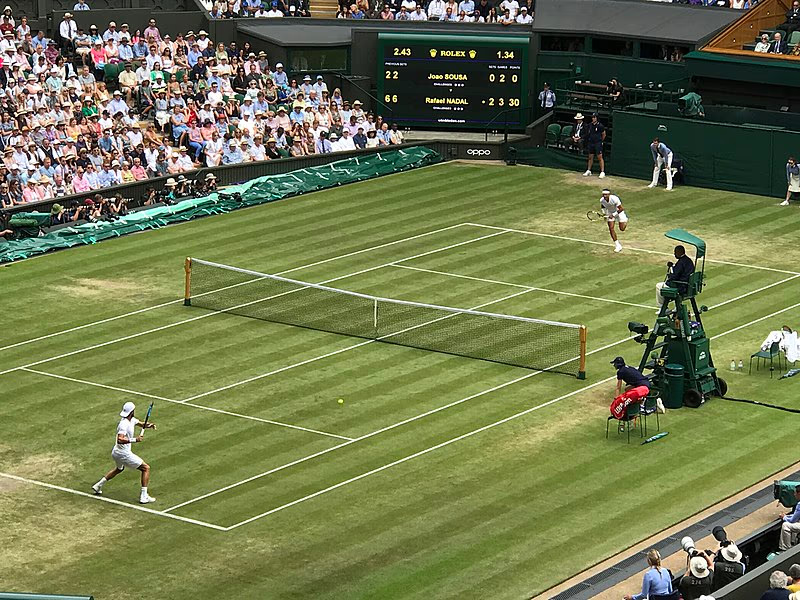
The court is a rectangle, longer than it is wide. Official dimensions are: Length: 23.77 m (78 feet); Width (singles): 8.23 m (27 feet); Width (doubles): 10.97 m (36 feet)
Lines at the ends of the court are called baselines. Lines at the sides of the court are called sidelines (there are singles sidelines and doubles sidelines).
The ITF Rules do not prescribe a specific surface material, but the ITF publishes a Court Pace Classification (CPC) system. Courts are classified on a scale of 1 (Slow) to 5 (Fast) based on the ITF's laboratory pace rating.
The ITF has formally incorporated Electronic Line Calling Live (ELC Live) into the Rules as of 2023, with refinements in 2025 and 2026. Where ELC is operational, all line calls are made electronically and are final (no challenges or reviews permitted).
If in doubt on a line call, give the benefit to your opponent
In matches without officials, players call their own side of the court. The universal cultural rule is that a ball that cannot be called out with certainty must be called good. Calling a ball out when you are unsure is considered cheating, not a judgment call.
The ITF Rules of Tennis state balls should be called promptly and in the opponent's favor when uncertain, codifying what began as cultural practice.
Shake hands at the net immediately after the match
Both players are expected to meet at the net for a handshake — often accompanied by a 'good game' — within seconds of the final point. Walking off court, refusing the handshake, or delaying it as a slight is one of the most serious breaches of tennis etiquette.
High-profile refusals or perfunctory handshakes on the ATP/WTA tours have generated significant media and peer condemnation.
Do not walk behind the baseline while your opponent is serving
Moving behind the baseline or crossing the player's line of sight during a service motion is considered a serious distraction and a breach of etiquette. Players are expected to remain still and out of the server's peripheral vision until the point begins.
At the recreational level this applies to both opposing players and spectators walking behind courts; a flagrant violation warrants a let.
Ready to dive deeper?
Call a let immediately when a ball rolls onto the court mid-point
If a ball from another court enters the playing area during a rally, the player who sees it is expected to stop play and call a let at once — not wait to see if the point resolves favorably. Playing through a distraction and then claiming a let after losing the point is widely regarded as gamesmanship.
Do not use a medical timeout for strategic momentum-breaking purposes
Medical timeouts are available for genuine injury or physical distress. Taking one when trailing, just after losing momentum, or when the opponent is in a hot streak — without a real injury — is widely condemned as gamesmanship. The practice is debated but broadly considered a violation of competitive spirit.
Several high-profile ATP and WTA matches have generated controversy over the strategic use of medical timeouts.