

















Section 1: Introduction
1.1 Overview and History
Archery is one of the oldest competitive disciplines in human history, evolving from a survival skill into a precision sport governed by exacting technical standards. Target archery first appeared at the Olympic Games in Paris in 1900, was contested intermittently through the 1920 Antwerp Games, and was then dropped from the Olympic programme. It returned permanently at the 1972 Munich Olympics under standardized international rules, and has remained a core Olympic sport ever since.
1.2 Governing Body
World Archery (WA), formerly known as the Fédération Internationale de Tir à l'Arc (FITA), is the international governing body for the sport of archery. Founded in 1931 and headquartered in Lausanne, Switzerland, WA oversees all international competition, sets equipment and competition rules, manages world rankings, and administers the Olympic archery programme in coordination with the International Olympic Committee (IOC). WA comprises over 170 member associations organized into continental confederations.
1.3 Olympic Programme
The current Olympic archery programme features recurve bow only and includes five medal events: men's individual, women's individual, men's team, women's team, and mixed team (introduced at the Tokyo 2020 Games). Each participating National Olympic Committee may enter a maximum of three men and three women, subject to world ranking qualification criteria. The Olympic format uses the 70-metre distance exclusively.
1.4 Competitive Divisions
Outside the Olympics, World Archery sanctions competition in three primary bow divisions: Recurve (the Olympic division), Compound (featured at World Championships but not the Olympics), and Barebow (added to the World Championships programme). Each division has distinct equipment rules and competition formats, detailed in Section 2.
Section 2: Equipment
2.1 Recurve Bow (Olympic Division)
The recurve bow is the only bow type permitted in Olympic competition. It consists of a riser (the central handle section, typically aluminium or carbon) and two detachable limbs that curve away from the archer at their tips, storing and releasing energy efficiently. The following accessories are permitted on a recurve bow:
- Sight: A single non-magnifying sight pin or ring, adjustable for windage and elevation. No lenses, prisms, or electronic components are permitted.
- Stabilizers: A long rod (typically 28–32 inches) extending forward from the riser, plus side rods (V-bars) with dampers, used to reduce torque and absorb vibration at the shot.
- Clicker: A thin metal blade mounted on the riser that clicks audibly when the arrow is drawn to a consistent length, ensuring draw consistency.
- Plunger (pressure button): A spring-loaded button in the riser that controls lateral arrow flex at release, tuning arrow flight.
- Arrow rest: A rest mounted on the riser to support the arrow before and during the draw.
There is no regulated maximum draw weight for recurve bows. Competitive archers typically draw between 38 and 50 pounds (17–23 kg), with bow lengths of 66–70 inches (168–178 cm). Archers draw and release the string using their fingers (a finger tab or glove is permitted); mechanical release aids are not allowed in the recurve division.
2.2 Compound Bow
The compound bow uses a system of cables and eccentric pulleys (cams) to provide let-off, reducing the holding weight at full draw to roughly 60–80% less than peak draw weight. This allows the archer to hold steadily for longer. Compound bows are permitted in World Archery Championships and World Cup events but are not included in the Olympic programme. Key permitted accessories include:
- Magnifying scope: A lens-equipped sight with a magnification level (typically 4×–8×) and a peep sight in the string.
- Mechanical release aid: A handheld device (trigger, hinge, or tension-activated) that releases the string mechanically for greater consistency.
- Stabilizers: Same general rules as recurve, though compound setups are often shorter.
Compound bows shoot at a target distance of 50 metres with a smaller 80 cm target face (or a triple-spot face with three 40 cm faces). Maximum arrow speed is not regulated, but let-off must not exceed 80%.
2.3 Barebow
Barebow archery uses a recurve-style bow stripped of most accessories. No sights, no stabilizers, no clicker, and no marks on the bow that could serve as aiming references are permitted. Archers aim using instinctive methods or string-walking (placing the fingers at different points on the string below the nock to adjust trajectory). Barebow competes at the World Archery Championships and is growing in popularity at national levels.
2.4 Arrows
All arrows used in competition must conform to WA specifications:
- Shaft: Aluminium, carbon, or aluminium-carbon composite. Maximum outer diameter of 9.3 mm (0.37 in). All arrows in a set must be identical in length, weight, and construction.
- Nock: The plastic fitting at the rear of the arrow that clips onto the bowstring. Must be of a type that does not damage the string.
- Fletching: Three vanes (plastic) or feathers attached near the nock to stabilize arrow flight. Configuration and colour are the archer's choice, but one vane (the index or cock vane) must be a different colour for consistent nocking.
- Point: A target point (bullet or break-off style) that must not cause excessive damage to target faces or buttresses.
- Identification: Each archer's arrows must be clearly marked with the archer's name, initials, or assigned number on the shaft. This allows judges to identify arrows during scoring.
2.5 Personal Protective Equipment
- Finger tab or glove: Worn on the drawing hand to protect the fingers and provide a smooth string release.
- Arm guard (bracer): Worn on the inside of the bow arm's forearm to prevent string slap.
- Chest guard: Optional; prevents clothing from catching the string.
- Binoculars and spotting scopes: Permitted for viewing arrows in the target from the waiting line, but not permitted on the shooting line during shooting.
2.6 Equipment Inspection
Before competition, all equipment undergoes mandatory inspection by WA judges. Bows, arrows, and accessories are checked for compliance with the division's rules. Any equipment found non-compliant must be corrected or replaced before the archer may compete. Judges may re-inspect equipment at any time during competition.
Section 3: Playing Area
3.1 Outdoor Range Layout
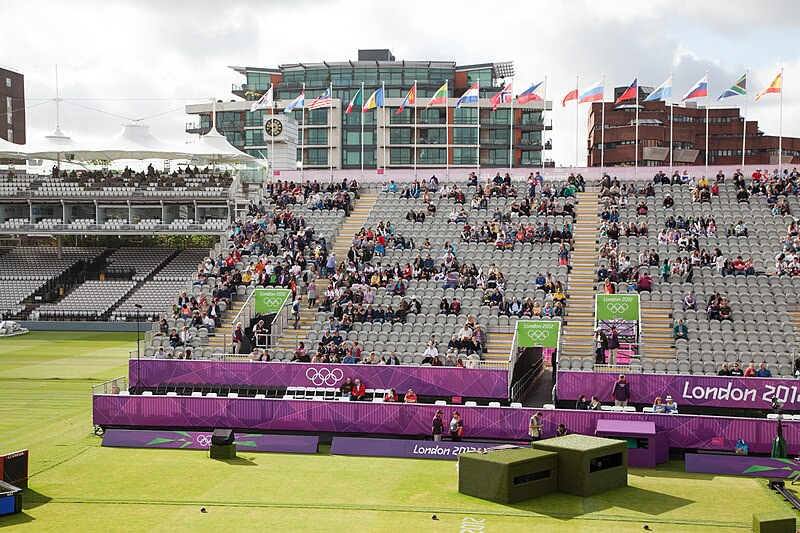
International outdoor target archery takes place on a flat, level field (the Field of Play) with clearly defined zones:
- Shooting line: A marked line on the ground from which all archers shoot. Archers must straddle or stand immediately behind this line.
- Waiting line: Located approximately 5 metres behind the shooting line. Archers wait here when not actively shooting.
- Spectator line: A barrier or marked line set well behind the waiting line (typically 10–20 metres further back) to keep spectators at a safe distance.
- Target line: The line on which target buttresses are placed, perpendicular to the shooting direction.
3.2 Distances and Target Faces
- Olympic recurve: 70 metres (229.7 ft) from shooting line to target face.
- Compound: 50 metres (164 ft) from shooting line to target face.
- 122 cm target face: Used for the 70 m ranking round. Features 10 concentric scoring zones in five colours (gold, red, blue, black, white), each colour divided into two rings.
- 80 cm target face: Used for individual and team elimination rounds at 70 m (recurve) and for compound at 50 m. Same colour scheme, proportionally smaller rings.
- Triple-spot face: Three separate 40 cm target faces arranged vertically, used in compound individual elimination rounds. One arrow per spot.
- Target height: The centre of the target face (the gold) must be 130 cm (51 in) above the ground.
3.3 Range Dimensions and Safety Zones
- Lane width: Minimum 5 metres (16.4 ft) per target butt, ensuring adequate spacing between adjacent archers.
- Overshoot area: A minimum of 110 metres (361 ft) of clear, controlled space behind the target line to safely arrest any arrows that miss or pass through the buttresses.
- Lateral safety zone: Minimum 25 metres (82 ft) on each side of the outermost targets.
- Safety netting: Overhead netting may be installed behind targets at major events to catch errant arrows, particularly in urban or stadium venues.
3.4 Wind Indicators
Small wind flags are placed at regular intervals along the range (typically at the shooting line and at the target line) so archers can read wind speed and direction. Flags are lightweight fabric, usually 25 cm × 80 cm. Archers use these flags to adjust their aim for crosswind drift — a critical skill at 70 metres where even a light breeze can shift an arrow several ring widths.
Section 4: Players & Officials
4.1 Individual Competitors
In the Olympic format, up to 64 archers per gender qualify for the individual event. Each archer competes independently. During the ranking round, all qualified archers shoot simultaneously. In elimination rounds, archers are seeded into a head-to-head bracket (1st seed vs 64th seed, 2nd vs 63rd, etc.) and compete one-on-one until a gold medallist is determined.
4.2 Team Composition
- Team event: 3 archers from the same nation. Each team member shoots 2 arrows per end (6 arrows total per team end). Teams are seeded by the combined ranking round scores of their three members.
- Mixed team event: 1 man and 1 woman from the same nation. Each archer shoots 2 arrows per end (4 arrows total per mixed team end), alternating shots. Mixed teams are seeded by the combined ranking round scores of the two members.
4.3 Officials and Their Roles
- Director of Shooting (DOS): Controls the flow of competition using light signals and audio signals. Responsible for starting and stopping shooting, managing the shot clock, and ensuring the schedule is followed.
- Judges: Qualified World Archery judges positioned on the field. They score arrows, resolve disputes about arrow values (using magnifying devices or callipers when an arrow is near a line), enforce time limits, and monitor equipment compliance. A minimum of one judge per four targets is required at international events.
- Timekeepers: Operate the electronic shot clock and traffic-light system. The clock displays remaining time; lights change from green (shoot) to amber (10 seconds remaining) to red (time expired).
- Technical Delegate: A WA-appointed official who oversees the entire event, ensuring compliance with WA rules and resolving appeals from the jury of appeal.
- Jury of Appeal: A panel (typically 3 members) that hears formal appeals from athletes or team managers regarding judge decisions. Their ruling is final.
4.4 Agent and Coach Access
Each team is permitted one coach in the designated coaches' area adjacent to the waiting line. Coaches may communicate with their archers between ends but not during active shooting. No electronic communication devices (earpieces, radios) are permitted between coaches and archers during competition.
Section 5: Rules of Play
5.1 Ranking Round
The competition begins with the ranking round (also called the qualification round). Each archer shoots 72 arrows at 70 metres, fired in 12 ends of 6 arrows each. The time limit is 4 minutes per end of 6 arrows (or 2 minutes per end of 3 arrows if the field uses alternating shooting). The maximum possible score is 720 (72 × 10). Ranking round scores determine the seedings for all subsequent elimination brackets (individual, team, and mixed team).
5.2 Individual Elimination (Set System)
Olympic individual matches use the set system. Each match consists of up to 5 sets of 3 arrows per archer:
- The archer with the higher 3-arrow total in a set wins that set and receives 2 set points.
- If both archers score the same total, each receives 1 set point.
- The first archer to accumulate 6 set points wins the match.
- A match can be won as early as after 3 sets (6-0) and will go to a maximum of 5 sets.
Each archer has 20 seconds to shoot each arrow in individual elimination, with archers shooting alternately (one arrow each in turn). The lower-seeded archer shoots first in each set.
5.3 Shoot-Off (Tiebreaker)
If the score is tied 5–5 after 5 sets, the match goes to a shoot-off. Each archer shoots 1 arrow within 20 seconds. The arrow closest to the centre of the target wins. If both arrows are in the same scoring ring, the arrow physically closer to the exact centre (measured by judges) wins. If the arrows are equidistant, a second shoot-off arrow is shot.
5.4 Team Elimination
Team matches also use the set system with up to 4 sets of 6 arrows per team (2 arrows per archer per set). Teams have 2 minutes per end (the three archers rotate to the shooting line and each shoots 2 arrows). Archers must shoot in a consistent order each end, alternating positions at the line. Set point scoring is the same as individual matches. The first team to reach 5 set points wins (a tie at 4–4 after 4 sets proceeds to a shoot-off). In a team shoot-off, each of the three archers shoots 1 arrow (3 arrows total), and the team with the highest 3-arrow total wins. If tied, the team with the arrow closest to centre wins.
5.5 Mixed Team Elimination
Mixed team matches follow the same set system with up to 4 sets of 4 arrows (2 per archer per set). The two archers alternate shots, with each archer shooting one arrow at a time. The time limit is 80 seconds per end of 4 arrows. The team reaching 5 set points first wins. A tie at 4–4 proceeds to a shoot-off where each archer shoots 1 arrow (2 total); highest total wins, with closest-to-centre as the tiebreaker.
5.6 Compound Format (Non-Olympic)
Compound individual matches do not use the set system. Instead, each archer shoots 5 ends of 3 arrows (15 arrows total), and the match is decided by cumulative score. The archer with the higher total wins. In case of a tied total, a single shoot-off arrow decides the match. Compound archers shoot at 50 metres on an 80 cm or triple-spot face. Time limit: 20 seconds per arrow in alternating format.
5.7 Shooting Procedure and Signals
The Director of Shooting controls all activity on the range using a standardized signal system:
- Two whistle blasts (or two audible signals): Archers may move from the waiting line to the shooting line and prepare to shoot.
- One whistle blast: Shooting may begin. The shot clock starts.
- Three whistle blasts: Archers must stop shooting, set down their bows, and proceed forward to score and retrieve arrows.
- Five or more rapid whistle blasts: Emergency stop. All shooting ceases immediately. Archers must un-nock any arrows, step back from the shooting line, and await further instruction. This signal indicates a safety hazard (e.g., a person on the range, equipment failure, or medical emergency).
A traffic-light system accompanies the whistle signals at major events: green light means shooting is permitted, amber indicates the final 30 seconds (or 10 seconds in alternating format), and red means time has expired and shooting must stop.
Section 6: Scoring
6.1 Scoring Zones
The target face is divided into 10 concentric scoring rings arranged in five colour bands, from the centre outward:
- Gold (innermost): X-ring (inner 10) and 10-ring. The X-ring has no higher point value than 10 but is used as a tiebreaker in ranking rounds. On a 122 cm face, the X-ring diameter is 12.2 cm (4.8 in); the 10-ring is 12.2 cm wide (6.1 cm radius to 12.2 cm radius).
- Gold (outer): 9-ring.
- Red: 8-ring and 7-ring.
- Blue: 6-ring and 5-ring.
- Black: 4-ring and 3-ring.
- White (outermost): 2-ring and 1-ring.
An arrow that misses the target face entirely or bounces off scores 0 (M, for miss).
6.2 Line-Cutting Rule
If an arrow shaft touches the line dividing two scoring zones, the arrow is awarded the higher value. This is determined by visual inspection; if doubt exists, judges use a magnifying loupe or a mechanical scoring device to determine whether the arrow shaft breaks the line. The arrow shaft (not the hole in the target face) is the reference for scoring.
6.3 Maximum Scores
- Per end (3 arrows): 30 points (three 10s).
- Per end (6 arrows): 60 points (six 10s).
- Ranking round (72 arrows): 720 points. A perfect 720 is exceptionally rare; scores above 690 are considered world-class for recurve.
- Compound match (15 arrows): 150 points.
6.4 Scoring Procedure
After each end, archers (or designated scorers) approach the targets and record scores before any arrows are removed. Scores are called from highest to lowest. Each archer's score is recorded on a scorecard and confirmed by a second scorer or the opposing archer. Arrows must not be touched until all scores on that target are agreed upon. In case of disagreement, a judge is called to make the final determination.
6.5 Ranking Round Tiebreakers
If two or more archers have the same 72-arrow total in the ranking round, ties are broken in order by: (1) number of 10s (including Xs), (2) number of Xs. If still tied, archers receive the same ranking and are placed into the bracket accordingly.
Section 7: Violations & Penalties
7.1 Timing Violations
- Shooting after time expires: Any arrow released after the red light activates or the time signal sounds is not scored (recorded as M/0). Judges observe the shooting line and the clock to enforce this rule.
- Shooting before the signal: An arrow released before the start signal is declared void and scored as 0. The archer may not replace it.
7.2 Arrow and Shooting Violations
- Too many arrows: If an archer shoots more arrows than permitted in an end, the highest-scoring arrow(s) in that end are removed from the score until the correct number remains.
- Shooting another archer's target: An arrow shot at the wrong target is scored as M/0 for the offending archer and is not counted for the other archer.
- Dropped arrow: If an arrow falls from the bow and the archer can reach it without leaving the shooting line, it may be re-shot. If it falls forward of the shooting line and cannot be retrieved without stepping forward, it is considered shot and scored where it lands (or as M if it does not reach the target).
7.3 Equipment Violations
- Non-compliant equipment: Use of equipment that does not meet the division's rules (e.g., a magnifying sight in recurve) results in immediate exclusion from the event.
- Equipment failure: If a bow or other equipment breaks during an end, the archer may request a time allowance of up to 15 minutes to make repairs or obtain replacement equipment. The replacement equipment must still be inspected by a judge. If the archer cannot continue, they forfeit the match.
7.4 Conduct Violations
- Unsportsmanlike conduct: Includes deliberate distraction of opponents, verbal abuse, disrespect toward officials, or any behaviour bringing the sport into disrepute. A first offence receives a yellow card (warning). A second offence results in a red card and the deduction of the highest-scoring arrow in the current or next end. Continued misconduct leads to disqualification (black card).
- Coaching during shooting: Any communication from a coach to an archer during active shooting (between the start and stop signals) results in a warning to the coach. Repeated violations may lead to the coach being removed from the field of play.
7.5 Appeals
An archer or team manager may lodge a formal appeal with the Jury of Appeal against a judge's decision. Appeals must be lodged promptly (typically before the next end begins). The Jury's decision is final and cannot be further appealed.
Section 8: Safety Considerations
8.1 Range Safety Protocols
Archery ranges are controlled environments where strict safety protocols are enforced at all times. The Director of Shooting has absolute authority over range safety, and all archers and officials must comply with their signals immediately.
- No nocking without permission: Archers must not place an arrow on the bowstring until they are on the shooting line and the start signal has been given.
- Never aim at anything other than the target: Drawing a bow and pointing it in any direction other than toward the targets is strictly prohibited.
- Range closed during scoring: When archers are forward of the shooting line to score and retrieve arrows, the range is closed. No one may remain on or approach the shooting line.
8.2 Whistle Signal System
The whistle (or audible signal) system is the primary safety communication tool:
- 2 blasts: Archers may approach the shooting line.
- 1 blast: Shooting may commence.
- 3 blasts: Shooting stops; archers move forward to score and collect arrows.
- 5 or more rapid blasts: EMERGENCY STOP. All activity ceases. Archers un-nock arrows, step back, set bows down, and await instructions. This signal may indicate a person on the range, a medical emergency, or any other immediate hazard.
8.3 Red Flag and Safety Zones
When a red flag is raised at the target line, no person may approach the targets. This indicates that the range is active and arrows may be in flight. The red flag is lowered only when the 3-blast stop signal has been given and all shooting has ceased. Safety zones behind targets (minimum 110 m) and to the sides (minimum 25 m) must be kept clear of all personnel and spectators at all times during shooting.
8.4 Medical and Emergency Preparedness
- A qualified medical team must be present on-site at all WA-sanctioned events, with first aid equipment and emergency transport capability.
- Arrow removal from targets: Archers must pull arrows straight out of the buttress to avoid injury. One hand is placed flat on the target face beside the arrow while the other grips the shaft close to the face and pulls directly backward.
- Damaged arrows: Bent, cracked, or otherwise damaged arrows must be removed from competition immediately. Shooting a damaged arrow risks the shaft breaking at release, which can cause serious injury to the archer.
- Weather: Competition may be suspended in lightning, high winds, or other dangerous weather. The DOS or Technical Delegate makes this determination.
8.5 Spectator Safety
Spectators must remain behind the designated spectator line at all times. At major events, physical barriers, fencing, or netting separate the public from the field of play. Mobile phones must be set to silent mode, and flash photography is prohibited during shooting as it may distract archers.