



Section 1: Introduction
The Fédération Internationale de Gymnastique (FIG) is the world governing body for gymnastics, founded on July 23, 1881 in Liège, Belgium, making it the oldest international sport federation. The FIG administers competition rules across all gymnastics disciplines for international competition, including the Olympic Games, World Championships, and World Cup series.
The FIG publishes separate Codes of Points for each discipline. The primary disciplines governed by the FIG are:
- Artistic Gymnastics (MAG/WAG) — Men's Artistic Gymnastics and Women's Artistic Gymnastics
- Rhythmic Gymnastics (RG) — Individual and Group events
- Trampoline Gymnastics (TRA) — Trampoline, Double Mini Trampoline, Tumbling
- Acrobatic Gymnastics (ACRO) — Pairs and Group events
- Aerobic Gymnastics (AER) — Individual, Mixed Pair, Trio, and Group events
- Parkour (PKR) — Speed and Freestyle
This rulebook references principally the FIG Code of Points for Artistic Gymnastics (MAG and WAG), 2022–2026 edition, which governs competition through the 2024 Paris Olympic Games cycle and into the current 2025–2028 quadrennium planning period. Supplementary reference is made to the FIG Technical Regulations 2024 and applicable FIG Statutes and Bylaws. Rule citations use the format "CoP [Discipline] [Year], Article/Section X.X."
The current WAG Code of Points entered into force on January 1, 2022, with updates published by the FIG Technical Committee (TC WAG) effective January 1, 2024. The current MAG Code of Points similarly entered into force January 1, 2022 with 2024 updates. Both codes are available via the FIG official website at fig-gymnastics.com.
The FIG Congress is the supreme body of the FIG; it meets every two years. The Executive Committee (ExCo) governs between Congresses. Each discipline is overseen by a Technical Committee (TC) that manages the respective Code of Points and judge training and certification.
Section 2: Equipment
All apparatus used in FIG-sanctioned competitions must be approved by the FIG and listed on the official FIG Approved Apparatus List. Manufacturers must obtain FIG certification prior to use at any FIG event. Equipment specifications are defined in the FIG Technical Regulations and the relevant Code of Points.
Men's Artistic Gymnastics (MAG) Apparatus
Per the FIG Technical Regulations and CoP MAG 2022–2026:
- Floor Exercise (FX): Spring floor measuring 12 m × 12 m (39.4 ft × 39.4 ft) with a safety border of at least 1 m on all sides. The total platform area is at least 14 m × 14 m. The floor surface must be covered with a non-slip carpet.
- Pommel Horse (PH): Height of the top surface: 1.15 m (3 ft 9.3 in) from the floor. Length: 1.60 m (5 ft 3 in). Width: 0.35 m (13.8 in). The pommels are set 0.40–0.42 m apart (center to center). Pommel height above the horse body: 0.12 m (4.7 in). The horse body must be covered with leather or synthetic material.
- Still Rings (SR): The rings hang at a height of 2.50 m (8 ft 2.4 in) from the floor to the lower inside edge of the rings when not in use. Ring inner diameter: 0.18 m (7.1 in). The wire/strap length from the point of suspension to the top of the ring: 3.00 m (9 ft 10 in) total suspension height from ceiling anchor. Cable diameter: minimum 0.009 m (9 mm).
- Vault (VT): The vaulting table is 1.20 m (3 ft 11.2 in) high (adjustable). Table surface length: 1.20 m (3 ft 11.2 in); width: 0.95 m (37.4 in). The springboard (Reuther board) is placed 0–1.20 m from the front of the table. The runway is at least 25 m (82 ft) long and 1 m wide.
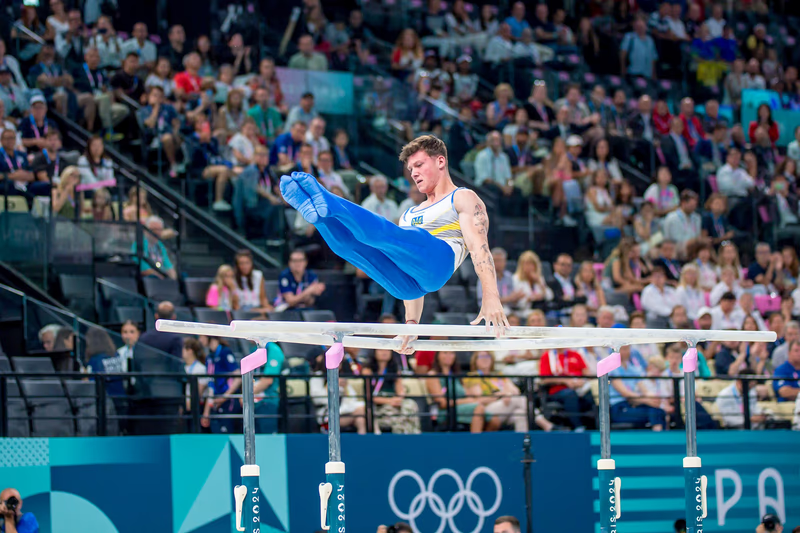
- Parallel Bars (PB): Bar height: 1.75 m (5 ft 9 in) from the floor. Bar length: 3.50 m (11 ft 6 in). Bar width (inside): 0.42–0.52 m (16.5–20.5 in), adjustable. The bars must be constructed of fiberglass or wood with appropriate flex characteristics.
- Horizontal Bar (HB): Bar height: 2.80 m (9 ft 2.2 in) from the floor to the top of the bar. Bar length: 2.40 m (7 ft 10.4 in). Bar diameter: 0.028 m (28 mm). The bar is constructed of special high-tensile steel. Guy wires must be set to stabilize the bar.
Women's Artistic Gymnastics (WAG) Apparatus
Per CoP WAG 2022–2026 and FIG Technical Regulations:
- Vault (VT): Vaulting table height: 1.25 m (4 ft 1.2 in). Table surface length: 1.20 m (3 ft 11.2 in); width: 0.95 m (37.4 in). Runway minimum length: 25 m.
- Uneven Bars (UB): High bar height: 2.50 m (8 ft 2.4 in). Low bar height: 1.70 m (5 ft 7 in). Both heights adjustable. Bar length: 2.40 m (7 ft 10.4 in). The distance between bars is adjustable from 0.130 m to 1.800 m (measured from near sides of bars). Bar diameter: 0.048 m (48 mm) for the high bar; 0.050 m (50 mm) for the low bar (fiberglass core with wood or synthetic coating).
- Balance Beam (BB): Height: 1.25 m (4 ft 1.2 in) from floor to top surface. Length: 5.00 m (16 ft 4.9 in). Width of top surface: 0.10 m (3.94 in). The beam surface must be covered with suede or synthetic leather material providing grip without excessive friction.
- Floor Exercise (FX): Same specifications as MAG floor: 12 m × 12 m spring floor with 1 m safety border. Women's floor exercise is performed to music (see Section 5).
Gymnastics Attire
Per FIG Technical Regulations, Article 5 (Clothing/Uniforms):
- Male gymnasts must wear athletic shorts or long trousers (called "longs") on all events except floor, where shorts are permitted. Shirts must cover the torso. On pommel horse, rings, parallel bars, and horizontal bar, gymnasts may wear either shorts or longs with foot straps.
- Female gymnasts must wear a leotard that is modest and appropriate. Unitards (leotard with leg covering) are permitted. Skirts are not permitted in competition.
- Gymnastics footwear (half-shoes, gymnastics slippers, or bare feet) is permitted. Shoes with hard soles are not permitted.
- Jewelry other than small ear studs is not permitted during competition (FIG Technical Regulations, Article 5.3).
- Handgrips (leather grips with or without dowels) may be worn on horizontal bar, rings, parallel bars (MAG), and uneven bars (WAG). Hand chalk (magnesium carbonate) is permitted on all apparatus.
Section 3: Playing Area
Competition venues must meet FIG requirements as outlined in the FIG Technical Regulations. The competition area (competition floor) must accommodate all apparatus with required safety zones, warm-up areas, judges' tables, and access corridors.
Competition Hall Requirements
Per FIG Technical Regulations, the following minimum ceiling heights are required above apparatus:
- Horizontal Bar (MAG): Minimum 8 m (26 ft 3 in) clear ceiling height above the floor.
- Uneven Bars (WAG): Minimum 7 m (22 ft 11.6 in) clear ceiling height.
- Trampoline events: Minimum 8–10 m (26–33 ft) clear ceiling height depending on event level.
- For all other apparatus (vault, beam, floor, pommel horse, rings, parallel bars): Minimum 6 m (19 ft 8 in) ceiling height recommended, though 8 m preferred.
Safety Zones and Landing Areas
Each apparatus must be surrounded by landing mats. FIG specifies minimum mat dimensions and placement:
- Landing mats: The standard competition landing mat (crash mat) must be at least 0.20 m (7.9 in) thick. Mats used for vaulting must be at least 0.20 m thick and 1.80 m × 1.20 m in surface area (minimum). Additional padding ("throw mats") of at least 0.10 m thickness may be added.
- Vault landing: The landing area beyond the vault table must be at least 6 m long from the front edge of the table, 2 m wide, covered by a landing mat. A soft/safety mat of at least 0.20 m thickness must be positioned immediately beyond the table.
- Floor exercise boundary: The spring floor is 12 m × 12 m. A safety border of at least 1 m on all four sides must be provided. Stepping outside the 12 m × 12 m boundary during a routine results in a penalty (see Section 7).
- Beam: Mats must be placed on all sides and ends of the balance beam. End mats must extend at least 2 m beyond each end of the beam.
- Horizontal Bar / Uneven Bars: Mats must cover the entire area beneath and around the bar(s), with a minimum of 2 m clear landing area on the dismount side.
Apparatus Placement and Spacing
In major FIG competitions (World Championships, Olympic Games), apparatus must be arranged to allow simultaneous competition on multiple events. The FIG Technical Delegate approves the final apparatus layout. Minimum clearances between adjacent apparatus and between apparatus and walls/structures are defined in the FIG Competition Regulations for each event type.
The warm-up area (podium training area) must replicate the competition setup with identical approved apparatus. At Olympic Games and World Championships, the FIG requires a separate competition podium (raised platform) arrangement for artistic gymnastics events. The podium height is typically 0.08–0.15 m (3–6 in) and must be constructed of stable, load-bearing material.
Lighting
Competition venue lighting must provide uniform illumination of at least 1,500 lux at apparatus level for televised FIG World Championships and Olympic Games, as specified in the FIG Competition Organization Manual. Adequate lighting must prevent shadows on the apparatus or landing areas that could impair judging or athlete safety.
Section 4: Players & Officials
Athletes / Gymnasts
Per FIG Technical Regulations and Statutes:
- Eligibility: Athletes must be registered with their National Federation (NF), which must be an affiliated member of the FIG. Athletes must hold the nationality of the country they represent. Age minimums apply: for Artistic Gymnastics, athletes must reach the age of 16 years in the calendar year of a World Championship or Olympic Games to be eligible (FIG Technical Regulations, Article 4.1, effective January 1, 1997, reinforced by updated regulations). For some World Cup and international events, a minimum age of 15 may apply for non-Olympic competitions.
- Team composition (WAG): At World Championships and Olympic Games, each nation may enter a team of up to 5 gymnasts in the team event. In team competition, 4 gymnasts compete on each apparatus, with the top 3 scores counting (4 up, 3 count format, as of the 2022–2024 cycle).
- Team composition (MAG): Teams consist of up to 5 gymnasts with 4 competing on each apparatus and the top 3 scores counting (same 4-3 format).
- Individual events: In addition to team competition, athletes may qualify for the All-Around Final (top 24 gymnasts, maximum 2 per country) and individual Event Finals (top 8 per event, maximum 2 per country).
- Athletes may use coaches and may consult with coaches between rotations at designated times. Coaches may not communicate with athletes during a routine.
Judges and Officials
Per the FIG Code of Points and Technical Regulations, judging panels are structured as follows for Artistic Gymnastics:
- Difficulty (D) Panel: Consists of 2 judges (D1 and D2) who independently evaluate the Difficulty Score. They assess the difficulty value (DV) of all elements performed, connection bonuses, and composition requirements. D judges must agree on the D score; if there is a discrepancy greater than 0.3 points, a Superior Jury review is triggered (CoP WAG 2022–2026, Chapter 1, Section 1).
- Execution (E) Panel: Consists of 5 judges (E1–E5) who evaluate execution, artistry, and technique. The highest and lowest scores are dropped, and the remaining 3 are averaged to produce the Execution Score. Each E judge scores independently from 10.0 downward (see Section 6).
- Line Judge(s): For floor exercise, line judges (typically 2) assess out-of-bounds deductions. They signal with a flag when a gymnast steps on or outside the boundary line.
- Superior Jury (Reference Panel): At FIG World Championships and Olympic Games, a Superior Jury consisting of senior FIG officials and Technical Committee members oversees judging, reviews protests, and may adjust scores in cases of clear error.
- Technical Delegate (TD): The FIG Technical Delegate is responsible for organizing the competition, approving apparatus, and overseeing all technical aspects of the event. The TD has authority to resolve disputes not addressed by the Code of Points.
- Competition Director / Meet Referee: Each competition has a designated Referee who manages the competition flow, timing, and official communications between gymnasts/coaches and the judging panel.
Judge Certification
FIG judges must hold current FIG brevet (certification) at the appropriate level (Category 1–4, with Category 1 being the highest level required for Olympic Games). Judges must pass written and practical examinations administered by the FIG and must attend refresher courses each quadrennium. Judges may be evaluated and removed from panels if their scores deviate significantly from the panel average over multiple competitions (FIG Judge Evaluation System).
Coaches and Team Officials
Each national team may have accredited coaches on the competition floor. Coaches must wear official accreditation and remain in designated coach zones. Per FIG Technical Regulations, Article 6, coaches may provide spotting assistance only during warm-up and podium training, not during competition routines (with the exception of assisting a gymnast to the apparatus). Coaches who interfere with competition may result in a deduction to their athlete's score.
Section 5: Rules of Play
General Competition Structure
FIG Artistic Gymnastics competitions follow a structured format with distinct phases (per FIG Technical Regulations and Competition Regulations):
- Qualifications (Podium Training): Prior to competition, athletes have access to apparatus for training. At World Championships, a single podium training session of 30–40 minutes per subdivision is held.
- Qualifications (Competition I): All qualified gymnasts/teams compete. Scores from Qualifications are used to determine advancement to Team Final, All-Around Final, and Event Finals. Qualification scores do not carry forward to Finals (fresh start in Finals).
- Team Final (Competition II): Top qualifying teams compete. Each team presents gymnasts on each apparatus per the 4-up, 3-count format.
- All-Around Final (Competition III): Top 24 individual qualifiers (max 2 per country) compete on all events.
- Event Finals (Competition IV): Top 8 qualifiers per apparatus (max 2 per country) compete for individual apparatus medals.
Rotation and Start Order
In team and all-around competition, gymnasts rotate through apparatus in a set order. In MAG, the order is: Floor Exercise → Pommel Horse → Still Rings → Vault → Parallel Bars → Horizontal Bar. In WAG, the order is: Vault → Uneven Bars → Balance Beam → Floor Exercise. The rotation order may be adjusted slightly by the competition organizer but must follow the official apparatus sequence (FIG Technical Regulations, Article 10).
Athletes are announced and have a 30-second preparation time from the moment the green light signals permission to start (CoP MAG/WAG 2022–2026, Chapter 1, General Rules). The preparation time clock is visible to the athlete. Failure to begin within the preparation time results in a deduction (see Section 7).
Routine Requirements — WAG
Per CoP WAG 2022–2026:
- Vault: Each gymnast performs one vault in Qualifications/Team Final/All-Around. In Event Finals, gymnasts perform two vaults of different values (different families). The maximum time from the signal to vault is 30 seconds.
- Uneven Bars: A routine must include a minimum of 5 and maximum of 8 elements from the Code of Points. The routine must include: one release element, a bar change (transition from high bar to low bar or vice versa), and a dismount. The minimum working time is not specified, but the routine ends with a dismount. The gymnast must mount within 30 seconds of the green light.
- Balance Beam: Duration: minimum 70 seconds, maximum 90 seconds (measured from the first movement/jump on the beam after mounting to the landing of the dismount). A time violation is assessed for routines shorter than 70 seconds (0.10 deduction) or longer than 90 seconds (0.10 deduction per 5-second interval, per CoP WAG 2022–2026, Chapter 7, Article 7.1). Requirements include: at least one acrobatic series, a dance series, an acrobatic element with flight, and a dismount.
- Floor Exercise: Duration: maximum 90 seconds (including music). The routine must begin at the sound of the music and end no later than the music conclusion. Music must be instrumental only (no lyrics/singing/humming/beatboxing) — this rule was updated effective January 1, 2023 for WAG (CoP WAG 2023 update). A time violation deduction applies if music/routine exceeds 90 seconds.
Routine Requirements — MAG
Per CoP MAG 2022–2026:
- Floor Exercise: Duration: maximum 70 seconds. Men's floor exercise is performed without music. Routine must include a minimum number of acrobatic and non-acrobatic elements. The gymnast must use the entire floor area (all four corners must be touched or passed through).
- Pommel Horse: Routine must include at least one circle on each pommel and at least one circle on the entire horse (end-to-end travel). The routine must end with a dismount. Maximum 8 counting elements.
- Still Rings: Routine must include two strength elements (at least one static strength hold, minimum 2-second hold time), swinging elements, and a dismount. Maximum 8 counting elements.
- Vault: Each gymnast performs one vault. Must be from the official MAG Vault Table (CoP MAG 2022–2026, Appendix: Vault Table).
- Parallel Bars: Routine must include both above-bar and below-bar elements. Maximum 8 counting elements.
- Horizontal Bar: Routine must include a minimum of one release-and-regrasp element. Maximum 8 counting elements. The dismount must be performed from a swing (not a static position).
Salute and Protocol
Prior to mounting and after dismounting, the gymnast must salute the head judge (Chief D Judge or Referee) to signal readiness and completion. The green light or flag signal from the judging panel gives permission to begin. If a gymnast begins before the signal, a deduction applies. After the routine, the gymnast again salutes; judges then post scores.
Section 6: Scoring
The FIG scoring system — often called the "open-ended" or "Code of Points" system — was adopted following a major reform after the 2004 Athens Olympics. The current system is described in the respective FIG Codes of Points (CoP MAG 2022–2026 and CoP WAG 2022–2026). The final score is calculated as:
Final Score = D Score + E Score − Neutral Deductions (ND)
Difficulty Score (D Score)
Per CoP WAG/MAG 2022–2026, Chapter 2 (Difficulty):
- The D Score is open-ended (no maximum) and is determined by the two D judges working together.
- Difficulty Value (DV): Only the best 8 elements in a routine count toward the D score (vault: 1 element only). Elements are rated from A (0.10 points) through G (0.70 points) and in some disciplines higher (H = 0.80, I = 0.90, etc. for MAG horizontal bar and WAG uneven bars per updated 2022–2026 tables).
- Connection Value (CV): Bonus points are awarded for directly connecting certain elements in specific combinations. The CV table specifies which element combinations earn bonuses of 0.10 or 0.20 points (CoP WAG 2022–2026, Chapter 2, Section 3).
- Compositional Requirements (CR): Each event has specific compositional requirements worth a set bonus (typically 0.50 points total per event, broken into 5 requirements at 0.10 each or 2–3 requirements at varying values). Failure to meet a CR results in no award for that requirement.
- The D score is finalized by the two D judges; if they agree within a 0.30-point tolerance, the higher is taken (or an average per specific protocols). Disputes are referred to the Superior Jury.
Execution Score (E Score)
Per CoP WAG/MAG 2022–2026, Chapter 3 (Execution, Artistry, and Technique):
- The E Score begins at a maximum of 10.00 points and deductions are subtracted.
- Five E judges each award a score independently. The highest and lowest scores are eliminated; the middle three are averaged.
- Common execution deductions include:
- Bent arms or legs (when straight required): 0.10 or 0.30 per occurrence depending on degree
- Feet/toes not pointed: 0.10 per occurrence
- Leg separation (when together required): 0.10 or 0.30 depending on degree
- Lack of amplitude (insufficient height/distance): 0.10 or 0.30
- Fall from apparatus: 1.00 deduction from the E score (taken by the E judges)
- Balance check on beam: 0.10 per occurrence
- Artistry deductions (WAG floor only): 0.10–0.30 for poor use of music, lack of choreographic variety, etc.
- Execution deductions are taken in increments of 0.10 per the standard deduction table. Deductions are classified as small (0.10), medium (0.30), and large (0.50) per CoP 2022–2026, Chapter 3.
Neutral Deductions (ND)
Neutral Deductions are applied by the Referee or designated judges and subtracted from the final score after D + E are summed. Common NDs include:
- Coach on podium/floor without permission: 0.30
- Stepping out of bounds on floor exercise: 0.10 per occurrence (assessed by line judges)
- Time violation (floor/beam too long or short): 0.10 per occurrence
- Starting before the green light: 0.30
- Missing salute before or after routine: 0.30
- Music with voice/lyrics (WAG floor): routine is stopped or 0.30 ND depending on circumstances
- Use of non-approved apparatus or unauthorized equipment modifications: 0.30–score invalidated depending on severity
Vault Scoring
For vault, the D score is predetermined in the Vault Table (CoP MAG/WAG 2022–2026, Appendix). Each vault has a fixed DV. The E score is calculated from 10.00 with execution deductions. In WAG Event Finals (two vaults), the scores of both vaults are averaged. If a gymnast performs the same vault twice in Event Finals, a 2.00-point deduction is applied to the lower score.
Final Score Display and Inquiry
Scores are posted after the salute. Coaches may submit an official inquiry to the Superior Jury within a specified time (usually 4 minutes of score posting) if they believe a D-score element was missed or incorrectly credited. Inquiries may only challenge D-score decisions, not E-score execution deductions (CoP 2022–2026, Chapter 1, Article 1.4 — Inquiry Procedure). A fee (typically $300 USD) may be charged for unsuccessful inquiries at some events per the FIG Technical Regulations.
Section 7: Violations & Penalties
Violations in FIG gymnastics result in deductions from the score, disqualification, or other sanctions depending on severity. The following are the principal violations and their consequences as specified in CoP WAG/MAG 2022–2026 and the FIG Technical Regulations.
Execution Deductions (Applied by E Judges)
- Fall from apparatus: 1.00 point deduction from E score. A fall is defined as uncontrolled contact of any body part other than hands/feet with the apparatus or landing mat. A gymnast may remount and continue after a fall; the fall deduction remains (CoP 2022–2026, Chapter 3, Article 3.4).
- Bent knees/elbows (when straight required): Small (0.10) for slight bend (<30°), medium (0.30) for significant bend (30°–90°), large (0.50) for extreme bend (>90°), per CoP deduction table.
- Leg separation (when together required): Small (0.10) for <30°, medium (0.30) for 30°–90°.
- Insufficient amplitude or height: 0.10 to 0.30 depending on degree.
- Balance errors on beam: 0.10 per balance check (touching beam with hands, additional steps). A stumble/additional swing: 0.10; near-fall requiring substantial support: 0.30.
- Landing errors (all dismounts and vaults): Step: 0.10; large step or stumble: 0.30; hop or jump: 0.10; deep squat: 0.30; fall: 1.00. One or two steps on landing are each assessed 0.10; if more than 2 steps, 0.30 applies.
Difficulty/Compositional Deductions (Applied by D Judges)
- Unrecognized element: If a skill is insufficiently performed to meet the element's minimum technical requirements (per element description in CoP), the element receives no DV and is not counted in the 8 elements.
- Missing compositional requirement (CR): 0.10 per unfulfilled CR (maximum 0.50 per event).
- Exceeding 8 counting elements: Only the 8 highest-value elements are counted; excess elements simply do not add to the D score. There is no penalty for including more elements, but they are not credited.
- Repeated element: An element from the same element group and value may only be credited once in a routine. Repeated elements receive no DV on subsequent performances (CoP 2022–2026, Chapter 2, Article 2.2).
- Same vault twice in WAG Event Finals: A 2.00-point deduction is applied to the lower-scored vault if both vaults are identical (same vault number).
Neutral Deductions (Applied by Referee/Line Judges)
- Out of bounds (floor exercise): 0.10 per occurrence when one or both feet touch or land on or beyond the white boundary line (CoP 2022–2026, Line Deductions, Article 7.3). The line itself is out-of-bounds. Assessed by line judges using flags.
- Time violation:
- Beam routine <70 seconds: 0.10 deduction
- Beam routine >90 seconds: 0.10 deduction per 5-second excess
- Floor routine (WAG) >90 seconds: 0.10 deduction; music ends before routine is completed also penalized
- Floor routine (MAG) >70 seconds: 0.10 deduction per 5-second excess
- Starting before the green light: 0.30 ND.
- Missing salute: 0.30 ND per missing salute (before mount or after landing).
- Coach on floor/podium without authorization: 0.30 ND per occurrence (FIG Technical Regulations, Article 6.4).
- Coaching during routine (verbal or physical signals): 0.30 ND; repeated violations may result in removal of coach from competition area.
- Unsportsmanlike conduct by athlete or official: Warning → 0.30 ND → disqualification from event, depending on severity and whether behavior is repeated (FIG Technical Regulations, Article 8 — Discipline).
- Anti-Doping Violations: Subject to FIG Anti-Doping Rules (adopting WADA Code). Sanctions include disqualification of results, suspension, and ineligibility periods as mandated by the WADA Code and CAS rulings. The FIG is a signatory to the WADA Code.
Disqualification
A routine or result may be disqualified (score of 0.000) for: performing on wrong apparatus, using another athlete's turn, performance after disqualification, or severe anti-doping or conduct violations. A team may be disqualified if fewer than the required number of gymnasts complete routines on any apparatus (e.g., fewer than 3 of 4 assigned gymnasts complete a valid routine in a 4-up, 3-count format).
Section 8: Safety Considerations
Athlete safety is a primary obligation of the FIG, National Federations, and competition organizers. The FIG has adopted several frameworks and regulations addressing safety, as described in the FIG Technical Regulations, the FIG Safe Sport Policy, and the FIG Medical Commission Guidelines.
Apparatus Safety Standards
- All apparatus must be FIG-certified and inspected prior to each competition day by the Technical Delegate or designated apparatus inspector. Apparatus showing signs of structural fatigue, damaged padding, or improper adjustment must be replaced or repaired before competition resumes.
- Landing mats must be inspected for proper positioning, thickness, and interlocking integrity before each session. A minimum mat thickness of 0.20 m is required for all landing zones. Soft/safety mats (Reuther mats) adjacent to the vault and dismount zones must not have gaps between mat sections exceeding 0.01 m (1 cm).
- Horizontal bar wires and cable attachments must be tensioned and verified by a certified apparatus technician before each competition. The FIG Technical Regulations require a minimum of two safety cables with redundancy. Bar sag under loading must not exceed permitted tolerances specified by the apparatus manufacturer and FIG certification standards.
- The springboard (Reuther board) used for vault must be inspected before each session. A worn or cracked springboard must be replaced. The board must be secured to the runway surface (e.g., via grip mats) to prevent slipping during vaulting.
Spotting and Warm-Up Safety
- Coaches are permitted and encouraged to provide manual spotting (physical assistance) during warm-up and podium training. Spotting is not permitted during competition routines except in cases of emergency to prevent serious injury.
- During competition, if a coach enters the competition area to prevent a gymnast from falling or being seriously injured, the physical safety action is recognized as emergency assistance. The routine may continue; however, a neutral deduction (0.30) is applied for coach floor entry, and the relevant elements may be downgraded or declared unrecognized per D judge assessment.
- FIG-affiliated gyms and competition venues must maintain a minimum safety equipment inventory including safety harnesses for overhead spotting on trampoline and developmental bar/beam work at training level, per FIG Safe Gymnastics guidelines (FIG Safe Sport and Medical Commission, 2022 guidelines).
Medical Staff and Emergency Procedures
- Per FIG Technical Regulations, Article 9 (Medical Services): Every FIG competition must have at least one qualified medical physician and at least one physiotherapist on-site during competition and official training sessions.
- A designated medical treatment area must be accessible from the competition floor without traversing the competition area, if possible.
- An automated external defibrillator (AED) must be available at the competition venue and within reach of the competition floor within 3 minutes.
- If a gymnast is injured during a routine, the routine is suspended. Competition management signals all activity to pause. The medical team has unrestricted access to the athlete. The gymnast may, at the discretion of the medical staff and the FIG Technical Delegate, be permitted to re-perform the routine within the remaining competition session time if medically cleared and if competition regulations allow (FIG Technical Regulations, Article 9.3 — Injury Protocol).
- All injuries at FIG World Championships and Olympic Games must be reported to the FIG Medical Commission using the official injury report form within 24 hours of the incident.
Safe Sport and Athlete Protection
- The FIG adopted the FIG Safe Sport Policy (revised 2020, with subsequent updates) establishing zero tolerance for abuse, harassment, and misconduct in gymnastics. The policy applies to all FIG-affiliated athletes, coaches, judges, and officials.
- National Federations are required to implement Safe Sport programs aligned with FIG policy, including a Safe Sport officer, reporting mechanisms, and educational programs for athletes and coaches.
- The FIG established the FIG Athletes' Committee as an official body providing athlete representation in governance decisions, including safety and welfare matters.
- The FIG complies with the IOC Safeguarding Policy for all Olympic-related events and upholds the Universal Declaration of Human Rights, Athlete Rights, and the Olympic Charter as they relate to athlete welfare.
- Training regimens involving athletes under 18 are subject to specific FIG guidance limiting training hours and requiring rest periods appropriate to athlete development stages, as detailed in the FIG Development Programs documentation.
Anti-Doping
The FIG is a signatory to the World Anti-Doping Agency (WADA) Code. Athletes at FIG competitions are subject to in-competition and out-of-competition testing. All gymnasts competing at World Championships and Olympic Games are included in the registered testing pool. Prohibited substances and methods are defined by the WADA Prohibited List (updated annually, effective January 1 each year). Violations are adjudicated per the FIG Anti-Doping Rules and may be appealed to the Court of Arbitration for Sport (CAS) in Lausanne, Switzerland.