











Section 1: Introduction
Association football, known as soccer in several countries, is the world's most popular sport, played by an estimated 250 million players in over 200 countries. The Laws of the Game are maintained by the International Football Association Board (IFAB), which was founded in 1886 and consists of FIFA and the four British football associations (England, Scotland, Wales, and Northern Ireland).
The Laws of the Game consist of 17 laws that govern all aspects of the sport at every level, from professional FIFA World Cup matches to grassroots community football. While the Laws are universal, IFAB permits certain modifications for youth, veteran, disability, and grassroots football where appropriate.
FIFA (Fédération Internationale de Football Association), founded in 1904 and headquartered in Zurich, Switzerland, is the international governing body responsible for organizing major international tournaments including the FIFA World Cup, FIFA Women's World Cup, and the FIFA Club World Cup. FIFA administers the Laws of the Game in conjunction with IFAB and oversees the global development and regulation of the sport.
The current Laws of the Game reflect ongoing refinements including the use of Video Assistant Referee (VAR) technology, semi-automated offside technology (SAOT), and concussion substitution protocols (made permanent in 2025). Notable changes effective July 1, 2025 include a new 8-second goalkeeper time limit, permanent concussion substitutions, and the optional "captain only" communication rule. The Laws of the Game 2026/27, effective July 1, 2026, introduced a visible five-second countdown for delayed throw-ins and goal kicks (Laws 15 and 16) and removed the mandatory caution for a Denial of an Obvious Goal-Scoring Opportunity when the referee plays advantage and a goal is subsequently scored (Law 12). The 2026 FIFA World Cup expands to 48 teams for the first time, hosted across the United States, Canada, and Mexico.
Section 2: Equipment
The Ball (Law 2)
- Spherical, made of suitable material (leather or equivalent)
- Circumference: 68–70 cm (27–28 inches)
- Weight at the start of the match: 410–450 g (14–16 oz)
- Pressure: 0.6–1.1 atmospheres (8.5–15.6 psi) at sea level
- FIFA Quality Programme approval required for competition balls in FIFA matches
Players' Equipment (Law 4)
The basic compulsory equipment of a player consists of:
- Jersey/shirt: Must have sleeves. Each team wears distinguishing colors. Goalkeepers must wear colors distinct from all other players, the referee, and assistant referees.
- Shorts: If undershorts or tights are worn, they must be the same color as the main color of the shorts.
- Socks: Must cover the shin guards entirely. Tape or similar material applied externally must be the same color as the part of the sock it covers.
- Shin guards: Must be covered entirely by socks, made of suitable material providing reasonable protection, and worn directly on the shin.
- Footwear: Boots or shoes (studs or cleats appropriate for the playing surface).
Prohibited Equipment
A player must not use equipment or wear anything that is dangerous, including any jewelry (necklaces, rings, bracelets, earrings, leather bands, rubber bands). Taping over jewelry is not permitted. Players must be inspected by the referee before the match and must not re-enter without the referee's permission. Electronic communication devices are not permitted for players.
Goalkeeper Equipment
Goalkeepers may wear tracksuit bottoms and gloves. Goalkeepers must wear a jersey color distinct from all other players and the match officials. In professional matches, goalkeepers may wear headgear, provided it meets safety specifications.
Section 3: Playing Area (Law 1)
The Field of Play
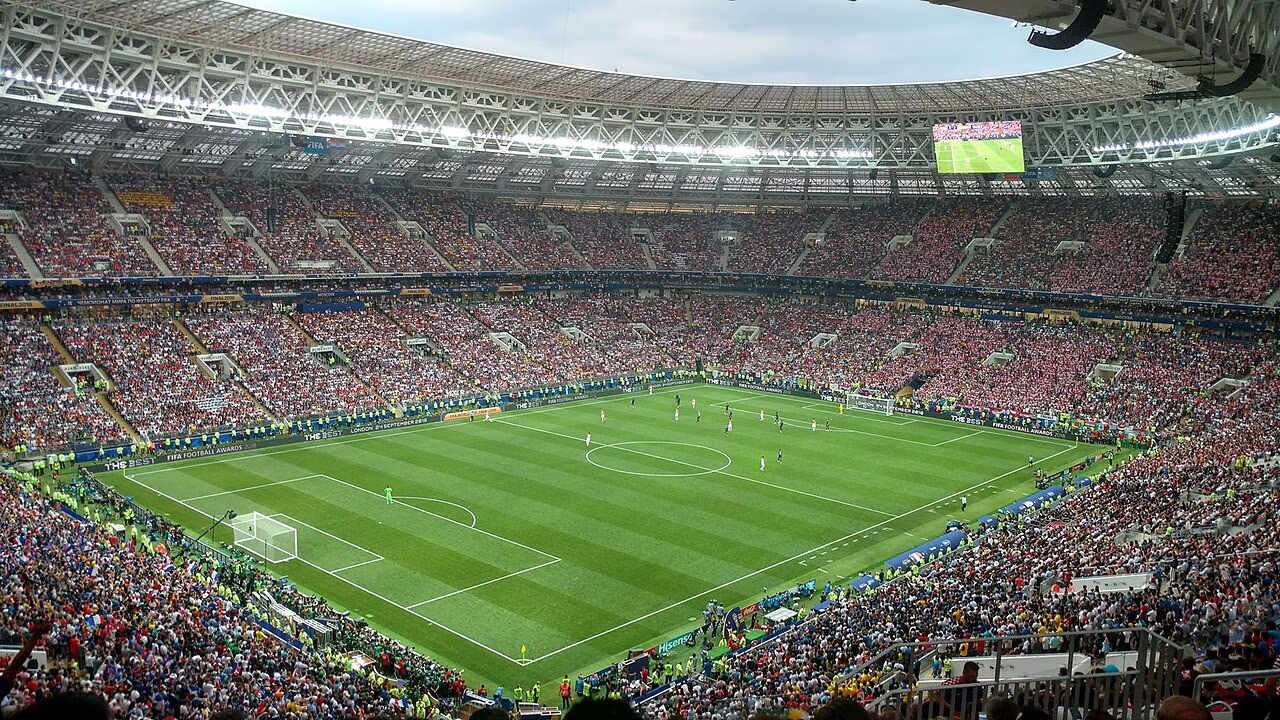
The field must be a rectangular natural or artificial turf surface, green in color. The field is defined by boundary lines: two longer touchlines and two shorter goal lines. The field is divided into two halves by the halfway line.
Dimensions
- Touchline (length): Minimum 90 m (100 yards), Maximum 120 m (130 yards)
- Goal line (width): Minimum 45 m (50 yards), Maximum 90 m (100 yards)
- International matches: Length 100–110 m, Width 64–75 m
- The touchline must be longer than the goal line
Field Markings
- Center circle: Radius of 9.15 m (10 yards) from the center mark
- Penalty area: 16.5 m (18 yards) from each goal post and 16.5 m into the field
- Goal area: 5.5 m (6 yards) from each goal post and 5.5 m into the field
- Penalty mark: 11 m (12 yards) from the midpoint of the goal line
- Penalty arc: Arc of 9.15 m radius from the penalty mark, outside the penalty area
- Corner area: Quarter circle with 1 m radius from each corner flag post
The Goals
Goals are placed at the center of each goal line. They consist of two vertical posts equidistant from the corner flag posts, joined at the top by a horizontal crossbar. The distance between the inside of the posts is 7.32 m (8 yards) and the distance from the lower edge of the crossbar to the ground is 2.44 m (8 feet). Goal posts and crossbars must be white. Nets must be attached to the goals and the ground behind the goal.
Section 4: Players/Officials
Number of Players (Law 3)
A match is played by two teams, each with a maximum of 11 players, one of whom must be the goalkeeper. A match may not start or continue if either team has fewer than 7 players. In official FIFA competition, a maximum of 5 substitutes may be used (with the recent permanent adoption of the five-substitution rule). Substitutions may be made during three opportunities per team plus the half-time interval, though an additional opportunity is granted if extra time is played.
Substitution Procedure
A substitute may only enter the field at the halfway line during a stoppage of play and after receiving the referee's signal. The player being replaced must leave the field before the substitute enters. A player who has been replaced may not take further part in the match. All substitutes are subject to the authority of the referee, whether called upon to play or not.
Concussion Substitutions (Permanent — effective July 2025)
IFAB has made the concussion substitution rule permanent (no longer a trial). Each team is permitted one additional "concussion substitution" when a player has an actual or suspected concussion. This substitution does not count toward the team's regular substitution limit. The opposing team also receives one additional substitution in response. The concussed player may not return to the match.
The Referee (Law 5)
Each match is controlled by a referee who has full authority to enforce the Laws of the Game. The referee's decisions regarding facts connected with play are final. The referee may only reverse a decision before play has restarted or if the referee realizes a decision is incorrect (including on the advice of another match official or VAR). The referee acts as timekeeper and keeps a record of the match.
Other Match Officials (Law 6)
- Assistant Referees (2): Positioned along each touchline, they assist with offside decisions, throw-in direction, corner/goal kicks, and fouls near their position.
- Fourth Official: Assists the referee with administrative duties, manages substitutions, and controls the technical areas.
- Video Assistant Referee (VAR): Reviews clear and obvious errors or serious missed incidents in four categories: goals, penalty decisions, direct red card incidents, and mistaken identity.
- Assistant VAR (AVAR): Assists the VAR, primarily monitoring live play while the VAR conducts a review.
Section 5: Rules of Play
Duration of the Match (Law 7)
A match consists of two equal halves of 45 minutes each, with a half-time interval not exceeding 15 minutes. The referee adds time at the end of each half for all time lost due to substitutions, assessment and/or removal of injured players, wasting time, disciplinary sanctions, medical stoppages, VAR reviews, goal celebrations, and any other cause. Penalty kicks awarded at the end of a half are completed even if time has expired.
Goalkeeper Time Limit (effective July 2025)
Goalkeepers now have a maximum of 8 seconds to release the ball from their hands. If the goalkeeper holds the ball for longer than 8 seconds, the opposing team is awarded a corner kick. This replaces the previous 6-second rule (which was rarely enforced) and is designed to reduce time-wasting.
Start and Restart of Play (Law 8)
A kick-off starts both halves and restarts play after a goal. The team that wins the coin toss decides which goal to attack in the first half; the other team takes the kick-off. A goal may be scored directly from the kick-off. Dropped ball restarts play when the referee stops play for any reason not mentioned in the Laws.
Ball In and Out of Play (Law 9)
The ball is out of play when it has wholly passed over the goal line or touchline, whether on the ground or in the air, or when play has been stopped by the referee. The ball is in play at all other times, including when it rebounds off a match official, goal post, crossbar, or corner flag post and remains on the field.
Offside (Law 11)
A player is in an offside position if any part of their head, body, or feet is nearer to the opponents' goal line than both the ball and the second-last opponent. A player is not in an offside position if they are in their own half of the field or level with the second-last opponent or level with the last two opponents. Being in an offside position is not an offense in itself; an offense occurs only when the ball is played or touched by a teammate and the player in an offside position becomes involved in active play.
Semi-automated offside technology (SAOT) has been adopted in FIFA competitions to provide faster and more accurate offside decisions, using limb-tracking cameras and a sensor in the match ball.
Scoring (Law 10)
A goal is scored when the whole of the ball passes over the goal line, between the goal posts and under the crossbar, provided no offense has been committed by the scoring team. The team scoring the greater number of goals wins. If both teams score an equal number of goals or no goals are scored, the match is a draw. Competition rules may provide for extra time or kicks from the penalty mark to determine a winner.
Set Pieces
- Free Kicks (Law 13): Awarded for fouls and misconduct. Direct free kicks allow a goal to be scored directly; indirect free kicks require the ball to touch another player before a goal can be scored.
- Penalty Kick (Law 14): Awarded when a foul punishable by a direct free kick is committed inside the penalty area. The kick is taken from the penalty mark with only the goalkeeper and kicker in the penalty area.
- Throw-in (Law 15): Awarded when the ball wholly crosses the touchline. The thrower must face the field, have part of each foot on or behind the touchline, and throw the ball with both hands from behind and over the head. Under the Laws of the Game 2026/27, if a team delays taking a throw-in, the referee applies a visible five-second countdown; if the throw-in has not been taken by the time the count expires, the throw-in is awarded to the opposing team.
- Goal Kick (Law 16): Awarded when the ball wholly crosses the goal line (not a goal) having last been touched by an attacking player. The ball is kicked from anywhere within the goal area. The ball is in play when it is kicked and clearly moves. Opponents must remain outside the penalty area until the ball is in play. Under the Laws of the Game 2026/27, the same five-second countdown for deliberate delay applies to the goal kick; if the kick has not been taken by the time the count expires, a corner kick is awarded to the opposing team.
- Corner Kick (Law 17): Awarded when the ball wholly crosses the goal line (not a goal) having last been touched by a defending player. A goal may be scored directly from a corner kick, but only against the opposing team.
Section 6: Scoring
Determining the Winner
The team that scores the most goals during a match wins. If the number of goals scored is equal, the match is a draw. When competition rules require a winner after a drawn match, the following procedures are permitted:
- Away goals rule: No longer used in FIFA and most major competitions as of 2021.
- Extra time: Two equal periods of 15 minutes each. Goals scored during extra time count toward the final score.
- Kicks from the penalty mark: If the score is still level after extra time (or after the match if no extra time is used), kicks from the penalty mark determine the winner. Each team takes five kicks alternately; if still tied, kicks continue in sudden-death fashion. All eligible players must take a kick before any player takes a second kick.
Competition Formats
FIFA competitions use various formats:
- Group stage: 3 points for a win, 1 point for a draw, 0 points for a loss
- Knockout stage: Extra time and penalty shootout if required
- Tiebreakers in groups: Points, goal difference, goals scored, head-to-head record, fair play points, drawing of lots
2026 FIFA World Cup — Expanded Format
The 2026 FIFA World Cup (hosted across the United States, Canada, and Mexico) expands from 32 to 48 teams for the first time. The new format features 12 groups of 4 teams each. The top 2 teams from each group plus the 8 best third-place teams advance to a new Round of 32, followed by Round of 16, quarterfinals, semifinals, and the final. The tournament will feature 104 total matches (up from 64), with the final scheduled for July 19, 2026 at MetLife Stadium in New Jersey.
VAR and Goal-Line Technology
Goal-line technology (GLT) is used in all major FIFA competitions and approved leagues to determine definitively whether the ball has wholly crossed the goal line. The system provides an instantaneous signal to the referee's watch within one second of a goal/no-goal situation. VAR supplements GLT by reviewing potential offside, fouls in the build-up, or handball incidents that may affect the validity of a goal.
Section 7: Violations/Penalties (Law 12)
Direct Free Kick Offenses
A direct free kick (or penalty kick if inside the offender's penalty area) is awarded if a player commits any of the following offenses against an opponent in a manner considered by the referee to be careless, reckless, or using excessive force:
- Charging
- Jumping at
- Kicking or attempting to kick
- Pushing
- Striking or attempting to strike (including headbutt)
- Tackling or challenging
- Tripping or attempting to trip
A direct free kick is also awarded if a player:
- Holds an opponent
- Impedes an opponent with contact
- Bites or spits at someone
- Throws an object at the ball, an opponent, or a match official
- Handles the ball deliberately (except the goalkeeper within their penalty area)
Handball
It is an offense when a player deliberately touches the ball with their hand/arm (including moving the hand/arm toward the ball), scores directly from their hand/arm (even if accidental), or creates a goal-scoring opportunity after the ball touches their hand/arm (even if accidental). The shoulder is not considered part of the arm. Not every contact of the ball with the hand/arm is an offense; the referee considers the position of the hand/arm in relation to the body, whether the player made their body unnaturally bigger, and whether the contact was unavoidable.
Indirect Free Kick Offenses
An indirect free kick is awarded when a player plays in a dangerous manner, impedes the progress of an opponent without contact, or commits any offense for which play is stopped to caution or dismiss a player. Specific goalkeeper indirect free kick offenses include controlling the ball with the hand/arm for more than six seconds, touching the ball with the hand/arm after deliberately receiving it from a teammate's kick or throw-in, and touching the ball with the hand/arm after releasing it and before it touches another player.
Disciplinary Action
- Yellow Card (Caution): Issued for unsporting behavior, dissent, persistent infringement, delaying the restart of play, failing to respect the required distance at set pieces, entering/leaving the field without permission, or deliberate handball to stop a promising attack (if outside the penalty area, the offense now results in a yellow card rather than a red under certain conditions).
- Red Card (Sending-off): Issued for serious foul play, violent conduct, spitting at or biting another person, denying an obvious goal-scoring opportunity by handling the ball (for non-goalkeepers), denying an obvious goal-scoring opportunity with a foul (outside the penalty area), using offensive/insulting/abusive language or gestures, or receiving a second yellow card. A player who is sent off must leave the field and its surroundings immediately.
Advantage
The referee may allow play to continue when a team against which an offense has been committed would benefit from the advantage. If the anticipated advantage does not materialize within a few seconds, the referee penalizes the original offense. Disciplinary action (yellow or red card) may still be taken at the next stoppage even if advantage is played. Under Law 12 of the Laws of the Game 2026/27, this last point now carries an exception for Denial of an Obvious Goal-Scoring Opportunity (DOGSO): if the referee applies advantage following a DOGSO offense and a goal is subsequently scored as a direct result of that passage of play, no caution is issued to the offending player, even though the original offense would otherwise have warranted a yellow card.
Section 8: Safety Considerations
Player Safety
Player safety is a fundamental principle underlying the Laws of the Game. The referee must stop play if a player is seriously injured and ensure the player is removed from the field. Play only restarts after the injured player has left the field, unless the injury was clearly minor. A player with a bleeding wound must leave the field and may not return until the bleeding has stopped and the wound is covered.
Concussion Protocol
IFAB has established a permanent concussion substitution protocol. If a player is suspected of sustaining a concussion, the team doctor may request that the player be substituted using the additional concussion substitution allowance. The player must not return to the match. This substitution does not count toward the team's regular substitution limit and is intended to remove any pressure on medical staff to allow a potentially concussed player to continue.
Lightning and Weather
The referee has the authority to suspend or abandon a match due to dangerous weather conditions, including lightning, extreme heat, or poor visibility. Matches may be suspended temporarily and resumed if conditions improve, or abandoned if conditions do not improve within a reasonable time.
Captain-Only Communication (Optional — effective 2025)
Competitions may adopt the optional "captain only" rule, which restricts communication with the referee to the team captain only. Implemented in the Premier League and endorsed by FIFA for the 2025-2026 season, this rule aims to reduce referee harassment and improve match flow. Non-captain players who approach or confront the referee may receive a yellow card.
Artificial Playing Surfaces
Where artificial turf is used, it must meet the requirements of the FIFA Quality Programme. The surface must be green and meet specific criteria for shock absorption, ball bounce, ball roll, and rotational resistance to protect player safety and preserve the quality of play.
Medical Provisions
The competition organizer must ensure adequate medical facilities and personnel are available at the match venue. A stretcher and medical personnel must be present at all official matches. In professional competition, an ambulance must be on standby at the venue.
Crowd Safety
While primarily governed by competition regulations rather than the Laws of the Game, the safety of spectators is a consideration. The referee has the authority to suspend or abandon a match if crowd behavior endangers players, officials, or spectators. Objects thrown onto the field must be removed before play continues.
Heat Breaks
In matches played in extreme heat conditions, the referee may authorize cooling breaks (separate from the half-time interval) of up to three minutes, typically around the 30th and 75th minutes of play. These are medical recommendations implemented to protect player health and are distinct from drinks breaks.