






Section 1: Introduction
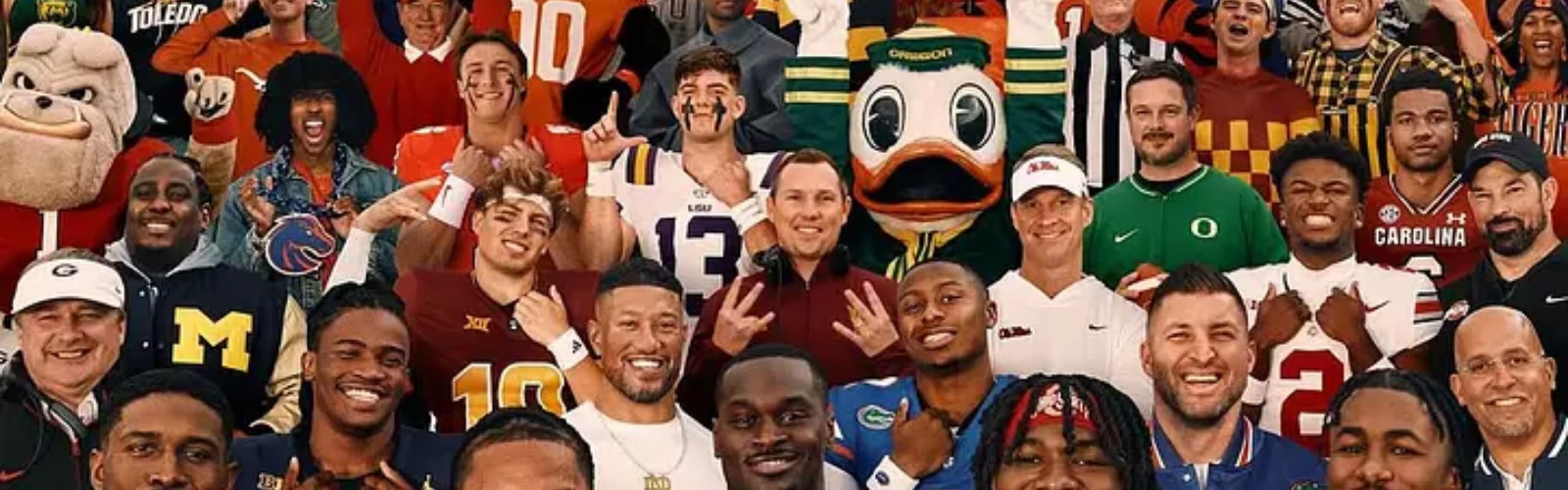
The National Collegiate Athletic Association (NCAA) governs college football in the United States across three divisions: Division I (subdivided into FBS and FCS), Division II, and Division III. The NCAA was founded in 1906, largely in response to the dangerous nature of early football — President Theodore Roosevelt convened a White House summit after 18 players died during the 1905 season, leading to the formation of the Intercollegiate Athletic Association of the United States (IAAUS), which became the NCAA in 1910.
NCAA football is one of the most popular sports in the United States, with FBS programs regularly drawing crowds exceeding 100,000 spectators. The College Football Playoff (CFP), expanded to 12 teams beginning with the 2024-2025 season, determines the national champion. The Heisman Trophy, awarded annually since 1935, recognizes the most outstanding player in college football.
The NCAA Football Rules Committee reviews and proposes rule changes annually, with new rules typically effective for the following season. This rulebook reflects the rules and interpretations adopted for the 2026 season, published in the 2026 NCAA Football Rules and Interpretations, including a one-year experimental change to the targeting penalty structure approved by the Division I Football Bowl Subdivision Oversight Committee, a clarified punt-formation eligibility rule under Rule 7-1-4, an updated unsportsmanlike conduct standard under Rule 9-2-1, and a play-clock adjustment for late-game instant replay reviews under Rule 12.
Key Differences from NFL Rules
- Clock management: The clock stops after every first down until the ball is spotted — NFL clock keeps running, making college games longer
- Overtime: Alternating possessions from the 25-yard line — NFL uses a modified sudden death format
- Catch rule: Only ONE foot inbounds required — NFL requires TWO feet
- Pass interference: Maximum 15-yard penalty — NFL is a spot foul (can be 40+ yards)
- Targeting: Automatic ejection for leading with crown of helmet to head/neck, now governed by a season-long progressive penalty structure — NFL penalizes but does not eject
- Hash marks: Wider than NFL, affecting offensive play design
- No coach's challenge: All reviews initiated by the replay booth, not coaches
- No in-helmet communication: Quarterbacks do not have speakers in their helmets
Section 2: Equipment
The Football
- Official ball: Wilson GST (same manufacturer as NFL's "The Duke")
- Dimensions: Long axis 10.875 to 11.4375 inches, short circumference 20.75 to 21.25 inches — same specifications as the NFL ball
- Weight: 14 to 15 ounces
- Inflation: 12.5 to 13.5 psi
- Color: Natural tan leather with white stripes on each end (NFL ball has no white stripes)
Helmets
- Mandatory: All players must wear a helmet with a face mask at all times during play — same as NFL
- Certification: Must meet NOCSAE (National Operating Committee on Standards for Athletic Equipment) standards
- Face mask: Made of coated metal, must be a non-opaque color
- Eye shields: Must be clear unless a medical exception is granted (NFL allows tinted visors)
- No in-helmet communication: Unlike the NFL, NCAA does not permit coach-to-player electronic communication in helmets
Mandatory Equipment
- Mouthguard: MANDATORY for all players — must be a visible color (not clear or white). In the NFL, mouthguards are recommended but not required.
- Shoulder pads: Required, fully covered by the jersey
- Thigh pads and knee pads: Required — worn inside the pants
- Hip pads and tailbone protector: Required
Uniforms
- Jersey numbers: Offensive linemen must wear 50-79 (or 90-99 with a report to the referee). Since 2021, other positions have more flexibility. Previously, specific number ranges were assigned to each position group.
- Jersey: Must be tucked into the pants; cannot hang below the waist
- Home team: Traditionally wears dark jerseys (NFL home teams also wear dark, though white is increasingly common)
- Name on back: Not required (NFL mandates player names on jerseys)
Section 3: Playing Area
The Field
- Length: 100 yards (300 feet / 91.44 meters) between end zones — same as NFL
- Width: 53⅓ yards (160 feet / 48.77 meters) — same as NFL
- End zones: 10 yards deep at each end — same as NFL
- Total playing surface: 120 yards × 53⅓ yards
- Surface: Natural grass or approved artificial turf
Hash Marks
This is a significant difference from the NFL that affects offensive strategy:
- NCAA: Hash marks are 40 feet (13.33 yards) from each sideline — positioned at the edge of the field numbers
- NFL: Hash marks are 70 feet 9 inches (23.58 yards) from each sideline — much closer to center
- Impact: The wider hash marks in college football create a wider "short side" of the field, giving defensive coordinators more opportunities to load one side. NFL's narrower hashes make the field more symmetrical.
Goal Posts
- Width: 18 feet 6 inches between the uprights — same as NFL
- Height: Crossbar at 10 feet, uprights extend at least 30 feet above the crossbar
- Location: Centered on the end line at the back of the end zone — same as NFL (goal posts were moved from the goal line to the end line in 1927 in college)
- Padding: Goal post bases must be padded
Field Markings
- Yard lines: Every 5 yards across the full width of the field
- Numbers: Field numbers at every 10-yard interval (10, 20, 30, 40, 50, 40, 30, 20, 10)
- Directional arrows: Placed next to yard numbers pointing toward the nearest end zone (except at the 50)
- Team areas: Between the 25-yard lines on each side, extending 6 feet from the sideline
Section 4: Players & Officials
Team Composition
- On the field: 11 players per side — same as NFL
- Roster: FBS programs may have up to 85 scholarship players and additional walk-ons (total roster often exceeds 100). NFL rosters are limited to 53.
- Substitutions: Unlimited free substitution — any number of players may enter or leave during a dead ball. Same as NFL.
Positions
NCAA uses the same positions as the NFL: quarterback, running backs, wide receivers, tight ends, offensive linemen (center, guards, tackles), defensive linemen, linebackers, cornerbacks, safeties, and special teams specialists. Number restrictions are similar but less rigid than they were historically.
Game Officials (7)
NCAA uses a crew of 7 officials — the same number as the NFL but with slightly different titles and responsibilities:
- Referee (R): White cap. Head official, has final authority. Positioned behind the offensive backfield on the throwing arm side of the quarterback.
- Umpire (U): Positioned in the defensive secondary (moved from behind the defensive line). Monitors line of scrimmage contact, illegal formations, and equipment.
- Head Linesman (HL): Positioned on the chain crew side of the line of scrimmage. Rules on offside, encroachment, and out-of-bounds on their side.
- Line Judge (LJ): Opposite side from the head linesman. Monitors the line of scrimmage and the neutral zone.
- Back Judge (BJ): Positioned in the deep secondary. Monitors deep passes, goal line plays, and the 25-second play clock.
- Field Judge (FJ): Deep secondary on the same side as the line judge. Monitors deep pass plays and timing.
- Side Judge (SJ): Deep secondary on the same side as the head linesman. Monitors sideline plays and deep passes.
Instant Replay
- Booth-initiated: All replay reviews are initiated by the replay official in the booth — coaches CANNOT challenge plays (NFL allows 2 coach's challenges per game)
- All plays reviewed: The replay official monitors every play and can stop the game for review at any time
- Targeting review: All targeting fouls are automatically reviewed, and the call can be confirmed, overturned, or upheld by rule
- Play clock freeze on late-game review (new for 2026): Under Rule 12, if the replay official stops the game for a review after the Two-Minute Timeout of the second or fourth quarter, the play clock is frozen at the moment of the stoppage and does not restart until the referee signals the ball ready for play. If the play clock shows fewer than 10 seconds when it is frozen, it is reset to 10 seconds before it restarts, so a review cannot be used to run time off the clock.
Section 5: Rules of Play
Game Duration
- Quarters: 4 × 15 minutes — same as NFL
- Halftime: 20 minutes (can be shortened by mutual agreement). NFL halftime is 12 minutes (longer for Super Bowl).
- Between quarters: Teams switch ends with a 1-minute interval
Clock Rules — Key Difference from NFL
The most significant rule difference affecting game pace:
- First down clock stoppage: After every first down, the game clock stops until the referee signals the ball ready for play and the ball is snapped. In the NFL, the clock continues to run after first downs (except in the final 2 minutes of each half).
- Impact: This makes college football games significantly longer and allows more total plays per game
- Play clock: 40 seconds from the end of the previous play, or 25 seconds after certain administrative stoppages — same as NFL
- Running clock in blowouts: Beginning in 2023, if the score differential reaches 35+ points in the second half, the clock runs continuously except for scores, timeouts, and injuries
Overtime — Completely Different from NFL
NCAA uses an alternating possession overtime system, not sudden death:
- Coin toss: The visiting team calls the toss. Winner chooses offense/defense or which end of the field.
- Starting position: Each team gets possession at the opponent's 25-yard line
- 1st and 2nd overtime: Each team gets one possession. Touchdowns may be followed by a PAT (1 point) or two-point conversion.
- 3rd overtime onward: Teams must attempt a two-point conversion after touchdowns — no PATs or field goals allowed
- 4th overtime onward (since 2021): Each team runs alternating two-point conversion plays only — no drives from the 25
- NFL comparison: NFL uses a modified sudden death with guaranteed possession for both teams (since 2022). First team to score a touchdown wins; if the first team kicks a field goal, the other team gets a possession.
Catch Rule
A critical difference:
- NCAA: A receiver needs only ONE foot inbounds while maintaining control of the ball for a legal catch
- NFL: A receiver must have TWO feet (or one body part other than a hand) inbounds
- Impact: This makes sideline catches significantly easier in college football and affects defensive coverage strategy
Kickoffs
- Kicked from: The 35-yard line — same as NFL
- Fair catch inside 25: A fair catch on a kickoff inside the receiving team's 25-yard line results in a touchback, with the ball placed at the 25-yard line
- Touchback: Ball placed at the 25-yard line — same as NFL
- Onside kick: Same rules as NFL — must travel 10 yards before the kicking team can recover
Punts & Scrimmage-Kick Formation Eligibility (new for 2026)
Rule 7-1-4 (Numbering Exceptions — Scrimmage Kick Formation) was clarified for the 2026 season to address punt formations that use "jersey-number exceptions" — players lined up in the tackle box who are not numbered in the traditional offensive-line range of 50-79. Under the clarified rule, when a team is in scrimmage-kick formation at the snap, the snapper and the two players lined up adjacent to the snapper on either side — if positioned in or touching the tackle box — are ineligible receivers by position and become the formation's numbering exceptions once the snapper takes his position. The change is intended to remove ambiguity over which players in a punt formation may legally act as pass or kick receivers.
Timeouts
- Each team: 3 timeouts per half — same as NFL
- Duration: 30 seconds for media timeouts, team timeouts vary by broadcast agreement
- Unused timeouts: Do not carry over between halves
Section 6: Scoring
Point Values
- Touchdown: 6 points — same as NFL
- Point after touchdown (PAT): 1 point, attempted from the 3-yard line (NFL uses the 15-yard line since 2015). This makes PATs nearly automatic in college but a meaningful challenge in the NFL.
- Two-point conversion: 2 points, attempted from the 3-yard line — same as NFL
- Field goal: 3 points — same as NFL
- Safety: 2 points — same as NFL
Defensive Scoring on Conversions
If the defense intercepts or recovers a fumble during a PAT or two-point attempt and returns it to the opposing end zone, the defensive team scores 2 points. The NFL also awards 2 points for this (since 2015).
Section 7: Violations & Penalties
Targeting — NCAA's Signature Safety Rule (progressive penalty restructured for 2026)
The targeting rule remains one of the most significant differences between NCAA and NFL football, and its penalty structure changed for the 2026 season:
- Definition: Rule 9-1-3 prohibits targeting and making forcible contact with the crown of the helmet against an opponent; Rule 9-1-4 prohibits targeting and making forcible contact to the head or neck area of a defenseless opponent with the helmet, forearm, hand, fist, elbow, or shoulder.
- Base penalty: 15 yards and automatic disqualification of the offending player from the game in which the foul occurs — unchanged for 2026.
- 2026 progressive penalty structure (one-year experimental rule): The Division I Football Bowl Subdivision Oversight Committee approved a season-long progressive strike system under Rules 9-1-3 and 9-1-4 that replaces the prior automatic-carryover standard for second-half fouls:
- 1st disqualification of the season: the player is ejected from the current game but remains eligible to play in the team's next game, regardless of whether the foul occurred in the first or second half.
- 2nd disqualification of the season: the player is ejected from the current game and must additionally sit out the first half of the team's next game.
- 3rd or subsequent disqualification of the season: the player is ejected from the current game and must sit out the team's entire next game.
- Appeals process (new for 2026): Beginning with a player's second targeting disqualification in a season, that player's conference may request a video review by the NCAA national coordinator of football officials, covering the second offense and, if relevant, the first. If a reviewed call is overturned, the strike count is reduced and any associated suspension is lifted.
- Review: All targeting calls remain automatically reviewed by the replay official under Rule 12. If the replay official determines targeting did not occur, the ejection is overturned (though the 15-yard penalty may stand as a personal foul).
- NFL comparison: The NFL penalizes similar hits with 15-yard unnecessary roughness penalties and potential fines/suspensions, but does not automatically eject the player during the game.
Pass Interference — Major Difference from NFL
- NCAA: Defensive pass interference is a 15-yard penalty from the previous spot and an automatic first down — regardless of where the foul occurred
- NFL: Defensive pass interference is a spot foul — the ball is placed where the foul occurred, which can result in penalties of 40, 50, or even 60+ yards
- Impact: This is one of the most debated differences. In college, a defender has more incentive to commit interference on deep passes because the maximum penalty is 15 yards. In the NFL, the spot-foul penalty makes deep interference devastating.
- Offensive pass interference: 15 yards from the previous spot in both NCAA and NFL
Common Penalties
- False start: 5 yards — same as NFL
- Offside / Encroachment: 5 yards — same as NFL
- Holding (offensive): 10 yards from the spot — same as NFL
- Holding (defensive): 5 yards + automatic first down — same as NFL
- Delay of game: 5 yards — same as NFL
- Illegal formation: 5 yards — NCAA requires 7 players on the line; 4 backs behind the line
- Ineligible receiver downfield: 5 yards — NCAA allows linemen up to 3 yards downfield on pass plays (NFL allows only 1 yard)
Unsportsmanlike Conduct & Celebrations (clarified for 2026)
Rule 9-2-1 was clarified for the 2026 season to focus officials' judgment on three categories of conduct: taunting actions directed at an opponent, actions that interfere with orderly game administration, and celebratory, abusive, or threatening actions that are demeaning to the game or an opponent.
Under the clarified Rule 9-2-1, the list of fouls that draw an automatic unsportsmanlike conduct flag was narrowed and made consistent across officiating crews. It specifically includes: any gesture simulating a firearm or brandishing a weapon; a throat-slash or nose-wipe gesture directed at an opponent; a player removing his helmet after the ball is dead, except during a team timeout or for an equipment adjustment; and dead-ball contact fouls — pushing, shoving, or striking — that occur clearly after the ball is dead and are not part of continuing game action.
Penalty: 15 yards, unchanged. Two unsportsmanlike conduct fouls by the same player in a game result in disqualification, unchanged.
Section 8: Safety Considerations
Concussion Protocol
The NCAA has some of the strictest concussion protocols in football:
- Mandatory removal: Any player exhibiting signs of a concussion must be immediately removed from the game
- Same-day return prohibited: A player diagnosed with a concussion may not return to play on the same day, even if cleared — this is stricter than the NFL, which allows same-day return after clearance
- Return-to-play protocol: Graduated 5-step protocol: (1) symptom-limited activity, (2) light aerobic exercise, (3) sport-specific exercise, (4) non-contact drills, (5) full-contact practice. Minimum 24 hours between each step.
- Medical clearance: Written clearance from a physician (not a trainer) is required before return
- Independent medical observer: Present at all FBS games to assist with concussion identification
Heat Illness Prevention
- Acclimatization period: Mandatory 5-day acclimatization period at the start of preseason practice. Days 1-2: no pads, limited practice time. Days 3-5: gradual increase in intensity and equipment.
- Wet bulb globe temperature (WBGT): Practice modifications required based on WBGT readings — activities may be suspended if WBGT exceeds thresholds
- Hydration: Unlimited water and electrolyte access required at all practices and games
- Cold water immersion: Ice tubs must be available at all practices and games for emergency treatment of exertional heat stroke
Targeting Rule Rationale
The targeting rule was introduced to change the culture of tackling in college football. By imposing automatic ejection — a penalty far more severe than the NFL equivalent — the NCAA aims to discourage helmet-first contact and reduce the incidence of traumatic brain injuries. Studies have shown a reduction in helmet-to-helmet hits since the rule's introduction in 2008 (with the ejection component added in 2013). The 2026 progressive-penalty trial, described in Section 7, keeps the automatic per-game ejection intact while scaling the multi-game suspension to the player's season-long history of fouls, which the Football Rules Committee framed as a way to strengthen coaching and player accountability for repeat offenders.
Equipment Safety Standards
- Helmet recertification: All helmets must be recertified annually to NOCSAE standards
- Position-specific helmets: Manufacturers now offer helmets designed for specific positions (lineman vs skill positions) based on impact patterns
- Practice contact limits: NCAA limits full-contact practices to 2 per week during the season and caps preseason contact days