

















Section 1: Introduction
Source Document
This rulebook is sourced from the Rules of Golf 2023–2026, jointly published by The R&A and the United States Golf Association (USGA), effective January 1, 2023. The Rules of Golf are revised on a four-year cycle; the current edition took effect on 1 January 2023 and remains authoritative through 31 December 2026. All rule citations below reference the numbered Rules contained in that joint publication.
The Game of Golf (Rule 1)
Rule 1.1 defines golf as a game where players use clubs to hit balls from the teeing area into the hole by successive strokes, following the Rules. The game is played on a course consisting of either 9 or 18 holes. Players are expected to act with integrity, show consideration for others, and take care of the course (Rule 1.2a).
Rule 1.2b addresses serious misconduct: a Committee may disqualify a player for conduct considered to be seriously contrary to the spirit of the game, even if no specific penalty is otherwise provided (Rule 1).
Rule 1.3 governs how the Rules are applied. A player who knows a Rule applies but chooses to ignore it cannot agree with another player to disregard it; any such agreement is void, and both players are disqualified (Rule 1.3b).
History and Governing Bodies
The R&A (formerly The Royal and Ancient Golf Club of St Andrews) has governed the rules of golf outside the United States and Mexico since 2004, when its rules-making function was separated from the Club into The R&A Ltd. The USGA governs golf in the United States and Mexico. Both bodies work jointly to produce a single unified set of Rules, last comprehensively revised in 2019 and updated for 2023.
Forms of Play (Rule 3)
Rule 3 specifies the primary forms of competition:
- Stroke Play (Rule 3.3): The player (or side) completing all rounds in the fewest total strokes wins.
- Match Play (Rule 3.2): A player wins a hole by completing it in fewer strokes than the opponent. The player who wins the most holes wins the match.
- Other Forms: Stableford, Maximum Score, Par/Bogey, Foursomes (Rule 22), Four-Ball (Rule 23), and Team Competition (Rule 24) are also governed by specific Rules.
Section 2: Equipment
Player's Equipment (Rule 4)
Rule 4 governs all equipment a player may use during a round. Equipment must conform to the Equipment Rules, the separate technical standards published jointly by the R&A and USGA (updated periodically, most recently effective January 1, 2024 for certain groove and punch mark standards) (Rule 4).
Clubs (Rule 4.1)
A player must not make a stroke with a club that does not conform to the Equipment Rules, or that has been deliberately damaged during the round (Rule 4.1a). A player may use a club that was damaged in the normal course of play (Rule 4.1b), though the club may be repaired or replaced only in specific circumstances.
Maximum Number of Clubs (Rule 4.1b): A player must not start a round with more than 14 clubs and must not have more than 14 clubs during the round. A player who starts with fewer than 14 clubs may add clubs up to that limit during the round, provided play is not unduly delayed.
Sharing Clubs (Rule 4.1b(3)): Players on the same side in a four-ball or foursomes competition may share clubs, provided the total number of clubs carried by all partners does not exceed 14.
Club Length: Under the Equipment Rules, club length (excluding putters) must be at least 18 inches (457.2 mm) and no longer than 48 inches (1,219.2 mm). Putters have no maximum length limit but must meet all other specifications. Note: A proposed Rule change to cap putter length at 48 inches was under consultation as of 2025; players should verify current Equipment Rules. (Rule 4.1)
The Ball (Rule 4.2)
A player must use a ball that conforms to the Equipment Rules. The ball must not be deliberately altered during the round (Rule 4.2a). If a ball is cut or cracked (as opposed to merely scuffed or scratched), the player may substitute another ball under Rule 4.2c.
Ball Specifications (Equipment Rules): (Rule 4.2)
- Minimum diameter: 1.680 inches (42.67 mm) (Rule 4.2).
- Maximum weight: 1.620 ounces (45.93 grams).
- Initial velocity must not exceed 250 feet per second (76.2 m/s) under the R&A/USGA test conditions (Rule 4.2).
- Overall distance standard: the ball must not travel more than 317 yards under test conditions (Equipment Rules test specification) (Rule 4.2).
One Ball Condition (Committee Option): A Committee may adopt a Local Rule requiring a player to use the same model and brand of conforming ball throughout a round. If adopted and a player changes ball models in breach, the penalty is two strokes in stroke play or loss of hole in match play per hole where the breach occurred (Rule 4.2).
Other Equipment (Rule 4.3)
Rule 4.3a prohibits the use of equipment or other items that artificially assist a player's performance by:
- Artificially eliminating or reducing the effects of wind, temperature, or other weather conditions (Rule 4.3).
- Helping with club selection (except a distance-measuring device permitted under Rule 4.3a(1)).
- Measuring slope, or measuring other parameters (such as wind speed or ball lie) that could affect play, unless specifically permitted by a Committee Local Rule (Rule 4.3).
- Gauging or measuring pace of play (a permitted use under Rule 4.3a(1) where a device measures only distance or elapsed time).
Distance-Measuring Devices: Under Rule 4.3a(1), players may use such a device to measure distance only, unless the Committee has adopted a Local Rule prohibiting them. A device that measures both distance and slope is not permitted unless it has a slope function that can be switched off and the player uses it only in the off mode (Rule 4.3).
Damaged Equipment (Rule 4.1b)
If a club becomes damaged during the round in the normal course of play (not by abuse), the player may continue to use or repair the damaged club, or replace it with another club, as long as:
- Play is not unduly delayed (Rule 5.6a).
- The replacement is not made by borrowing a club selected for play by another player on the course (Rule 4.1b).
Section 3: Playing Area
The Course (Rule 2)
Rule 2 defines the five defined areas of the course. Understanding these areas is essential because different Rules apply in each area (Rule 2).
Five Defined Areas of the Course (Rule 2.2)
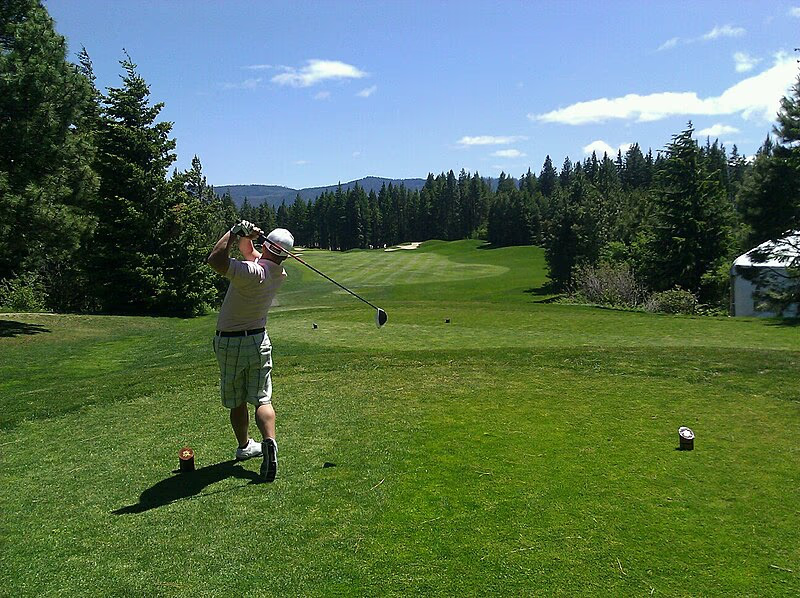
- The Teeing Area (Rule 6.2): The starting point for each hole. It is a rectangular area two club-lengths deep, defined by the front edge of two tee-markers. Players must play from within or behind this area (though stance may be taken outside the teeing area). The tee-markers are immovable obstructions for all other players until the hole has been started; for the player playing that hole they are movable obstructions.
- The General Area (Rule 2.2b): Covers all of the course except the other four defined areas. Includes the fairway, rough, and all other ground not specifically defined. The general area is the default area when no other area applies.
- Penalty Areas (Rule 17): Bodies of water or other areas defined by the Committee as penalty areas, marked with red or yellow stakes or lines. Yellow penalty areas: players may take stroke-and-distance relief or back-on-the-line relief. Red penalty areas: players may additionally take lateral relief within two club-lengths of the point where the ball last crossed the penalty area edge (Rule 17.1d).
- Bunkers (Rule 12): Specially prepared areas of sand defined by the Committee. Rule 12.2a prohibits touching sand with a hand, club, or equipment before making a stroke, with limited exceptions (e.g., removing loose impediments under Rule 15.1, or fairly searching for the ball).
- The Putting Green (Rule 13): The specially prepared area designed for putting. The flagstick is located in the hole on the putting green. Under Rule 13.2a, a ball played from the putting green that hits the attended or unattended flagstick results in no penalty (changed from pre-2019 rules); a ball must be played as it lies if it hits the flagstick in the hole.
The Hole (Rule 13.1)
The hole on the putting green must be 4¼ inches (108 mm) in diameter and at least 4 inches (101.6 mm) deep. If a lining is used, it must be sunk at least 1 inch (25.4 mm) below the putting green surface, and its outer diameter must not exceed 4¼ inches (108 mm) (Rule 13.1).
Out of Bounds (Rule 18.2)
Out of bounds is defined by white stakes or lines, or the boundary of the course as defined by the Committee. When white lines define out of bounds, the line itself is out of bounds. A ball is out of bounds only when the entire ball lies out of bounds. A player may stand out of bounds to play a ball that is in bounds (Rule 18.2).
Abnormal Course Conditions (Rule 16)
Rule 16.1 provides free relief (no penalty stroke) from abnormal course conditions: animal holes, ground under repair, immovable obstructions, and temporary water (formerly called casual water). Relief is taken within one club-length of the nearest point of complete relief, no nearer the hole. On the putting green, the ball is placed at the nearest point of complete relief (Rule 16).
Course Care
Under Rule 1.2a, players are required to take good care of the course. This includes raking bunkers after play, repairing ball-marks on the putting green (Rule 13.1c permits repair of any damage on the putting green), and replacing divots. Spike marks on the putting green that are not ball-marks may also be repaired under Rule 13.1c (a 2019 rule change; previously only ball-marks could be repaired).
Section 4: Players & Officials
Players (Rule 1.2)
Rule 1.2a requires all players to act with integrity (by following the Rules and being honest in all aspects of play), show consideration to others (by playing at a prompt pace, keeping noise down, and ensuring their safety), and take care of the course. Conduct that is considered seriously contrary to the spirit of the game may result in disqualification under Rule 1.2b, even if no specific Rule addresses the conduct (Rule 1.2).
Player Responsibilities During a Round
Under Rule 5.3, the player is responsible for starting on time at the correct teeing area. Under Rule 5.6a, the player must not delay play or allow play to be unreasonably slow. Under Rule 5.7a, a player must stop play immediately when the Committee signals suspension of play for a dangerous situation.
Caddies (Rule 10.3)
Rule 10.3a allows a player to have one caddie at a time to carry their clubs and provide advice and other assistance. Having more than one caddie at a time is a breach; the penalty is two strokes (stroke play) or loss of hole (match play) for each hole at which the breach occurs, with a maximum penalty of four strokes per round (Rule 10.3).
A caddie may assist the player in searching for the ball (Rule 7.1), tend the flagstick (Rule 13.2b), lift and replace the ball on the putting green (Rule 14.1b), mark the ball's position, and carry equipment. However, a caddie may not concede a putt or a hole in match play on the player's behalf, stand behind the player while they make a stroke (Rule 10.2b(4)), or physically assist the player's stance or swing.
Advice (Rule 10.2a): A player must not give advice to anyone in the competition except their partner (in four-ball or foursomes), and must not ask for advice from anyone other than their caddie or partner. "Advice" means any counsel or suggestion that could influence how a player plays, chooses a club, or makes a stroke. It does not include publicly available information such as the position of hazards or hole locations.
Order of Play
Match Play (Rule 6.4a): The player whose ball is farthest from the hole plays first ("honors" on the first tee goes to the player determined by the Committee or by lot). If a player plays out of turn in match play, the opponent may cancel the stroke and require the player to replay it in the correct order (no penalty, but the replay must be done promptly).
Stroke Play (Rule 6.4b): The player farthest from the hole plays first. Ready golf (playing when ready, out of strict order) is encouraged to improve pace and is not a breach, provided it does not unduly affect another player. Note: The Committee may adopt a Local Rule requiring strict order of play.
Referees and Committees
Referees (Rule 20.2): A referee is an official authorised by the Committee to decide questions of fact and apply the Rules. A player must follow a referee's decision. A referee may intervene before or after a player makes a stroke, and may impose any penalty even if not requested.
The Committee (Rule 20.3): The Committee is responsible for organising and supervising the competition. It may adopt Local Rules for abnormal conditions, define the course, fix conditions of competition, and resolve rules disputes. Committee decisions on questions of fact are final.
Rules Issues During a Round (Rule 20.1): In stroke play, if players disagree on the application of a Rule, the player must play two balls under Rule 20.1c: one under the procedure they believe is correct and one under the other procedure. The player must report the facts to the Committee before returning the scorecard. The Committee then determines which ball counts.
Section 5: Rules of Play
Playing the Round (Rule 5)
Rule 5.1: A round consists of playing the holes of the course in the correct order, unless the Committee allows or requires another order. A round consists of 18 holes unless a shorter number is set by the Committee. Rule 5.2 prohibits practice on the course before a stroke play round on that day (except on a separate practice area), though practice between rounds or before/during a match play round is generally permitted unless the Committee prohibits it (Rule 5).
Playing a Hole (Rule 6)
Rule 6.1: A hole starts when the player makes a stroke at a ball in the teeing area. Rule 6.3a: The player's ball must be teed up on or between the tee-markers, within the rectangular teeing area. The ball may be teed on a tee-peg, or may be placed on the ground. Rule 6.3b: If a ball falls off a tee or is knocked off by the player before making a stroke, it may be re-teed without penalty (Rule 6).
Rule 6.4: Players must play in correct order (farthest from hole first in stroke play, by agreement or lot in match play). Under Rule 6.4b(2), the player who wins the previous hole has the honor on the next teeing area in match play (Rule 6).
Ball Search (Rule 7)
Rule 7.1 allows the player to take reasonable actions to find and identify their ball, including moving sand in a bunker or water in a penalty area, moving or bending vegetation, and probing the ground. If the player accidentally moves their ball during search, there is no penalty and the ball must be replaced (Rule 7.4).
Lost Ball: A ball is lost if it is not found within three minutes after the player (or their caddie) begins searching for it (Rule 18.2a). The three-minute rule was reduced from five minutes in 2019.
Playing the Ball as It Lies (Rules 8 and 9)
Rule 8.1 prohibits improving the conditions affecting the stroke, including the lie of the ball, area of intended stance, area of intended swing, line of play, or relief area — by moving, bending, or breaking anything growing or fixed; by removing or pressing down divots; by creating a foothold; or by moving sand. Exceptions include fairly taking a stance, making a stroke, removing loose impediments, and repairing damage on the putting green (Rule 13.1c).
Rule 9.2: If it is known or virtually certain that a player, opponent, or outside influence moved a ball at rest, the ball must be replaced to its original spot. If the original spot is not known, the ball must be replaced on the estimated original spot (Rule 14.2). If not known or virtually certain who moved the ball, there is no penalty and the ball is played from where it lies.
Making a Stroke (Rule 10.1)
Rule 10.1a: A stroke is made by fairly striking the ball with the head of the club. A player must not push, scrape, or scoop the ball. Rule 10.1b: The player must not make a stroke from a stance astride or touching the line of play (with limited exceptions for putts). Rule 10.1c: The player must not anchor the club, directly or by use of an anchor point, when making a stroke (the anchoring prohibition was introduced in 2016 and retained in 2019). Rule 10.1d: The player must not make a stroke at a moving ball, with exceptions (e.g., ball falling off tee, ball in water moving in current) (Rule 10.1).
Lifting, Marking, Replacing, Dropping, and Placing (Rule 14)
Rule 14.1: Before lifting a ball, the player must mark its spot with a ball-marker or a small object (a coin, for example) placed directly behind or next to the ball. Failure to mark before lifting results in a one-stroke penalty. Rule 14.2: A ball must be replaced on its original spot by placing it by hand; it must not be dropped onto the spot. Rule 14.3: When dropping in a relief area, the ball must be dropped from knee height (changed from shoulder height in 2019) and must come to rest in the defined relief area. If it does not, the player must re-drop once; if the second drop also fails, the ball is placed at the spot where it first touched the ground on the second drop (Rule 14).
Relief Procedures
Stroke-and-Distance Relief (Rule 18.1): Always available as an option: the player takes a penalty of one stroke and returns to where the previous stroke was made. This applies for lost balls, out-of-bounds balls, and unplayable balls.
Lateral Relief from Penalty Areas (Rule 17.1d): For red penalty areas only, the player may drop within two club-lengths of the point where the ball last crossed the edge of the penalty area, no nearer the hole, for one penalty stroke.
Unplayable Ball (Rule 19): At any place except a penalty area, a player may declare their ball unplayable for one penalty stroke and take one of three options: (1) stroke-and-distance; (2) back-on-the-line relief, going back as far as desired on a line from the hole through the ball spot; or (3) lateral relief within two club-lengths of the ball spot, no nearer the hole. In a bunker, options (2) and (3) must keep the ball in the bunker, or the player may take back-on-the-line relief outside the bunker for two penalty strokes.
Flagstick (Rule 13.2)
Under Rule 13.2a (effective 2019), there is no penalty if a ball played from anywhere on the course hits the unattended flagstick in the hole. Prior to 2019, a ball played from the putting green that hit the flagstick in the hole incurred a two-stroke penalty. Players may have the flagstick attended, removed, or left in the hole before making a stroke (Rule 13.2).
Section 6: Scoring
Stroke Play Scoring (Rule 3.3)
In stroke play, the player's score for each hole is the number of strokes made (including penalty strokes). The player's total for the round is the sum of all hole scores. The player (or side) with the lowest total score for the stipulated round(s) wins (Rule 3.3).
Scorecard (Rule 3.3b): Each player in stroke play must have a marker (another player in the competition) who records the player's score on a scorecard after each hole. At the end of the round, the player and marker must certify the score for each hole is correct by signing the scorecard. The player is responsible for ensuring the scorecard is returned to the Committee without delay.
Wrong Score (Rule 3.3b(3)): If the score recorded for a hole is lower than actually taken, the player is disqualified. If the score recorded is higher than actually taken, the higher score stands. Score errors must be corrected before the scorecard is returned; the Committee corrects any arithmetic errors in the total.
Match Play Scoring (Rule 3.2)
In match play, a player wins a hole by completing it in fewer strokes than the opponent. If both players complete a hole in the same number of strokes, the hole is halved. The match is won when a player leads by more holes than there are holes remaining (e.g., "3 and 2" means the winner was 3 holes up with only 2 remaining) (Rule 3.2).
Concessions (Rule 3.2b): In match play, a player may concede the opponent's next stroke, a hole, or the match at any time before the hole or match is concluded. A concession cannot be declined or withdrawn. There is no penalty for making a stroke that has been conceded.
Common Scoring Terms
- Par: The expected number of strokes a scratch golfer would need to complete a hole or round.
- Birdie: One stroke under par on a hole.
- Eagle: Two strokes under par on a hole.
- Albatross (Double Eagle): Three strokes under par on a hole.
- Bogey: One stroke over par on a hole.
- Double Bogey: Two strokes over par on a hole.
Stableford Scoring (Rule 21.1)
In Stableford play, a player's score is based on points awarded in relation to a fixed score (usually par) for each hole. Typical points allocation:
- More than one over fixed score: 0 points (Rule 21.1)
- One over fixed score (bogey): 1 point (Rule 21.1)
- Equal to fixed score (par): 2 points (Rule 21.1)
- One under fixed score (birdie): 3 points (Rule 21.1)
- Two under fixed score (eagle): 4 points (Rule 21.1)
- Three under fixed score (albatross): 5 points (Rule 21.1)
The player with the highest total points wins. Under Rule 21.1b(1), if a player cannot score a point on a hole they must pick up, and there is no need to complete the hole (Rule 21.1).
Maximum Score (Rule 21.2)
The Committee sets a maximum score per hole (e.g., double par, or a fixed number). A player's score cannot exceed that maximum. This format is designed to improve pace of play (Rule 21.2).
Handicap Play
The Rules of Golf incorporate the World Handicap System (WHS), jointly administered by the R&A and USGA (launched November 2020, replacing six prior systems worldwide). Under the WHS, a player's Handicap Index reflects their potential playing ability based on the best 8 of their last 20 score differentials. Course Handicap converts the Handicap Index to a specific number of strokes received for a particular course and set of tees. Playing Handicap is the final adjustment used in competition.
Four-Ball Stroke Play (Rule 23)
Each partner plays their own ball, and the lower score on each hole counts as the side's score. If both partners are disqualified on a hole (or neither completes the hole), the side has no score for that hole and is disqualified unless the Committee determines the overall result is not affected (Rule 23).
Section 7: Violations & Penalties
General Penalty
Under the Rules of Golf 2023, the general penalty is defined as: two strokes in stroke play, and loss of hole in match play. Unless a specific Rule provides for a different penalty, the general penalty applies (Rule 1.3c(4)).
One-Stroke Penalties
- Stroke-and-distance relief (Rule 18.1): One penalty stroke for taking relief and returning to the spot of the previous stroke (applies to lost ball, out of bounds, or when chosen as relief option).
- Penalty area relief options (Rule 17.1d): One penalty stroke for taking back-on-the-line or lateral relief from a penalty area.
- Unplayable ball relief (Rule 19.2/19.3): One penalty stroke for taking any of the three standard unplayable ball options (two strokes for the extra unplayable option outside a bunker in Rule 19.3b).
- Accidentally moving ball during search (Rule 7.4): No penalty (changed from one-stroke penalty in 2019).
- Ball marker moved (Rule 14.1b): One penalty stroke if the ball-marker is accidentally moved by the player or their equipment during marking or lifting.
- Failing to mark ball before lifting (Rule 14.1): One penalty stroke.
- Substituting wrong ball (Rule 6.3c): One penalty stroke for playing the wrong ball; the player must correct the error before making a stroke from the next teeing area or the round is over.
Two-Stroke / Loss of Hole Penalties (General Penalty)
- Improving conditions affecting the stroke (Rule 8.1a): Two strokes/loss of hole for moving, bending, or breaking objects growing or fixed, pressing down sand or soil, or removing or pressing down divots.
- Playing from wrong place (Rule 14.7): Two strokes/loss of hole. In stroke play, if the error gives a significant advantage, the player is disqualified.
- Touching sand in a bunker before the stroke (Rule 12.2b): Two strokes/loss of hole.
- Playing a wrong ball (Rule 6.3c): Two strokes/loss of hole (the strokes made with the wrong ball do not count).
- Giving or asking for advice in breach of Rule 10.2: Two strokes/loss of hole.
- Failing to start on time (Rule 5.3a): Two strokes/loss of hole for being late but within five minutes of the starting time; disqualification if more than five minutes late.
- Excess clubs (Rule 4.1b(1)): Two strokes per hole at which the breach occurred, maximum of four strokes (two holes) per round. Player must immediately declare the excess club out of play.
- Anchoring the club during a stroke (Rule 10.1c): Two strokes/loss of hole.
- Standing astride or on line of play (Rule 10.1b): Two strokes/loss of hole.
Disqualification
- Wrong score on scorecard lower than actual (Rule 3.3b(3)): Disqualification.
- Failure to return scorecard (Rule 3.3b(2)): Disqualification.
- Late start by more than five minutes (Rule 5.3a): Disqualification.
- Using non-conforming equipment (Rule 4.1a, 4.2a): Disqualification.
- Agreeing with another player to waive the Rules (Rule 1.3b): Disqualification for both players.
- Signing scorecard while knowingly recording lower score (Rule 3.3b): Disqualification.
- Serious misconduct contrary to spirit of game (Rule 1.2b): Disqualification at Committee's discretion.
- Playing from wrong place with significant advantage in stroke play (Rule 14.7b): Disqualification.
No Penalty Situations (Notable Changes Since 2019)
- Ball hits unattended flagstick in hole (Rule 13.2a) — no penalty (was two strokes in stroke play prior to 2019).
- Accidentally moving ball during search (Rule 7.4) — no penalty (was one stroke prior to 2019).
- Accidentally moving ball on putting green (Rule 13.1d) — no penalty (was one stroke prior to 2019).
- Ball moved by natural forces (Rule 9.3) — no penalty; play ball from new position (exception: on putting green, replace if ball moved after being marked and lifted).
- Double-hitting the ball (Rule 10.1a) — one stroke counts for the swing; no additional penalty (prior to 2019, a one-stroke penalty was added).
Section 8: Safety Considerations
Suspension of Play for Dangerous Conditions (Rule 5.7)
Rule 5.7a requires all players to stop play immediately when the Committee signals a suspension for a dangerous situation (one prolonged siren blast in most competitions). If a player does not stop play promptly, the Committee may impose the disqualification penalty. Players may stop play on their own initiative when they reasonably believe there is a danger from lightning, even if the Committee has not yet signaled suspension (Rule 5.7a, second paragraph).
Rule 5.7b governs what happens during a suspension: a player must not practice on the course unless permitted. Rule 5.7c: when play is resumed, each player must resume from the spot where they stopped (if a hole was not completed) or from the teeing area of the next hole (if the previous hole was completed). Rule 5.7d: players discontinuing play must mark their ball position before leaving (Rule 5.7).
Lightning Safety
The R&A and USGA strongly recommend that all players, caddies, and spectators leave the course immediately upon the first indication of a thunderstorm, even before a formal suspension is called. The R&A publishes separate guidance on lightning safety as part of its Health & Safety resources. Standard industry guidance (followed at R&A championship events) includes:
- Seek shelter in substantial buildings or hard-topped vehicles. Do not shelter under isolated trees, in open-sided shelters, or in shallow depressions.
- If caught in the open, crouch low on the balls of your feet, minimize contact with the ground, and stay away from other people and tall objects.
- Do not hold metal objects (including golf clubs) during a storm.
- Wait at least 30 minutes after the last thunder before resuming outdoor activity.
Pace of Play (Rule 5.6)
Rule 5.6a requires players to play without undue delay. Each player should be ready to play when it is their turn and should play their stroke in no more than 40 seconds (or less) after it is their turn to play and they are able to do so, as recommended by the R&A and USGA in their Pace of Play guidance (not a Rule penalty by default, but Committees may adopt pace-of-play Local Rules under Rule 5.6b).
Rule 5.6b allows the Committee to set a maximum time for a round, a hole, or a stroke. If a player's group exceeds the maximum time by more than one stroke (out of position), the slowest player may be penalized: one stroke for the first breach, the general penalty for a second breach, and disqualification for a third breach, as specified in the Committee's Local Rule (Rule 5.6).
Player Conduct and Welfare
Rule 1.2a calls on all players to show consideration for others, including playing promptly, not distracting others during their stroke, and ensuring the safety of fellow players, caddies, and spectators before making a stroke. A player should not make a stroke until other players, caddies, or bystanders are at a safe distance from the intended line of play and landing zone.
The R&A and USGA have collaborated with PGA TOUR and other governing bodies to develop heat and extreme weather policies that may be adopted as Local Rules at the Committee's discretion. These may include mandatory water breaks, modified tee-time intervals, and early round suspension triggers for extreme heat or air quality conditions, particularly at elite professional and amateur events.
Course Safety Marking
Committees must mark all penalty areas (Rule 17), out-of-bounds limits (Rule 18.2), and abnormal course conditions (ground under repair, immovable obstructions) clearly before competition. Inadequately marked areas can create safety hazards for players searching for balls in rough terrain, thick vegetation, or near water. R&A championships use stake-and-line systems with reflective markers for visibility in low-light conditions during early morning or late afternoon play.
Dangerous Animal Conditions (Rule 16.2)
Rule 16.2 provides that if a player's ball lies near a dangerous animal (e.g., a venomous snake, wasp nest, alligator, or biting insect swarm) that could cause physical injury, the player may take free relief under the same procedure as for abnormal course conditions (one club-length from nearest point of complete relief, no nearer the hole), even in a penalty area. This protection applies regardless of where the ball lies on the course (Rule 16.2).