














Section 1: Introduction
1.1 Overview and Governing Body
Olympic weightlifting is governed by the International Weightlifting Federation (IWF), founded in 1905 and headquartered in Lausanne, Switzerland. The sport operates under the IWF Technical and Competition Rules and Regulations (TCRR), updated before each Olympic cycle. With over 190 member federations, the IWF administers one of the most globally practiced strength sports.
1.2 Olympic History
Weightlifting is one of the original Olympic sports, appearing at the first modern Games in Athens (1896). The sport was contested intermittently in the early 20th century before becoming a permanent fixture from the 1920 Antwerp Games onward. Women's weightlifting was added to the Olympic programme at the 2000 Sydney Games. The sport has undergone several reforms in weight categories, anti-doping protocols, and governance structures, particularly following doping scandals that led to the IWF leadership overhaul in 2020.
1.3 The Two Lifts
Olympic weightlifting consists of exactly two competition lifts:
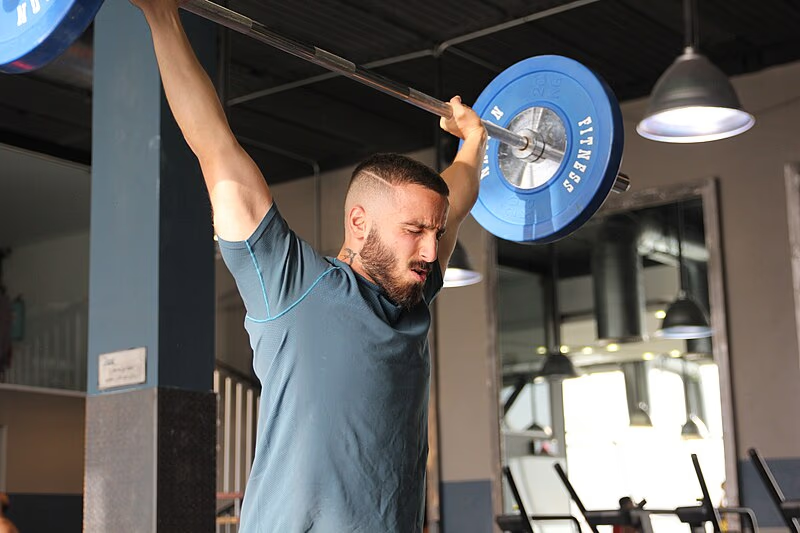
- Snatch: The barbell is lifted from the platform to overhead in one continuous, uninterrupted motion. The athlete typically receives the bar in a deep squat (squat snatch) or partial squat (power snatch) with arms fully locked overhead, then stands to full extension.
- Clean and Jerk: A two-part lift. The clean brings the barbell from the platform to the shoulders (front rack position). After standing fully, the jerk drives the barbell from the shoulders to overhead with arms locked. Common jerk variations include the split jerk (lunge stance), push jerk (straight legs), and squat jerk (full squat under the bar).
Section 2: Equipment
2.1 The Barbell
- Men's bar: Weight 20 kg (44.1 lb). Total length 220 cm (86.6 in). Shaft diameter 28 mm (1.1 in). Sleeve (collar) diameter 50 mm. Rotating sleeves with needle bearings to allow plates to spin freely during the lift.
- Women's bar: Weight 15 kg (33.1 lb). Total length 201 cm (79.1 in). Shaft diameter 25 mm (0.98 in). Same sleeve specifications as the men's bar.
- Knurl markings: Standardised grip markings on the bar shaft. Men's bars have two knurl rings at 91 cm apart; women's bars at 71 cm apart. These help athletes consistently position their grip.
2.2 Weight Plates
Competition plates are rubber-coated (bumper plates) designed for safe dropping from overhead. They are colour-coded by weight as mandated by the IWF:
- 25 kg — Red
- 20 kg — Blue
- 15 kg — Yellow
- 10 kg — Green
- 5 kg — White
- 2.5 kg, 2 kg, 1.5 kg, 1 kg, 0.5 kg — Change plates (smaller metal discs)
- Collars: 2.5 kg each, securing the plates on the sleeve
Plates must be loaded in descending order of weight from the inside out, with the heaviest plates closest to the collar of the bar. All plates must display the IWF certification stamp.
2.3 Athlete Equipment
- Weightlifting shoes: Raised heel (maximum sole height 130 mm / 5.1 in from floor, minimum 3 mm). Rigid sole for stability. Strap or lace closure.
- Singlet: One-piece competition singlet. Must not cover the elbows or extend below the knees. Team or national federation colours.
- Belt: Maximum width 120 mm (4.7 in). Must be worn outside the singlet.
- Wrist wraps: Maximum width 10 cm (3.9 in). May extend from the wrist over the hand but must not cover the full palm.
- Knee sleeves: Maximum length 30 cm (11.8 in). Must be a single, continuous piece of material. Knee wraps (winding-style) are not permitted.
- Chalk: Magnesium carbonate (gymnastic chalk) is provided and permitted for grip enhancement. No liquid chalk or alternative adhesives.
Section 3: Playing Area
3.1 Competition Platform
The competition platform is the defined lifting area:
- Dimensions: 4 m x 4 m (13.1 ft x 13.1 ft)
- Surface: Wooden or composite non-slip material, designed to absorb impact from dropped barbells. The surface must be flat, level, and free of debris.
- Elevation: At major competitions, the platform is raised on a stage for audience visibility. The stage must be at least 10 cm (3.9 in) and no more than 150 cm (59 in) above the venue floor.
- Markings: No markings are required on the platform itself, but the platform boundaries must be clearly defined.
3.2 Warm-Up Area
A separate warm-up room must be provided adjacent to the competition venue. It must contain a minimum of one warm-up platform per 3–4 athletes in the session, each equipped with a competition-standard barbell and full set of plates. A television monitor displays the competition board (current weight, athlete order, timer) so athletes can time their warm-up attempts.
3.3 Competition Stage Layout
The competition stage includes the platform, a referee panel positioned at the front (one centre referee, two side referees), a jury table behind or to the side, a scoreboard visible to athletes and spectators, a competition clock, and the athlete/coach waiting area. The loaders' area flanks the platform on both sides where IWF-certified loaders add and remove plates between attempts.
Section 4: Players & Officials
4.1 Weight Categories (2024 Olympic Programme)
The IWF periodically restructures weight categories. The 2024 Paris Olympic weight categories are:
- Men: 61 kg, 73 kg, 89 kg, 102 kg, +102 kg (5 categories)
- Women: 49 kg, 59 kg, 71 kg, 81 kg, +81 kg (5 categories)
Non-Olympic IWF World Championship categories include additional intermediate weight classes. Athletes weigh in 2 hours before their competition session. The weigh-in lasts 1 hour, and each athlete weighs in once on certified scales.
4.2 Session Structure
Athletes are divided into sessions (Group A, Group B, etc.) based on their entry total (sum of declared opening snatch + opening clean & jerk). Group A contains the strongest lifters and is the medal-deciding session. Each session typically includes 8–12 athletes and lasts approximately 2–3 hours.
4.3 Officials
- Three referees: Centre referee and two side referees. Each referee independently judges every lift, pressing a white button (good lift) or red button (no lift). A majority decision (2 of 3) determines the outcome. The "down" signal is given by the centre referee once the lift meets the criteria for completion.
- Jury: Panel of 3–5 senior officials who may overrule referee decisions if a clear and obvious error occurred. The jury reviews video replays and can reverse a good-lift decision to no-lift (or vice versa) within a limited time window.
- Technical controller: Manages the competition board, athlete order, timer, and weight changes.
- Loaders: IWF-certified loading crew (minimum 2 per side) who add and remove plates between attempts. Loading must be completed within 30 seconds.
- Timekeeper: Operates the competition clock (1-minute or 2-minute countdown).
Section 5: Rules of Play
5.1 Attempt Structure
Each athlete receives 3 attempts in the snatch and 3 attempts in the clean & jerk. The snatch is always contested first. After all athletes complete their snatch attempts, there is a 10-minute break before the clean & jerk begins. The best successful attempt from each lift is summed to produce the Total.
5.2 Weight Declaration and Changes
- Athletes declare their opening weight before the session begins (during the weigh-in period).
- The barbell is loaded progressively — weight can only increase, never decrease during a session.
- Minimum increment: 1 kg between attempts (0.5 kg increments are permitted only for record attempts).
- Athletes may change their declared weight up to 2 times per attempt, with the final change permitted no later than 30 seconds before the clock starts for that attempt.
5.3 Lifting Order
The athlete requesting the lightest weight goes first. If multiple athletes request the same weight, the athlete with the lower lot number (drawn at weigh-in) goes first. If an athlete is following themselves (back-to-back attempts), they receive 2 minutes instead of the standard 1 minute.
5.4 Time Limits
Once the athlete's name is announced and the barbell is loaded, the competition clock starts:
- Standard time: 1 minute to initiate the lift (bar must leave the platform)
- Consecutive attempts: 2 minutes if the same athlete is attempting again immediately
If the athlete fails to initiate the lift within the time limit, the attempt is declared a "no lift" and the clock resets for the next athlete.
5.5 The Snatch — Technical Requirements
- The barbell must be pulled from the platform to overhead in one continuous motion without stopping or pausing at any point.
- The athlete may squat, split, or power-receive the bar. Any receiving position is legal provided the lift is completed in one motion.
- At the finish, the athlete must stand fully upright with feet in line (parallel), arms locked overhead, and the bar motionless.
- The centre referee gives the "down" signal (audible buzz and visible light). The athlete must lower the bar under control — it may be dropped from overhead but not behind the lifter's body plane.
5.6 The Clean & Jerk — Technical Requirements
- Clean: The barbell is pulled from the platform to the shoulders. The athlete receives the bar on the shoulders/upper chest (front rack). The elbows must not touch the knees or thighs during the clean recovery. The athlete must stand fully upright before initiating the jerk.
- Jerk: From the front rack position, the athlete drives the barbell overhead using leg drive. The bar must finish with arms fully locked, feet in line, and the athlete standing motionless. Split jerk (lunging under the bar), push jerk (pressing overhead with a slight knee dip), and squat jerk are all legal.
- The "down" signal applies identically to the jerk finish as to the snatch.
Section 6: Scoring
6.1 The Total
The Total is the sum of the athlete's best successful snatch and best successful clean & jerk. The athlete with the highest Total in their weight category wins. An athlete who fails to record a valid attempt in either lift (three consecutive misses) is eliminated and receives no Total ("bombed out").
6.2 Tiebreakers
If two or more athletes achieve the same Total:
- The athlete with the lighter bodyweight at weigh-in wins.
- If bodyweight is also identical, the athlete who achieved the Total first (earlier in the session) wins.
6.3 Records
The IWF recognises three categories of records: Snatch, Clean & Jerk, and Total. Records are kept at world, Olympic, continental, and national levels. A record is valid only if the athlete passes all anti-doping controls at the competition. The IWF periodically resets records when weight categories are restructured.
6.4 Sinclair Coefficient
To compare performances across weight categories, the IWF uses the Sinclair coefficient — a mathematical formula that normalises an athlete's total relative to bodyweight. The highest Sinclair total is used to determine "pound-for-pound" rankings and for events like the IWF Grand Prix where athletes from different weight classes compete for an overall title.
Section 7: Violations & Penalties
7.1 No-Lift Infractions (Red Light)
- Press-out: The elbows visibly bend and re-extend during the overhead phase (indicates the athlete did not lock out cleanly).
- Incomplete lockout: Arms not fully extended at the finish position.
- Touch-and-go: In the clean & jerk, failing to stand fully between the clean and the jerk phase. The athlete must demonstrate a clear pause at full standing before initiating the jerk.
- Elbow-to-thigh contact: Elbows touching the knees or thighs during the clean recovery phase.
- Dropping behind: Dropping the barbell behind the body plane during or after the snatch.
- Stepping off the platform: Feet touching the floor outside the 4 m x 4 m platform boundary during the lift.
- Lowering the bar: Lowering the barbell below shoulder level before the referee's "down" signal.
- Failure to show control: The athlete is unable to hold the bar motionless in the finish position.
7.2 Procedural Violations
- Exceeding the time limit: declared a no-lift
- Requesting a weight decrease: not permitted; the athlete must take the declared weight or pass the attempt
- Improper attire: belt worn under the singlet, singlet covering elbows/knees, or non-approved equipment results in the athlete being asked to correct before attempting
7.3 Anti-Doping
Weightlifting has historically faced significant doping challenges. The IWF operates under WADA (World Anti-Doping Agency) guidelines and conducts extensive in-competition and out-of-competition testing. All medallists and randomly selected athletes are tested at every IWF event. Adverse findings result in immediate provisional suspension, result annulment, and potential multi-year bans. Nations with multiple doping violations may face reduced Olympic quota places or suspension from competition.
Section 8: Safety Considerations
8.1 Platform Safety
- The platform surface must be clean, dry, and free of chalk buildup before each session. Loaders sweep the platform between attempts as needed.
- Bumper plates are specifically designed for overhead dropping. Metal plates may not be used on the outermost position.
- Collars must be properly secured on every attempt to prevent plates from shifting during the lift.
8.2 Athlete Safety
- Athletes are trained in safe bail-out techniques for failed lifts — pushing the bar forward and stepping back during a missed snatch, or pushing the bar forward off the shoulders during a failed jerk.
- Chalk (magnesium carbonate) is provided to improve grip and prevent the bar from slipping.
- Lifting belts provide lumbar support but do not prevent injury — proper technique is the primary safety mechanism.
- Minimum competition age: 17 years for IWF senior international events. Youth and junior categories have lower weight limits and separate programming.
8.3 Medical Provisions
A qualified medical team must be present at all sanctioned competitions. Medical personnel are positioned adjacent to the competition platform. In the event of injury during an attempt, competition is halted and the athlete receives immediate attention. Common injuries include wrist sprains, shoulder impingement, and lower back strain. Concussion protocols apply if an athlete strikes their head during a failed lift.
8.4 Loading Safety
Loaders are trained and certified by the IWF. Loading must follow strict protocols: plates are loaded and removed in pairs (one per side), collars are secured before every attempt, and the bar is never left unattended with an asymmetric load. A loading chief supervises the crew and verifies the correct weight is loaded before the athlete is called.