


🏛️Official — IWF
Loading OpenSourceSports…
Stay composed after a missed lift on the platform
Throwing the bar, slamming equipment in anger, or having a visible emotional breakdown on the competition platform after a missed attempt is frowned upon. A degree of composure when leaving the platform — regardless of how critical the miss — is expected by the weightlifting community.
Never walk across a competitor's platform in the warm-up room
The lifting platform — even a practice one — is treated as the lifter's personal space during their preparation. Crossing or stepping onto another athlete's platform without permission is a significant breach, disruptive to focus and preparation ritual.
Do not celebrate a competitor's missed lift or bomb-out
When a rival misses an attempt — especially a bomb-out that ends their competition — showing visible joy, laughing, or making remarks is considered disrespectful. A neutral or sympathetic reaction is expected regardless of how significant the outcome is for your own placing.
Men's bar: Weight 20 kg (44.1 lb). Total length 220 cm (86.6 in). Shaft diameter 28 mm (1.1 in). Sleeve (collar) diameter 50 mm. Rotating sleeves with needle bearings to allow plates to spin freely during the lift.; Women's bar: Weight 15 kg (33.1 lb). Total length 201 cm (79.1 in). Shaft diamete...
Why people argue about this
People often assume that the rubber coating on competition plates is purely for aesthetic reasons, when in fact it's crucial for safety - preventing damage during handling and dropping overhead, which could lead to injury or equipment failure. The official rule emphasizes this safety aspect but some overlook the technical importance of the rubber coating.
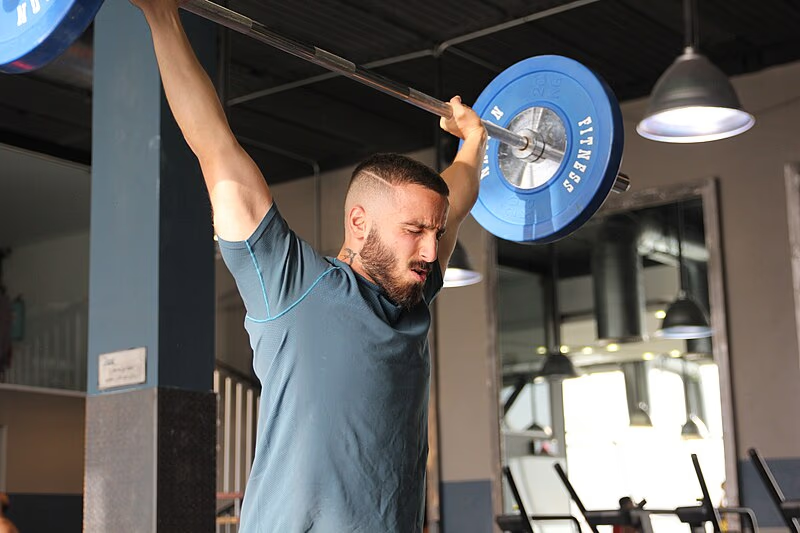
Competition plates are rubber-coated (bumper plates) designed for safe dropping from overhead.
Why people argue about this
People often assume that weight plates are rubber-coated solely for safety in lifting, forgetting that they're also used on barbells during competition to prevent damage. The confusion arises because the official purpose of these rubber coatings isn't just about protecting athletes from injury but also ensuring the integrity and longevity of equipment used in competitions.
Weightlifting shoes: Raised heel (maximum sole height 130 mm / 5.1 in from floor, minimum 3 mm). Rigid sole for stability. Strap or lace closure.; Singlet: One-piece competition singlet. Must not cover the elbows or extend below the knees. Team or national federation colours.; Belt: Maximum width...
Why people argue about this
People often assume that rubber-coated weight plates are optional safety features, when in fact they're a mandatory requirement specified by IWF for all competitions. The confusion arises because many athletes initially overlook or misinterpret this detail as an extra precaution rather than a strict rule enforced to ensure uniform safety standards across the board.
The competition platform is the defined lifting area: Dimensions: 4 m x 4 m (13.1 ft x 13.1 ft); Surface: Wooden or composite non-slip material, designed to absorb impact from dropped barbells. The surface must be flat, level, and free of debris.; Elevation: At major competitions, the platform is...
Why people argue about this
People often assume that the competition platform is just a designated area where athletes lift weights, forgetting that it's also crucial for ensuring fair judging conditions like level surfaces and consistent measurement points. The confusion arises because they overlook how precise measurements and standardized conditions are essential for accurate scoring in weightlifting.
A separate warm-up room must be provided adjacent to the competition venue. It must contain a minimum of one warm-up platform per 3–4 athletes in the session, each equipped with a competition-standard barbell and full set of plates.
Why people argue about this
People often assume that just any warm-up area will do as long as it's near the competition venue, forgetting about the crucial detail of having a dedicated platform per 3-4 athletes equipped with standard equipment. The confusion arises because they overlook the specific requirement for each athlete to have their own space and proper gear during practice sessions.
The competition stage includes the platform, a referee panel positioned at the front (one centre referee, two side referees), a jury table behind or to the side, a scoreboard visible to athletes an...
Why people argue about this
People often assume that the exact layout of the competition stage is rigidly defined by the IWF, leading to misunderstandings about what exactly constitutes a "valid" setup for an official weightlifting competition. However, the rule only specifies general positions and visibility requirements without detailing every specific element's precise placement or arrangement.
The IWF periodically restructures weight categories. The 2024 Paris Olympic weight categories are: Men: 61 kg, 73 kg, 89 kg, 102 kg, +102 kg (5 categories); Women: 49 kg, 59 kg, 71 kg, 81 kg, +81 kg (5 categories)
Why people argue about this
People often assume that athletes are randomly assigned to sessions based solely on their weight class, forgetting that their session is determined by their total score from attempting both lifts (snatch and clean & jerk). The confusion arises because they overlook how their performance in key attempts can significantly impact which session they're placed into.
) based on their entry total (sum of declared opening snatch + opening clean & jerk). Group A contains the strongest lifters and is the medal-deciding session.
Why people argue about this
People think that the session division is solely based on their best single attempt (the highest lift they've ever done), but actually, it's determined by their total for the opening attempts in each event (snatch and clean & jerk). This often leads to confusion because athletes might have a strongest single effort in one event but not necessarily in both.
Three referees: Centre referee and two side referees. Each referee independently judges every lift, pressing a white button (good lift) or red button (no lift). A majority decision (2 of 3) determines the outcome. The "down" signal is given by the centre referee once the lift meets the criteria f...
Why people argue about this
People often assume that if they're within 2 hours of their session, they can weigh in whenever they want, without regard for when they step on the scale. But actually, the rule specifies they must weigh in on certified scales within 2 hours of their designated session start time, not just any 2-hour window before.
Each athlete receives 3 attempts in the snatch and 3 attempts in the clean & jerk. The snatch is always contested first.
Why people argue about this
People often assume that athletes get 6 attempts total between snatch and clean & jerk, with equal splits for each lift. But actually, they receive 3 attempts at each lift (snatch first) regardless of order or total number of lifts, which can lead to confusion about how many attempts are available in the second round if they don't succeed in the first.
Athletes declare their opening weight before the session begins (during the weigh-in period).; The barbell is loaded progressively — weight can only increase, never decrease during a session.; Minimum increment: 1 kg between attempts (0.5 kg increments are permitted only for record attempts).
Why people argue about this
People often assume that weight declaration order is randomly assigned at the start of competition, forgetting that it's based on a predetermined draw from lot numbers taken during weigh-ins, leading to confusion about who gets to choose their weight first.
The athlete requesting the lightest weight goes first. If multiple athletes request the same weight, the athlete with the lower lot number (drawn at weigh-in) goes first.
Why people argue about this
People often assume that weight is the only factor considered in lifting order, so they argue about which athlete should lift first based solely on their chosen competition weights. However, the actual rule specifies that lot numbers also play a role when athletes have selected the same weight class, leading to confusion and disputes over who gets the coveted early-lift advantage.
Once the athlete's name is announced and the barbell is loaded, the competition clock starts: Standard time: 1 minute to initiate the lift (bar must leave the platform); Consecutive attempts: 2 minutes if the same athlete is attempting again immediately
Why people argue about this
People often assume that once their name is called out and they've loaded the barbell, the clock starts ticking immediately, but actually, it only begins when the official gives the command "Go," ensuring everyone understands the race to start together.
The barbell must be pulled from the platform to overhead in one continuous motion without stopping or pausing at any point.; The athlete may squat, split, or power-receive the bar. Any receiving position is legal provided the lift is completed in one motion.; At the finish, the athlete must stand...
Why people argue about this
People often assume that a 10-minute break applies between each individual snatch attempt for an athlete, rather than recognizing it as a collective time limit for all snatch attempts combined from both athletes in a competition session. The confusion arises because the rule doesn't specify per-attempt breaks but instead refers to the entire sequence of snatch attempts across all competitors.
Clean: The barbell is pulled from the platform to the shoulders. The athlete receives the bar on the shoulders/upper chest (front rack). The elbows must not touch the knees or thighs during the clean recovery. The athlete must stand fully upright before initiating the jerk.; Jerk: From the front ...
Why people argue about this
People often assume that a single successful Clean & Jerk attempt is enough for calculating their total score, forgetting that both lifts are assessed separately according to technical requirements. The confusion arises because they overlook the fact that each lift must meet specific criteria before being considered in the final Total calculation.
The Total is the sum of the athlete's best successful snatch and best successful clean & jerk. The athlete with the highest Total in their weight category wins.
Why people argue about this
People think they can just focus solely on their snatch performance for maximum points, forgetting that their clean & jerk attempt is equally crucial as it contributes directly to their Total score. The confusion arises because both attempts are weighted equally in determining who wins, not just prioritizing the snatch over the clean & jerk.
If two or more athletes achieve the same Total: The athlete with the lighter bodyweight at weigh-in wins.; If bodyweight is also identical, the athlete who achieved the Total first (earlier in the session) wins.
Why people argue about this
People often assume that a tiebreaker system exists for deciding who wins in cases of identical total scores, forgetting that it's only applied if individuals have different snatch or clean & jerk totals. They overlook the fact that within those categories, there are no tiebreakers - each athlete gets one shot to improve their best lift and the highest score among them decides the winner.
The IWF recognises three categories of records: Snatch, Clean & Jerk, and Total. Records are kept at world, Olympic, continental, and national levels.
Why people argue about this
People often assume that only top-tier athletes can set records in weightlifting, thinking it's limited to Olympic-level competition when in fact, IWF recognizes records at world, continental, and national levels as well. The confusion arises because they focus solely on the Olympic level without considering these broader categories.
To compare performances across weight categories, the IWF uses the Sinclair coefficient — a mathematical formula that normalises an athlete's total relative to bodyweight. The highest Sinclair total is used to determine "pound-for-pound" rankings ...
Why people argue about this
People often assume that the Sinclair Coefficient is a measure of strength itself, when in reality it's used as a normalization tool to compare performances across different weight categories, thus reflecting how an athlete stacks up relative to their bodyweight rather than absolute strength levels.
Press-out: The elbows visibly bend and re-extend during the overhead phase (indicates the athlete did not lock out cleanly).; Incomplete lockout: Arms not fully extended at the finish position.; Touch-and-go: In the clean & jerk, failing to stand fully between the clean and the jerk phase. The at...
Why people argue about this
People often assume that the "7.1 No-Lift Infractions (Red Light)" rule is strictly about lifting weights too quickly during a competition, but actually it refers to spotting errors where an official incorrectly signals for a lifter to lift when they shouldn't, leading to potential doping violations if the athlete takes advantage of this mistake by using performance-enhancing drugs.
Exceeding the time limit: declared a no-lift; Requesting a weight decrease: not permitted; the athlete must take the declared weight or pass the attempt; Improper attire: belt worn under the singlet, singlet covering elbows/knees, or non-approved equipment results in the athlete being asked to co...
Why people argue about this
People often assume that since weightlifting is a clean sport with stringent testing protocols, procedural violations are rare. But in reality, they misunderstand that these violations can stem from misinterpretation of rules or oversight during procedures, leading to doping incidents that WADA and the IWF work tirelessly to detect and address.
Weightlifting has historically faced significant doping challenges. The IWF operates under WADA (World Anti-Doping Agency) guidelines and conducts extensive in-competition and out-of-competition testing.
Why people argue about this
People think that anti-doping rules are only about performance-enhancing drugs (PEDs), but actually, they cover a much broader spectrum including substances that can affect mood or energy levels, like certain supplements, which athletes often overlook and use without realizing it violates the rule.
The platform surface must be clean, dry, and free of chalk buildup before each session. Loaders sweep the platform between attempts as needed.; Bumper plates are specifically designed for overhead dropping. Metal plates may not be used on the outermost position.; Collars must be properly secured ...
Why people argue about this
People often assume that just having a medical team nearby is enough, but in fact, the official rule requires them to be qualified and positioned right next to the platform where athletes compete, which can lead to misunderstandings about their actual role and presence at competitions.
Athletes are trained in safe bail-out techniques for failed lifts — pushing the bar forward and stepping back during a missed snatch, or pushing the bar forward off the shoulders during a failed jerk.; Chalk (magnesium carbonate) is provided to improve grip and prevent the bar from slipping.; Lif...
Why people argue about this
People often assume that just having a medical team nearby is enough, but in weightlifting, they misunderstand that these medical personnel must be actively involved and positioned right next to the competition platform where athletes are performing, ensuring immediate access if an athlete needs emergency care during their lift.
A qualified medical team must be present at all sanctioned competitions. Medical personnel are positioned adjacent to the competition platform.
Why people argue about this
People often assume that just having a medical team present is enough under Rule 8.3, but in reality, they need to be positioned right next to the competition platform where athletes are performing, ready to intervene if needed during their lifts. This rule's specificity about location can lead to misunderstandings of its application and necessity.
Loaders are trained and certified by the IWF. Loading must follow strict protocols: plates are loaded and removed in pairs (one per side), collars are secured before every attempt, and the bar is never left unattended with an asymmetric load.
Why people argue about this
People often assume that loading safety only applies during competition when it's a daily routine for weightlifters. They misunderstand the strict protocols like plates being loaded in pairs or collars secured before every attempt as unnecessary because they think these are just extra steps, not critical to ensuring safety throughout their training sessions.
Competition plates are rubber-coated (bumper plates) designed for safe dropping from overhead.
Why people argue about this
People often assume that competition plates must be made of rubber solely for safety reasons, forgetting that the official reason is also to allow safe dropping from overhead, which isn't necessarily about preventing injury but ensuring a smooth and controlled drop during lifts.
The competition platform is the defined lifting area: Dimensions: 4 m x 4 m (13.1 ft x 13.1 ft); Surface: Wooden or composite non-slip material, designed to absorb impact from dropped barbells. The surface must be flat, level, and free of debris.; Elevation: At major competitions, the platform is...
Why people argue about this
People often assume that anything outside of the designated competition platform is fair game for lifting, mistaking it as a free-for-all area where they can experiment with different techniques or weights. But in reality, the official verdict clearly states that only what's within the defined lifting area is allowed, leaving no room for such misunderstandings and arguments about boundary lines.
The IWF periodically restructures weight categories. The 2024 Paris Olympic weight categories are: Men: 61 kg, 73 kg, 89 kg, 102 kg, +102 kg (5 categories); Women: 49 kg, 59 kg, 71 kg, 81 kg, +81 kg (5 categories); Three referees: Centre referee and two side referees. Each referee independently j...
Why people argue about this
People often think that athletes are randomly assigned to sessions based on their total weight lifted, which can lead to unfair advantages since they might end up with heavier competitors in one session or lighter ones in another. But actually, it's calculated by adding up their declared opening snatch and clean & jerk totals, ensuring a fair comparison across different lifts.
Each athlete receives 3 attempts in the snatch and 3 attempts in the clean & jerk. The snatch is always contested first.
Why people argue about this
People often assume that athletes get 3 attempts in clean & jerk before they have a chance at snatch, which leads to misunderstanding of the official order: actually, each athlete starts with 3 attempts for the snatch first, then moves on to the clean & jerk. This reversal can cause confusion and disputes among officials and spectators alike.
The Total is the sum of the athlete's best successful snatch and best successful clean & jerk. The athlete with the highest Total in their weight category wins.
Why people argue about this
People often assume that an athlete's best total is solely based on their snatch performance, forgetting they can also achieve a high score with a strong clean & jerk, leading them to overlook this crucial aspect of scoring in weightlifting.
Weightlifting has historically faced significant doping challenges. The IWF operates under WADA (World Anti-Doping Agency) guidelines and conducts extensive in-competition and out-of-competition testing.
Why people argue about this
People often assume that since weightlifting is a clean sport, there shouldn't be as many doping issues compared to others like cycling. But actually, they overlook the fact that even in sports where performance enhancement isn’t as prevalent, athletes can still find ways to cheat, and WADA guidelines require thorough testing regardless of perceived integrity.
A qualified medical team must be present at all sanctioned competitions. Medical personnel are positioned adjacent to the competition platform.
Why people argue about this
People often assume that just having medical personnel nearby is enough, but in fact, the official rule requires a fully qualified medical team present at all competitions, indicating they have the expertise and resources to handle emergencies effectively.