
















Section 1: Introduction
1.1 Overview and Governing Body
Breaking is a dynamic dance form rooted in hip-hop culture, characterized by athletic movement, rhythmic interpretation, and individual expression. The sport is governed internationally by the World DanceSport Federation (WDSF), which administers competition rules, judging standards, and athlete eligibility for all sanctioned breaking events worldwide. WDSF was recognized by the International Olympic Committee (IOC) as the international federation responsible for breaking's inclusion in the Olympic programme.
1.2 Olympic Debut
Breaking made its historic Olympic debut at the 2024 Paris Games, contested at Place de la Concorde as part of the urban sports cluster. The Olympic programme featured two medal events — B-Boys (men) and B-Girls (women) — each with 16 athletes competing in a head-to-head battle format. The inclusion of breaking represented a landmark moment for hip-hop culture and street dance on the global stage. Breaking was not included in the 2028 Los Angeles programme but remains eligible for future Olympic Games.
1.3 History and Culture
Breaking originated in the early 1970s in the South Bronx, New York City, as one of the four foundational elements of hip-hop culture alongside DJing, MCing (rapping), and graffiti writing. Pioneers such as DJ Kool Herc, who extended musical breakbeats, and early crews like the Rock Steady Crew and New York City Breakers established the movement vocabulary and competitive battle tradition. Breaking spread globally through the 1980s, evolving distinct regional styles in Korea, Japan, France, Brazil, and across Europe. The competitive circuit formalized through events such as Battle of the Year, Red Bull BC One, and the WDSF Breaking for Gold series.
1.4 Competition Tiers
WDSF oversees a structured competition pathway for breaking athletes:
- Olympic Games: Highest level, 16 athletes per event (B-Boys, B-Girls)
- World Championships: Annual WDSF World Breaking Championships
- Continental Championships: Regional qualifying events (European, Pan American, Asian, African, Oceanian)
- WDSF Breaking for Gold Series: International events awarding Olympic qualification ranking points
- National Championships: Domestic competitions governed by WDSF member national federations
Section 2: Equipment
2.1 Dance Floor Surface
The competition floor must be a smooth, flat, non-slip surface suitable for dynamic movement. WDSF-approved floor materials include vinyl sport flooring, polished hardwood, or specialized dance surface overlays. The floor must provide consistent grip and controlled slide characteristics across its entire area. Joints or seams in modular flooring must be flush and securely fastened to prevent tripping hazards.
2.2 Footwear
Athletes must wear athletic footwear appropriate for breaking. Sneakers with flat, non-marking rubber soles are standard. Footwear must be clean and free of debris that could damage the floor surface. Shoes with exposed metal components (such as steel-toed boots or cleats) are prohibited. Athletes may not compete barefoot. Footwear must be securely fastened and may not come off during a round — a shoe loss during a throwdown does not halt the round but may affect the athlete's performance score.
2.3 Clothing and Appearance
Athletes may wear clothing that reflects their personal style and cultural identity, consistent with breaking's expressive tradition. However, the following restrictions apply:
- Clothing must not contain offensive, discriminatory, or political messaging
- No sharp, hard, or protruding accessories (buckles, chains, spikes, rings, or jewelry that could cause injury)
- Headwear (hats, beanies, bandanas) is permitted provided it does not obstruct the view of judges or pose a safety risk
- Athletes must display their competition bib number clearly and visibly at all times during battles
- Gloves are permitted but must not extend beyond the wrist
- Knee pads, elbow pads, and wrist guards are permitted at the athlete's discretion
2.4 Prohibited Items
Athletes may not bring props, objects, or external devices into the battle area. This includes but is not limited to flags, signs, electronic devices, and any item thrown or placed on the floor during a round. Violation results in a warning or disqualification at the head judge's discretion.
Section 3: Playing Area
3.1 Stage Dimensions
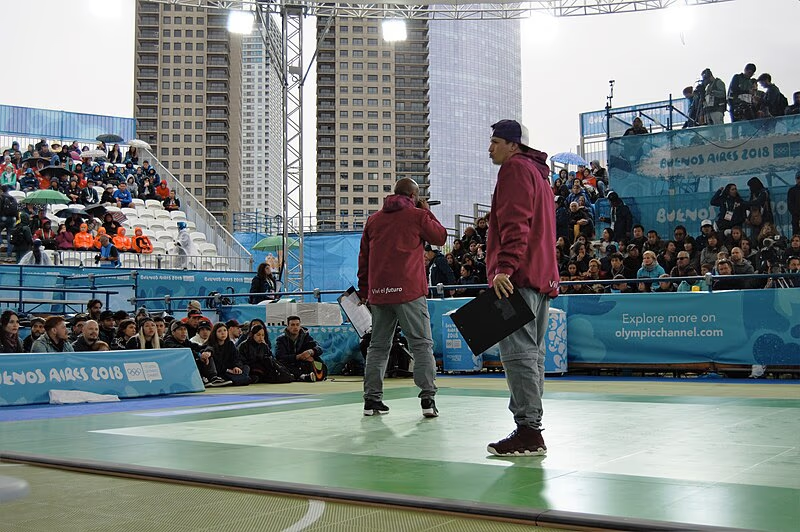
The competition battle area (also called the "cypher" or "stage") must be a clearly defined space measuring a minimum of 7 metres × 7 metres for international WDSF events and Olympic competition. For lower-tier national events, a minimum of 6 metres × 6 metres is acceptable. The battle area must be marked with visible boundary lines or tape that contrast with the floor surface. Athletes must remain within the designated area during their throwdowns.
3.2 Floor Surface Requirements
The floor must be level (maximum 2mm deviation per metre), free of debris, moisture, and irregularities. It must support dynamic movements including head spins, windmills, air flares, and power moves without excessive friction burn or uncontrolled sliding. The floor must be inspected and cleaned between sessions. Temperature and humidity should be controlled to prevent condensation or surface changes during competition. For outdoor venues, a covered stage with weather protection is mandatory.
3.3 DJ Booth
A DJ booth must be positioned adjacent to the battle area with clear sightlines to the stage. The DJ must have professional-grade audio equipment capable of delivering consistent, high-quality sound throughout the venue. The sound system must cover a frequency range suitable for hip-hop, funk, and breakbeat music (sub-bass through high frequencies). Volume levels must be sufficient for athletes to clearly hear musical cues and rhythmic patterns without causing hearing damage to spectators or officials.
3.4 Lighting and Venue Setup
The battle area must be illuminated uniformly with minimum 500 lux intensity to ensure all judges can clearly observe athlete movements. Lighting must not produce glare on the floor surface or cast distracting shadows. Stroboscopic or rapidly flashing lighting effects are prohibited during active battles. The judges' panel must be positioned along one side of the battle area with an unobstructed view. Spectator seating or standing areas must be separated from the battle area by a minimum 2-metre buffer zone.
Section 4: Players & Officials
4.1 Athletes (B-Boys and B-Girls)
Competitors in breaking are referred to as B-Boys (male) and B-Girls (female). Athletes compete individually in 1v1 battles. Each athlete must be registered with their national federation and hold a valid WDSF athlete license for international competition. Athletes must pass any required anti-doping controls administered by WADA or the relevant national anti-doping agency. Minimum age for WDSF senior international competition is 16 years.
4.2 Judging Panel
WDSF breaking competitions at the Olympic and World Championship level use a panel of nine (9) judges. Judges are certified through the WDSF Breaking Adjudication Programme and must demonstrate expertise in breaking culture, movement vocabulary, and competitive evaluation. The judging panel is arranged to provide multiple viewing angles of the battle area. Each judge independently evaluates the athletes using the Trivium judging system. The highest and lowest scores are dropped, and the remaining seven scores determine the round winner. Judges must declare any conflicts of interest (e.g., coaching relationships) and may be recused at the head judge's discretion.
4.3 Head Judge
The head judge oversees the judging panel, resolves disputes, and ensures the integrity of the adjudication process. The head judge does not score battles but has authority to overrule procedural violations, issue warnings, and refer matters to the WDSF Disciplinary Panel. In the event of a tied score after the standard judging process, the head judge casts the deciding vote.
4.4 MC (Master of Ceremonies)
The MC manages the flow of the competition, introduces athletes, announces round results, and maintains the energy and atmosphere of the event. The MC must remain neutral, avoid commentary that could influence judges, and follow the official event script. The MC coordinates with the DJ and head judge on timing and event progression.
4.5 DJ
The DJ selects and plays music for all battles. Music selection is at the DJ's creative discretion but must be drawn from genres rooted in breaking culture — primarily hip-hop, funk, breakbeat, and soul. The DJ must not play tracks that give an unfair advantage to any specific athlete (e.g., a known signature track). The DJ controls the start and end of each round's music and must maintain consistent tempo and energy appropriate to the battle's progression.
Section 5: Rules of Play
5.1 Battle Format
Breaking competitions use a 1v1 head-to-head battle format. Two athletes face each other across multiple rounds, alternating throwdowns (solo dance sets). The athlete who wins the majority of rounds advances. At the Olympic level, preliminary rounds consist of best-of-one battles (round robin), while knockout rounds from the quarterfinals onward are best-of-three.
5.2 Throwdowns and Round Structure
Each round consists of alternating throwdowns. A throwdown is a single continuous performance by one athlete. During a throwdown, the athlete enters the battle area and performs a set of movements. A standard round consists of two throwdowns per athlete (one each, alternating). The athlete who goes first is determined by a coin toss or the MC's direction for the opening round; the order alternates in subsequent rounds.
5.3 Time Limits
Each throwdown is limited to 60 seconds maximum. The DJ provides the musical framework, and the athlete must complete their set within the allotted time. A visible countdown timer or an audible signal (provided by the DJ fading the music) indicates the approaching time limit. Athletes who significantly exceed the time limit receive a warning; repeated time violations may result in a score deduction or round forfeiture at the head judge's discretion.
5.4 Music and Rhythm
The DJ plays continuous music throughout each round. Athletes do not choose their own music — they must adapt to whatever the DJ plays in real time. This tests musicality, adaptability, and the ability to interpret unfamiliar tracks. The DJ may change tracks between throwdowns within a round. The tempo typically ranges from 100 to 130 BPM, though the DJ has creative freedom within breaking-appropriate genres.
5.5 Competition Progression
The Olympic competition structure proceeds as follows:
- Round Robin: 16 athletes divided into four groups of four, each athlete battles every other group member (best-of-one rounds). Top two from each group advance.
- Quarterfinals: Eight athletes in best-of-three battles
- Semifinals: Four athletes in best-of-three battles
- Final: Two athletes in a best-of-three battle for gold and silver; losing semifinalists receive bronze (no bronze medal match)
A battle is won by the athlete who wins the majority of rounds as determined by the aggregate judging panel scores.
Section 6: Scoring
6.1 The Trivium Judging System
WDSF uses the Trivium judging system for all sanctioned breaking competitions. Each judge evaluates athletes across two complementary dimensions, each containing three criteria. The system is designed to balance athletic execution with artistic expression and cultural authenticity.
6.2 Physical Dimension
The physical dimension evaluates the tangible, observable elements of the performance:
- Technique: The quality of movement execution, including control, precision, form, balance, and physical difficulty. Clean landings, smooth transitions, and mastery of foundational and advanced moves are assessed.
- Vocabulary: The breadth and depth of the athlete's movement repertoire. This includes toprock (standing dance), footwork (floor-level legwork), power moves (acrobatic spins and rotations), freezes (held positions), and transitions between these categories.
- Execution: The overall delivery and completeness of the throwdown. This encompasses the athlete's confidence, composure under pressure, and ability to recover from mistakes without losing momentum.
6.3 Artistic Dimension
The artistic dimension evaluates the interpretive and creative qualities of the performance:
- Musicality: The athlete's ability to interpret, respond to, and ride the music. This includes hitting beats, accenting musical phrases, adapting to tempo changes, and demonstrating rhythmic sensitivity beyond simply moving on the beat.
- Originality: The uniqueness and personal signature of the athlete's style. Judges reward distinctive movement vocabulary, creative concepts, and innovation. Copying or "biting" another athlete's signature moves is penalized.
- Creativity: The inventiveness of transitions, combinations, and overall set composition. This includes unexpected movement choices, risk-taking, and the ability to create visually and kinetically surprising moments.
6.4 Score Aggregation
Each judge determines a round winner based on their holistic assessment across all six criteria. Judges do not assign numerical scores to individual criteria — they render a binary decision selecting the winner of each round. The nine judges' decisions are collected, the highest and lowest outliers are dropped, and the remaining seven votes determine the round winner by simple majority. In the event of a systematic tie across rounds, the head judge casts the deciding vote.
The Trivium system ensures that breaking is judged as both an athletic discipline and an art form, honoring the sport's cultural heritage.
Section 7: Violations & Penalties
7.1 Physical Contact (Crashing)
Deliberate physical contact with an opponent is strictly prohibited. This includes pushing, shoving, grabbing, or any aggressive physical gesture directed at the opposing athlete. Incidental contact during transitions (e.g., brushing past each other when entering or exiting the battle area) is not penalized. Deliberate crashing results in an immediate warning for the first offense and disqualification for a second offense within the same battle.
7.2 Exceeding Time Limits
Athletes must complete their throwdown within the allotted 60-second window. The first minor time overage (up to 5 seconds) results in a verbal warning from the head judge. Exceeding the time limit by more than 5 seconds or repeated minor overages result in the round being awarded to the opponent. Deliberately extending a throwdown to deny the opponent their turn is treated as unsportsmanlike conduct.
7.3 Unsportsmanlike Conduct
The following behaviors constitute unsportsmanlike conduct and may result in warnings, score penalties, or disqualification:
- Verbal abuse, taunting, or threatening gestures directed at the opponent, judges, or officials
- Deliberately disrupting the opponent's throwdown (entering the battle area during their set, making distracting noises)
- Refusing to battle or deliberately performing a minimal effort throwdown to manipulate tournament brackets
- Displaying offensive symbols, gestures, or language
- Damaging the floor surface or venue equipment
7.4 Interference and External Assistance
Athletes must compete independently. Receiving coaching instructions, verbal cues, or signals from crew members, coaches, or spectators during an active round is prohibited. The use of in-ear audio devices or communication equipment is prohibited during battles. Athletes found receiving external assistance may have the affected round voided or be disqualified from the event at the head judge's discretion.
7.5 Penalty Escalation
WDSF applies a progressive penalty system: verbal warning, formal caution (recorded), round forfeiture, and disqualification. The head judge determines the appropriate penalty level based on the severity and intent of the violation. All formal cautions and disqualifications are reported to WDSF and may affect the athlete's ranking and future event eligibility.
Section 8: Safety Considerations
8.1 Warm-Up Requirements
Athletes must be provided with a dedicated warm-up area separate from the competition stage. The warm-up area must have appropriate flooring (not concrete or hard tile) and sufficient space for athletes to prepare safely. A minimum 30-minute warm-up period must be scheduled before the start of competition each day. Athletes are responsible for their own physical preparation, but event organizers must ensure the warm-up environment supports safe practice of dynamic movements.
8.2 Injury Protocols
A qualified medical team must be present on-site throughout practice sessions and competition. The medical team must include personnel experienced in treating musculoskeletal injuries common in breaking, including sprains, fractures, wrist injuries, and head/neck trauma. If an athlete sustains an injury during a battle, the head judge may pause the round to allow medical assessment. An athlete cleared to continue resumes the battle; an athlete unable to continue forfeits the remaining rounds. Any suspected head or spinal injury requires immediate withdrawal and medical clearance under return-to-play concussion protocols before the athlete may compete again.
8.3 Floor Safety
The competition floor must be inspected before each session for moisture, debris, loose panels, or surface damage. Cleaning supplies and a floor maintenance crew must be available to address spills or surface issues immediately. The floor surface must provide adequate friction for head spins and back spins without causing friction burns — athletes may apply rosin or approved grip products to their hands. Liquid substances (water, sweat towels) must not be placed on or near the battle area during active rounds.
8.4 Hydration and Environmental Safety
Athletes must have access to water and hydration stations at all times, including during the competition. For outdoor venues or indoor venues without climate control, the following environmental thresholds apply:
- Temperatures exceeding 35°C (95°F): mandatory cooling breaks every 60 minutes, shade structures required
- Temperatures below 10°C (50°F): extended warm-up periods required, floor surface must be verified for condensation
- Humidity exceeding 80%: floor must be monitored and dried continuously to prevent slipping
- Outdoor events must have contingency plans for rain, wind, and lightning (competition suspended during active lightning within 10 km)
8.5 Athlete Welfare
- Athletes may withdraw from any battle at any time without disciplinary penalty (the battle is forfeited to the opponent)
- Competition schedules must include adequate rest periods between an athlete's battles (minimum 20 minutes between consecutive battles)
- Mental health support resources should be available to athletes throughout the event
- Anti-doping controls are conducted in accordance with WADA regulations; athletes must comply with all testing requirements