Section 1: Introduction
1.1 Overview and Governing Body
Water polo is one of the oldest Olympic team sports, with men's competition debuting at the 1900 Paris Games and women's added at the 2000 Sydney Games. Governed by World Aquatics (formerly FINA) under the World Aquatics Water Polo Rules (WP 1–WP 22), the sport is played between two teams of seven players in a pool. Often described as one of the most physically demanding team sports in existence, water polo combines swimming endurance, ball-handling skill, tactical awareness, and physical contact in a continuous aquatic environment.
1.2 History and Olympic Status
Water polo originated in late 19th-century Britain as an aquatic form of rugby. The sport was included in the second modern Olympics (Paris, 1900) and has appeared at every Summer Games since. Women's water polo gained Olympic status a century later at Sydney 2000. Hungary holds the most Olympic gold medals in men's water polo, while the United States has dominated the women's event in recent cycles. The sport is played professionally in leagues across Europe, with Italy, Spain, Greece, Croatia, Montenegro, and Serbia maintaining top-tier domestic competitions.
1.3 World Aquatics Structure
World Aquatics, headquartered in Lausanne, Switzerland, oversees all aquatic disciplines including swimming, diving, artistic swimming, open-water swimming, high diving, and water polo. The Water Polo Technical Committee (WPTC) develops and updates the rules, which are revised on a four-year Olympic cycle. Continental federations (LEN for Europe, UANA for the Americas, etc.) administer regional competitions under World Aquatics rules.
Section 2: Equipment
2.1 The Ball
- Men's ball: Circumference 68–71 cm (26.8–28 in), weight 400–450 g (14.1–15.9 oz)
- Women's ball: Circumference 65–67 cm (25.6–26.4 in), weight 350–400 g (12.3–14.1 oz)
- Waterproof, non-absorbent outer surface with a textured grip coating
- Inflated to 90–97 kPa (13–14 psi), must float when released
- Typically bright yellow for visibility; contrasting color to cap colors
- Ball approved and stamped by World Aquatics for international competition (WP Rule 3)
2.2 Caps and Numbering
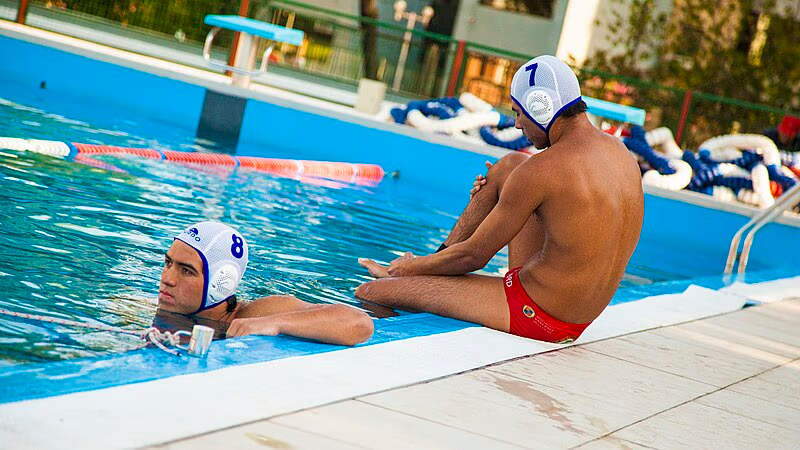
- Each team wears distinctly colored caps: one team wears white, the other dark blue (or contrasting dark color)
- Goalkeepers wear red caps, numbered #1 (starting goalkeeper) or #13 (reserve goalkeeper)
- Field players numbered 2–13 (excluding 1 and 13 for non-goalkeepers)
- Caps fitted with integrated ear guards to protect against impact and facilitate hearing the referee
- Caps secured by chin straps; cap must be worn at all times during play
- Numbers must be at least 10 cm (3.9 in) high, printed on both sides of the cap
2.3 Goals
- Width: 3 m (9.84 ft) between the inner edges of the goalposts
- Crossbar underside: 0.90 m (2.95 ft) above the water surface when water depth is 1.50 m (4.92 ft) or more; 2.40 m (7.87 ft) from the bottom when depth is less than 1.50 m
- Goals may be rigid (anchored to the pool deck or wall) or floating (secured to prevent movement)
- Net must be attached to the goal frame and extend at least 0.30 m (1 ft) behind the goal line
- Goalposts and crossbar painted white; contrasting markings not permitted
2.4 Additional Equipment
- Swimwear: Non-transparent, one-piece or two-piece swimsuit (no body suits extending past shoulders or knees)
- Mouthguards: Recommended but not mandatory under World Aquatics rules
- No jewelry, watches, or hard accessories permitted
- Fingernails must be trimmed short; referees inspect before each match
- Goalkeepers may wear a face mask at their discretion (no competitive advantage permitted)
Section 3: Playing Area
3.1 Pool Dimensions
- Men’s field: 30 m × 20 m (98.4 ft × 65.6 ft) for FINA/World Aquatics and Olympic competitions
- Women’s field: 25 m × 20 m (82 ft × 65.6 ft) for FINA/World Aquatics and Olympic competitions
- Domestic and junior competitions may use shorter fields (minimum 20 m × 10 m)
- Minimum water depth: 1.80 m (5.9 ft); preferably 2.0 m (6.6 ft) or deeper — players must not touch or push off the bottom at any time
- Water temperature: 25–27 °C (77–81 °F) for international competition
3.2 Lane and Distance Markings
- 2 m line (red/red markers): Marks the zone in front of each goal; ordinary fouls by the attacking team inside this area result in a free throw at the 2 m line
- 5 m line (yellow markers): Penalty throw line; also defines the zone where exclusion fouls that prevent probable goals are upgraded to penalty throws
- 6 m line: Direct free-throw line used for certain restart situations
- Half-distance line (white): Center of the field; used for restarts after goals and at the beginning of each period
- Re-entry area: Marked on each side of the pool near the goal lines, where excluded players re-enter after serving their exclusion or when possession changes
3.3 Timing and Scoreboard Equipment
- Visible shot clock (30-second countdown) displayed on both sides of the pool
- Game clock showing actual playing time per period
- Electronic scoreboard visible to teams, officials, and spectators
- Buzzer or audible signal system for shot clock expiration, period end, and timeout signals
Section 4: Players & Officials
4.1 Team Composition
- In the water: 7 players per team (6 field players + 1 goalkeeper)
- Roster: Maximum 13 players per team (11 field players + 2 goalkeepers)
- A team must have at least 7 players to start a match
- One designated team captain per side, identified by a captain's armband or cap marking
4.2 Substitutions
- Unlimited substitutions permitted, but only from the re-entry area during a dead-ball situation or after a goal
- Flying substitutions (during play) allowed only at the re-entry area; the departing player must fully leave the water before the substitute enters
- Goalkeeper-to-goalkeeper substitution: the replacement goalkeeper must wear a red cap
- Improper substitution (entering before the departing player exits) results in an exclusion foul
4.3 Player Positions and Roles
- Center forward (hole set / 2-meter player): Positions directly in front of the opposing goal at the 2 m line; primary target for entry passes
- Center back (hole-D): Defends the center forward; physical, pressing defense
- Wings: Position at the sides of the attacking formation; drive and shoot from angles
- Drivers (flats/points): Perimeter players who create motion offense through driving toward the goal
- Goalkeeper: Special privileges within 5 m of own goal (may use two hands, punch the ball)
4.4 Officials
- 2 referees: One on each side of the pool; share equal authority; signal fouls with whistle and hand signals
- 2 goal judges: Positioned behind each goal; signal goals, corner throws, and goal throws
- Timekeeper: Operates the game clock, records exclusion times
- Secretary: Records goals scored, personal fouls, and exclusions for each player
- Shot-clock operator: Manages the 30-second possession clock; resets on change of possession or reset events
Section 5: Rules of Play
5.1 Match Duration and Periods
- 4 periods of 8 minutes actual playing time (clock stops on every whistle)
- 2-minute interval between the first and second periods and between the third and fourth periods
- 5-minute interval at halftime (between the second and third periods); teams switch ends
- Overtime (if tied): two 3-minute periods of actual play with a 3-minute interval; if still tied, penalty shootout
- Penalty shootout: 5 alternating penalty throws per team; sudden-death if still level
5.2 Ball Handling
- Field players may touch the ball with only one hand at a time (except the goalkeeper)
- Goalkeeper may use two hands on the ball within the 5 m area of their own goal
- The ball may not be pushed underwater by any player — this is an ordinary foul
- A player may not hold the ball underwater when tackled — turnover foul
- Players may dribble the ball (push it ahead while swimming), pass to teammates, or shoot at goal
- A player may not take the ball under the water surface to avoid an opponent
5.3 Shot Clock and Possession
- 30-second shot clock: The attacking team must attempt a shot that contacts the goal frame (posts, crossbar, or goalkeeper) or enters the goal within 30 seconds of gaining possession
- Shot clock resets to 30 seconds on: change of possession, a shot hitting the goal/goalkeeper, awarded exclusion foul, corner throw awarded to attacking team
- Shot clock resets to 20 seconds when: an exclusion foul is awarded and the attacking team retains possession with advantage
- If the shot clock expires without a valid shot: turnover — free throw to the defending team
5.4 Timeouts
- Each team may call 2 timeouts per game (plus 1 additional in overtime)
- Timeouts are 1 minute in duration
- A timeout may only be called by the team in possession during a dead-ball situation
- Teams huddle at their bench; the coach may provide tactical instruction
5.5 Goalkeeper Privileges and Restrictions
- Within their own 5 m area: may use two hands, punch the ball with a fist, stand or walk on the bottom (if shallow enough)
- Beyond the 5 m area: treated as a field player (one hand only, no two-hand privileges)
- May not cross the half-distance line
- May score goals from any legal position within their own half
- May not hold the ball for more than the shot clock limit
5.6 Restarts and Set Plays
- Free throw: Awarded for ordinary fouls; taken immediately from the spot of the foul without waiting for the referee’s whistle
- Goal throw: Awarded when the attacking team last touches the ball before it goes over the goal line outside the goal; taken by the goalkeeper from within the 2 m area
- Corner throw: Awarded when the defending team (including the goalkeeper) last touches the ball before it goes over the goal line; taken from the 2 m mark on the side nearest where the ball crossed
- Neutral throw: Referee tosses the ball into the water between two opposing players (similar to a jump ball); used for simultaneous fouls or disputed possession
5.7 WP4 (4x4) Format
Effective under the World Aquatics Competition Regulations in force as from February 2026, World Aquatics established WP4, a 4-a-side water polo discipline governed by Superseding Rules to Part Six, Appendix 9. WP4 is a distinct discipline from the 7-a-side game described elsewhere in this rulebook; Appendix 9 applies specifically at World Aquatics WP4 Events and does not change the rules of standard water polo.
- Each team fields four players in the water rather than seven, on a smaller field of play than the 30 m × 20 m / 25 m × 20 m pools used for 7-a-side competition (Appendix 9)
- A WP4 match consists of four periods of 5 minutes of actual playing time each (Appendix 9)
- Each period is contested as a “set”: the team scoring more goals within a period wins that set, and each set won is worth 1 point; the team with the most points at the end of the match wins (Appendix 9)
- WP4 uses a shortened shot-clock cycle relative to the 30-second possession clock used in 7-a-side play, consistent with the format’s faster tempo (Appendix 9)
- WP4 is designed to be staged in non-traditional venues, including temporary and urban pool installations, to broaden participation and audience reach
The inaugural World Aquatics Water Polo 4x4 Open Championships were held in Dubrovnik, Croatia (31 August–6 September 2026), and WP4 is scheduled to be contested at the 2027 World Aquatics Championships in Budapest.
Section 6: Scoring
6.1 Valid Goal
A goal is scored when the entire ball passes fully across the goal line between the goalposts and under the crossbar. The ball may be thrown, pushed, or deflected by any part of the body except a clenched fist (field players). The goal is valid if the ball was last legally touched by an attacking player, entered off a deflection from a defending player, or crossed the line directly from a penalty throw.
6.2 Goals from Various Situations
- A goal may be scored from anywhere within the field of play (including by the goalkeeper from their own half)
- A goal may not be scored directly from a free throw outside the 5 m area without the ball first being played by another player or being deflected
- A goal may be scored directly from a free throw taken inside the 5 m area
- Goals may be scored directly from a corner throw without additional touches
- The last field player to legally touch the ball is credited with the goal
6.3 Penalty Throw
- Taken from the 5 m line, directly in front of the goal
- All players except the shooter and the defending goalkeeper must be behind the 5 m line and at least 2 m from the shooter
- Goalkeeper must position on the goal line without moving beyond until the ball leaves the shooter’s hand
- Shooter must throw the ball with a continuous arm motion without faking; any interruption results in a turnover
- If the goalkeeper commits a violation (moving early), the penalty is retaken if the shot is missed
6.4 Winning the Match
The team with the most goals at the end of regulation time wins. If the match is part of a knockout tournament and ends in a tie, overtime periods and then a penalty shootout are used to determine the winner (see Section 5.1).
Section 7: Violations & Penalties
7.1 Ordinary Fouls (Turnovers)
Ordinary fouls result in a free throw to the opposing team. Common ordinary fouls include:
- Impeding or blocking the movement of an opponent who is not holding the ball
- Pushing the ball underwater
- Taking the ball underwater when tackled
- Holding the ball with two hands (field player)
- Wasting time (failing to progress the ball)
- Pushing off an opponent to gain position or momentum
- Standing on or pushing off the bottom of the pool (if depth allows it physically)
- Deliberately splashing water in an opponent’s face
7.2 Exclusion Fouls (20-Second Penalty)
Exclusion fouls result in the offending player being removed from the water for 20 seconds of actual play, or until a goal is scored, or until the excluded player’s team regains possession. The excluded player must leave the water and enter the penalty area immediately.
- Holding, sinking, or pulling back an opponent who is not holding the ball
- Interfering with a free throw, goal throw, or corner throw
- Deliberately impeding the free movement of an opponent during a dead-ball situation
- A goalkeeper going beyond the half-distance line
- Intentional splashing to distract or impede a player taking a throw
- Misconduct (showing disrespect toward officials, using offensive language)
7.3 Accumulation and Ejection
- 3 exclusion fouls: Player is permanently excluded from the remainder of the match; a substitute may enter after 20 seconds
- The ejected player’s team plays short-handed for the 20-second exclusion period of the third foul
- A substitute wearing the ejected player’s cap number enters after the exclusion period ends
7.4 Penalty Fouls
A penalty throw is awarded when an exclusion foul is committed inside the 5 m area by a defending player against an attacker who has possession of the ball and a probable scoring opportunity. Penalty fouls include:
- Pulling back, holding, or sinking an attacker with the ball within the 5 m area who has a probable goal
- A goalkeeper or defender deliberately pulling down the goal to prevent a goal
- A field defender using two hands to block a shot inside the 5 m area
- A defender committing an act of brutality inside the 5 m area during a probable-goal situation
7.5 Brutality
- Red card: Player permanently excluded with no substitution for 4 minutes of actual play
- Team plays one player short for the full 4-minute penalty
- Defined as kicking, striking, or attempting to strike with malicious intent; head-butting
- May be called regardless of whether the ball is in play
- The offending player must leave the competition area entirely (not just the pool)
Section 8: Safety Considerations
8.1 Water Depth and Pool Safety
- Minimum water depth of 1.80 m (5.9 ft) strictly enforced to prevent players from pushing off the bottom and to reduce injury risk from contact near the pool floor
- Pool walls must have no sharp edges, protruding fittings, or hazards within the field of play
- Goals must be padded at the base and securely anchored to prevent tipping
- Anti-wave lane ropes may be used outside the field of play but not within it
8.2 Player Safety and Medical Provisions
- Fingernails inspected before each match; long or sharp nails result in the player being barred from play until trimmed
- No jewelry, watches, bracelets, or hard hair accessories permitted
- Players who are bleeding must leave the water immediately and may only return after the bleeding has stopped and the wound is covered
- Concussion protocols: any player suspected of a concussion must be assessed by the medical team before returning to play; the referee may require a substitution
- Trained medical personnel and a defibrillator must be present poolside at all sanctioned competitions
8.3 Dangerous Play and Officiating
- Referees monitor for dangerous play including elbows to the head, underwater kicks, and holding a player’s head underwater
- Video review (VAR) available at major international competitions for brutality incidents and goal-line decisions
- Officials have the authority to suspend a match for lightning, severe weather, or facility emergencies
- Warm-up and cool-down periods supervised by officials; no unsupervised swimming in competition pools
8.4 Environmental and Facility Requirements
- Water quality must meet World Aquatics standards (chlorination levels, pH, turbidity)
- Adequate lighting: minimum 1500 lux at the water surface for televised events
- Water temperature maintained between 25–27 °C (77–81 °F)
- Emergency exits and evacuation routes clearly marked for spectators and athletes