


🏛️Official — World Aquatics
Loading changelog…
Loading OpenSourceSports…
Auto-detected content change during sync (commit 2d24e8d)
Recorded Aug 22, 2026
Auto-detected content change during sync (commit dfeb511)
Recorded Aug 22, 2026
Auto-detected content change during sync (commit ba87936)
Recorded May 13, 2026
Foundational sport-origin milestone — water polo descends from the 1870s "water rugby" tradition developed at English regattas, with the modern sport name coming from the English pronunciation of the Balti word for ball, "pulu". The 1870s origins predate FINA (founded 1908) by roughly 35 years and gave water polo its earliest competitive identity. The sport's transition from informal English-regatta entertainment to codified team sport in the 1870s-1890s set the foundation for the 1900 Olympic admission and the eventual FINA / World Aquatics governance structure.
Recorded May 10, 2026
Most consequential historic milestone for water polo — the sport was the FIRST TEAM SPORT introduced at the modern Olympics. Men's water polo at the Olympics was the first team sport introduced at the 1900 Paris Games, alongside cricket, rugby, football, polo (with horses), rowing, and tug of war. Water polo's continuous Olympic presence from 1900 onward is the longest-running team-sport Olympic streak (every Summer Games since 1900 has carried men's water polo). The 1900 Olympic admission gave water polo formal international rule-making standing two decades before FINA's founding (1908) and is the proximate ancestor of every modern World Aquatics water polo rule.
Recorded May 10, 2026
Most consequential modern federation milestone for water polo. Women's water polo became an Olympic sport at the 2000 Sydney Olympic Games — after political protests from the Australian women's team that secured the 100-year-overdue Olympic admission. The 2000 Sydney debut completed gender parity in Olympic water polo a full century after the men's first appearance at 1900 Paris. The Australian women's team famously won gold at the inaugural 2000 Olympic women's water polo, validating the federation-level advocacy that drove the admission. Every modern World Aquatics rule on women's water polo qualification, contest format, and pool/court specifications descends from this 2000 Sydney admission.
Recorded May 10, 2026
Auto-detected content change during sync (commit b26c38c)
Recorded Mar 22, 2026
Section 5: Rules of Play
Aug 22, 20268.4 Environmental and Facility Requirements
May 23, 20268.3 Dangerous Play and Officiating
May 23, 20268.2 Player Safety and Medical Provisions
May 23, 20268.1 Water Depth and Pool Safety
May 23, 2026Section 8: Safety Considerations
May 23, 20267.5 Brutality
May 23, 20267.3 Accumulation and Ejection
May 23, 20266.3 Penalty Throw
May 23, 20266.2 Goals from Various Situations
May 23, 20265.6 Restarts and Set Plays
May 23, 20265.5 Goalkeeper Privileges and Restrictions
May 23, 20265.4 Timeouts
May 23, 20265.3 Shot Clock and Possession
May 23, 20265.2 Ball Handling
May 23, 20265.1 Match Duration and Periods
May 23, 20264.4 Officials
May 23, 20264.3 Player Positions and Roles
May 23, 20264.2 Substitutions
May 23, 20264.1 Team Composition
May 23, 2026Section 4: Players & Officials
May 23, 20263.3 Timing and Scoreboard Equipment
May 23, 20263.2 Lane and Distance Markings
May 23, 20263.1 Pool Dimensions
May 23, 2026Section 3: Playing Area
May 23, 20262.4 Additional Equipment
May 23, 20262.3 Goals
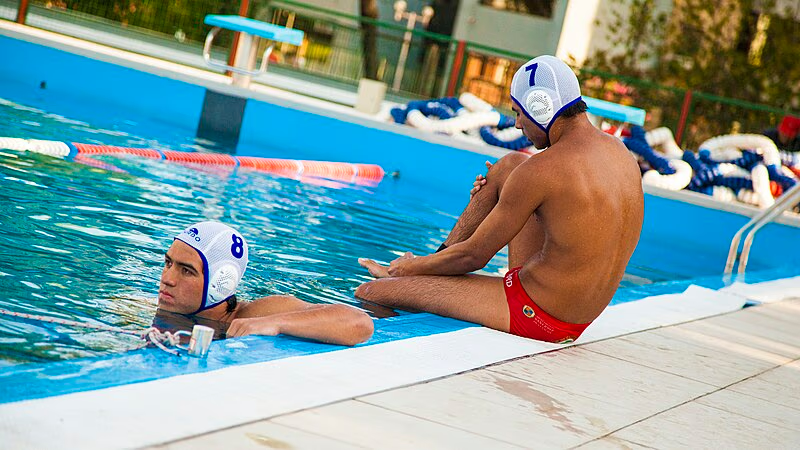
May 23, 20262.2 Caps and Numbering
May 23, 20262.1 The Ball
May 23, 2026Section 2: Equipment
May 23, 20266.4 Winning the Match
May 23, 20267.1 Ordinary Fouls (Turnovers)
May 23, 2026Section 7: Violations & Penalties
May 23, 2026Section 6: Scoring
Mar 22, 2026