






Section 1: Introduction
The Women's National Basketball Association (WNBA) is the premier professional women's basketball league in the world. The league was approved by the NBA Board of Governors in April 1996 and tipped off its inaugural season on June 21, 1997. The WNBA operates as a separate legal entity affiliated with the NBA, sharing administrative resources and arena infrastructure with its men's counterpart.
The league is organized into two conferences — the Eastern Conference and the Western Conference — and has grown from 8 charter franchises to its current size through periodic expansion. The current league roster is published at wnba.com/teams.
The WNBA is governed by a Commissioner, currently Cathy Engelbert, who has held the role since 2019. League rules are maintained by the WNBA Competition Committee, which reviews proposed changes and refers them to the league's Board of Governors for approval. The WNBA Official Rule Book is updated annually and published at wnba.com/wnba-rule-book.
The WNBA regular season runs from May through September. The 2026 regular season tips off on May 8, 2026 (per the league's official key-dates calendar at wnba.com/keydates). The top teams in the league qualify for the WNBA Playoffs, an elimination tournament culminating in the WNBA Finals.
The league has produced generational talents including Cynthia Cooper, Sheryl Swoopes, Lisa Leslie, Sue Bird, Diana Taurasi, Maya Moore, Candace Parker, Breanna Stewart, and A'ja Wilson. The WNBA's All-Star Game, Commissioner's Cup mid-season tournament, and Rookie of the Year, Most Valuable Player, and Finals MVP awards are administered annually by the league office.
Section 2: Equipment
The Basketball
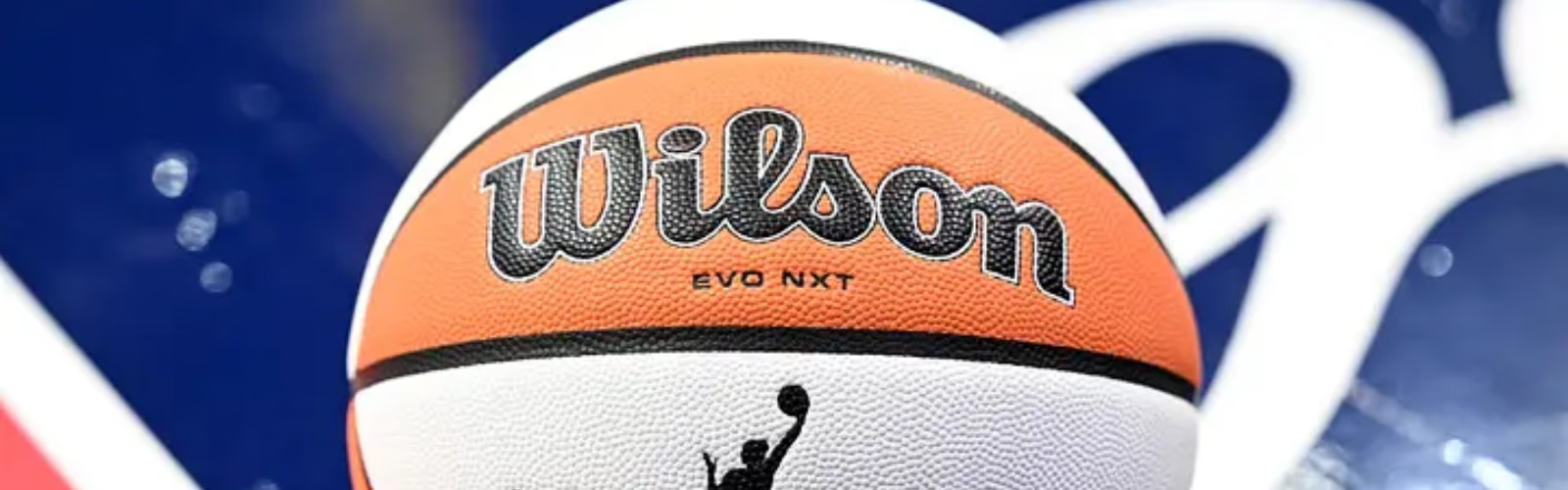
The WNBA uses a women's official-size basketball (Size 6), which is smaller and lighter than the men's Size 7 ball used by the NBA. The official game ball is manufactured by Wilson under a multi-year league agreement and must meet the following specifications:
- Size: Size 6 (women's official) with a circumference of 28.5 inches (72.4 cm)
- Weight: Approximately 20 ounces (567 g)
- Material: Composite leather with a pebbled grip surface, designed for indoor play
- Inflation: Between 7.5 and 8.5 pounds per square inch (psi)
- Bounce: The ball must rebound to a specified height when dropped from a fixed test height onto a hardwood surface, as confirmed by the league prior to each game
- Color: Traditional orange with black seams and the WNBA logo
Home teams supply the game balls, which are inspected and approved by the game officials prior to tip-off.
Backboard and Rim
- Backboard: Rectangular, 6 feet (1.83 m) wide by 3.5 feet (1.07 m) tall, made of transparent tempered glass with a 2-inch (5.08 cm) white border
- Rim (basket): 18 inches (45.7 cm) in internal diameter, made of solid steel rod, painted orange, with a pressure-release breakaway mechanism
- Rim height: 10 feet (3.05 m) above the playing floor, measured to the top edge of the rim
- Net: White cord, 15 to 18 inches (38.1–45.7 cm) in length, designed to momentarily check the ball as it passes through the basket
Player Uniforms
- Jerseys: Numbered front and back; numbers may use single digits (0–5) or pairs of digits in any combination, consistent with NBA convention
- Shorts: Team-issued, with consistent color and trim across the roster
- Footwear: Basketball shoes meeting league safety standards
- Sponsor patches: The WNBA permits a marquee partner jersey patch and additional sponsor logos in designated locations subject to league approval
- Compression sleeves and tights: Permitted when matching the team's primary uniform color
- Mouthguards, knee braces, and protective eyewear: Permitted, provided they meet league-approved safety specifications and do not endanger other players
Scoreboard and Game Clock
- Game clock: Displays time remaining in the current period to tenths of a second under one minute
- Shot clock: 24-second shot clock displayed at each end of the court
- Scoreboard: Shows score, period, team fouls, individual player fouls, and timeouts remaining
- Public-address signage: Used for substitutions, fouls, and official announcements
Section 3: Playing Area
Court Dimensions
The WNBA plays on a regulation NBA-size court, since league franchises share arenas with NBA teams and other tenants. The court is rectangular with the following specifications:
- Length: 94 feet (28.65 m) end line to end line
- Width: 50 feet (15.24 m) sideline to sideline
- Surface: Polished hardwood (typically northern hard maple)
- Boundary lines: 2 inches (5.08 cm) wide, considered out of bounds
Key Court Markings
- Center circle: 12 feet (3.66 m) in diameter at the exact midpoint of the court, used for the opening jump ball
- Half-court line: Divides the court into the offensive and defensive halves
- Free throw line: 15 feet (4.57 m) from the backboard
- Free throw lane (the "key" or "paint"): 16 feet (4.88 m) wide, rectangular, extending from the baseline to the free throw line
- Restricted area (no-charge arc): A semicircle with a 4-foot (1.22 m) radius centered under the basket, used to determine block/charge fouls near the rim
- Three-point line: Arc at 22 feet 1.75 inches (6.75 m) from the center of the basket, with the parallel side segments straightening to 22 feet (6.71 m) in the corners — identical to NBA distance
- Coaching boxes: Marked along each sideline in front of the team bench; the head coach must remain within this area during play
- Substitution box: The area at the scorer's table where substitutes report
Basket and Backboard Position
- Basket centerline: Located 5 feet 3 inches (1.60 m) from the inner edge of the baseline
- Backboard overhang: The inner edge of the backboard is 4 feet (1.22 m) from the baseline, with the rim extending 6 inches (15.24 cm) inward from the backboard
Team Bench and Scorer's Table
Each team bench is located on the same sideline, separated by the scorer's table. The scorer's table is staffed by the official scorer, timekeeper, shot clock operator, and a league-assigned table observer. Teams are permitted up to 13 active and inactive players to sit in the bench area, along with the coaching staff, athletic trainers, and team physician.
Section 4: Players & Officials
Team Composition
- Roster size: Each WNBA team's regular-season roster is capped by the collective bargaining agreement; teams typically dress 12 active players for each game.
- Players on the court: 5 players per team are on the court simultaneously, organized loosely into the traditional 5 positions (point guard, shooting guard, small forward, power forward, center). Modern lineups frequently use positionless basketball.
Substitutions
- Substitutions may be made during any dead-ball situation (after a made basket, during a timeout, after a foul, after a violation, or at the start of a period)
- A substitute must report to the scorer's table and wait to be beckoned onto the court by an official
- There is no limit to the number of substitutions a team may make during a game
- A player who has fouled out (6 personal fouls) must be replaced immediately and may not re-enter the game
- If a team is reduced to fewer than 5 eligible players due to fouls, injuries, or ejections, the rules provide for a reinstated player to continue play subject to additional technical-foul penalties for each subsequent personal foul
Game Officials
Each WNBA game is officiated by a crew of three referees:
- Crew Chief: The senior official with final authority on rule interpretations and disputes; administers the game and has sole authority to declare a forfeit.
- Referee: The second official, sharing floor responsibilities with the crew chief and assisting on calls and reviews.
- Umpire: The third official; all three referees rotate positions throughout the game (lead, trail, and slot/center) to ensure comprehensive coverage.
Additional Game Personnel
- Official Scorer: Maintains the official score and records all field goals, free throws, fouls, and timeouts
- Timekeeper: Operates the game clock
- Shot Clock Operator: Operates the 24-second shot clock, resetting it as required by the rules
- Replay Center: The WNBA, in coordination with the NBA Replay Center in Secaucus, New Jersey, supports video review of specified reviewable matters during the game
- Alternate Official: Available to replace any on-court official who becomes unable to continue
Section 5: Rules of Play
Game Duration
A WNBA game consists of four 10-minute quarters, for a total of 40 minutes of regulation play. This is a key structural difference from the NBA's 12-minute quarters and aligns the WNBA more closely with FIBA international rules timing. The game clock stops for dead balls, fouls, violations, timeouts, and other stoppages; actual elapsed time is typically 1.75 to 2 hours.
- Halftime: A 15-minute intermission occurs between the second and third quarters
- Between quarters: A short break occurs between the first and second quarters and between the third and fourth quarters
Shot Clock (24 Seconds)
The offensive team must attempt a shot that hits the rim within 24 seconds of gaining possession of the ball.
- Full reset (24 seconds): After a change of possession, a defensive foul that does not result in free throws, or a kicked-ball violation by the defense
- Partial reset (14 seconds): After an offensive rebound, after the ball goes out of bounds off the offensive team and is retained in the frontcourt, or after specified defensive infractions in the frontcourt
- Shot clock violation: If the shot clock expires before a valid shot attempt (one that hits the rim), possession is awarded to the opposing team
Starting Play
- Jump ball: Each game begins with a jump ball at center court. Two opposing players stand inside the center circle and the referee tosses the ball upward between them; each jumper may tap the ball after it reaches its highest point.
- Held-ball situations: Held balls and simultaneous possessions during play are resolved as specified in the rule book (typically by a referee-tossed jump ball at the nearest circle).
Ball Advancement
- The offensive team must advance the ball past the half-court line within 10 seconds of gaining possession in the backcourt
- Once the ball is established in the frontcourt (both feet of the ball-handler and the ball are past the half-court line), the offensive team may not return the ball to the backcourt — doing so is a backcourt violation (over-and-back)
Timeouts
- Each team is granted a fixed number of timeouts per game, allocated by half and quarter under league rules
- Timeout duration and television-mandated breaks are governed by the league's broadcast protocol
- Limits apply on how many timeouts a team may carry into the final stretch of the fourth quarter
- Each team receives additional timeouts for any overtime period; unused regulation timeouts do not carry over
Overtime
- If the score is tied at the end of the fourth quarter, a 5-minute overtime period is played
- Overtime begins with a jump ball at center court
- Additional overtime periods are played until one team has a higher score at the end of a period — WNBA games cannot end in a tie
- Personal fouls carry over from regulation into overtime; team foul counts reset for each overtime period
Inbounding the Ball
- After a violation, a foul resulting in a throw-in, or an out-of-bounds play, the ball is inbounded from the designated spot nearest to the infraction. The inbounding player has 5 seconds to release the pass.
- In the final stretch of the fourth quarter and overtime, a team calling a timeout after a made basket may elect to inbound from the frontcourt sideline instead of behind the baseline (the "advance the ball" rule)
Section 6: Scoring
Field Goals
- Two-point field goal (2 points): A basket made from inside the three-point arc. This includes layups, dunks, hook shots, floaters, and mid-range jump shots.
- Three-point field goal (3 points): A basket made from beyond the three-point arc. The shooter's feet must be completely behind (not touching) the three-point line at the time of the shot. If any part of the shooter's foot is on the line, the basket counts as two points.
Free Throws
- Free throw (1 point each): Uncontested shots taken from the free throw line, awarded after certain fouls
- The shooter must release the ball within the time prescribed by the rule book after receiving it from the official
- Other players line up in designated lane spaces during free throw attempts: two offensive players occupy the first spaces closest to the baseline, and three defensive players occupy the second and third spaces on each side
- Players may not enter the lane or cross the free throw line extended until the ball touches the rim
Free Throw Awards
- Shooting foul on a successful 2-point shot: Basket counts (2 points) plus 1 free throw (the "and-one")
- Shooting foul on a missed 2-point shot: 2 free throws
- Shooting foul on a successful 3-point shot: Basket counts (3 points) plus 1 free throw
- Shooting foul on a missed 3-point shot: 3 free throws
- Foul on a non-shooter while team is in the bonus: 2 free throws (after the threshold of team fouls per period has been crossed)
- Technical foul: 1 free throw plus possession for the offended team
- Flagrant foul (Type 1 or 2): 2 free throws plus possession for the offended team
Winning the Game
- The team with the higher score at the end of regulation play wins the game
- If the score is tied at the end of regulation, overtime periods are played until a team has a higher score at the end of a period
- WNBA games cannot end in a tie
Playoffs and Championship
The top finishing teams from the regular season qualify for the WNBA Playoffs, an elimination tournament conducted in successive rounds of best-of series. The tournament culminates in the WNBA Finals, which determines the league champion. Specific bracket size, seeding rules, and series formats are governed by the league's Playoff Manual and are subject to revision in advance of each postseason. Refer to the official key-dates page at wnba.com/keydates for the current postseason schedule.
Section 7: Violations & Penalties
Personal Fouls
A personal foul is illegal physical contact by a player against an opponent. Personal fouls include holding, pushing, charging, blocking, hand-checking, and illegal screens. Each player is allowed a maximum of 6 personal fouls per game; upon committing a sixth foul, the player is disqualified ("fouled out") and must leave the game.
Team Fouls and the Bonus
- Each team's personal fouls are tracked per quarter. When a team reaches the team-foul threshold specified in the rule book, the opposing team enters the "bonus" (also called the penalty).
- While in the bonus, all subsequent non-offensive defensive fouls result in 2 free throws for the fouled player, regardless of whether the foul occurred during a shot attempt.
- Team fouls reset to zero at the start of each quarter; in overtime, the team foul count resets for each overtime period.
Flagrant Fouls
- Flagrant Foul 1 (unnecessary contact): Contact that is unnecessary but not excessive. Penalty: 2 free throws and possession for the offended team. The play is reviewable by the officials and the Replay Center.
- Flagrant Foul 2 (unnecessary and excessive contact): Contact that is both unnecessary and excessive. Penalty: 2 free throws, possession for the offended team, and immediate ejection of the offending player. The player may face additional fines and suspension from the league office.
- Flagrant foul points accumulate during the season and postseason. A player who accumulates a specified number of flagrant foul points is subject to automatic suspension.
Technical Fouls
- Unsportsmanlike conduct: Taunting, excessive arguing with officials, using profanity, or engaging in actions that disrespect the game
- Delay of game: Interfering with the ball after a made basket, failing to immediately pass the ball to the nearest official after a violation
- Hanging on the rim: A player may not hang on the rim unless doing so is necessary to avoid injury to themselves or another player
- Penalty: 1 free throw plus possession for the offended team. A player who receives 2 technical fouls in a game is automatically ejected. Players who accumulate technical fouls beyond a season-long threshold are subject to automatic suspension.
Ball-Handling Violations
- Traveling: Moving one's pivot foot illegally or taking more steps than the rules allow without dribbling the ball. After gathering the ball (picking up the dribble or catching a pass), the rule book defines the permitted step count before stopping, passing, or shooting.
- Double dribble: Dribbling the ball, stopping, and then dribbling again. Also called for dribbling with both hands simultaneously.
- Carrying (palming): Allowing the ball to rest momentarily in the palm or turning the hand over (under the ball) while dribbling.
- Kicked ball: Intentionally striking the ball with any part of the leg or foot. Accidental contact with the foot is not a violation.
Timing Violations
- Shot clock violation (24 seconds): Failure to attempt a shot that hits the rim within 24 seconds of gaining possession
- Backcourt violation (10 seconds): Failure to advance the ball past the half-court line within 10 seconds of gaining possession in the backcourt
- 5-second inbound violation: Failure to pass the ball inbounds within 5 seconds
- 5-second closely guarded violation: Holding the ball for 5 seconds while being closely guarded (within 6 feet) without dribbling, passing, or shooting
Lane Violations
- Offensive three-second violation: An offensive player may not remain in the paint for more than 3 consecutive seconds while their team has possession of the ball in the frontcourt. The count resets when the player exits the lane, a shot is attempted, or there is a loss of team control.
- Defensive three-second violation: A defensive player may not remain in the paint for more than 3 consecutive seconds unless they are actively guarding an offensive player within arm's reach. Penalty: a technical foul assessed to the offending team (1 free throw plus possession to the opposing team).
Goaltending and Basket Interference
- Defensive goaltending: A defender may not touch the ball while it is on its downward arc toward the basket, above the rim level, or after it has touched the backboard during a shot attempt. If a defensive goaltending violation occurs, the basket counts automatically.
- Offensive goaltending / basket interference: An offensive player may not touch the ball while it is on or within the cylinder above the rim, or touch the rim or net while the ball is on or within the basket. If an offensive violation occurs, the basket is disallowed.
Other Violations
- Out of bounds: The ball is out of bounds when it touches the floor, a player, or any object on or outside the boundary line. Possession is awarded to the opposing team of the player who last touched the ball.
- Backcourt violation (over and back): Once the ball is established in the frontcourt, the offensive team may not cause the ball to return to the backcourt. Penalty: turnover.
- Illegal screen (moving pick): An offensive player setting a screen must be stationary; if they are moving or leaning into the defender when contact occurs, a foul is called on the screener.
Section 8: Safety Considerations
Concussion Protocol
The WNBA maintains a comprehensive concussion management program developed in collaboration with the Women's National Basketball Players Association (WNBPA). The protocol includes the following key elements:
- Baseline testing: All players undergo baseline neurocognitive testing (ImPACT or equivalent) during the preseason, providing a reference point if a concussion is suspected during the season.
- In-game evaluation: If a player exhibits signs of a concussion (loss of consciousness, disorientation, balance problems, blank stare, slow response), she is immediately removed from the game for evaluation by the team physician.
- No same-day return: A player diagnosed with a concussion may not return to play in the same game.
- Return-to-play protocol: The player must complete a graduated, multi-step return-to-participation process supervised by the team physician and reviewed by an independent concussion specialist before being cleared to play.
- Independent specialists: The WNBA's medical advisors may flag players for evaluation and must approve return-to-play clearance.
Replay and Video Review
The WNBA uses the NBA Replay Center in Secaucus, New Jersey for instant replay support. The Replay Center assists on-court referees with specific reviewable matters, including:
- Whether a shot was a two-pointer or a three-pointer (shooter's foot on the line)
- Whether a shot was released before the shot clock or game clock expired
- Flagrant foul review (determining if contact was unnecessary, excessive, or both)
- Out-of-bounds plays in the closing stretch of the fourth quarter and overtime
- Goaltending and basket interference calls
- Clock malfunctions and correct time determinations
- Coach's Challenge reviews (each team receives one challenge per game to contest certain calls)
Coach's Challenge
Each team is entitled to one Coach's Challenge per game. A coach may challenge a personal foul called on her team, a goaltending or basket interference call, or an out-of-bounds call. To initiate a challenge, the team must have at least one timeout remaining. If the challenge is successful (the call is overturned), the team retains its timeout; if unsuccessful, the team is charged a timeout.
Player Safety on the Court
- Stanchion padding: The basket support stanchion (pole) is padded to reduce injury risk from player collisions
- Courtside seating: A minimum buffer distance is maintained between the court boundary and the first row of spectator seating to provide a safety zone for players diving for loose balls
- Wet spot protocol: Dedicated court attendants immediately dry any wet spots on the court caused by condensation, spills, or perspiration to prevent slipping injuries
- Camera and equipment placement: Courtside cameras, media personnel, and equipment must be positioned to minimize collision risk with players moving at high speed
Anti-Fighting Rules
- Any player who leaves the bench area during an altercation on the court is subject to automatic suspension and fine, even if she does not participate in the altercation
- Players involved in fighting are subject to ejection, fines, and suspension from subsequent games
- The league office reviews all ejections, flagrant fouls, and on-court altercations after the game and may impose additional discipline
Health and Wellness Protocols
- Medical staff: Each team must have a certified athletic trainer and team physician present at all games and practices
- Cardiac screening: All players undergo comprehensive cardiovascular screening as part of their annual physical examination
- Mental health: The WNBA and WNBPA provide confidential mental health and wellness resources to all players, including licensed psychologists and counselors
- Anti-doping: The WNBA Anti-Drug Program includes random testing for performance-enhancing drugs, drugs of abuse, and diuretics/masking agents during the season and offseason
- Maternity and family planning: The 2020 collective bargaining agreement and subsequent updates expanded paid maternity leave, child-care stipends, and family planning benefits for players