


🏛️Official — World Aquatics
Loading OpenSourceSports…
Two-Meter Pit Mutual Combat
The positional battle between hole-set and hole guard is understood as a mutually accepted, continuous physical contest. Both players enter this role knowing they will be held, pushed, and maneuvered underwater constantly. Neither complains to officials about ordinary wrestling in this zone — it is the agreed terms of those positions.
The Underwater Contract
Extensive wrestling, holding, and grappling below the surface is treated by mutual consent as an accepted layer of the game. What referees cannot see is implicitly fair game — players on both sides engage in and expect this physical combat throughout a match without complaint.
Men's ball: Circumference 68–71 cm (26.8–28 in), weight 400–450 g (14.1–15.9 oz); Women's ball: Circumference 65–67 cm (25.6–26.4 in), weight 350–400 g (12.3–14.1 oz); Waterproof, non-absorbent outer surface with a textured grip coating
— Rule 3
Why people argue about this
People often assume that the ball's circumference is measured from one side of the ball to the other through its thickest part, but actually, it’s measured along a line passing through the center of the ball, making it thinner at the top and bottom. This misunderstanding can lead to disputes over whether a ball falls within the approved range.
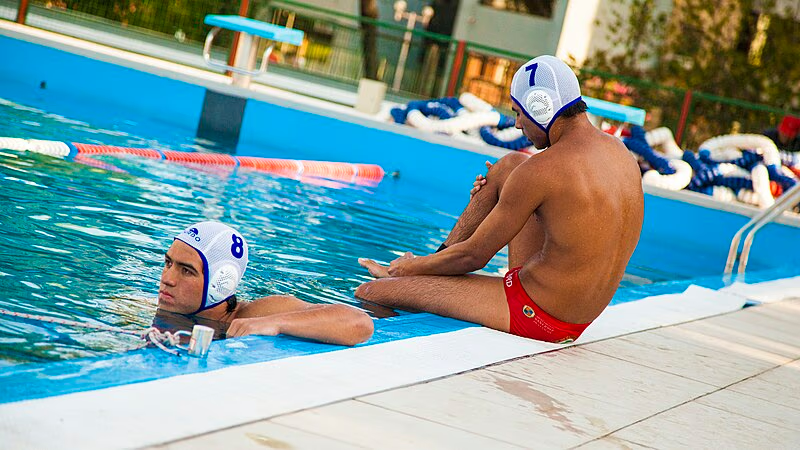
Each team wears distinctly colored caps: one team wears white, the other dark blue (or contrasting dark color); Goalkeepers wear red caps, numbered #1 (starting goalkeeper) or #13 (reserve goalkeeper); Field players numbered 2–13 (excluding 1 and 13 for non-goalkeepers)
Why people argue about this
People often assume that only goalkeepers are supposed to wear red caps numbered 1 or 13, forgetting that all players must have distinctively colored caps regardless of their position on the field. The confusion arises because this rule applies to every player, not just the goalie.
Width: 3 m (9.84 ft) between the inner edges of the goalposts; Crossbar underside: 0.90 m (2.95 ft) above the water surface when water depth is 1.50 m (4.92 ft) or more; 2.40 m (7.87 ft) from the bottom when depth is less than 1.50 m; Goals may be rigid (anchored to the pool deck or wall) or floa...
Why people argue about this
People often argue that a goal isn't scored if part of the ball touches the water before crossing the line, thinking it's about timing, but actually, the key is whether the entire ball passes over the line beneath the crossbar, regardless of where it enters or exits the water.
Swimwear: Non-transparent, one-piece or two-piece swimsuit (no body suits extending past shoulders or knees); Mouthguards: Recommended but not mandatory under World Aquatics rules; No jewelry, watches, or hard accessories permitted
Why people argue about this
People often assume that the colored caps are just for decoration, forgetting that they serve a crucial role in signaling which team's players are out of play during goalkeeping situations. The confusion arises because these caps aren't merely aesthetic; they're essential for maintaining fair play and preventing disputes over whether a player is offside or not.
Men’s field: 30 m × 20 m (98.4 ft × 65.6 ft) for FINA/World Aquatics and Olympic competitions; Women’s field: 25 m × 20 m (82 ft × 65.6 ft) for FINA/World Aquatics and Olympic competitions; Domestic and junior competitions may use shorter fields (minimum 20 m × 10 m)
Why people argue about this
People often assume that the pool dimensions apply only to the playing area, forgetting about the water depth requirement entirely. They overlook how crucial a minimum 1.80m depth is for proper gameplay, leading them to believe it's an afterthought rather than a fundamental aspect of the rule.
2 m line (red/red markers): Marks the zone in front of each goal; ordinary fouls by the attacking team inside this area result in a free throw at the 2 m line; 5 m line (yellow markers): Penalty throw line; also defines the zone where exclusion fouls that prevent probable goals are upgraded to pe...
Why people argue about this
People often assume that fouls inside the 2m line are only for attackers, which leads to arguments when defenders commit fouls there too. The confusion arises because the rule specifically states "fouls by attackers," but doesn't explicitly exclude other players from being penalized if they're caught in this area during a play.
Visible shot clock (30-second countdown) displayed on both sides of the pool; Game clock showing actual playing time per period; Electronic scoreboard visible to teams, officials, and spectators
Why people argue about this
People often assume that Section 3 of World Aquatics' rules covers everything about playing conditions in water polo, including timing and scoreboard equipment. But they misunderstand that while it specifies pool dimensions, depths, temperatures, and markings, it doesn't extend to the technical aspects like how games are time-managed or scoreboards operate during matches.
In the water: 7 players per team (6 field players + 1 goalkeeper); Roster: Maximum 13 players per team (11 field players + 2 goalkeepers); A team must have at least 7 players to start a match
Why people argue about this
People often assume that having 7 players is a minimum for just one game session, forgetting that teams can replace injured or ejected players during the match using their roster of up to 13. This leads to misunderstandings about how many active players are required at any given moment in play versus what's needed on the field at once.
Unlimited substitutions permitted, but only from the re-entry area during a dead-ball situation or after a goal; Flying substitutions (during play) allowed only at the re-entry area; the departing player must fully leave the water before the substitute enters; Goalkeeper-to-goalkeeper substitutio...
Why people argue about this
People often assume that unlimited substitutions mean you can replace players as many times as you want without limit, which leads them to misunderstand that there are specific conditions for goalkeeper-to-goalkeeper substitution and improper entry penalties that still apply even with this rule. They overlook these nuances, leading to confusion about when substitutions are truly allowed.
Center forward (hole set / 2-meter player): Positions directly in front of the opposing goal at the 2 m line; primary target for entry passes; Center back (hole-D): Defends the center forward; physical, pressing defense; Wings: Position at the sides of the attacking formation; drive and shoot fro...
Why people argue about this
People often assume that unlimited substitutions are only allowed during actual matches (dead-ball situations) when in fact, they can happen at any time, even after a goal is scored, as long as it doesn't disrupt play and maintains game continuity. This rule's flexibility leads to misunderstandings about its application timing.
2 referees: One on each side of the pool; share equal authority; signal fouls with whistle and hand signals; 2 goal judges: Positioned behind each goal; signal goals, corner throws, and goal throws; Timekeeper: Operates the game clock, records exclusion times
Why people argue about this
People often assume that improper substitution in water polo is penalized by a direct foul against the offending player rather than an exclusion foul for the team, which can lead to confusion about how substitutions are enforced and who gets penalized. The rule actually states it's the team that suffers the penalty, not just the individual making the mistake.
4 periods of 8 minutes actual playing time (clock stops on every whistle); 2-minute interval between the first and second periods and between the third and fourth periods; 5-minute interval at halftime (between the second and third periods); teams switch ends
Why people argue about this
People often assume that the halftime break is between periods rather than after each period, leading to misunderstandings about when exactly it occurs during a Water Polo match. The confusion arises because in water polo, as in many other sports, the halftime break is typically used to switch players and refresh, not necessarily marking the end of one set of 8 minutes against another.
Field players may touch the ball with only one hand at a time (except the goalkeeper); Goalkeeper may use two hands on the ball within the 5 m area of their own goal; The ball may not be pushed underwater by any player — this is an ordinary foul
Why people argue about this
People often assume that all players can use both hands like a goalkeeper within their own 5m area, which leads to misunderstandings about when they're allowed to do so. The confusion arises because this specific part of the rule only applies to goalkeepers in their designated zone, not to other field players at any time or place on the court.
30-second shot clock: The attacking team must attempt a shot that contacts the goal frame (posts, crossbar, or goalkeeper) or enters the goal within 30 seconds of gaining possession; Shot clock resets to 30 seconds on: change of possession, a shot hitting the goal/goalkeeper, awarded exclusion fo...
Why people argue about this
People often argue that pushing underwater should be penalized more harshly than an ordinary foul, thinking it's a serious infringement on gameplay timing, but actually, the rule is designed to keep things moving quickly by only penalizing this as a minor infraction if it happens during play rather than when the ball is out of play.
Each team may call 2 timeouts per game (plus 1 additional in overtime); Timeouts are 1 minute in duration; A timeout may only be called by the team in possession during a dead-ball situation
Why people argue about this
People often assume that timeouts in Water Polo are just like in other sports where they last for a short burst of playtime, but actually, these 5-minute timeouts allow coaches to strategize extensively during their break, leading to significant adjustments and strategy changes before the next period or halftime kicks off.
Within their own 5 m area: may use two hands, punch the ball with a fist, stand or walk on the bottom (if shallow enough); Beyond the 5 m area: treated as a field player (one hand only, no two-hand privileges); May not cross the half-distance line
Why people argue about this
People often assume that a goalkeeper can use both hands freely anywhere in their own 5-meter area, thinking it's an unlimited advantage. But actually, they're restricted to using only two hands within this specific 5 m radius of their goal line, which is designed to balance the power and control on defense while preventing overreach advantages.
Free throw: Awarded for ordinary fouls; taken immediately from the spot of the foul without waiting for the referee’s whistle; Goal throw: Awarded when the attacking team last touches the ball before it goes over the goal line outside the goal; taken by the goalkeeper from within the 2 m area; Co...
Why people argue about this
People often assume that pushing underwater is only a serious foul when it results in a penalty shot. But the official rule clearly states it's an ordinary foul anytime you push underwater, leading to confusion about its severity and enforcement.
Effective under the World Aquatics Competition Regulations in force as from February 2026, World Aquatics established WP4, a 4-a-side water polo discipline governed by Superseding Rules to Part Six, Appendix 9. WP4 is a distinct discipline from th...
Why people argue about this
People often assume that WP4 in 4x4 water polo means exactly what it sounds like—four players per side—but actually, WP4 refers to a format where teams play with four players on each side for both halves of the game, rather than the traditional six-a-side setup. This can lead to misunderstandings about how many players are actively involved in scoring and gameplay during these matches.
A goal is scored when the entire ball passes fully across the goal line between the goalposts and under the crossbar. The ball may be thrown, pushed, or deflected by any part of the body except a clenched fist (field players).
Why people argue about this
People often assume that a goal is scored as long as the ball crosses the line, regardless of how it got there - whether by a teammate's pass or an opposing player's deflection. But actually, they need to have used their hands (except for field players), which leads to arguments about whether a defender who hit the ball with their stick legally earned that goal.
A goal may be scored from anywhere within the field of play (including by the goalkeeper from their own half); A goal may not be scored directly from a free throw outside the 5 m area without the ball first being played by another player or being deflected; A goal may be scored directly from a fr...
Why people argue about this
People often assume that if a water polo game ends in a tie at the end of regulation time, it automatically goes straight into penalty shootouts without trying overtime first. The confusion arises because Section 6.2 specifically mentions that if there's still no winner after regular play and extra time, only then do they turn to penalties, not skipping the mandatory overtime periods.
Taken from the 5 m line, directly in front of the goal; All players except the shooter and the defending goalkeeper must be behind the 5 m line and at least 2 m from the shooter; Goalkeeper must position on the goal line without moving beyond until the ball leaves the shooter’s hand
Why people argue about this
People often assume that if a game ends in a tie, teams automatically go straight into penalty shootouts without playing overtime first. But actually, they play at least one period of overtime before deciding to use penalties. This rule can lead to confusion because it skips the more manageable overtime process for resolving ties and goes directly to penalties.
The team with the most goals at the end of regulation time wins. If the match is part of a knockout tournament and ends in a tie, overtime periods and then a penalty shootout are used to determine the winner (see Section 5.1).
— Section 5.1
Why people argue about this
People often assume that if a water polo match ends in a tie at the end of regulation time, it's automatically decided by penalty shootout, forgetting that overtime periods are supposed to come first as a tiebreaker method before resorting to penalties. The confusion arises because they mix up the order of these tie-breaking methods.
Ordinary fouls result in a free throw to the opposing team. Common ordinary fouls include: Impeding or blocking the movement of an opponent who is not holding the ball; Pushing the ball underwater; Taking the ball underwater when tackled
Why people argue about this
People often assume that if a player is excluded for 20 seconds, they can simply swim away from their team during those 20 seconds, which leads to confusion about how possession changes hands or when play restarts. The actual rule states the excluded player must leave the water and enter the penalty area immediately, not allowing them to float off with the ball.
Exclusion fouls result in the offending player being removed from the water for 20 seconds of actual play, or until a goal is scored, or until the excluded player’s team regains possession. The excluded player must leave the water and enter the penalty area immediately.
Why people argue about this
People often assume that if a player is excluded for 20 seconds, they can simply return to play as soon as their team regains possession without needing to go through the penalty area again, which confuses them about the necessity of leaving and re-entering the penalty area immediately after being excluded.
3 exclusion fouls: Player is permanently excluded from the remainder of the match; a substitute may enter after 20 seconds; The ejected player’s team plays short-handed for the 20-second exclusion period of the third foul; A substitute wearing the ejected player’s cap number enters after the excl...
Why people argue about this
People often think that if a defender commits an exclusion foul inside the 5-meter area while the attacker has possession of the ball and it seems like there's a scoring opportunity, they'll get ejected right away. But actually, what this rule means is that a penalty throw will be awarded instead, which allows both players to continue their play but with a disadvantage for the fouling team.
A penalty throw is awarded when an exclusion foul is committed inside the 5 m area by a defending player against an attacker who has possession of the ball and a probable scoring opportunity.
Why people argue about this
People often think that if a defender commits an exclusion foul inside their 5-meter area against an attacker with possession of the ball, it's always automatically a penalty throw. But actually, they only award a penalty throw if there’s also a probable scoring opportunity involved, ensuring fairness and preventing unnecessary penalties.
Red card: Player permanently excluded with no substitution for 4 minutes of actual play; Team plays one player short for the full 4-minute penalty; Defined as kicking, striking, or attempting to strike with malicious intent; head-butting
Why people argue about this
People often assume that "7.5 Brutality" refers to physical contact between players, thinking it's about fouling. However, the official verdict clarifies that brutality isn't defined in Section 7 of the Water Polo rulebook provided, which leaves room for interpretation and debate on what exactly constitutes this offense.
Minimum water depth of 1.80 m (5.9 ft) strictly enforced to prevent players from pushing off the bottom and to reduce injury risk from contact near the pool floor; Pool walls must have no sharp edges, protruding fittings, or hazards within the field of play; Goals must be padded at the base and s...
Why people argue about this
People often assume that 1.80 meters is just a depth requirement for safety, forgetting that it also affects how players push off from the bottom of the pool during sprints or dives, potentially leading to misunderstandings about its actual purpose in gameplay and safety.
Fingernails inspected before each match; long or sharp nails result in the player being barred from play until trimmed; No jewelry, watches, bracelets, or hard hair accessories permitted; Players who are bleeding must leave the water immediately and may only return after the bleeding has stopped ...
Why people argue about this
People often assume that only long nails are a problem in water polo, forgetting about sharp ones too. The misunderstanding stems from believing the rule is strictly about length, overlooking the potential injury risk posed by sharp edges on fingers.
Referees monitor for dangerous play including elbows to the head, underwater kicks, and holding a player’s head underwater; Video review (VAR) available at major international competitions for brutality incidents and goal-line decisions; Officials have the authority to suspend a match for lightni...
Why people argue about this
People often assume that pushing off pool walls is okay as long as they're outside the field of play, forgetting that it's strictly prohibited within the playing area to prevent injuries. The confusion arises because they overlook the specific wording about "within the field of play," which includes near the walls and bottom where pushing could be dangerous.
Water quality must meet World Aquatics standards (chlorination levels, pH, turbidity); Adequate lighting: minimum 1500 lux at the water surface for televised events; Water temperature maintained between 25–27 °C (77–81 °F)
Why people argue about this
People often assume that the 1.80 m water depth is only for safety reasons, forgetting that it's also crucial for maintaining proper ball control and preventing players from easily reaching over the edge of the pool. The confusion arises because this rule ensures a level playing field where no player has an unfair advantage by being closer to the surface or having easier access points.
Men's ball: Circumference 68–71 cm (26.8–28 in), weight 400–450 g (14.1–15.9 oz); Women's ball: Circumference 65–67 cm (25.6–26.4 in), weight 350–400 g (12.3–14.1 oz); Waterproof, non-absorbent outer surface with a textured grip coating
— Rule 3
Why people argue about this
People often assume that the ball size difference between men's and women's games is solely for physical differences in players' sizes, but actually, it’s designed to ensure fair play by accounting for water resistance and player visibility from a distance. The confusion arises because some overlook how different ball sizes affect gameplay dynamics like passing accuracy and goalkeeping strategy.
Men’s field: 30 m × 20 m (98.4 ft × 65.6 ft) for FINA/World Aquatics and Olympic competitions; Women’s field: 25 m × 20 m (82 ft × 65.6 ft) for FINA/World Aquatics and Olympic competitions; Domestic and junior competitions may use shorter fields (minimum 20 m × 10 m)
Why people argue about this
People often assume that the 20m x 10m requirement is about the court size for Water Polo games, but actually it's referring to the area where players must stay within their own end of the pool during play. They overlook the fact that this rule pertains specifically to ensuring adequate depth for safety and preventing injuries, not just the dimensions of the playing field itself.
In the water: 7 players per team (6 field players + 1 goalkeeper); Roster: Maximum 13 players per team (11 field players + 2 goalkeepers); A team must have at least 7 players to start a match
Why people argue about this
People often assume that a team can start with fewer than 7 players in the water if they have more on their roster, misunderstanding that while teams are allowed to carry up to 13 players, they must have at least 7 active in the pool to begin a game and cannot bring substitutes onto the court during play.
Effective under the World Aquatics Competition Regulations in force as from February 2026, World Aquatics established WP4, a 4-a-side water polo discipline governed by Superseding Rules to Part Six, Appendix 9. WP4 is a distinct discipline from th...
Why people argue about this
People often assume that water polo players take timeouts when referees blow their whistle during play, which is why they argue about it. However, the official verdict clarifies that there are no stoppages for whistles during actual play time in Water Polo, unlike other sports where a referee's whistle indicates a pause or timeout.
A goal is scored when the entire ball passes fully across the goal line between the goalposts and under the crossbar. The ball may be thrown, pushed, or deflected by any part of the body except a clenched fist (field players).
— Section 5.1
Why people argue about this
People often assume that a goal is scored only if the ball touches a player's body before crossing the line, which can lead to arguments when it happens naturally, like a deflection off an arm or leg. The confusion arises because they misinterpret "any part of the body" as meaning only hands and feet are allowed to touch the ball, ignoring other parts that also count in water polo.
Ordinary fouls result in a free throw to the opposing team. Common ordinary fouls include: Impeding or blocking the movement of an opponent who is not holding the ball; Pushing the ball underwater; Taking the ball underwater when tackled
Why people argue about this
People often assume that if a player is excluded for 20 seconds, they can simply wait out the time in the penalty area without having to actually leave the water. But according to Y (the official verdict), the player must leave the water and enter the penalty area immediately upon receiving the exclusion foul, ensuring fairness in play continuity.
Minimum water depth of 1.80 m (5.9 ft) strictly enforced to prevent players from pushing off the bottom and to reduce injury risk from contact near the pool floor; Pool walls must have no sharp edges, protruding fittings, or hazards within the field of play; Goals must be padded at the base and s...
Why people argue about this
People often assume that the requirement for players to remove jewelry is solely about aesthetics, forgetting that sharp edges from piercings can cause serious injuries in a collision-heavy game like water polo. The prohibition on hard accessories also gets misunderstood as just a fashion rule, overlooking how these items could pose a danger if caught by an opponent's stick or another player.