















Section 1: Introduction
Netball is a fast-paced indoor team sport played by two teams of seven, in which players move the ball by passing it from one to another and attempt to score goals by shooting the ball through a 3.05 m elevated ring at the opposing end of the court. Netball traces its origin to early adaptations of basketball and was codified in its modern form in the early twentieth century; it is played competitively in over 80 nations today and is one of the most-played women's team sports in the Commonwealth.
The international governing body is World Netball (formerly the International Netball Federation, INF), which publishes the canonical Rules of Netball. The current edition is the 2024 Edition, which came into force for all international matches on 1 January 2024 and remains in force through the 2026 season unless and until a subsequent edition is adopted.
The 2024 Edition focused on player safety, game-management clarity, and the simplification of long-standing provisions. Substantive 2024 changes included the removal of the toss-up restart, refinements to the centre-pass procedure, clarifications to advantage and contact, and updates to short-pass and playing-the-ball provisions. These changes reflect a multi-year cycle of consultation between World Netball, the regional federations, and the elite competitions.
This entry summarizes the major rule mechanics for educational purposes. It does not reproduce the rule text and is not a substitute for the canonical World Netball Rules of Netball 2024 Edition, which is authoritative in any dispute and which is published by World Netball in English, Spanish, Hebrew, and Chinese (see source URL in metadata).
Section 2: Equipment
The Ball
- Spherical, made of leather, rubber, or synthetic material
- Circumference: 690–710 mm
- Weight: 400–450 g
- The ball is presented in distinguishable colors approved by World Netball for international competition
Goalposts and Rings
- Two upright goalposts, one at the centre of each goal line, height 3.05 m to the top of the ring
- Each post supports a horizontal metal ring of 380 mm internal diameter, with a net attached
- The ring projects 150 mm horizontally from the post
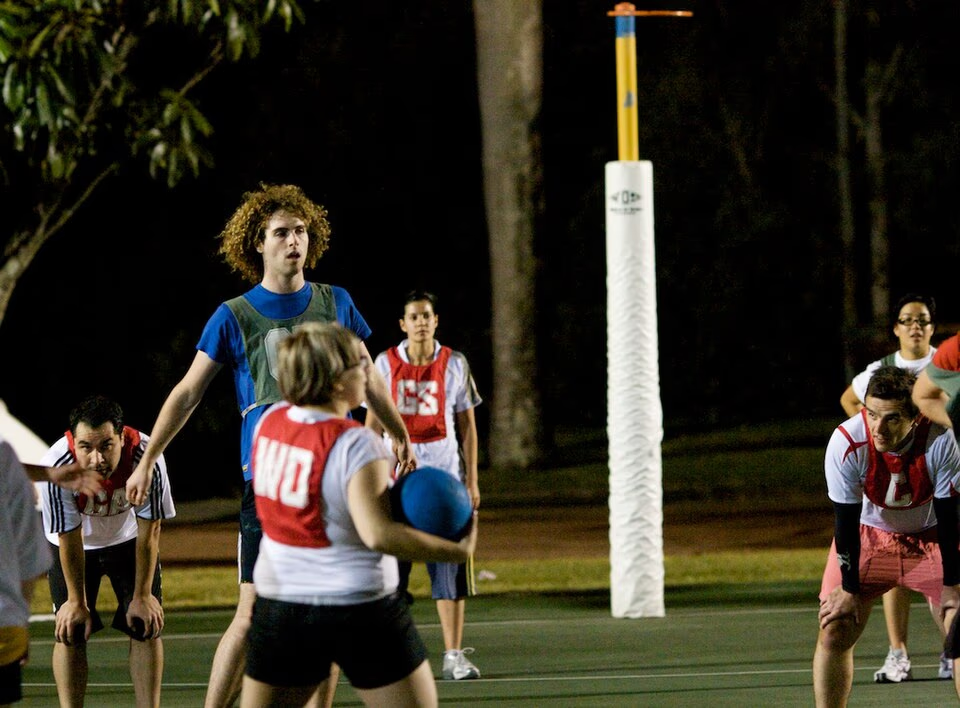
- The post must be padded to a minimum height of 2 m to protect players who collide with it
Player Apparel
- Team uniform (dress, top and skirt, or top and shorts) clearly distinguishing the two teams
- Position bib worn on the front and back, displaying the position abbreviation (GS, GA, WA, C, WD, GD, GK)
- Footwear suitable for the playing surface; no spikes
- No jewelry that may cause injury (taped-over rings and stud earrings are addressed in the rules)
- Fingernails kept short and smooth
Officiating Equipment
- Whistles for each umpire
- Stopwatches for the timekeeper
- Match scoresheet and digital scoring/match management equipment in international competition
Section 3: Playing Area
Court Dimensions
- Length: 30.5 m (100 ft) measured between the goal lines
- Width: 15.25 m (50 ft) measured between the sidelines
- Court is divided lengthwise into three equal thirds by two transverse lines: defensive third, centre third, attacking third (orientations relative to each team)
- Centre circle: 0.9 m diameter at the centre of the court
- Goal circle (shooting circle): semi-circle of 4.9 m radius at each end, struck from the centre of the goal line
Surface and Surrounding Area
The court must be a firm, even surface. International matches are played on a sprung wooden floor or an approved synthetic indoor surface. A clear runoff area of at least 3.05 m around the perimeter is required for safety; spectators, benches, and scoring tables are positioned outside the runoff.
Court Markings
- Goal lines (end lines) at each end of the court
- Sidelines along each long edge
- Two transverse third-lines dividing the court into three equal thirds
- Centre circle (0.9 m diameter)
- Two goal circles (4.9 m radius semicircles)
- All lines are 50 mm wide and form part of the area they bound
Position-Restricted Areas
Each of the seven playing positions has a defined permitted area. A player who enters an area not permitted to that position commits an "offside" infringement and is penalized (Section 7).
Section 4: Players & Officials
Team Composition
Each team fields seven players on court at any time, drawn from a match squad of up to twelve. Each on-court player wears a position bib indicating their assigned position; the seven positions and their permitted areas are:
- Goal Shooter (GS) — attacking goal third including the shooting circle
- Goal Attack (GA) — centre third and attacking goal third including the shooting circle
- Wing Attack (WA) — centre third and attacking goal third, excluding the shooting circle
- Centre (C) — all three thirds, excluding both shooting circles
- Wing Defence (WD) — centre third and defensive goal third, excluding the shooting circle
- Goal Defence (GD) — centre third and defensive goal third including the shooting circle
- Goal Keeper (GK) — defensive goal third including the shooting circle
Substitutions and Position Changes
- Substitutions and position changes may be made at the quarter-time intervals, the half-time interval, and at the three-quarter-time interval
- Additional substitutions are permitted for an injured player, a bleeding player, or an unwell player at any time, subject to the umpire authorizing a brief stoppage
- A substituted player may return to the match in any subsequent permitted substitution period
Captains
Each team has a designated captain who represents the team in dealings with the umpires and may request clarification of an umpire's ruling at the next available stoppage. The captain wears a captain's armband.
Match Officials
- Two umpires, one for each half of the court along the sideline; each umpire is responsible for one sideline and one goal line and shares responsibility for play that crosses between halves
- One timekeeper
- One scorer (and an assistant scorer in international competition)
- A reserve umpire and a Bench Official may be appointed for international and elite competition
Coaches and Bench
Coaches, team officials, and substitute players occupy the team bench, located along one sideline outside the runoff. Coaching is permitted from the bench only during permitted breaks and must not interfere with on-court play.
Section 5: Rules of Play
Match Structure
- International matches are played in four 15-minute quarters
- Quarter-time and three-quarter-time intervals are 4 minutes; half-time interval is 12 minutes
- The team scoring more goals at the end of the fourth quarter wins; tie-breaking procedures (typically two 7-minute halves of extra time) apply in knock-out competition
Centre Pass
- The match begins with a centre pass taken by the Centre of one team standing wholly within the centre circle
- Centre passes alternate between the two teams thereafter, regardless of which team scored the previous goal
- The centre pass must be received in the centre third
- The umpire signals the start of play with a whistle; the centre must release the ball within three seconds of the whistle
Footwork Rule
A player in possession of the ball may not let the landing foot touch the ground a second time after lifting it, while still in possession. The player may pivot on the landing foot or take a step on the other foot — effectively 1.5 steps before throwing or shooting. Pivoting on the landing foot does not constitute a step. A breach of footwork is penalised by a free pass to the opposing team.
Three-Second Rule
A player in possession of the ball must throw or shoot within three seconds of receiving it. Failure to release within three seconds is "held ball" and is penalised by a free pass to the opposing team.
Movement of the Ball
- The ball is moved exclusively by passing or shooting; players may not run or dribble with the ball
- A pass must be released to a different player; a pass thrown by one player and caught by the same player is "replayed ball" and penalised
- The ball must be touched by a player in each adjacent third — a pass thrown over an entire third without being touched is an "over-a-third" infringement
Contact and Obstruction
- Contact: Contact with an opponent that interferes with their play is an infringement, penalised by a penalty pass to the contacted player from where the contact occurred
- Obstruction: A defending player must be at least 0.9 m (3 ft) from the landed foot of the player in possession before extending arms to defend or before attempting to intercept the ball; closer-than-0.9 m defence is "obstruction" and penalised by a penalty pass
- The 0.9 m distance is measured from the landed foot, not from the body or hands
Advantage
The umpire may apply advantage if penalising an infringement would penalise the non-offending team — the umpire calls "Advantage" and play continues. The 2024 Edition refined the wording around when advantage may be applied.
Out of Court
The ball is out of court when it touches the ground outside the court, or when it touches a player or any object in contact with the ground outside the court. The ball is brought back into play by a throw-in by a player from the opposing team to the player who last touched the ball before it went out, taken from outside the court at the point where the ball crossed the line.
Section 6: Scoring
Goal
A goal is scored when the ball is thrown by either the Goal Shooter (GS) or the Goal Attack (GA) from any point within the shooting circle and passes through the ring. Only GS and GA may score; a shot taken by any other player, or a shot taken by GS/GA from outside the shooting circle, does not count and a free pass is awarded to the defending team.
Standard Goal Value
Under the World Netball Rules of Netball 2024 Edition, a goal is worth 1 point regardless of the position of the shooter within the shooting circle. (Some elite competitions, including Suncorp Super Netball, run a "Super Shot" or 2-goal trial in which goals from the outer portion of the shooting circle in the final quarter are worth 2 points; this is a competition-specific variant and is not part of the World Netball Rules of Netball.)
Goal Confirmation
- The shooter's footwork must be legal at the moment of release
- The ball must pass downward through the ring
- The shot must be released within three seconds of receiving the ball
- The umpire confirms each goal; the scorer records each goal
Match Result
- The team with the higher goal total at the end of the fourth quarter wins the match
- If scores are level at the end of the fourth quarter in a knock-out match, two 7-minute halves of extra time are typically played; a "first-to-two-clear-goals" sudden death may be applied per the competition regulations
- Round-robin matches that finish level remain level — no extra time
Section 7: Violations & Penalties
Free Pass
A free pass is awarded to the non-offending team for technical infringements that do not involve interference with an opponent. The non-offending team takes the pass from where the infringement occurred. Free pass infringements include:
- Footwork
- Held ball (failure to release within 3 seconds)
- Replayed ball
- Over-a-third
- Offside (a player entering an area not permitted to their position)
- Short pass (a pass at which the catcher's arms could touch the thrower's arms — too short to be a legitimate pass)
- Breaking at the centre pass (a player leaving their position before the umpire's whistle)
Penalty Pass
A penalty pass is awarded to the non-offending team for infringements involving interference with an opponent — contact and obstruction. The penalty pass is taken from where the infringement occurred. Critically, the offending player must "stand out of play" alongside the player taking the penalty pass and may not move or attempt to intercept until the ball has left the hands of the player taking the pass.
Penalty Pass or Shot
A penalty pass awarded inside the shooting circle for a defending team's infringement may, at the option of the attacking team's GS or GA, be taken as a shot at goal — a "penalty pass or shot." The offending defender stands out of play.
Toss-Up — Removed (2024 Edition)
The toss-up restart, in which the umpire put the ball into play between two opposing players after simultaneous infringement, was removed in the 2024 Edition. Restarts that previously used a toss-up are now resolved per the updated procedures specified in the Rules text.
Discipline
- Caution: Verbal warning to a player for unsporting conduct
- Suspension: A player may be suspended from the match for a defined period (typically 2 minutes) for repeated unsporting conduct or a serious infringement; the team plays short during the suspension
- Ordering off: A player ordered off takes no further part in the match; the team plays short for the remainder of the match (with substitution permitted at the next interval per competition rules)
- Discipline applies equally to court players and to bench officials
Section 8: Safety Considerations
Court and Equipment Safety
- The 3.05 m runoff around the court must be clear of obstacles; players regularly leave the court at high speed pursuing the ball
- Goalposts must be padded to a minimum height of 2 m
- The court surface must be firm and even; wet patches and debris must be cleared before play resumes
- Footwear must be appropriate to the surface and free of metal spikes or sharp edges
Player Safety
- Fingernails must be kept short and smooth — long or sharp nails are an injury risk to opponents during contests for the ball
- Jewelry that may cause injury must be removed or, where permitted by the umpires (e.g., medical bracelets, religious items), securely covered
- The 0.9 m obstruction distance is in part a player-safety mechanism — closer defence increases collision risk
- Players treating cuts or bleeding wounds must leave the court for treatment; bleeding wounds must be covered before return to play
Concussion and Head Injury
World Netball follows the World Rugby/IOC consensus on concussion in sport: any player with a suspected concussion is removed from play and is subject to a graduated return-to-play assessment before being cleared for subsequent training and competition. Match-day diagnosis of concussion is the responsibility of the team medical staff, supported by an independent match medical observer in international competition.
Heat and Hydration
Indoor netball venues are typically climate-controlled, but outdoor competition (most often at school and club level) may face heat-related risks. World Netball recommends WBGT-based heat thresholds and play modifications; specific implementation is at the discretion of the host federation and the match-day medical staff.
Match Officials' Authority
The umpires have authority to suspend play for any safety concern, including unsafe surface conditions, unsafe equipment, or a medical incident. Play resumes only after the umpires are satisfied that the safety concern has been resolved.