





Section 1: Introduction
Overview
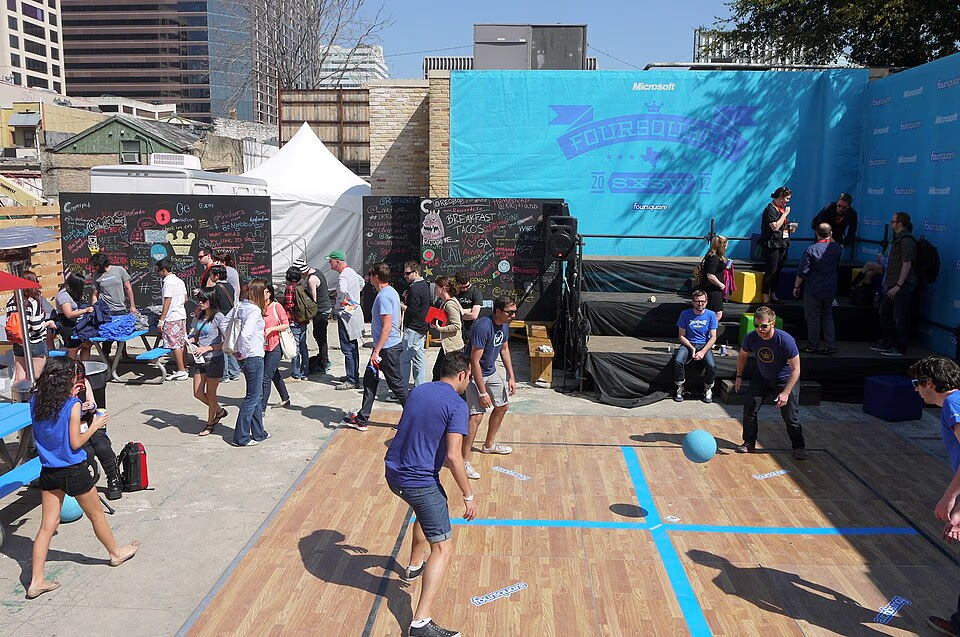
Four Square is a ball game played among four players on a square court divided into quadrants. Players hit a rubber ball between each other's squares, attempting to eliminate opponents through strategic bouncing, spinning, and placement. The game combines hand-eye coordination, quick reflexes, and social strategy in a format that is easy to learn but difficult to master.
History
Four Square has been a staple of schoolyard recreation since at least the 1950s in the United States, though similar bouncing games have existed for much longer across various cultures. The game gained widespread popularity through physical education programs and recess periods, becoming one of the most recognizable playground games in North America, Australia, and parts of Europe. By the 2000s, organized adult Four Square leagues and tournaments had emerged, with the Four Square World Championships drawing competitors from around the globe. The game's simplicity and minimal equipment requirements have ensured its enduring appeal across generations.
Competitive Scene
While most Four Square is played casually on playgrounds and in backyards, a competitive circuit has developed in recent decades. Organizations such as the World Four Square Federation host annual championships with standardized rules. Competitive play introduces stricter line-call protocols, designated referees, and formal elimination brackets. Many cities and colleges host recreational leagues that blend the casual fun of playground Four Square with structured competition.
Spirit of the Game
Four Square is fundamentally a social game. It rewards creativity, sportsmanship, and quick thinking over raw athleticism. Players are expected to resolve disputes fairly, respect the rotation system, and maintain an inclusive atmosphere. The King's ability to declare special rules each round adds a layer of democratic creativity that distinguishes Four Square from most other sports.
Section 2: Equipment
The Ball
- Type: Standard rubber playground ball (also called a kickball or utility ball)
- Size: 8.5 inches (21.6 cm) in diameter is the standard; 10-inch balls are acceptable for younger players
- Material: Inflatable rubber with a textured surface for grip
- Inflation: The ball should bounce to approximately waist height when dropped from shoulder height on the playing surface. Over-inflated balls are dangerous; under-inflated balls are difficult to control
- Color: Traditional red is most common, though any color is acceptable. Competitive tournaments may specify official ball brands
Court Marking Materials
- Chalk: Standard sidewalk chalk for concrete or asphalt surfaces. Lines should be clearly visible and approximately 1-2 inches wide
- Tape: Painter's tape or court-marking tape for indoor gymnasium floors. Duct tape may be used on outdoor surfaces for more permanent markings
- Paint: Many schoolyards and parks have permanently painted Four Square courts. Semi-gloss outdoor paint is recommended for longevity
- Pre-made mats: Portable rubber Four Square mats are available for use on grass or uneven surfaces
Playing Surface
- Preferred: Smooth concrete, asphalt, or sealed gymnasium flooring
- Acceptable: Rubber sport court surfaces, outdoor basketball courts, tennis courts
- Not recommended: Grass, gravel, sand, or any surface where the ball does not bounce consistently
Optional Equipment
- Numbered markers: Cones or signs labeled 1-4 (or King, Queen, Jack, Peasant) placed in each square
- Spare balls: At least one backup ball in case the primary ball is damaged or lost
- Whistle: For organized play with a referee
Section 3: Playing Area
Court Dimensions
The standard Four Square court is a 16-foot by 16-foot (4.9 m x 4.9 m) square divided into four equal quadrants, each measuring 8 feet by 8 feet (2.4 m x 2.4 m). For younger players, courts may be reduced to 12 feet by 12 feet (3.7 m x 3.7 m) with 6-foot quadrants. Competitive tournaments typically use the full 16-foot standard.
Court Layout
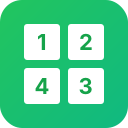
The court is divided by two perpendicular lines that bisect the square, creating four equal quadrants. When facing the court, the squares are arranged as follows:
- Square 4 (King): Top-right quadrant. This is the highest-ranked position and the serving square
- Square 3 (Queen): Top-left quadrant. The second-highest position
- Square 2 (Jack): Bottom-left quadrant. The third-ranked position
- Square 1 (Peasant / Dunce / Ace): Bottom-right quadrant. The lowest-ranked position and the entry square for new players
Note: Square numbering and naming conventions vary by region. Some variations number the King's square as 1 (highest) rather than 4. The rules in this document use the most common convention where Square 4 is King.
Lines
- Outside boundary lines: The outer perimeter of the 16x16 foot court. Balls landing outside these lines are out of bounds
- Inside dividing lines: The two lines that divide the court into quadrants. These lines belong to the lower-numbered square in most rulesets
- Line width: Lines should be 1-2 inches wide. In competitive play, lines are considered part of the court
The Serving Area
The King serves from within their square (Square 4). The ball must be served diagonally to Square 1 (Peasant). Some variations allow the King to serve to any square. The serve must be initiated from behind the back line of the King's square or from within the square, depending on the house rules in effect.
Waiting Area
Players waiting to enter the game should line up in an orderly queue adjacent to Square 1. The waiting area should be at least 6 feet from the court boundary to avoid interference with active play. The first player in line enters the game when a player is eliminated.
Surrounding Space
A minimum of 6 feet (1.8 m) of clear space should surround all sides of the court. This buffer zone allows players to chase errant balls and prevents collisions with walls, fences, or other obstacles. Indoor courts should be at least 10 feet from walls on all sides.
Section 4: Players & Officials
Active Players
Four Square requires exactly four active players at any time, one occupying each quadrant of the court. Players are ranked by their square number, with the King (Square 4) holding the highest rank and the Peasant (Square 1) holding the lowest.
The Queue
Any number of additional players may wait in a queue (also called "the line" or "the bench") adjacent to Square 1. When a player is eliminated from the court, they go to the back of the queue, all remaining players advance one square, and the first player in the queue enters Square 1. This rotation system ensures continuous play and equal participation.
Player Roles
- King (Square 4): The highest-ranked player. The King serves the ball and, in many rulesets, has the privilege of declaring special rules for the round. Retaining the King position through multiple rounds is the primary objective
- Queen (Square 3): The second-ranked player. The Queen is one elimination away from becoming King and often plays conservatively to protect their position
- Jack (Square 2): The third-ranked player. Jacks are mid-tier and typically play aggressively to advance while avoiding elimination
- Peasant (Square 1): The lowest-ranked active player and the entry position for players joining from the queue. Peasants receive the King's serve
Rotation System
When a player is eliminated, all players in lower-numbered squares advance one position. For example, if the Queen (Square 3) is eliminated, the Jack moves to Square 3 and the Peasant moves to Square 2. The next player in the queue enters Square 1. If the King is eliminated, all three remaining players advance one square.
Referee (Optional)
Casual games are typically self-officiated, with disputes resolved by consensus or by the King's ruling. In organized or competitive play, a designated referee may be used to make line calls, rule on disputed plays, and enforce the rules. The referee stands outside the court with a clear view of all four squares. In tournament settings, two referees may be used, positioned at opposite corners of the court.
Scorekeeper (Optional)
In competitive formats, a scorekeeper may track King retention streaks, individual win records, and elimination statistics. This role is unnecessary for casual play.
Section 5: Rules of Play
Objective
The objective of Four Square is to advance to the King position (Square 4) and remain there for as many consecutive rounds as possible. Players advance by eliminating higher-ranked opponents through strategic ball placement, spin, and speed. A player is eliminated when they fail to properly return the ball to another player's square.
Starting a Round
Each round begins with the King serving the ball. The King drops the ball and hits it after one bounce, directing it into the Peasant's square (Square 1). The serve must bounce once in the Peasant's square before the Peasant can return it. Once the Peasant returns the serve, the ball is live and any player may hit it to any other player's square.
Basic Play
After the serve, players hit the ball back and forth between squares. On each hit, the ball must bounce exactly once in the receiving player's square. The receiving player must then hit the ball into another player's square before it bounces a second time in their own square. Play continues until a player commits a fault, at which point they are eliminated and the rotation occurs.
Serving Rules
- The King serves by dropping the ball and striking it after one bounce within their own square
- The serve must land in the Peasant's square (Square 1) in standard rules. Some variations allow the King to serve to any square
- The serve must be underhand. Overhand serves are not permitted on the opening serve
- The ball must clear the inside dividing line and land cleanly within the receiving square
- A serve that lands on a line, out of bounds, or fails to reach the receiving square is a fault on the server (King), and the King is eliminated
- The server may not fake a serve or excessively delay. The serve must be delivered within 5 seconds of the referee's (or group's) signal
Legal Hits
Players may strike the ball using any part of their hands or forearms. The following hit types are all legal unless specifically prohibited by King's Rules for the current round:
- Underhand hit: The most common technique. The player swings their open palm upward to loft the ball into another square. This is the standard hit for beginners and produces a predictable, high-arc trajectory
- Overhand hit (spike/slam): The player strikes the ball downward with an open palm or closed fist, producing a fast, low-bouncing shot. Overhand hits are legal during regular play but not on serves
- Slap: A quick, flat-handed strike that redirects the ball laterally with speed. Slaps are effective for changing the ball's direction suddenly
- Fist hit (punch/knuckle): Striking the ball with a closed fist. This produces a harder, less controlled shot. Legal in most rulesets but may be restricted by King's Rules
- Fingertip hit: Using the fingers to push or flick the ball. This allows for precise placement and spin but less power
- Two-handed hit: Using both hands clasped together (volleyball-style bump). Legal unless restricted
Carrying and Holding Violations
A "carry" occurs when a player's hand remains in contact with the ball for too long during a hit, effectively catching and throwing the ball rather than striking it. Carrying is illegal. The distinction between a clean hit and a carry is based on the duration and nature of the contact:
- A clean hit involves a single, instantaneous contact with the ball
- A carry involves the hand cradling, guiding, or redirecting the ball through extended contact
- If the ball visibly changes direction during a prolonged contact, it is a carry
- "Holding" or "catching" the ball (stopping it completely before redirecting) is always a violation
- Players may not scoop the ball from below and loft it; this is a carry
Lines
Line rules are among the most debated aspects of Four Square. The standard rules are as follows:
- Outside lines: A ball that lands on or outside the outer boundary line is out of bounds. The last player to touch the ball is eliminated
- Inside dividing lines: A ball that lands on an inside dividing line is out for the player who hit it. The hitter is eliminated because they failed to land the ball cleanly in a single square
- Line ownership: In some regional variations, inside lines "belong" to the lower-numbered square, meaning a ball landing on the line between Square 3 and Square 2 is considered in Square 2. This rule should be agreed upon before play begins
- Benefit of the doubt: In casual play without a referee, close line calls should generally favor the receiver (the ball is considered in). In competitive play, the referee's call is final
Double Bounces
If the ball bounces twice in a player's square before they hit it, that player is eliminated. The bounce must be within the player's own square. A ball that bounces once in a player's square and once outside the court is out of bounds, not a double bounce. Players must react quickly to prevent the second bounce, which is the primary source of eliminations in Four Square.
Interference
Interference occurs when an outside factor disrupts play. Common interference situations include:
- A player from the queue stepping onto the court during active play
- Another ball or object rolling onto the court
- A spectator or passerby obstructing a player's movement
- Wind or weather conditions significantly altering the ball's trajectory (outdoor play)
When interference is called, the point is replayed (a "redo" or "do-over"). The King re-serves. Any player may call interference, but frivolous or repeated interference calls may be penalized at the referee's discretion.
Cherry Bomb
A "Cherry Bomb" (also called a "slam," "spike," or "tomahawk") is a powerful overhand slam directed at another player's square. The ball is hit forcefully downward, causing it to bounce high and fast, making it difficult to return. Cherry Bombs are legal during regular play unless the King declares "No Cherry Bombs" as a King's Rule. In some rulesets, Cherry Bombs are only permitted after the ball has been in play for at least three hits (to prevent immediate elimination off the serve return).
Black Magic
"Black Magic" (also called "spinners" or "topspin") refers to hitting the ball with deliberate spin. The player strikes the ball with a brushing or rolling motion of the hand, causing it to curve, skip, or bounce unpredictably. Types of spin include:
- Topspin: The ball spins forward, causing it to accelerate after the bounce and stay low
- Backspin: The ball spins backward, causing it to slow down, bounce higher, or bounce backward after landing
- Sidespin: The ball curves left or right after bouncing, making it harder to predict the landing zone
Black Magic is legal by default but can be banned by King's Rules. Spinning the ball is considered an advanced technique and is one of the most effective strategies in competitive play.
Bus Stop
"Bus Stop" (also called "holding" or "trapping") is a technique where a player catches or traps the ball momentarily before releasing it. True Bus Stop (catching and throwing) is always illegal as it constitutes a carry. However, some house rules allow a brief "catch and release" (holding the ball for up to one second before hitting it). If Bus Stop is declared as a King's Rule, players may briefly hold the ball before striking it, adding a strategic pause to the game.
Around the World
"Around the World" is a King's Rule where the ball must travel to each square in sequential order (King to Queen to Jack to Peasant, or the reverse) rather than to any square. Players must pass the ball to the adjacent square in the declared direction. Hitting the ball out of sequence results in elimination. This rule adds a structured, rhythmic quality to the game and tests players' consistency rather than their ability to target specific opponents.
Friendlies and Unfriendlies
"Friendlies" (also called "tea party" or "gentle play") is a King's Rule where aggressive shots such as Cherry Bombs, hard spikes, and fast slams are prohibited. All hits must be moderate in force, promoting a rally-style game. "Unfriendlies" is the opposite: all aggressive techniques are explicitly permitted, including Cherry Bombs, Black Magic, and maximum-power shots. The King may declare either mode at the start of a round.
King's Rules
One of the most distinctive features of Four Square is the King's Rules system. At the start of each round (or each time a new King ascends), the King may declare one or more special rules that apply for the duration of that round. Common King's Rules include:
- No Cherry Bombs: Overhand slams are prohibited
- No Black Magic: Spinning the ball is prohibited
- Bus Stop allowed: Players may briefly hold the ball
- Around the World: Ball must travel in sequential square order
- Friendlies/Unfriendlies: Gentle or aggressive play declared
- Coconut: Players must hit the ball with closed fists only
- Pac-Man: Players must remain on the lines of the court while the ball is in play
- Bobblehead: Players may only use their heads to hit the ball (no hands)
- Categories: The King names a category (e.g., "colors," "animals") and each player must call out a unique item from that category before hitting the ball. Failing to name an item results in elimination
- Silent Ball: No talking is allowed during the round. Any player who speaks is eliminated
- Double Tap: Players must hit the ball twice in their own square (letting it bounce once between taps) before sending it to another square
King's Rules must be declared before the serve and cannot be changed mid-round. Rules must be reasonable and cannot target a specific player unfairly. If players collectively object to a proposed King's Rule, the King must choose a different rule or proceed with no special rules.
Showdown
"Showdown" is a method for resolving disputes when two players disagree about a call (such as whether the ball was in or out, or who touched it last). In a Showdown, the two disputing players face off in a one-on-one rally using only their two squares. The first player to commit a fault loses the dispute and is eliminated. Showdowns are typically initiated by mutual agreement or by the referee's decision. During a Showdown, the other two players step back and do not participate.
Popcorn
"Popcorn" (also called "babies" or "tiny taps") is a technique where a player hits the ball very softly, causing it to barely clear the line and bounce low in the opponent's square. Popcorn shots are legal but can be countered by King's Rules requiring minimum hit force or height. This technique is effective against aggressive players who position themselves far from the dividing lines.
Body Shots
If the ball strikes a player's body (other than their hands or forearms) while the ball is in play, the player who was struck is eliminated. Players may not intentionally use their body to block or redirect the ball. If a player hits the ball and it strikes another player above the shoulders, the hitter may be eliminated instead (see Safety Considerations).
Tipping
"Tipping" occurs when a player barely grazes the ball with their fingertips, failing to redirect it with a clean hit. In most rulesets, a tip counts as a touch, meaning if the ball then goes out of bounds or fails to land in a valid square, the tipper is responsible. Players should strive for clean, full-contact hits rather than tips.
Ball Recovery
When the ball leaves the court after an elimination, the eliminated player is typically responsible for retrieving the ball and delivering it to the King for the next serve. In organized play, ball retrievers or spare balls may be used to minimize downtime between rounds.
Section 6: Scoring
Elimination-Based Format
Traditional Four Square does not use a point-based scoring system. The game is elimination-based: players are either in the game or out. The goal is to reach and maintain the King position for as many consecutive rounds as possible. There is no defined endpoint to a game of Four Square; play continues as long as players are willing to participate.
Advancement Through Squares
Players advance by surviving rounds and moving into higher-numbered squares as other players are eliminated. Each successful round where a higher-ranked player is eliminated moves the surviving lower-ranked players up one position. Reaching King is a significant achievement, and defending the King position against challengers is the ultimate measure of skill.
King Retention Streaks
In competitive and organized play, a player's "King streak" (the number of consecutive rounds they maintain the King position) is the primary measure of performance. A player who defends the King position for 10 consecutive rounds has achieved a 10-round streak. Tournament formats may use King streaks to determine rankings or seed players in brackets.
Competitive Scoring Variants
Some organized leagues and tournaments use modified scoring systems:
- Point accumulation: Players earn points based on their square position at the end of each round (4 points for King, 3 for Queen, 2 for Jack, 1 for Peasant, 0 for eliminated). Points are tallied over a set number of rounds
- Time-based King: The player who holds the King position for the most total time during a timed session wins
- Elimination count: Players are ranked by the number of opponents they personally eliminate over a series of rounds
- Round robin: Multiple games are played with rotating groups, and players are ranked by aggregate performance across all games
Tournament Formats
Tournament play may use single-elimination brackets, double-elimination brackets, or pool play followed by knockout rounds. In pool play, groups of 6-8 players play Four Square for a set number of rounds, with the top performers advancing to the next stage. Finals are typically played as a single extended game where the last King standing wins.
Section 7: Violations & Penalties
Carrying
Catching, cradling, scooping, or guiding the ball with extended hand contact instead of striking it cleanly. A carry results in immediate elimination of the offending player.
Double Touch
Hitting the ball twice in succession (unless a King's Rule such as "Double Tap" is in effect). If a player hits the ball and it returns to them without another player touching it, they may not hit it again. A double touch results in elimination.
Out of Bounds
Hitting the ball so that it lands outside the court boundary without first bouncing in another player's square. The hitter is eliminated. If the ball bounces in a valid square and then rolls or bounces out of bounds, the player in whose square it bounced is responsible for returning it before it exits.
Hitting Above the Shoulders
Deliberately aiming the ball at another player's head or face is unsportsmanlike and results in elimination of the hitter. If the ball incidentally strikes a player above the shoulders during normal play, the play may be ruled a redo at the referee's (or group's) discretion, particularly if the hit was unintentional and the struck player was in a normal playing posture.
Foot Faults
Stepping into another player's square to hit the ball is a foot fault. Players must keep both feet within their own square (or outside the court) when striking the ball. A player who steps on or over the dividing line into another square while hitting the ball is eliminated. Players may reach across the line with their arms as long as their feet remain in their own square.
Serving Violations
- Serving overhand (the initial serve must be underhand)
- Serving to the wrong square (standard rules require serving to Square 1)
- Serving before the receiving player is ready
- Failing to let the ball bounce once before striking it on the serve
- Excessive delay in serving (more than 5 seconds after signal)
All serving violations result in the server's (King's) elimination.
Unsportsmanlike Conduct
The following behaviors are considered unsportsmanlike and may result in elimination or removal from the game:
- Intentionally hitting another player with the ball (as opposed to hitting their square)
- Verbal abuse, taunting, or excessive trash talk
- Deliberately interfering with another player's movement
- Refusing to accept a fair call or the referee's ruling
- Repeatedly making false interference calls to disrupt play
- Kicking the ball or using prohibited body parts to hit it
- Delaying the game by slow-playing or refusing to retrieve the ball
Penalty Enforcement
In casual play, violations are enforced by group consensus. The offending player goes to the back of the queue. In competitive play with a referee, the referee's call is final and cannot be appealed (except through the Showdown mechanism for borderline calls between two players). Repeated unsportsmanlike conduct may result in a player's ejection from the session or tournament.
Disputed Calls
When two or more players disagree on a call and no referee is present, the following resolution methods are available, in order of preference:
- Redo: Replay the point with a new serve from the King
- Showdown: The two disputing players play a 1v1 point to settle the dispute
- King's ruling: The King makes the final call (only if the King is not one of the disputing parties)
- Group vote: All players (including those in the queue) vote on the outcome
Section 8: Safety Considerations
Ball Pressure and Condition
- Ensure the ball is properly inflated before play. An over-inflated ball bounces too high and can cause hand and wrist injuries. An under-inflated ball is unpredictable and leads to frustration
- Inspect the ball for cracks, tears, or surface damage before each session. A damaged ball may bounce erratically or burst during play
- Replace balls that have become excessively hard or lost their rubber coating
- Use age-appropriate ball sizes: smaller, softer balls for younger players (under 8)
Surface Hazards
- Inspect the playing surface for cracks, holes, raised edges, wet patches, loose gravel, or debris before play
- Wet surfaces are slippery and significantly increase the risk of falls. Do not play on wet concrete or asphalt
- Indoor gymnasium floors should be clean, dry, and free of dust or wax buildup
- Ensure the court is level. Uneven surfaces cause unpredictable bounces and trip hazards
- Remove any sharp objects, glass, or stones from the court area and surrounding buffer zone
Physical Contact
- Four Square is a non-contact sport. Players must not push, shove, trip, or block other players
- Players should be aware of others' positions to avoid collisions, especially when lunging for the ball near dividing lines
- If two players collide, the point should be replayed (redo) and the players reminded to maintain spatial awareness
- Players waiting in the queue must remain outside the buffer zone to prevent collisions with active players
Preventing Injury
- Warm up before playing, especially before competitive sessions. Light stretching of hands, wrists, shoulders, and legs is recommended
- Players with hand or wrist injuries should avoid playing until healed, as repeated ball strikes can aggravate existing conditions
- Encourage players to hit the ball with an open palm rather than a closed fist to reduce the risk of hand injuries
- Cherry Bombs and hard slams should be moderated when playing with younger or less experienced players
- Enforce the "no hitting above the shoulders" rule strictly to prevent facial and head injuries
Sun and Weather
- When playing outdoors, ensure players have access to water and shade during breaks
- Avoid playing on hot asphalt during peak summer heat, as the surface can cause burns from falls and the ball may become slippery from sweat
- Suspend play during lightning, heavy rain, or high winds that affect ball control
- Apply sunscreen and wear hats or visors during extended outdoor sessions
Age-Appropriate Modifications
- For young children (ages 5-7): Use a smaller, softer ball; reduce court size to 10x10 feet; prohibit Cherry Bombs and hard spikes
- For elementary-age players (ages 8-12): Standard court and ball sizes; adult supervision recommended; encourage Friendlies rules
- For adults and competitive play: Full rules apply; players assume responsibility for their own safety
- Mixed-age games should default to the safety standards appropriate for the youngest participant
Supervision
Games involving children should have adult supervision, particularly on school playgrounds and in organized recreation settings. Supervisors should be familiar with the rules and empowered to resolve disputes, enforce safety rules, and remove players who engage in dangerous behavior. A first aid kit should be accessible at the playing location.