
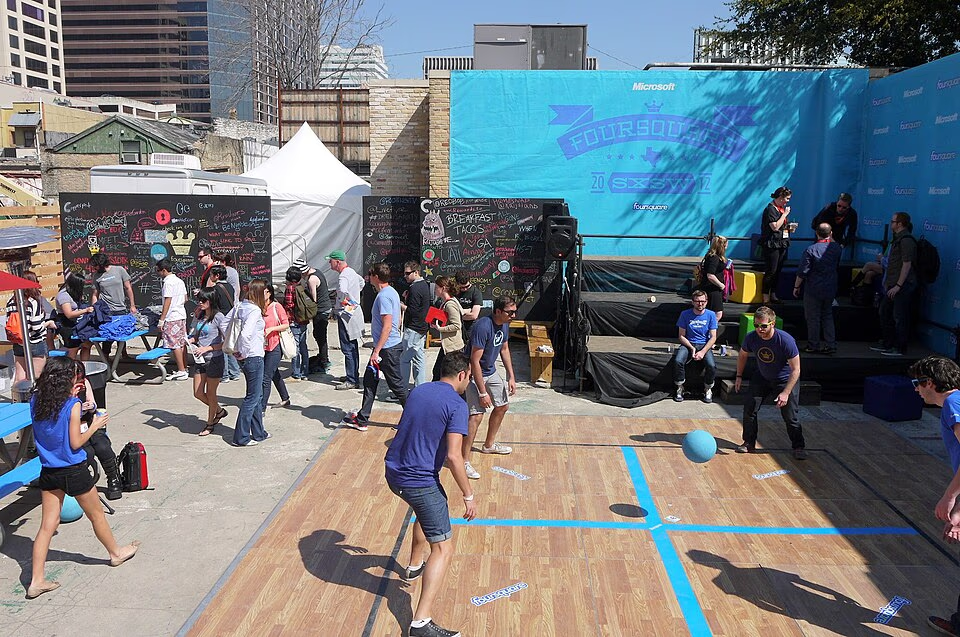

Four Square·Playground Games
Four Square
🌱Community
Loading OpenSourceSports…
Four Square requires exactly four active players at any time, one occupying each quadrant of the court. Players are ranked by their square number, with the King (Square 4) holding the highest rank and the Peasant (Square 1) holding the lowest.
Why people argue about this
People often assume that if there are four players in the game, they must all be actively playing at once, which leads them to think it's a strict count of active players rather than who is currently shooting or has possession of the ball. The confusion arises because the rule doesn't specify when players become inactive; they can still be part of the team even if not actively shooting.
Players advance by surviving rounds and moving into higher-numbered squares as other players are eliminated. Each successful round where a higher-ranked player is eliminated moves the surviving lower-ranked players up one position.
Why people argue about this
People often assume that advancing through squares means simply moving up in number order after each round, forgetting that only players who are eliminated can advance; it's actually about surviving rounds where higher-ranked opponents are removed from play, allowing lower-ranked players to move up a spot.
For young children (ages 5-7): Use a smaller, softer ball; reduce court size to 10x10 feet; prohibit Cherry Bombs and hard spikes; For elementary-age players (ages 8-12): Standard court and ball sizes; adult supervision recommended; encourage Friendlies rules; For adults and competitive play: Ful...
Why people argue about this
People often assume that adult supervision is only necessary during official games in organized settings like school playgrounds, forgetting that it's crucial for informal play on neighborhood courts as well. They overlook the fact that even without formal rules enforcement, a safe environment requires adult presence to prevent accidents and ensure fair play among kids of different ages.
"Around the World" is a King's Rule where the ball must travel to each square in sequential order (King to Queen to Jack to Peasant, or the reverse) rather than to any square. Players must pass the ball to the adjacent square in the declared direction.
Why people argue about this
People often assume that declaring a special rule like "Around the World" only applies to the King's next turn, when in fact it affects every single player move during that round, regardless of who initiated it. The confusion arises because they misinterpret the timing and scope of this declaration.
Ensure the ball is properly inflated before play. An over-inflated ball bounces too high and can cause hand and wrist injuries. An under-inflated ball is unpredictable and leads to frustration; Inspect the ball for cracks, tears, or surface damage before each session. A damaged ball may bounce er...
Why people argue about this
People often assume that adult supervision is only necessary for enforcing penalties and removing troublemakers, forgetting that it's also crucial for teaching proper ball handling techniques and ensuring all players are using balls in good condition, which can be a source of disputes if not monitored closely.
When the ball leaves the court after an elimination, the eliminated player is typically responsible for retrieving the ball and delivering it to the King for the next serve. In organized play, ball retrievers or spare balls may be used to minimize downtime between rounds.
Why people argue about this
People often assume that once a ball leaves the court during an elimination, it's up to the King player to fetch it themselves, which can lead to delays. However, the official rule allows for the use of spare balls or ball retrievers to expedite this process and minimize downtime between rounds.
After the serve, players hit the ball back and forth between squares. On each hit, the ball must bounce exactly once in the receiving player's square.
Why people argue about this
People often assume that the ball must bounce twice in their square before hitting back, which they see as a more generous rule. But actually, the official rule specifies one bounce only in the receiving player's square, leading to confusion about whether this includes the initial serve or not.
Black Magic is legal by default but can be banned by King's Rules. Spinning the ball is considered an advanced technique and is one of the most effective strategies in competitive play.
Why people argue about this
People often assume that spinning the ball is a banned technique under Black Magic simply because it's described as one of the most effective strategies, but actually, spinning the ball is explicitly allowed by default in Four Square and only becomes illegal if King’s Rules decide to ban it. They overlook the fact that Black Magic itself is legal by default unless King’s Rules intervene.
If the ball strikes a player's body (other than their hands or forearms) while the ball is in play, the player who was struck is eliminated. Players may not intentionally use their body to block or redirect the ball.
Why people argue about this
People often assume that body shots are only about intentional contact, forgetting that unintentional strikes can also result in elimination. They overlook the part where it specifically says "may not intentionally use their body," leading to misunderstandings about what constitutes an accidental hit.
"Bus Stop" (also called "holding" or "trapping") is a technique where a player catches or traps the ball momentarily before releasing it. True Bus Stop (catching and throwing) is always illegal as it constitutes a carry.
Why people argue about this
People often assume that declaring a Bus Stop rule means it's only about stopping play like on a real bus stop sign. Actually, it allows the King to temporarily change the game’s basic rules for the duration of the round, which can lead to all sorts of chaos and confusion among players.
Catching, cradling, scooping, or guiding the ball with extended hand contact instead of striking it cleanly. A carry results in immediate elimination of the offending player.
Why people argue about this
People often assume that carrying means literally lifting the ball off the ground with their hands, which is why they argue; however, the official definition of a carry includes catching, cradling, scooping, or guiding it with an extended hand contact rather than striking it cleanly with the foot or racket.
A "carry" occurs when a player's hand remains in contact with the ball for too long during a hit, effectively catching and throwing the ball rather than striking it. Carrying is illegal.
Why people argue about this
People often think that carrying is only about grabbing the ball quickly after hitting it, forgetting that holding onto the ball for a split second longer than usual can also be considered carrying, leading to confusion on when exactly it's illegal.
A "Cherry Bomb" (also called a "slam," "spike," or "tomahawk") is a powerful overhand slam directed at another player's square. The ball is hit forcefully downward, causing it to bounce high and fast, making it difficult to return.
Why people argue about this
People often assume a "Cherry Bomb" is just a regular slam, but they misunderstand the key detail: it must be overhand and directed specifically at another player's square, making it more of an aggressive tactic than a simple forceful hit. The confusion arises because this precise definition isn't always clearly communicated or enforced consistently in games.
Some organized leagues and tournaments use modified scoring systems: Point accumulation: Players earn points based on their square position at the end of each round (4 points for King, 3 for Queen, 2 for Jack, 1 for Peasant, 0 for eliminated). Points are tallied over a set number of rounds; Time-...
Why people argue about this
People think that pool play means each player gets a turn in every game, but actually it's about groups of players playing multiple rounds together, with only the top performers from those groups advancing to the next stage, which can lead to confusion on how exactly the scoring works within these pools.
The standard Four Square court is a 16-foot by 16-foot (4.9 m x 4.9 m) square divided into four equal quadrants, each measuring 8 feet by 8 feet (2.4 m x 2.4 m). For younger players, courts may be reduced to 12 feet by 12 feet (3.7 m x 3.7 m) with 6-foot quadrants.
Why people argue about this
People often assume that the 16-foot by 16-foot court size means each side is exactly eight feet wide, but actually it's a square, so the actual width on one side would be less due to the diagonal of the square being slightly more than 8 feet at any given point.
The court is divided by two perpendicular lines that bisect the square, creating four equal quadrants.
Why people argue about this
People often assume that the two lines bisecting the court must be perfectly parallel to each other, leading them to think they're playing in a square-shaped area rather than four equal quadrants. But the official layout allows for some variation in angle and distance between these lines, which can lead to misunderstandings about how the court is divided.
Chalk: Standard sidewalk chalk for concrete or asphalt surfaces. Lines should be clearly visible and approximately 1-2 inches wide; Tape: Painter's tape or court-marking tape for indoor gymnasium floors. Duct tape may be used on outdoor surfaces for more permanent markings; Paint: Many schoolyard...
Why people argue about this
People often assume that only sidewalk chalk is allowed for court marking materials because they've seen it used in other games, forgetting that the official rule specifically mentions sidewalk chalk or painter's tape. They overlook the fact that the rule doesn't specify which of these two options must be used, leading to confusion about whether either would suffice.
When two or more players disagree on a call and no referee is present, the following resolution methods are available, in order of preference: Redo: Replay the point with a new serve from the King; Showdown: The two disputing players play a 1v1 point to settle the dispute; King's ruling: The King...
Why people argue about this
People often assume that if a call is disputed in Four Square without an official present, players can simply decide by majority vote on the spot. But actually, the rule specifies a structured process for resolving disputes when no referee is available, not just a free-for-all decision-making session among disputing players.
If the ball bounces twice in a player's square before they hit it, that player is eliminated. The bounce must be within the player's own square.
Why people argue about this
People often assume that a double bounce happens only if the ball hits the ground twice before it's hit by the player. They forget about the crucial part where they must be within their own square for the second bounce to count, leading to misunderstandings and disputes over whether an illegal bounce occurred or not.
Hitting the ball twice in succession (unless a King's Rule such as "Double Tap" is in effect). If a player hits the ball and it returns to them without another player touching it, they may not hit it again.
Why people argue about this
People often assume that hitting the ball twice in succession is always a foul, forgetting that if another player touches it between hits, it's okay to hit it again—this double-touch confusion stems from overlooking the crucial "without another player touching it" part of the rule.
Traditional Four Square does not use a point-based scoring system. The game is elimination-based: players are either in the game or out.
Why people argue about this
People often assume that in Four Square, players are eliminated based on who scores the most points, which is why they argue against the official statement. The confusion arises because the game's structure involves players being "out" when their opponent hits all four squares consecutively, not based on a cumulative score system.
Stepping into another player's square to hit the ball is a foot fault. Players must keep both feet within their own square (or outside the court) when striking the ball.
Why people argue about this
People often assume stepping into another player's square is just a penalty for being too aggressive, but in fact, it’s explicitly defined as a foot fault because the rule prevents players from gaining an unfair advantage by positioning themselves to hit the ball before their opponent can react, thus ensuring fair play and equal chances.
"Friendlies" (also called "tea party" or "gentle play") is a King's Rule where aggressive shots such as Cherry Bombs, hard spikes, and fast slams are prohibited. All hits must be moderate in force, promoting a rally-style game.
Why people argue about this
People often assume that only the King can declare Friendlies and Unfriendlies, forgetting that any player in the game has the right to request a special round at any time by asking for "King's Rules." The confusion arises because they mistakenly believe these are solely the King’s prerogative, overlooking their collective power.
Deliberately aiming the ball at another player's head or face is unsportsmanlike and results in elimination of the hitter. If the ball incidentally strikes a player above the shoulders during normal play, the play may be ruled a redo at the refere...
Why people argue about this
People often assume that hitting above shoulders is only considered unsportsmanlike if it's intentional, so they argue about whether a player meant to hit high or just happened to do so accidentally during gameplay. The confusion arises because the rule doesn't differentiate between intent and accident in its application.
Interference occurs when an outside factor disrupts play. Common interference situations include: A player from the queue stepping onto the court during active play; Another ball or object rolling onto the court; A spectator or passerby obstructing a player's movement
Why people argue about this
People often assume interference means a player physically touches another during gameplay, which is incorrect in Four Square as per official rules. The real issue is when an outside factor like a ball or stray object from the sidelines interferes with play, and this can be tricky to spot since it doesn't involve direct physical contact between players.
In competitive and organized play, a player's "King streak" (the number of consecutive rounds they maintain the King position) is the primary measure of performance. A player who defends the King position for 10 consecutive rounds has achieved a 10-round streak.
Why people argue about this
People often argue that a 10-round streak is too short for such an important performance metric in Four Square, thinking it's meant to be even longer like some other sports do, but actually, the official rule specifies exactly what constitutes a "streak" as 10 consecutive rounds of defending the King position.
One of the most distinctive features of Four Square is the King's Rules system. At the start of each round (or each time a new King ascends), the King may declare one or more special rules that apply for the duration of that round.
Why people argue about this
People often assume that as King, you can make up any crazy rule you want, but in reality, the King must choose from a predefined list of special rules like "no double-kicks" or "double points for winning," ensuring fairness and keeping it simple yet strategic.
Players may strike the ball using any part of their hands or forearms.
Why people argue about this
People often assume that only hitting with the hands is allowed in Four Square, mistakenly believing forearms are off-limits for legal hits despite the official rules stating otherwise. The confusion arises because the rulebook explicitly mentions using "any part of their hands or forearms," which includes the forearm as a valid striking area.
Line rules are among the most debated aspects of Four Square. The standard rules are as follows: Outside lines: A ball that lands on or outside the outer boundary line is out of bounds. The last player to touch the ball is eliminated; Inside dividing lines: A ball that lands on an inside dividing...
Why people argue about this
People often assume that if a ball touches the line during play in Four Square, it's automatically out, which leads to arguments. However, the official rule states that if the ball crosses the line while in motion and is not touched by a player, it’s considered good - only direct contact with the line results in an out. This subtle distinction can cause confusion and disputes among players.
Outside boundary lines: The outer perimeter of the 16x16 foot court. Balls landing outside these lines are out of bounds; Inside dividing lines: The two lines that divide the court into quadrants. These lines belong to the lower-numbered square in most rulesets; Line width: Lines should be 1-2 in...
Why people argue about this
People often assume that lining up 6 feet away from the court boundary is solely for safety reasons, but they overlook the fact that it prevents their teammates from accidentally bumping into them while entering the game, which can disrupt play and lead to disputes over who entered first.
The objective of Four Square is to advance to the King position (Square 4) and remain there for as many consecutive rounds as possible. Players advance by eliminating higher-ranked opponents through strategic ball placement, spin, and speed.
Why people argue about this
People often think that advancing means simply getting closer to the King position, but in reality, it's about remaining there for as many rounds as possible without being eliminated by a lower-ranked player. The confusion arises because they focus too much on reaching the goal rather than maintaining control of their space once they get there.
Numbered markers: Cones or signs labeled 1-4 (or King, Queen, Jack, Peasant) placed in each square; Spare balls: At least one backup ball in case the primary ball is damaged or lost; Whistle: For organized play with a referee
Why people argue about this
People often assume that optional equipment in Four Square allows them to use any ball they want, leading to arguments about whether a beach volleyball could be used instead of the standard rubber playground ball. The confusion arises because the official rule clearly specifies what constitutes optional equipment for this game.
Hitting the ball so that it lands outside the court boundary without first bouncing in another player's square. The hitter is eliminated.
Why people argue about this
People often assume that hitting the ball out of bounds means it must land completely outside the court boundary, which leads them to argue about whether a partial bounce in their own square still counts as being "out." Actually, the rule only considers the ball's final position after bouncing; if it touches any part of the opponent's square before landing fully outside, they are out.
In casual play, violations are enforced by group consensus. The offending player goes to the back of the queue.
Why people argue about this
People often assume that in casual Four Square games, if a violation happens, it's decided by a coin toss who gets penalized. But actually, the official rule states that violations are resolved through group consensus, and the player who committed the infraction goes to the back of the queue rather than flipping a coin for punishment.
Four Square is a non-contact sport. Players must not push, shove, trip, or block other players; Players should be aware of others' positions to avoid collisions, especially when lunging for the ball near dividing lines; If two players collide, the point should be replayed (redo) and the players r...
Why people argue about this
People often assume that physical contact is strictly prohibited in Four Square matches, forgetting that friendly bumping between players during play is part of the game's strategy and spirit. The confusion arises because they overlook the nuances of how much physical interaction is allowed for competitive advantage versus what constitutes unsafe or unsportsmanlike conduct.
King (Square 4): The highest-ranked player. The King serves the ball and, in many rulesets, has the privilege of declaring special rules for the round. Retaining the King position through multiple rounds is the primary objective; Queen (Square 3): The second-ranked player. The Queen is one elimin...
Why people argue about this
People often assume that if a higher-numbered player is eliminated, all players move up one position regardless of their current square number, leading to arguments about which squares should be vacated and who moves where. The confusion arises because this rule only applies when an elimination occurs in lower-numbered squares, not for those already above it.
Preferred: Smooth concrete, asphalt, or sealed gymnasium flooring; Acceptable: Rubber sport court surfaces, outdoor basketball courts, tennis courts; Not recommended: Grass, gravel, sand, or any surface where the ball does not bounce consistently
Why people argue about this
People often assume that the line width of 1-2 inches is strictly about making lines visible, but they overlook the fact that these precise measurements are crucial for ensuring fair play by maintaining consistent playing areas between players. The exact dimensions help prevent any potential disputes over who's in bounds or out of bounds during a game.
"Popcorn" (also called "babies" or "tiny taps") is a technique where a player hits the ball very softly, causing it to barely clear the line and bounce low in the opponent's square. Popcorn shots are legal but can be countered by King's Rules requiring minimum hit force or height.
Why people argue about this
People often think the "Popcorn" rule only applies when a player's body is hit directly by the ball, forgetting that it also covers situations where a player inadvertently blocks or redirects the ball with their body, which could be seen as unintentional but still results in elimination.
Warm up before playing, especially before competitive sessions. Light stretching of hands, wrists, shoulders, and legs is recommended; Players with hand or wrist injuries should avoid playing until healed, as repeated ball strikes can aggravate existing conditions; Encourage players to hit the ba...
Why people argue about this
People often assume that adult supervision is only about preventing physical harm, so they argue it's unnecessary since Four Square doesn't involve contact. The actual confusion arises because they overlook how adult presence can prevent more subtle forms of danger like unsuitable gameplay or bullying among children, and ensure the game runs smoothly according to rules without chaos.
Casual games are typically self-officiated, with disputes resolved by consensus or by the King's ruling. In organized or competitive play, a designated referee may be used to make line calls, rule on disputed plays, and enforce the rules.
Why people argue about this
People often assume that casual Four Square games don't need a referee at all, which leads to disputes when someone does step in as one. The issue is figuring out who gets to be the referee and what their specific role should be—whether it's just for making line calls or handling more serious rule violations.
When a player is eliminated, all players in lower-numbered squares advance one position. For example, if the Queen (Square 3) is eliminated, the Jack moves to Square 3 and the Peasant moves to Square 2.
Why people argue about this
People often assume that only the player who was eliminated moves up a spot, forgetting that all players in lower-numbered squares move forward one position as well. This oversight leads to confusion about whose turn it is after an elimination, especially when multiple players are ahead of the eliminated player.
In competitive formats, a scorekeeper may track King retention streaks, individual win records, and elimination statistics. This role is unnecessary for casual play.
Why people argue about this
People often assume that a scorekeeper is essential for keeping track of scores in every game, forgetting that Four Square can be played casually without one. The misunderstanding stems from believing that competition requires detailed record-keeping, while casual play naturally evolves with no need for such formalities.
Type: Standard rubber playground ball (also called a kickball or utility ball); Size: 8.5 inches (21.6 cm) in diameter is the standard; 10-inch balls are acceptable for younger players; Material: Inflatable rubber with a textured surface for grip
Why people argue about this
People often assume that any ball will do in Four Square as long as it's soft, forgetting that a 8.5-inch diameter is specifically outlined for fairness and safety. They think they can use whatever they have on hand, but actually, the official rule dictates using only standard inflatable rubber balls to ensure consistent gameplay conditions across all games.
The standard Four Square court is a 16-foot by 16-foot (4.9 m x 4.9 m) square divided into four equal quadrants, each measuring 8 feet by 8 feet (2.4 m x 2.4 m). For younger players, courts may be reduced to 12 feet by 12 feet (3.7 m x 3.7 m) with 6-foot quadrants.
Why people argue about this
People often assume that the exact dimensions of 16 feet by 16 feet are for each side of the court, leading to arguments about how much space is actually available for playing. Actually, this dimension refers to the total area including both sides and the center circle, which can lead to misunderstandings on how much usable court surface players have access to.
Four Square requires exactly four active players at any time, one occupying each quadrant of the court. Players are ranked by their square number, with the King (Square 4) holding the highest rank and the Peasant (Square 1) holding the lowest.
Why people argue about this
People often assume that a player can leave their square at will without consequence, thinking it's just about who starts with which square number. But actually, the rule strictly mandates exactly four players active in each quadrant at all times, so leaving your spot is not allowed and results in immediate penalty.
The objective of Four Square is to advance to the King position (Square 4) and remain there for as many consecutive rounds as possible. Players advance by eliminating higher-ranked opponents through strategic ball placement, spin, and speed.
Why people argue about this
People often assume that winning the King position is solely about having the fastest spin or quickest reflexes, forgetting that strategic ball placement can be just as crucial in eliminating opponents early on. The confusion arises because they overlook how positioning the ball to force an opponent into a lower square can be more effective than relying purely on speed and skill.
Traditional Four Square does not use a point-based scoring system. The game is elimination-based: players are either in the game or out.
Why people argue about this
People often assume that Four Square involves a point system like basketball or soccer, where you win by accumulating more points than your opponents. But in traditional Four Square, scoring is actually about elimination - players are either still playing (in) or have been eliminated from the game (out), which leads to some confusion when they expect to see scores and rankings on a board.
Catching, cradling, scooping, or guiding the ball with extended hand contact instead of striking it cleanly. A carry results in immediate elimination of the offending player.
Why people argue about this
People think you can only be penalized for catching or carrying the ball if it's thrown directly at you, but in Four Square they argue over whether tossing the ball into play from another player counts as a carry too, even if it's not aimed specifically at them. The confusion arises because of how loosely defined "direct contact" is interpreted by different players and officials.
Games involving children should have adult supervision, particularly on school playgrounds and in organized recreation settings. Supervisors should be familiar with the rules and empowered to resolve disputes, enforce safety rules, and remove players who engage in dangerous behavior.
Why people argue about this
People often assume that adult supervision is only for enforcing rules and removing troublemakers, forgetting its primary role in ensuring safety, which can lead to misunderstandings about what "adult supervision" entails in a Four Square game setting. The confusion arises because they overlook how crucial it is to create a safe environment where kids can play without fear of injury or harm.
The King serves by dropping the ball and striking it after one bounce within their own square; The serve must land in the Peasant's square (Square 1) in standard rules. Some variations allow the King to serve to any square; The serve must be underhand. Overhand serves are not permitted on the ope...
Why people argue about this
People often assume that only their hands are allowed in service, forgetting that forearms can be used too. This leads to arguments when players inadvertently use their forearms during a serve, thinking they're breaking the rules by using anything other than their palms.
All serving violations result in the server's (King's) elimination.
Why people argue about this
People often assume that serving violations are about who starts first in a game of Four Square, forgetting that these violations pertain specifically to how players serve their balls - like flicking or bouncing it off another player's square instead of directly into play. They think it’s just about starting order, but the real issue is with serving technique and fairness in gameplay.
"Showdown" is a method for resolving disputes when two players disagree about a call (such as whether the ball was in or out, or who touched it last). In a Showdown, the two disputing players face off in a one-on-one rally using only their two squares.
Why people argue about this
People often assume that if a player accidentally touches the ball with their body during play, they're instantly out, which leads to arguments when it's actually only intentional contact or blocking that results in elimination according to the rule.
Each round begins with the King serving the ball. The King drops the ball and hits it after one bounce, directing it into the Peasant's square (Square 1).
Why people argue about this
People often assume that the King can serve from anywhere in their square as long as it bounces once before hitting it into the Peasant's square, but actually, they must drop it deliberately to ensure fairness and consistency across all rounds.
When playing outdoors, ensure players have access to water and shade during breaks; Avoid playing on hot asphalt during peak summer heat, as the surface can cause burns from falls and the ball may become slippery from sweat; Suspend play during lightning, heavy rain, or high winds that affect bal...
Why people argue about this
People think that adult supervision is only necessary for safety reasons, forgetting that it's also crucial for enforcing the rules fairly and ensuring disputes are resolved in a way that maintains the spirit of the game, which can sometimes lead to disagreements about how games should be played or who gets penalized.
Games involving children should have adult supervision, particularly on school playgrounds and in organized recreation settings. Supervisors should be familiar with the rules and empowered to resolve disputes, enforce safety rules, and remove players who engage in dangerous behavior.
Why people argue about this
People often assume that supervision is only about ensuring kids don't get hurt physically, so they argue it's unnecessary if players are just throwing a ball around in Four Square. But what they miss is how crucial adult oversight can be in interpreting and enforcing rules fairly, especially when disputes arise over scoring or gameplay interpretation among young players.
Inspect the playing surface for cracks, holes, raised edges, wet patches, loose gravel, or debris before play; Wet surfaces are slippery and significantly increase the risk of falls. Do not play on wet concrete or asphalt; Indoor gymnasium floors should be clean, dry, and free of dust or wax buildup
Why people argue about this
People often assume that adult supervision is only about preventing kids from getting hurt by other players, forgetting that it's also crucial for ensuring games are played safely according to the rules—like removing hazards like loose tiles or protruding equipment that could cause slips and falls, which directly impacts their understanding of what "surface hazards" truly mean in Four Square.
A minimum of 6 feet (1.8 m) of clear space should surround all sides of the court. This buffer zone allows players to chase errant balls and prevents collisions with walls, fences, or other obstacles.
Why people argue about this
People often assume that the 6-foot clearance is about creating a safe zone from accidental collisions, but in reality, it's more about ensuring each player has enough room to execute their dribbling moves and spin turns without hitting their opponent’s feet or legs. The rule isn't just about safety; it's crucial for maintaining the game's fluidity and fairness among players.
Type: Standard rubber playground ball (also called a kickball or utility ball); Size: 8.5 inches (21.6 cm) in diameter is the standard; 10-inch balls are acceptable for younger players; Material: Inflatable rubber with a textured surface for grip
Why people argue about this
People think that the ball should bounce at waist height when dropped from head height instead of shoulder height, but the official intention is for it to be waist-height when thrown from shoulder level during a serve or shot attempt. This discrepancy often leads to arguments about how high players believe they need to hit the ball to comply with the rule.
Any number of additional players may wait in a queue (also called "the line" or "the bench") adjacent to Square 1. When a player is eliminated from the court, they go to the back of the queue, all remaining players advance one square, and the first player in the queue enters Square 1.
Why people argue about this
People often assume that players in the queue automatically get a turn right away when someone is eliminated, forgetting about advancing all remaining players one square before the new player enters Square 1. This oversight leads to misunderstandings and disputes over whose turn it is next.
The King serves from within their square (Square 4). The ball must be served diagonally to Square 1 (Peasant).
Why people argue about this
People often assume that the 6-foot distance from the court boundary is solely for safety reasons, forgetting that it's also meant to prevent them from accidentally interfering with players who are already serving or playing in Square 1, which could lead to disputes over whether a player entered the game too early.
"Tipping" occurs when a player barely grazes the ball with their fingertips, failing to redirect it with a clean hit. In most rulesets, a tip counts as a touch, meaning if the ball then goes out of bounds or fails to land in a valid square, the tipper is responsible.
Why people argue about this
People think that if a ball is knocked out of bounds during an elimination, they must personally retrieve it themselves, which can be frustratingly time-consuming in fast-paced games. But actually, the rule allows for spare balls or ball retrievers to expedite this process and minimize downtime between rounds.
Tournament play may use single-elimination brackets, double-elimination brackets, or pool play followed by knockout rounds. In pool play, groups of 6-8 players play Four Square for a set number of rounds, with the top performers advancing to the next stage.
Why people argue about this
People often assume that in pool play, each group of players plays against every other player within their group for advancement, which can lead to a lot of games played and potentially long tournaments. However, the official verdict clarifies that it's actually just groups playing multiple rounds, with only top performers advancing, so there’s no need for all those matches.
The following behaviors are considered unsportsmanlike and may result in elimination or removal from the game: Intentionally hitting another player with the ball (as opposed to hitting their square); Verbal abuse, taunting, or excessive trash talk; Deliberately interfering with another player's m...
Why people argue about this
People often assume that just because a player is ejected for unsportsmanlike conduct doesn't mean they're out of the game permanently. They think it's an immediate ban from all future games, but actually, it means they get removed from their current match and could be reinstated if no further issues arise.
Players waiting to enter the game should line up in an orderly queue adjacent to Square 1. The waiting area should be at least 6 feet from the court boundary to avoid interference with active play.
Why people argue about this
People think they can stand anywhere near Square 1 as long as they're in the waiting area, but actually, the official rule requires them to line up adjacent to Square 1 with at least a 6-foot buffer from the court boundary to prevent interference and maintain clear play space for active players.