Section 1: Introduction
Capture the Flag is a classic outdoor team game in which two teams each defend a flag placed within their own territory while simultaneously attempting to infiltrate the opposing team's territory, seize their flag, and carry it back across the boundary line. The game combines elements of speed, stealth, teamwork, and strategic planning, making it one of the most popular playground and recreation games worldwide.
Origins and Popularity
Capture the Flag has roots in military training exercises and battlefield simulations. Over time it evolved into a widely played recreational game at summer camps, schools, community events, and organized youth programs. Its simplicity and scalability allow it to be enjoyed by groups ranging from a handful of friends to large organized events with dozens of participants.
Spirit of the Game
Capture the Flag relies on fair play, honesty, and sportsmanship. Because there are no formal referees in most casual settings, players are expected to acknowledge when they have been tagged, respect boundaries, and resolve disputes amicably. The primary objective is fun, teamwork, and active outdoor play.
Section 2: Equipment
Required Equipment
- Two flags: One per team. Flags can be bandanas, scarves, towels, shirts, or purpose-made fabric flags. Each team's flag should be a distinct, easily identifiable color.
- Boundary markers: Cones, chalk lines, rope, natural landmarks (trees, fences), or any visible markers to delineate the center line and playing-area boundaries.
Optional Equipment
- Pinnies or team bands: Colored vests or wristbands to clearly identify team membership, especially useful with large groups.
- Timer or stopwatch: For timed rounds or sudden-death periods.
- Whistle: For a designated referee or to signal the start and end of rounds.
- Glow sticks or flashlights: For nighttime variants of the game.
- Jail markers: Cones or chalk to mark jail zones within each territory.
Flag Specifications
Flags should be large enough to be clearly visible when placed and when carried by a player. A minimum size of roughly 30 cm x 30 cm (12 in x 12 in) is recommended. Flags must be placed so they are partially visible and not completely concealed inside an object or buried underground.
Section 3: Playing Area
Field Layout
The playing field is a large open area divided into two equal halves by a clearly marked center line (the "boundary line" or "midfield line"). Each half is one team's territory. The recommended minimum field size is approximately 30 m x 60 m (100 ft x 200 ft), though this can be adjusted based on the number of players and available space.
Territory Zones
- Team Territory: Each team's half of the field. Players are safe from being tagged while in their own territory.
- Flag Station: A designated area at the far end or center-rear of each team's territory where the flag is placed. The flag station should be clearly marked and accessible from multiple directions.
- Jail Zone: A designated area within each team's territory where tagged opponents are held. The jail should be clearly marked and positioned away from the flag station, typically near the boundary line or in a visible location.
- Safe Zone (optional): A narrow strip along the boundary line where players from either team cannot be tagged. This variant is sometimes used to encourage crossing.
Field Requirements
- The playing surface should be relatively flat and free of major obstacles or hazards.
- Outdoor grass fields, parks, and open spaces are ideal.
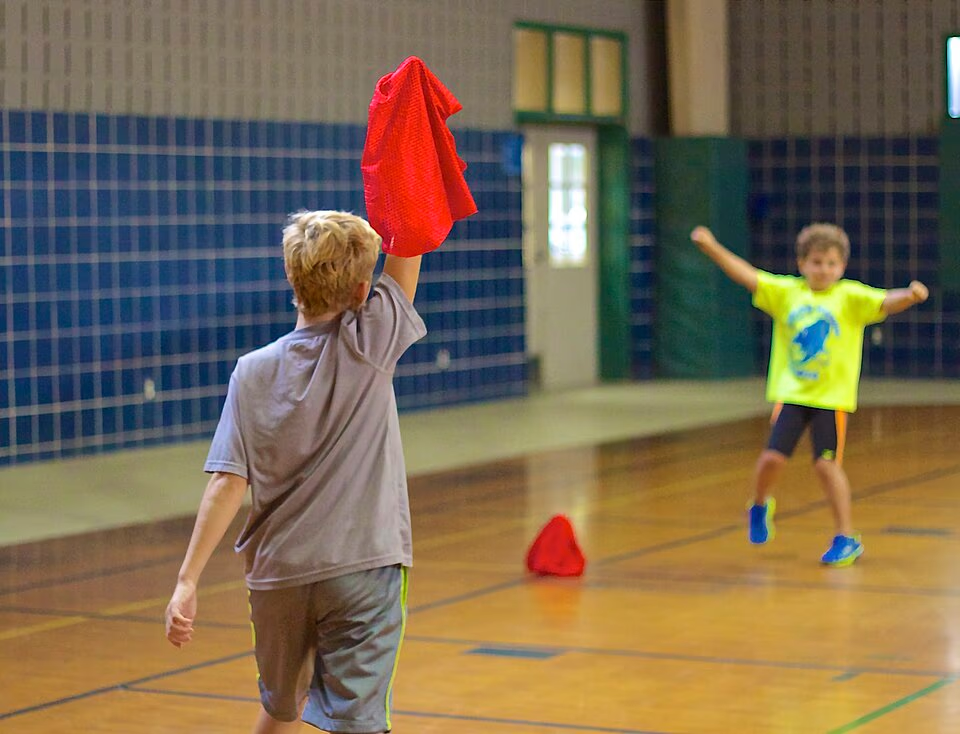
- Indoor gymnasiums or large halls can be used with adjusted boundaries.
- Natural features such as trees, hills, and bushes add strategic depth but should not pose safety risks.
- All outer boundaries must be clearly defined so players know the limits of the playing area.
Flag Placement Rules
- Each team places their flag within their own territory before the game begins.
- The flag must be visible — it cannot be hidden inside a container, buried, or tied to a player's body.
- The flag must be placed on the ground or mounted on a post or cone at waist height or below.
- The flag may be placed anywhere within the team's territory but is typically at the far end, away from the center line.
- A "no-guard zone" circle with a radius of approximately 3 m (10 ft) around the flag may be enforced, meaning defenders cannot stand within this zone unless an attacker is also inside it.
Section 4: Players & Officials
Team Composition
- Minimum players: 4 total (2 per team)
- Recommended: 10-20 total (5-10 per team)
- Maximum: No formal limit; large-scale games with 20+ players per team are common at camps and organized events
- Teams must have an equal number of players. If numbers are uneven, one player may sit out or rotate between teams each round.
Player Roles
While all players are equal, teams typically assign informal roles based on strategy:
- Attackers (Runners): Fast players who attempt to cross into enemy territory, evade defenders, and capture the flag.
- Defenders (Guards): Players who patrol their own territory to tag intruders and protect the flag.
- Midfielders: Players who position themselves near the boundary line to support both offense and defense.
- Jail Breakers: Players who specifically target the enemy jail to free captured teammates.
- Scouts: Players who cross the boundary to gather information about enemy flag placement and defensive positions before committing to a full run.
Officials
- Casual play: No officials required. Players self-officiate using the honor system.
- Organized play: One or two neutral referees are recommended to settle disputes, monitor boundaries, confirm flag captures, and ensure safety.
- Large events: Additional line judges may be stationed along boundaries and at jail zones.
Section 5: Rules of Play
Starting the Game
- Divide players into two equal teams. Each team is assigned one half of the playing field.
- Each team places their flag within their territory according to the flag placement rules.
- Teams are given a brief preparation period (1-3 minutes) to plan strategy and assign roles.
- A whistle, countdown, or verbal signal starts the game. Both teams begin play simultaneously.
Core Gameplay
- Players attempt to cross into the opposing team's territory, locate their flag, and carry it back across the boundary line into their own territory.
- While in enemy territory, a player can be tagged by any opposing player. A valid tag is a firm but gentle touch on the torso, arm, or shoulder. No pushing, grabbing, tackling, or striking is permitted.
- When a player is tagged in enemy territory, they must immediately proceed to the tagging team's designated jail zone.
- Players in their own territory cannot be tagged.
- The flag must be picked up and carried by hand. It cannot be thrown, kicked, hidden on the body (e.g., stuffed inside clothing), or passed to a teammate.
- If a flag carrier is tagged, the flag is dropped at the spot where the tag occurred. The defending team may return the flag to its original station, or it remains where it was dropped (agree on this rule before play).
The Jail System
- Tagged players are sent to the opposing team's jail zone and must remain there until freed.
- Jailed players can be freed when a teammate enters the jail zone and tags one or more jailed players (depending on the agreed variant).
- Single rescue: One tag frees one jailed player.
- Mass rescue (jailbreak): One tag frees all currently jailed players. This is the most common variant.
- Freed players and their rescuer receive a "free walk" — they may return to their own territory without being tagged. They must walk (not run) directly back.
- A player performing a jail rescue cannot simultaneously carry the flag during the same trip.
Winning the Game
The game is won when a player successfully carries the opposing team's flag across the boundary line into their own territory. The flag carrier must have both feet across the line with the flag in hand for the capture to count.
Timed Games
- If no capture occurs within the agreed time limit (typically 10-20 minutes per round), the round ends in a draw or the team with fewer jailed players wins.
- An overtime or sudden-death period may be added where the first flag capture wins.
Game Variants
Multiple Flags
- Each team has 2-3 flags placed at different locations within their territory.
- Teams must capture all of the opposing team's flags to win, or the team with the most captured flags at the end of the time limit wins.
Nighttime Capture the Flag
- Played after dark with glow sticks attached to each player for visibility.
- Flags are replaced with glow-in-the-dark objects or illuminated flags.
- Boundaries must be well-lit or clearly marked with reflective tape.
- Adult supervision is strongly recommended.
Indoor Capture the Flag
- Played in a gymnasium, large building, or multi-room indoor space.
- Boundaries are walls, hallways, or tape on the floor.
- Running may be restricted to walking to prevent collisions in tight spaces.
Flag Football Hybrid
- Instead of tagging, each player wears a flag belt. A "tag" is achieved by pulling a flag from the opponent's belt.
- This variant removes disputes about whether a tag was valid.
Freeze Tag Variant
- Instead of going to jail, tagged players freeze in place where they were tagged.
- Teammates can unfreeze them with a tag.
- This variant keeps all players on the field and increases action near the boundary line.
Capture the Flag with Shields
- Each player carries a soft object (pool noodle, foam ball, or dodgeball).
- Players are "tagged" by being hit with the soft object rather than hand-tagged.
- This variant adds a throwing and dodging element to the game.
Section 6: Scoring
Standard Scoring
- The first team to successfully capture the opposing team's flag and return it to their own territory wins the round.
- A single capture ends the round immediately.
Match Formats
- Single round: First capture wins the match.
- Best of 3: First team to win 2 rounds wins the match. Teams switch sides between rounds.
- Best of 5: First team to win 3 rounds wins the match. Used in tournament settings.
- Timed match: Multiple rounds within a fixed time. The team with the most round wins at the end of time wins the match.
Tiebreaker Methods
- Sudden death: One additional round with a reduced time limit (5 minutes). First capture wins.
- Jail count: If time expires with no capture, the team with fewer jailed players wins.
- Flag advancement: The team whose flag carrier advanced furthest into enemy territory (or closest to returning) is awarded the win.
Point-Based Scoring (Tournament Variant)
For organized tournaments or leagues, a point system may be used:
- Flag capture: 5 points
- Jailbreak rescue: 1 point per player freed
- Clean round (no players jailed): 2 bonus points
- The team with the most points across all rounds wins the match.
Section 7: Violations & Penalties
Common Violations
- Flag throwing: Throwing, kicking, or tossing the flag instead of carrying it by hand.
- Flag hiding: Concealing the flag inside clothing, under objects, or in any way that makes it invisible to opponents.
- Flag guarding (camping): A defender standing within the no-guard zone around the flag when no attacker is present. This prevents stalemates.
- Refusing jail: A tagged player who does not go to jail, argues excessively about a tag, or delays going to jail.
- Out of bounds: Leaving the designated playing area to gain a strategic advantage or avoid being tagged.
- Physical contact: Pushing, grabbing, holding, tackling, or any contact beyond a light tag.
- Flag relocation: Moving the flag from its original station without authorization.
- Illegal passing: Handing or tossing the flag to a teammate (unless a specific variant allows this).
Penalties
- Flag throwing/passing: The flag is returned to its original station. The offending player is sent to jail.
- Flag guarding: First offense results in a warning. Repeated offenses may result in the offending player being sent to their own jail for a set time (1-2 minutes).
- Refusing jail: The player is sent to jail with an additional time penalty (must remain in jail for one extra round of play even if a jailbreak occurs).
- Out of bounds: The player is immediately sent to the nearest jail.
- Physical contact: The offending player is removed from the current round. Repeated offenses result in ejection from the match.
- Flag relocation: The flag is returned to its station and the offending team receives a warning.
Dispute Resolution
- In casual play, disputes are resolved through honest discussion between the involved players.
- If a referee is present, their decision is final.
- The "do-over" rule may be invoked: if a tagging situation is unclear, the play is reset with the attacking player returning to the boundary line unpenalized.
Section 8: Safety Considerations
Physical Safety
- No tackling or physical contact beyond a gentle tag on the arm, shoulder, or torso. This is the most important safety rule.
- Players should wear appropriate footwear for the playing surface (athletic shoes for grass, non-slip shoes for gymnasium floors).
- Remove jewelry, watches, and other items that could cause injury during tagging.
- Players with existing injuries or medical conditions should inform others before play.
Field Safety
- Inspect the playing area before the game for hazards such as holes, rocks, broken glass, tree roots, sprinkler heads, or uneven ground.
- Establish clear boundaries that keep players well away from roads, parking lots, bodies of water, steep drops, and other environmental hazards.
- Mark any obstacles within the playing area that cannot be removed (trees, posts, benches) so players are aware.
- Ensure adequate lighting for evening games. Do not play in darkness without proper illumination.
Weather Considerations
- Avoid playing on wet or slippery surfaces to prevent falls.
- In hot weather, provide access to water and take regular hydration breaks.
- Watch for signs of heat exhaustion, especially during long matches.
- Suspend play during lightning, heavy rain, or other severe weather conditions.
Age-Appropriate Play
- Younger children (under 8) should play with simplified rules, shorter fields, and close adult supervision.
- Mixed-age groups should emphasize that older or larger players must tag gently and be mindful of smaller participants.
- For very young players, consider walking-only rules to reduce collision risk.
Emergency Procedures
- Designate a central meeting point in case of emergency.
- Ensure at least one adult or responsible participant has access to a first aid kit.
- Establish a clear signal (whistle blow, specific call) that immediately stops all play.
- All players should know the location of the nearest shelter and emergency exits (for indoor play).