Section 1: Introduction
Overview
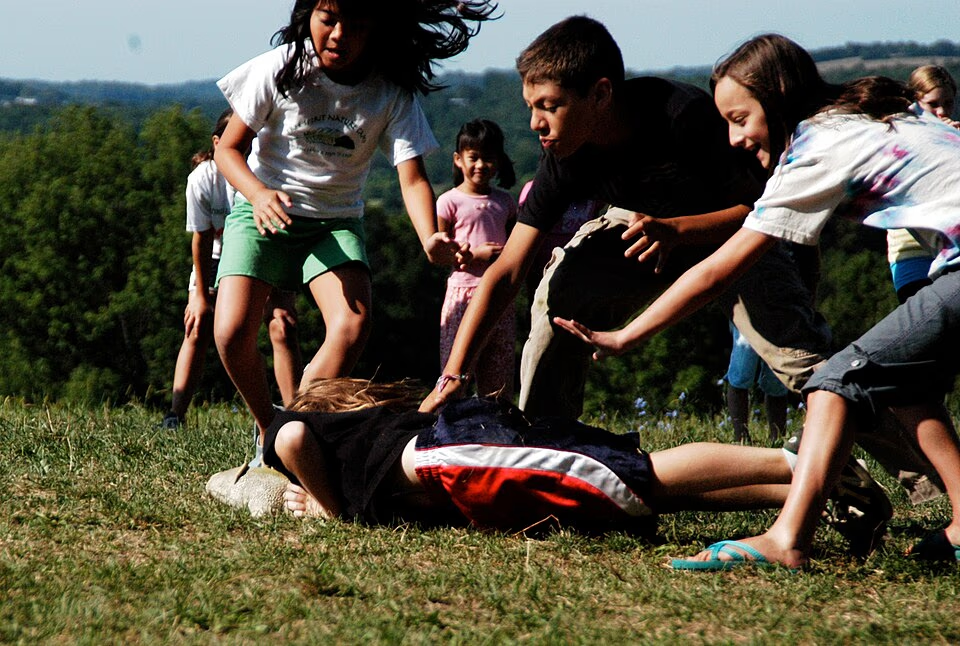
Tag is one of the oldest and most universal games in human history. At its core, the game is elegantly simple: one player designated as "IT" chases the other players and attempts to touch (tag) one of them. When a player is tagged, they become the new IT, and the cycle continues. This basic mechanic of pursuit and evasion has captivated children and adults across every continent and every era of recorded history.
History and Origins
Tag predates written history. Virtually every culture on Earth has independently developed some form of chase game. Ancient Greek pottery from the 5th century BCE depicts children playing chase games. In medieval Europe, variations of tag were played in village squares and churchyards. The Japanese game "Onigokko" (demon chase) dates back centuries, while "Kabaddi" in South Asia blends tag with wrestling and has roots stretching back thousands of years. The English word "tag" likely derives from the Middle English "tek" meaning "touch" or "tap." In many cultures the game goes by different names: "Tig" in parts of the United Kingdom, "Fangen" in Germany, "Chat" in France, "Pilla-pilla" in Spain, and "Kejar-kejaran" in Indonesia.
Cultural Significance
Tag holds a special place in childhood development and playground culture. It is often the first organized game children learn to play, requiring no equipment, no literacy, and no formal instruction. The game teaches fundamental social and physical skills: spatial awareness, negotiation of rules, burst speed, agility, decision-making under pressure, and the concept of fair play. Developmental psychologists recognize tag as a critical form of play that helps children process concepts of pursuit, escape, risk assessment, and social hierarchy.
Worldwide Variations
The simplicity of tag's core mechanic has led to an extraordinary number of variations worldwide. From Freeze Tag on American playgrounds to British Bulldog in the United Kingdom, from Marco Polo in swimming pools to Kabaddi on professional sports fields, tag's DNA runs through dozens of formalized games. This document covers the foundational rules of classic tag along with the most popular and widely played variants.
Spirit of the Game
Tag is meant to be fun, inclusive, and accessible. The game thrives on laughter, excitement, and the thrill of the chase. Players of all ages and athletic abilities can participate. The rules are intentionally flexible, allowing groups to adapt the game to their environment, group size, and preferences. Sportsmanship, honesty, and mutual respect are the cornerstones of every game of tag.
Section 2: Equipment
Core Requirements
Tag requires no equipment whatsoever. This is one of the game's greatest strengths — it can be played anywhere, anytime, by anyone, with nothing but open space and willing participants. No ball, no net, no bat, no goal. Just players and a place to run.
Optional Boundary Markers
- Cones: Plastic sport cones can be used to mark the boundaries of the playing area, especially on open fields where natural landmarks are absent
- Chalk: Sidewalk chalk can outline boundaries on paved surfaces such as playgrounds, driveways, or parking lots
- Natural landmarks: Trees, sidewalks, fences, walls, and painted lines on sports courts all serve as effective boundary markers
- Rope or tape: In indoor settings, masking tape or jump ropes laid on the floor can define the play area
Optional Identification for IT
- Pinnie or vest: A brightly colored vest or pinnie worn by IT makes it easy for all players to identify who is chasing
- Hat or bandana: A hat, bandana, or headband passed to the new IT upon tagging
- Pool noodle or foam baton: In some variants, IT carries a soft foam object and tags by touching other players with it, reducing disputes about whether a tag occurred
- Flashlight: Required for Flashlight Tag (nighttime variant); a standard handheld flashlight used by IT to "tag" by shining the beam on a player
Optional Safe Zone Markers
- Base markers: Cones, hula hoops, mats, or chalk circles to designate safe zones or bases where players cannot be tagged
- Flags or ribbons: Used in Flag Tag variants where players wear flags tucked into waistbands; pulling a flag constitutes a tag
Footwear and Clothing
- Closed-toe athletic shoes are recommended for outdoor play on grass or hard surfaces
- Bare feet are acceptable on soft grass or sand but increase the risk of cuts and stubbed toes
- Loose, comfortable clothing that allows free movement is ideal
- Avoid scarves, necklaces, lanyards, or dangling accessories that could catch on objects or other players
Section 3: Playing Area
Outdoor Spaces
Tag is most commonly played outdoors. Ideal outdoor playing areas include:
- Grass fields: School playgrounds, parks, backyards, and sports fields provide soft, open terrain
- Paved areas: Blacktop playgrounds, driveways, cul-de-sacs, and basketball courts offer firm, flat surfaces
- Beaches: Sand provides a soft landing surface, though running speed is reduced
- Wooded areas: Light forest or tree-dotted parks add obstacles and hiding spots for more dynamic gameplay
Indoor Spaces
Tag can be adapted for indoor play in spaces such as:
- Gymnasiums: The most common indoor tag venue, with clear boundaries and flat floors
- Large rooms or halls: Community centers, church halls, and cafeterias can be used when furniture is cleared
- Hallways and multi-room areas: For variants like Hide-and-Seek Tag, indoor spaces with multiple rooms add complexity
Defining Boundaries
Before play begins, all players must agree on the boundaries of the playing area. Clear boundaries are essential to prevent disputes and ensure safety.
- Size: The play area should be large enough for players to run freely but small enough that IT has a reasonable chance of catching someone. A good guideline is approximately 30 by 30 feet (9 by 9 meters) for 5 to 8 players, scaling up with more participants.
- Shape: Rectangular or square boundaries are easiest to manage, but any enclosed shape works
- Visibility: All boundaries should be clearly visible or understood by every player
- Hazard buffer: Boundaries should be set at least 6 feet (2 meters) away from walls, fences, roads, water, steep drops, or other hazards
Safe Zones and Bases
- Some variants designate one or more "safe zones" or "bases" where players cannot be tagged
- Bases may be physical objects (a tree, a bench, a mat, a painted circle) or designated areas
- Players occupying a base are immune from tagging but typically cannot remain on base indefinitely
- Common time limits for base occupancy: 10 seconds, or a count to 10 by IT
- Only one player may occupy a base at a time in most rule sets; if a second player arrives, the first must leave
Obstacle and Terrain Considerations
- Remove or clearly mark any tripping hazards (rocks, roots, holes, sprinkler heads) within the play area
- If playing near playground equipment, establish whether climbing on equipment is allowed or if the play area is ground-level only
- Wet or muddy areas should be avoided or excluded from the play boundaries
- If the play area includes slopes or hills, ensure they are not steep enough to cause falls at running speed
Section 4: Players & Officials
Minimum and Maximum Players
- Minimum: 3 players (1 IT and at least 2 runners). While 2 players can technically play, the game is far more dynamic with 3 or more.
- Ideal group size: 5 to 15 players for classic tag
- Large groups: 15 to 40+ players can play team-based variants such as Blob Tag, Zombie Tag, or British Bulldog
- There is no upper limit on player count, though larger groups benefit from larger play areas and team-based variants
Selecting Who Is IT
Before the game begins, one player must be designated as IT. Common selection methods include:
- Volunteer: A player volunteers to be IT first
- Counting rhyme: Players stand in a circle while one person points to each player in turn while reciting a rhyme (e.g., "Eeny, meeny, miny, moe"); the last player pointed to is IT (or is eliminated, with the final remaining player becoming IT)
- Last one to a spot: All players race to touch a designated object; the last player to arrive is IT
- Random selection: Drawing straws, flipping a coin, or using a random number
- Previous game: The last person tagged in the previous round starts as IT
- Nose goes: When someone calls "nose goes," the last player to touch their nose is IT
Roles
- IT (Chaser): The player whose goal is to tag another player. IT actively pursues runners. In some variants, there may be multiple ITs.
- Runners (Evaders): All other players. Their goal is to avoid being tagged by IT while staying within the boundaries.
- Freed players (variant-specific): In Freeze Tag, Tunnel Tag, and similar variants, runners who have been tagged take on a temporary "frozen" state until freed by another runner.
Officials and Self-Governance
Tag is a self-governed game. There are no referees, umpires, or officials in any standard form of tag.
- Players are expected to honestly acknowledge when they have been tagged
- Disputes are resolved by group consensus, re-doing the play, or "do-over" rules
- An adult supervisor may serve as a neutral arbiter for younger children but does not formally officiate
- In organized recreational or camp settings, a counselor or teacher may set the rules and settle disputes
Age and Ability Mixing
- Tag naturally accommodates mixed ages and abilities
- For groups with significant speed differences, consider handicaps such as requiring faster players to skip or hop
- Smaller children can be given a head start or a closer base
- Wheelchair users can participate with adapted boundaries and tagging rules (touching the chair counts as a tag)
Section 5: Rules of Play
Basic Tag (Classic)
The foundational version of tag from which all variants derive.
- One player is designated as IT.
- IT counts to a predetermined number (usually 5 or 10) while other players scatter within the boundaries.
- IT then chases the other players, attempting to touch (tag) any one of them with their hand.
- A tag is a clear touch on any part of the body — a tap on the shoulder, arm, back, or torso. Clothing counts.
- When IT successfully tags another player, the tagged player immediately becomes the new IT.
- The previous IT becomes a runner.
- The new IT may begin chasing immediately or may be required to count to 3 or 5 before pursuing (by group agreement).
- Play continues indefinitely until the group decides to stop or switch to a different variant.
No Tag-Backs Rule
The most universal supplementary rule in tag:
- When a new player becomes IT, they may not immediately tag the person who just tagged them
- This prevents two players from endlessly tagging each other back and forth
- The no-tag-backs rule typically lasts for one tag cycle — after IT tags someone else (or after a set time like 5 seconds), the restriction lifts
- Some groups extend no-tag-backs to the last 2 or 3 people who were IT
Base and Safe Zone Rules
- If the group designates safe zones (bases), a player touching or standing on a base cannot be tagged
- Players may not stay on a base for more than 10 seconds (or an agreed count)
- When IT counts a player out of their base time, the player must leave and re-enter open play
- A base can typically only protect one player at a time
- IT may not stand directly on or next to a base and wait (this is called "camping" or "guarding" and is generally prohibited)
Freeze Tag
One of the most popular tag variants, especially for younger children and larger groups.
- One or more players are designated as IT.
- When IT tags a runner, the runner must immediately "freeze" — stand perfectly still with feet planted and arms out.
- Frozen players cannot move, run, or tag anyone.
- A frozen player is "unfrozen" (freed) when another runner who is not frozen touches them or tags them.
- Once unfrozen, the player may immediately resume running.
- IT wins the round if all runners are frozen simultaneously.
- If IT cannot freeze everyone, a time limit (3 to 5 minutes) may be set; if any runners remain unfrozen when time expires, the runners win.
Variations on freezing:
- Frozen players must stand with legs apart; they are freed when another player crawls between their legs (see Tunnel Tag below)
- Frozen players must hold a specific pose (hands on head, one foot up, etc.)
- Freed by a high-five instead of a simple touch
TV Tag
A creative variant that combines physical play with quick thinking.
- Standard tag rules apply — one player is IT and chases the others.
- A player about to be tagged can become temporarily safe by crouching or sitting down and shouting the name of a TV show.
- Each TV show can only be used once per game by any player. If a player names a show that has already been called, they are not safe.
- The safe period lasts only a few seconds — the player must stand up and resume running after IT moves away or after a count of 3.
- Players cannot use the TV show defense more than 2 or 3 times per round (by group agreement).
Variations: Instead of TV shows, players may call out movie titles, cartoon characters, animal names, book titles, or any agreed category.
Zombie Tag
A team-based variant where the group of ITs grows as the game progresses.
- One player starts as the Zombie (IT).
- The Zombie chases all other players (the Survivors).
- When a Survivor is tagged, they become a Zombie as well and join the chasing team.
- Zombies work together to corner and tag the remaining Survivors.
- The last Survivor standing wins the round and typically becomes the first Zombie in the next game.
- Zombies may be required to move differently — walking only (no running), arms extended forward, groaning — to give Survivors an advantage.
Variations:
- Speed Zombies: Zombies can run at full speed (harder for Survivors)
- Slow Zombies: Zombies can only walk or shuffle (easier for Survivors)
- Antidote: A hidden object in the play area can be found by a Survivor to "cure" one Zombie back to a Survivor
Flashlight Tag
A nighttime variant that transforms tag into a thrilling hide-and-seek hybrid.
- Played after dark in an outdoor area (yard, park, campground) or a darkened indoor space.
- One player is IT and is given a flashlight.
- Other players hide and move throughout the play area.
- IT searches for players using the flashlight. A player is "tagged" when IT shines the flashlight beam on them and calls out their name.
- Tagged players go to a designated "jail" area or are out for the round.
- The last player found wins and becomes IT for the next round.
Safety note: Flashlight Tag requires extra caution. The play area must be free of tripping hazards, holes, and obstacles that are hard to see in the dark. Boundaries should be well understood before darkness falls.
Shadow Tag
A sunny-day variant where players tag by stepping on shadows rather than touching bodies.
- Played outdoors on a sunny day when players cast clear shadows on the ground.
- IT tags other players by stepping on their shadow.
- When IT steps on a player's shadow, that player becomes the new IT.
- Players can avoid being tagged by standing in the shade (where they cast no shadow), crouching to shrink their shadow, or positioning themselves so the sun is behind IT.
- Shadow Tag is best played in the morning or late afternoon when shadows are long and clearly defined.
Variations:
- Players must jump to avoid shadow-stepping (only shadow contact while feet are on the ground counts)
- Shaded areas are off-limits as safe zones to keep the game moving
Tunnel Tag
A Freeze Tag variant with a specific and entertaining unfreezing mechanic.
- Standard Freeze Tag rules apply — IT tags runners, who then freeze in place.
- Frozen players must stand with their legs spread wide apart.
- A frozen player is freed only when another runner crawls through their legs (the "tunnel").
- The crawling player is vulnerable while going through the tunnel and can be tagged by IT during the attempt.
- Once freed, the previously frozen player can immediately run.
- IT wins when all players are frozen simultaneously.
Strategy: IT should try to freeze players near each other so crawling between them is risky. Runners should free isolated frozen players first to keep the rescue chain alive.
Blob Tag
A cooperative variant where the chasing entity grows larger and more unwieldy over time.
- One player starts as IT (the Blob).
- When the Blob tags a runner, the tagged player joins hands with the Blob, forming a chain.
- The Blob grows with each tag — 1 becomes 2, then 3, then 4, and so on.
- Only the players on the two ends of the Blob chain (who have a free hand) can tag runners.
- The Blob must stay connected — if the chain breaks, the Blob must stop and reconnect before continuing to chase.
- The last runner standing wins.
Variations:
- Splitting Blob: When the Blob reaches 4 players, it may split into two separate Blobs of 2, each operating independently. This speeds up the endgame.
- Amoeba Tag: Instead of a chain, tagged players surround the Blob in a cluster, moving as a group
Sharks and Minnows
A territorial tag variant played across a defined field.
- One or more players are designated as Sharks and stand in the middle of the play area.
- All other players (Minnows) line up on one side of the field.
- On a signal, Minnows attempt to run from one side to the other without being tagged by a Shark.
- Any Minnow tagged becomes a Shark for the next round.
- The last Minnow standing wins and becomes the Shark in the next game.
Capture Tag (Cops and Robbers)
A team-based variant that adds a jail and rescue mechanic.
- Players divide into two teams: Cops (taggers) and Robbers (runners).
- A "jail" area is designated within the play boundaries.
- Cops chase Robbers. When a Cop tags a Robber, the Robber goes to jail.
- Jailed Robbers can be freed if a free Robber reaches the jail and tags them without being caught.
- Cops win when all Robbers are in jail. Robbers win by surviving for an agreed time limit or if they can never all be jailed simultaneously.
- Teams switch roles after each round.
Elbow Tag (Link Tag)
A fast-paced variant for larger groups that involves pairing up.
- All players except two form pairs, linking elbows and standing scattered within the play area.
- One unpaired player is IT; the other unpaired player is the Runner.
- IT chases the Runner. To escape, the Runner can link elbows with either member of any standing pair.
- When the Runner links with a pair, the person on the opposite end of the pair is displaced and becomes the new Runner.
- If IT tags the Runner, roles reverse — the tagged Runner becomes IT and the former IT becomes the Runner.
- The game is continuous and fast — roles shift rapidly as runners link and displace partners.
Band-Aid Tag
A variant designed for continuous play without role-switching pauses.
- Standard tag rules apply with the following addition:
- When tagged, a player places one hand on the spot where they were tagged (the "band-aid") and continues playing — they are not IT.
- If tagged a second time, the player places their other hand on the new tag spot. They now have two "band-aids" and limited mobility.
- If tagged a third time, the player must go to a designated "hospital" area, perform an agreed action (5 jumping jacks, spin around 3 times, etc.), and then re-enter the game with no band-aids.
Duck, Duck, Goose
A seated circle variant popular with younger children.
- All players except one sit in a circle facing inward.
- The standing player (the Picker) walks around the outside of the circle, tapping each seated player on the head and saying "Duck" for each tap.
- When the Picker taps a player and says "Goose," the Goose must jump up and chase the Picker around the circle.
- The Picker tries to run all the way around and sit in the Goose's vacated spot before being tagged.
- If the Picker sits down safely, the Goose becomes the new Picker.
- If the Goose tags the Picker, the Picker must go to the center of the circle ("the mush pot") for one round, then rejoin. The Goose sits back down.
Section 6: Scoring
Classic Tag — No Scoring
In traditional tag, there is no formal scoring system. The game is continuous and does not have a defined winner or loser. The objective is simply the experience of chasing and evading. Play continues until the group collectively decides to stop or switch games.
Elimination-Based Variants
Several tag variants have a natural "last one standing" win condition:
- Zombie Tag: The last Survivor wins
- Blob Tag: The last player not absorbed into the Blob wins
- Sharks and Minnows: The last Minnow standing wins
- Freeze Tag: If IT freezes all runners, IT wins; if time expires with runners still free, the runners win
Timed Scoring
For groups that want a competitive element, timed scoring can be applied to classic tag:
- IT duration: Track how long each player spends as IT during a set time period. The player with the least time as IT wins.
- Tag count: Track how many tags each IT makes before being replaced. The player with the most tags in a round wins.
- Survival time: In one-IT games, track how long each runner avoids being tagged. The player who survives the longest wins.
Team Scoring
In team-based variants, scoring is typically round-based:
- Cops and Robbers: Time how long it takes Cops to jail all Robbers. Teams swap roles. The team that jails all opponents faster wins.
- Sharks and Minnows: Count how many Minnows survive each crossing. The team with more survivors across rounds wins.
- Capture the Flag Tag: Points are awarded per flag capture. First team to an agreed number of captures wins.
Point Systems (Optional)
For organized play or physical education classes, a point system can formalize the game:
- 1 point for each successful tag (as IT)
- 1 point for each successful evasion lasting more than 30 seconds
- 2 points for freeing a frozen teammate (Freeze Tag, Tunnel Tag)
- 3 points for being the last player standing in elimination variants
- Points are tallied across multiple rounds; the player or team with the most points at the end of the session wins
Section 7: Violations & Penalties
Leaving the Boundaries
- Any player who steps outside the agreed boundaries is automatically IT (in classic tag) or is considered tagged/frozen (in elimination variants)
- If IT steps outside the boundaries while chasing, the tag does not count and IT must re-enter the play area before resuming
- Repeated boundary violations may result in the player sitting out for one round
Physical Contact Violations
- Pushing: Shoving, pushing, or body-checking another player is prohibited. A player who pushes another player becomes IT as a penalty (or if already IT, the push victim is declared safe).
- Tripping: Deliberately tripping another player results in the offender sitting out for one round and the tripped player being declared safe
- Grabbing: Holding onto another player's clothing, limbs, or body to prevent them from running is prohibited. Tags must be a tap, not a grab.
- Excessive force: Tags should be a light touch, not a hit, slap, or shove. A forceful tag is treated as a push violation.
- Tackling: Tackling is never permitted in any form of tag. A player who tackles is immediately removed from the game for that round.
Hiding and Stalling
- Excessive hiding: In tag variants that do not involve hiding (all except Flashlight Tag), a player who hides and refuses to participate in active play may be called out by the group and given a 10-second warning to rejoin
- Base camping: A player who stays on or near a safe zone for excessive time is given a countdown. After 10 seconds, they must leave the base.
- IT camping a base: IT may not stand directly adjacent to a base and wait for a player to leave. IT must actively chase. If IT is perceived as camping, the group may require IT to move at least 10 feet from the base before a player is required to leave it.
- Refusing to be IT: A player who is clearly tagged but denies it is given one warning. On the second occurrence, they become IT regardless of the dispute.
Cheating and Dishonesty
- Denying a valid tag: Since tag is self-governed, honesty is paramount. A player who consistently denies legitimate tags may be excluded from the game by group vote.
- Pretending to be frozen: In Freeze Tag, a player who pretends to be frozen to avoid being chased, then runs when IT approaches, is tagged and frozen for real.
- False freezing/unfreezing: In Freeze Tag, an unfrozen player who claims to have been frozen (to avoid being chased) is penalized by being frozen for real.
Unsportsmanlike Conduct
- Taunting, name-calling, or deliberately humiliating slower or less skilled players is not tolerated
- Targeting a single player repeatedly when other runners are available ("bullying tag") is discouraged. IT should chase whichever player is nearest or most accessible.
- Deliberately colliding with other players is treated as a physical contact violation
- Persistent unsportsmanlike behavior results in exclusion from the current game
Section 8: Safety Considerations
Running Surface
- Inspect the play area before starting for holes, rocks, broken glass, roots, sprinkler heads, and uneven ground
- Grass is the safest surface for running games; it provides cushioning for falls
- Asphalt and concrete increase the severity of falls — players should be reminded to be cautious on hard surfaces
- Wet surfaces (grass after rain, wet blacktop) are significantly more slippery and increase fall risk. Consider postponing play or reducing the play area.
- Sand and gravel provide soft landings but can cause twisted ankles and reduced traction
- Indoor play on gym floors requires non-marking athletic shoes for proper traction
Age-Appropriate Rules
- Ages 3 to 5: Use walking tag (no running) or slow-motion tag. Boundaries should be very small. Simple freeze tag with easy unfreezing (a touch) works well. Adult supervision is essential.
- Ages 6 to 8: Standard tag rules apply with clearly marked boundaries. Introduce Freeze Tag, TV Tag, and Shadow Tag. Keep group sizes manageable (5 to 10).
- Ages 9 to 12: All variants are appropriate. Players can handle larger group sizes, team-based variants (Zombie, Blob, Sharks and Minnows), and more complex rules. Self-governance works well at this age.
- Teens and adults: All variants including night games (Flashlight Tag), larger-scale games (British Bulldog, Capture Tag), and competitive scoring. Physical intensity is highest in this age group — emphasize no-pushing and no-tackling rules.
Boundary Awareness
- Set boundaries at least 6 feet (2 meters) from any wall, fence, road, parking area, body of water, or steep drop-off
- If playing near a road, designate an adult spotter or use cones and barriers to prevent players from running into traffic
- Swimming pool areas require special caution — no running on pool decks, and only play pool tag (Marco Polo) while swimming, not on the deck
- Playground equipment boundaries should be clearly communicated — decide before play whether climbing structures are in-bounds or out-of-bounds
Hydration and Rest
- Tag is high-intensity exercise involving repeated sprints. Players should have water available and take breaks every 15 to 20 minutes.
- In hot weather (above 85°F / 30°C), shorten play periods, ensure shade is available, and watch for signs of heat exhaustion (dizziness, nausea, excessive sweating or lack of sweating)
- In cold weather, players generate significant body heat while running but cool rapidly when standing still (as in Freeze Tag). Layered clothing is recommended.
- Players who feel dizzy, short of breath, or unwell should stop playing immediately and rest
Collision Prevention
- Players should be instructed to watch where they are running and avoid collisions with other players
- In games with multiple ITs (Zombie Tag, Blob Tag), collisions are more likely as players focus on evading multiple chasers. Remind players to keep their heads up.
- Players should slow down when approaching boundaries, walls, or fences rather than running full-speed into them
- In Blob Tag, the connected chain of players can be a collision hazard — the Blob should move at a pace that all members can safely maintain
Nighttime Play Safety (Flashlight Tag)
- Walk the entire play area in daylight before playing to identify and mark hazards
- Remove or clearly flag any tripping hazards (garden hoses, stakes, low chains, uneven sidewalk joints)
- Set boundaries tighter than daytime play to keep all players within a manageable area
- Establish a "freeze" call — when any player shouts "freeze," all players must stop moving immediately (used for safety situations)
- All players should carry or wear a small light source (glow stick, reflective bracelet) so they can be seen and avoid collisions
- An adult supervisor should be present with an additional flashlight for safety oversight
Supervision and First Aid
- For children under 8, direct adult supervision is strongly recommended
- For children ages 8 to 12, an adult should be present in the area and aware that the game is being played
- A basic first aid kit should be accessible at the play location (adhesive bandages, antiseptic wipes, ice pack)
- Establish a rule that play stops immediately when any player is injured, regardless of the game state
- Know the location of the nearest phone for emergency calls
Inclusive Play
- Adapt rules to include players with physical disabilities — wheelchair users, players with limited mobility, or players with visual impairments can all participate with simple adjustments
- Consider "walking only" rounds for groups with mixed mobility levels
- For players with sensory sensitivities, provide advance notice of loud calls or signals used in the game
- Ensure no player is excluded or consistently targeted. Rotate IT selection methods to give everyone a turn in different roles.