


🏛️Official — WDSF
Loading OpenSourceSports…
Never bite another breaker's signature moves
Directly copying another b-boy or b-girl's signature moves, freezes, or stylistic vocabulary and presenting them as your own is the most serious violation in breaking culture. Influence and homage are acceptable; lifting someone's personal signature work is not. Every breaker is expected to cultivate an original style.
Do not cut into the cipher while someone is mid-set
The cipher (the circular performance space created by onlookers) has strict unspoken entry rules. Stepping in while another dancer is clearly mid-set is a serious breach. You wait for a natural opening — a finish, a pause, or a mutual signal — before entering.
Complete your set — never abandon a round mid-routine
Once you step into a battle or take the floor in a cipher, you are expected to finish. Stopping prematurely, freezing up visibly, or retreating mid-set signals unpreparedness and is considered disrespectful to your opponent, the judges, and the audience.
The competition floor must be a smooth, flat, non-slip surface suitable for dynamic movement. WDSF-approved floor materials include vinyl sport flooring, polished hardwood, or specialized dance surface overlays.
Why people argue about this
People often assume that wearing sneakers with flat rubber soles is strictly for comfort during practice sessions only, forgetting that these shoes are mandated by the official rules for competitions in Breaking (WDSF). The confusion arises because they believe this rule applies only to safety and comfort on the dance floor, not as a critical part of how the breaking technique itself is executed.
Athletes must wear athletic footwear appropriate for breaking. Sneakers with flat, non-marking rubber soles are standard.
Why people argue about this
People often assume that "athletic footwear appropriate for breaking" means anything goes so long as it's comfortable - they think it can be sneakers of any kind. But actually, the standard is specifically about flat, non-marking rubber soles to prevent damage during the sharp movements and rotations required in this sport. It's a fine line between comfort and safety!
Athletes may wear clothing that reflects their personal style and cultural identity, consistent with breaking's expressive tradition.
Why people argue about this
People often assume that props like flags or signs are allowed as long as they're not thrown, forgetting that anything placed on the floor counts against them under "2.3 Clothing and Appearance." The confusion arises because this rule specifically prohibits items from being brought into the battle area in any form, whether held up or left behind.
Athletes may not bring props, objects, or external devices into the battle area. This includes but is not limited to flags, signs, electronic devices, and any item thrown or placed on the floor during a round.
Why people argue about this
People often assume that only physical objects like flags are prohibited, forgetting about electronic devices which can be just as disruptive in a competitive environment. The confusion arises because the official text specifies "any item thrown or placed on the floor," leaving room for interpretation of what exactly constitutes an 'external device.
The competition battle area (also called the "cypher" or "stage") must be a clearly defined space measuring a minimum of 7 metres × 7 metres for international WDSF events and Olympic competition. For lower-tier national events, a minimum of 6 metres × 6 metres is acceptable.
Why people argue about this
People often assume that the exact dimensions of 7m x 7m are strictly mandatory for all competitions, leading to misunderstandings about flexibility in design or materials used within these spaces. The confusion arises because they overlook the rule's allowance for a minimum size rather than an absolute requirement, which can vary based on venue constraints and cost-efficiency considerations.
The floor must be level (maximum 2mm deviation per metre), free of debris, moisture, and irregularities. It must support dynamic movements including head spins, windmills, air flares, and power moves without excessive friction burn or uncontrolled sliding.
Why people argue about this
People often assume that the floor must be perfectly flat with no visible imperfections at all, which leads them to argue about minor bumps or dips they perceive as major issues. However, the actual requirement is for a level surface within a very narrow tolerance of 2mm deviation per meter, allowing for natural variations like slight unevenness without compromising safety and performance.
A DJ booth must be positioned adjacent to the battle area with clear sightlines to the stage. The DJ must have professional-grade audio equipment capable of delivering consistent, high-quality sound throughout the venue.
Why people argue about this
People often assume that uniform lighting is solely about brightness, forgetting that it must also be evenly distributed without creating glare or casting distracting shadows, which can vary based on the type of floor material used in Breaking competitions. They overlook how different materials reflect light and how this affects visibility for judges.
The battle area must be illuminated uniformly with minimum 500 lux intensity to ensure all judges can clearly observe athlete movements. Lighting must not produce glare on the floor surface or cast distracting shadows.
Why people argue about this
People often assume that uniform lighting is just about brightness level, forgetting that it needs to be evenly distributed across the entire area without creating glare or unwanted shadows, which can mislead judges on athlete movements in this precision sport like Breaking.
Competitors in breaking are referred to as B-Boys (male) and B-Girls (female). Athletes compete individually in 1v1 battles.
Why people argue about this
People often assume that B-Boys and B-Girls are gender-neutral terms used for all competitors in breaking battles, but actually, they specifically refer to male and female participants in 1v1 matches as per this rule. The confusion arises because the term "breaking" can be interpreted more broadly than just these individual combatants.
WDSF breaking competitions at the Olympic and World Championship level use a panel of nine (9) judges. Judges are certified through the WDSF Breaking Adjudication Programme and must demonstrate expertise in breaking culture, movement vocabulary, and competitive evaluation.
Why people argue about this
People often assume that all nine judges are equally skilled in breaking culture and movement vocabulary, which leads to disputes over scoring fairness when they don't realize some may be less experienced or specialized in certain aspects of the sport compared to others on the panel.
The head judge oversees the judging panel, resolves disputes, and ensures the integrity of the adjudication process. The head judge does not score battles but has authority to overrule procedural violations, issue warnings, and refer matters to the WDSF Disciplinary Panel.
Why people argue about this
People often assume that the Head Judge (DJ) can choose any music they want for battles, which leads to misunderstandings about genre restrictions. Actually, while the DJ has creative freedom, they must select from specific genres like hip-hop, funk, breakbeat, and soul, causing debates on what exactly constitutes these styles.
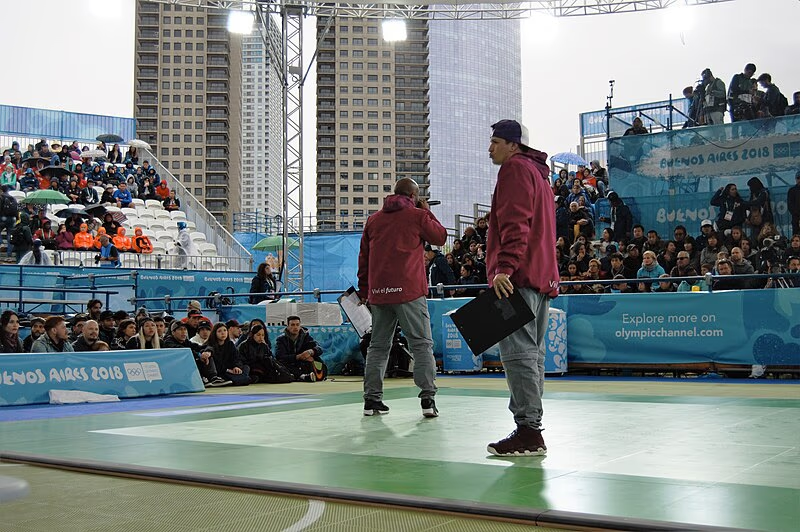
The MC manages the flow of the competition, introduces athletes, announces round results, and maintains the energy and atmosphere of the event. The MC must remain neutral, avoid commentary that could influence judges, and follow the official event script.
Why people argue about this
People often assume that the DJ's musical choices are limited only by their personal taste within those specified genres, forgetting that they must also consider the overall flow and dynamics of each battle, which can lead to arguments about whether a particular song fits the moment perfectly or not.
The DJ selects and plays music for all battles. Music selection is at the DJ's creative discretion but must be drawn from genres rooted in breaking culture — primarily hip-hop, funk, breakbeat, and soul.
Why people argue about this
People often assume that the DJ's music selection is limited solely by breaking culture genres like hip-hop, funk, breakbeat, and soul, but actually, it can be a bit broader as long as it aligns with the creative discretion granted to the DJ in this rule.
Breaking competitions use a 1v1 head-to-head battle format. Two athletes face each other across multiple rounds, alternating throwdowns (solo dance sets).
Why people argue about this
People often assume that in a 1v1 battle format, each competitor gets an equal number of solo dance sets throughout the competition, but actually, it's just alternating between throwdowns without specifying how many times per match or across matches. This lack of clarity leads to misunderstandings about the total duration and structure of the battles.
Each round consists of alternating throwdowns. A throwdown is a single continuous performance by one athlete.
Why people argue about this
People often assume that a throwdown must involve two athletes performing simultaneously, thinking it's like a tag team event where partners take turns throwing each other. But in reality, the rule specifies a single athlete performing continuously as a throwdown, so there can be no simultaneous throws between different athletes within one round.
Each throwdown is limited to 60 seconds maximum. The DJ provides the musical framework, and the athlete must complete their set within the allotted time.
Why people argue about this
People often assume that if their music runs over 60 seconds, they can just keep playing until time runs out, thinking it's up to the DJ to cut off their set early. Actually, the confusion arises because the official rule specifies that athletes must complete their throwdown within the 60-second limit themselves, not relying on the DJ to stop them.
The DJ plays continuous music throughout each round. Athletes do not choose their own music — they must adapt to whatever the DJ plays in real time.
Why people argue about this
People often assume that in a battle of music and rhythm between two athletes, it's solely about which athlete plays their music better or more creatively. But actually, the key is how judges score each round based on those performances, with the winner being decided by the aggregate scores from all rounds judged by the panel, not just who wins individual battles.
The Olympic competition structure proceeds as follows: Round Robin: 16 athletes divided into four groups of four, each athlete battles every other group member (best-of-one rounds). Top two from each group advance.; Quarterfinals: Eight athletes in best-of-three battles; Semifinals: Four athletes...
Why people argue about this
People often assume that a battle is decided based solely on who wins individual rounds, forgetting that it's ultimately about which athlete scores more points overall across all rounds, as judged by an aggregate panel score. This oversight leads to arguments because they overlook how crucial every round and the judges' collective scoring are in determining victory.
WDSF uses the Trivium judging system for all sanctioned breaking competitions. Each judge evaluates athletes across two complementary dimensions, each containing three criteria.
Why people argue about this
People often assume that the Trivium system means judges evaluate athletes based on six criteria total, which leads to a lot of debate about how many points each athlete gets. But actually, it's just three criteria per judge across two dimensions—each athlete is scored once by each judge, not six times in total as some might think.
The physical dimension evaluates the tangible, observable elements of the performance: Technique: The quality of movement execution, including control, precision, form, balance, and physical difficulty. Clean landings, smooth transitions, and mastery of foundational and advanced moves are assesse...
Why people argue about this
People often assume that since judges don't assign numerical scores, they must be evaluating each criterion on a sliding scale with percentages. But in reality, they're simply deciding which of two competitors excels across all six criteria and declaring them the winner for that round. The lack of numeric breakdown leaves room for interpretation about how much weight is given to each aspect.
The artistic dimension evaluates the interpretive and creative qualities of the performance: Musicality: The athlete's ability to interpret, respond to, and ride the music. This includes hitting beats, accenting musical phrases, adapting to tempo changes, and demonstrating rhythmic sensitivity be...
Why people argue about this
People often assume that since judges don't assign numerical scores, they must be evaluating each criterion separately and then adding them up for a total score. But in reality, they're making binary decisions on who wins each round based solely on their overall impression of artistic dimension across all six criteria. This leads to confusion about how the final score is calculated.
Each judge determines a round winner based on their holistic assessment across all six criteria. Judges do not assign numerical scores to individual criteria — they render a binary decision selecting the winner of each round.
Why people argue about this
People often assume that judges are supposed to assign numerical scores out of 10 for each criterion before making a decision on who wins each round. But in reality, they're only deciding which dancer or couple excels across all six criteria without assigning individual scores, leading to confusion about how the final score is determined.
Deliberate physical contact with an opponent is strictly prohibited. This includes pushing, shoving, grabbing, or any aggressive physical gesture directed at the opposing athlete.
Why people argue about this
People often assume that minor contact is okay as long as it's unintentional, leading to arguments about whether a push was accidental or deliberate. The confusion arises because in Breaking, even slight pushing can be considered 'crashing' if done with intent to harm or disrupt the opponent’s movement, regardless of how light the touch might seem.
Athletes must complete their throwdown within the allotted 60-second window. The first minor time overage (up to 5 seconds) results in a verbal warning from the head judge.
Why people argue about this
People often assume that just a 5-second time overage results in an automatic penalty, forgetting that it's only a verbal warning for the first minor overage up to those 5 seconds. They miss the nuance that after one minor overage, anything beyond that becomes a major infraction.
The following behaviors constitute unsportsmanlike conduct and may result in warnings, score penalties, or disqualification: Verbal abuse, taunting, or threatening gestures directed at the opponent, judges, or officials; Deliberately disrupting the opponent's throwdown (entering the battle area d...
Why people argue about this
People often assume that receiving general encouragement from spectators is okay as long as it's non-verbal, leading to arguments when they realize actual coaching instructions or cues are strictly prohibited under "7.3 Unsportsmanlike Conduct" in Breaking (WDSF), despite the rule allowing for some verbal support from crew members and coaches during competition.
Athletes must compete independently. Receiving coaching instructions, verbal cues, or signals from crew members, coaches, or spectators during an active round is prohibited.
Why people argue about this
People often assume that external assistance is strictly about hearing coaching instructions, but they overlook the broader category of receiving any kind of verbal cue or signal from anyone during a round, which includes non-verbal cues like gestures or even subtle body language – all of which are prohibited under this rule in Breaking (WDSF).
WDSF applies a progressive penalty system: verbal warning, formal caution (recorded), round forfeiture, and disqualification. The head judge determines the appropriate penalty level based on the severity and intent of the violation.
Why people argue about this
People often assume that verbal warnings are just words and don't count as a penalty, so they argue about why their team didn’t get one even though it's part of the progressive system where each level builds on the last. They miss understanding how every step in this escalating process contributes to the final outcome.
Athletes must be provided with a dedicated warm-up area separate from the competition stage. The warm-up area must have appropriate flooring (not concrete or hard tile) and sufficient space for athletes to prepare safely.
Why people argue about this
People often assume that just because athletes need a warm-up area separate from competition doesn't mean they should have their own dedicated flooring like rubber mats or turf. They mistakenly think the official only requires a space with anything other than concrete, not specifically mentioning what kind of flooring is acceptable.
A qualified medical team must be present on-site throughout practice sessions and competition. The medical team must include personnel experienced in treating musculoskeletal injuries common in breaking, including sprains, fractures, wrist injuries, and head/neck trauma.
Why people argue about this
People often assume that just having a medical team present is enough, without considering their expertise in treating breaking-specific injuries like wrist and musculoskeletal issues. They overlook how crucial it is for these professionals to be on-site during both practice and competition sessions.
The competition floor must be inspected before each session for moisture, debris, loose panels, or surface damage. Cleaning supplies and a floor maintenance crew must be available to address spills or surface issues immediately.
Why people argue about this
People often assume that just checking for issues before a session is enough, but they overlook the need for immediate cleaning supplies and a maintenance crew ready to fix problems on-site, misunderstanding that it's about having quick action plans in place rather than just inspecting once.
Athletes must have access to water and hydration stations at all times, including during the competition.
Why people argue about this
People often assume that hydration stations are merely for convenience, thinking they're only needed during breaks between routines. But in fact, the rule emphasizes continuous access to water throughout the entire competition period, including intense moments when athletes might not realize they need a drink.
Athletes may withdraw from any battle at any time without disciplinary penalty (the battle is forfeited to the opponent); Competition schedules must include adequate rest periods between an athlete's battles (minimum 20 minutes between consecutive battles); Mental health support resources should ...
Why people argue about this
People often assume that a dedicated warm-up area is only about having enough space for equipment, forgetting that it's crucial for safety with proper flooring to absorb impact during exercises like flips and jumps. They overlook how critical it is to prevent injuries in such high-impact routines.
Athletes must wear athletic footwear appropriate for breaking. Sneakers with flat, non-marking rubber soles are standard.
Why people argue about this
People often assume that since they're breaking, they can wear whatever shoes they want as long as they look cool or are comfortable. But actually, the rule specifies athletic footwear with flat, non-marking rubber soles to prevent damage and ensure fair competition in this precision sport.
The competition battle area (also called the "cypher" or "stage") must be a clearly defined space measuring a minimum of 7 metres × 7 metres for international WDSF events and Olympic competition. For lower-tier national events, a minimum of 6 metres × 6 metres is acceptable.
Why people argue about this
People often assume that the exact measurements are less critical for lower-tier national events since they're not as prestigious, but in reality, the official intent is to ensure a consistent playing area size across all competitions for fair and reliable scoring, regardless of event tier.
Competitors in breaking are referred to as B-Boys (male) and B-Girls (female). Athletes compete individually in 1v1 battles.
Why people argue about this
People often assume that B-Girls are necessarily dancers who perform hip-hop moves, but in breaking as governed by WDSF's Section 4, they refer specifically to athletes competing individually against each other in a one-on-one battle format, not necessarily related to gender or dance style.
Breaking competitions use a 1v1 head-to-head battle format. Two athletes face each other across multiple rounds, alternating throwdowns (solo dance sets).
Why people argue about this
People often assume that in a 1v1 format, each athlete gets an equal number of throws throughout the competition, but actually, it's all about alternating between solo dance sets with no predetermined number of rounds or throws per athlete to ensure unpredictability and excitement. The exact number can vary based on the specific event rules, adding to the confusion.
WDSF uses the Trivium judging system for all sanctioned breaking competitions. Each judge evaluates athletes across two complementary dimensions, each containing three criteria.
Why people argue about this
People often assume that each judge evaluates athletes based on six criteria instead of three, leading to misunderstandings about how scores are calculated in WDSF's Trivium system for breaking competitions. The confusion arises because they focus too much on the number '6' rather than splitting it into two sets of three.
Deliberate physical contact with an opponent is strictly prohibited. This includes pushing, shoving, grabbing, or any aggressive physical gesture directed at the opposing athlete.
Why people argue about this
People often assume that pushing is only about forceful collisions, so they argue it includes gentle nudges or taps - forgetting that the key here is intent: deliberate physical contact with aggressive purpose, regardless of strength. The confusion arises because they overlook the crucial element of intent in this rule.
Athletes must be provided with a dedicated warm-up area separate from the competition stage. The warm-up area must have appropriate flooring (not concrete or hard tile) and sufficient space for athletes to prepare safely.
Why people argue about this
People often assume that a dedicated warm-up area is solely for comfort and convenience, forgetting its critical role in safety. The confusion arises because they overlook how proper flooring can prevent injuries from falls or collisions during the crucial pre-competition preparation phase.