Section 1: Introduction
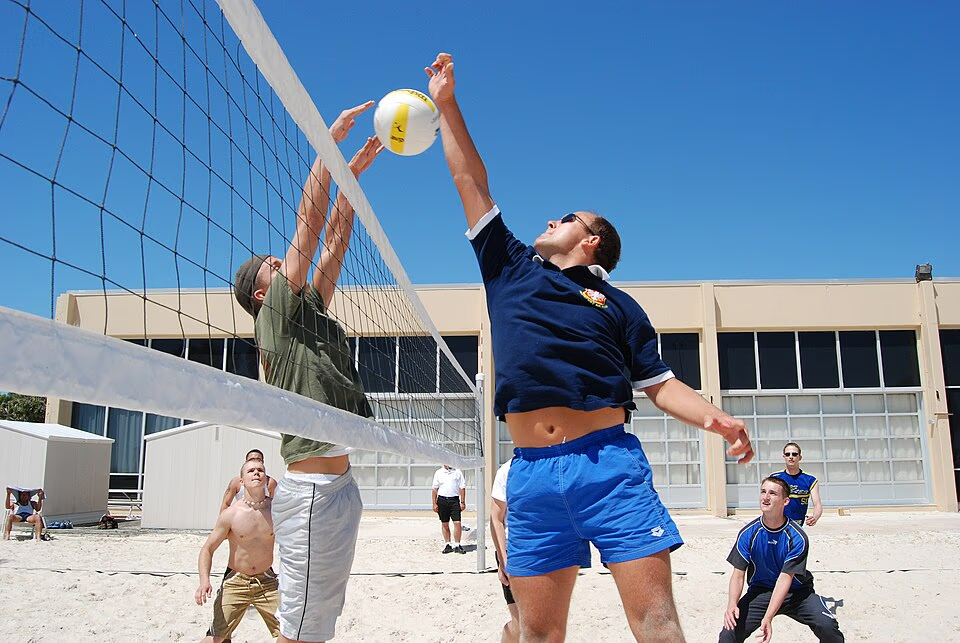
NCAA Beach Volleyball is the collegiate variant of beach volleyball played as a dual-team competition between paired student-athletes. Each NCAA dual-meet contest is a head-to-head competition between two universities, scored by individual pairs matches contested simultaneously on adjacent courts. NCAA beach volleyball is officially a women's sport at the NCAA level; the NCAA Beach Volleyball Championship has been contested annually since 2016, with the 2026 championship held May 1-3, 2026 at Gulf Place Beach, Gulf Shores, AL.
NCAA beach volleyball is played under the FIVB Beach Volleyball Rules as the baseline (the FIVB sibling entry in this directory is the canonical text for the underlying playing rules), with NCAA-specific modifications published annually as the NCAA Beach Volleyball Rules Modifications document. The current edition is the 2026 Beach Volleyball Rules Modifications issued by the NCAA Playing Rules Oversight Panel (PROP).
The defining structural feature of NCAA beach volleyball is the dual-meet format: each team contests five pairs matches simultaneously (one pair per court on five adjacent courts), the first team to win three of the five pairs matches wins the dual. This entry summarizes the NCAA-specific modifications and the surrounding competition structure; for the underlying playing-rule mechanics (court markings, ball, hand setting, blocking, etc.) consult the FIVB Beach Volleyball Rules entry in this directory.
Section 2: Equipment
The Ball
- FIVB-approved beach volleyball ball
- Spherical, made of flexible material (leather or synthetic leather)
- Circumference: 66–68 cm (slightly larger than indoor volleyball)
- Weight: 260–280 g
- Internal pressure: 0.175–0.225 kg/cm² (lower than indoor volleyball)
- Multi-color or single-color FIVB-approved ball; ball color and pattern subject to NCAA approval per the Modifications document
Net
- Height: 2.43 m for men's beach volleyball (not applicable to NCAA; men's NCAA beach volleyball is not contested)
- Height: 2.24 m for women's beach volleyball (NCAA standard)
- Net length: 8.5 m
- Antennas on both side bands marking the legal crossing zone
Player Apparel
- Team uniform consistent with university branding; pair partners may differ in style but team identifiability is required
- Athletic footwear is permitted but not required — many NCAA beach volleyball players compete barefoot
- No jewelry that may cause injury; sunglasses permitted; visors and hats permitted
- Sun protection (sunscreen, lip balm) is encouraged
Section 3: Playing Area
Court Dimensions
- Rectangular court, 16 m × 8 m (smaller than the 18 m × 9 m indoor court)
- No center line on the sand court — players may move freely under the net into the opponent's court space as long as they do not interfere with the opponent's play
- Sand surface: minimum 40 cm depth of clean, sifted sand free of stones, debris, and hazards
- Free zone of at least 3 m around the court perimeter
- Court boundaries marked by 5 cm-wide tape or rope, fastened to the sand at the corners and intermediate points
Net and Surrounding Area
- Net with antennas marking the legal crossing zone
- Posts secured to support the net at the correct height; padded for player safety
- Officiating stand on one side; secondary umpire station on the opposite side
- Score table and scoreboard positioned at the end of the court
Multi-Court Layout
NCAA dual-meet competitions are typically played on five adjacent courts simultaneously to support the 5-pair format. Each court has its own officiating crew and scoring table; the dual-meet result is determined by the count of pairs-matches won across the five courts.
Section 4: Players & Officials
Team Format
- Each NCAA beach volleyball team consists of 10 student-athletes split into 5 pairs
- The 5 pairs are designated as pairs 1 through 5, ranked by the head coach in order of ability
- The "order of ability" is determined by the coach but must be applied consistently — pair 1 must be the team's strongest pair, pair 2 the next strongest, etc.
- Minimum of 6 physically able players must be present for a dual-meet match to be contested
Lineup Form and Challenge Form
- Each head coach submits a lineup form before the dual meet listing the 5 pairs in order 1-5
- The opposing head coach may challenge the lineup via the NCAA Challenge Form within a defined window if the lineup appears to violate the order-of-ability requirement
- The Championship Lineup Form and Challenge Form are NCAA-standard documents required at all NCAA-sanctioned competitions
Officiating Crew
- Each court has a first referee (R1, on the elevated stand), a second referee (R2, opposite the R1), and line judges (typically 2 or 4)
- Scorer at the score table
- Tournament referee oversees the multi-court venue
Substitutions
NCAA beach volleyball (under FIVB rules) does not permit substitutions within a pairs match. If a player is unable to continue due to injury or illness, the match is forfeited unless one of the published exceptions applies (e.g., declared injury timeout with medical clearance). The pair plays the entire match — no rotation, no substitute.
Section 5: Rules of Play
Dual-Meet Structure
- Each dual meet consists of 5 pairs matches contested simultaneously on adjacent courts
- The first team to win 3 of the 5 pairs matches wins the dual meet
- Each pairs match is worth 1 point in the dual-meet score
- Dual-meet scoring is independent of individual set scores
Pairs Match Format
- Each pairs match is best of three sets
- Sets 1 and 2 are played to 21 points, must win by 2
- Set 3 (only if needed) is played to 15 points, must win by 2
- No upper cap — rally scoring continues in deuce until a team wins by 2 points
Service and Rally
- The serving order alternates within each pair (each player serves until the pair loses the rally; then the other player serves)
- The serve must be made from behind the end line and within the boundaries of the serving zone
- Each pair may contact the ball a maximum of 3 times before returning the ball over the net
- A block contact (defensive contact at the net) counts as one of the three permitted contacts in beach volleyball (this differs from indoor volleyball, where a block does not count as a contact)
Hand Setting Rule (Beach-Specific)
Beach volleyball applies a stricter standard than indoor volleyball to overhand finger-tip "sets":
- An overhead set must be clean — no extended contact (no "throw"), no spin imparted to the ball, hands must be square to the target
- Setting the ball over the net is permitted only on a clean overhead set with the trajectory perpendicular to the shoulder line of the setter
- Doubles contact (the ball contacting both hands at slightly different moments) is permitted on a hard-driven attack but not on a controlled set
- The hand-setting standard is one of the most-coached and most-contested judgments in beach volleyball; NCAA referee crews receive specific training on the standard
Timeouts
- Each pair is permitted 1 timeout of 30 seconds per set
- Technical timeouts may be applied per FIVB rules in higher-level tournaments (NCAA may or may not implement technical timeouts depending on the published Modifications)
Switching Sides
Pairs switch sides of the court at every 7-point total in sets 1 and 2, and every 5-point total in set 3. The side-switch is to compensate for wind, sun, and surface differences between the two sides.
Section 6: Scoring
Point Scoring
Beach volleyball uses rally scoring: a point is awarded on every rally regardless of which team served. A team scores a point when:
- The ball lands in the opponent's court within the boundaries
- The opponent commits a fault (ball out, net touch, antenna contact, four-contact, hand-setting violation, etc.)
- The opponent commits a serving fault
Set Result
- Sets 1 and 2: first to 21 points, must win by 2 (deuce continues without cap)
- Set 3 (decider): first to 15 points, must win by 2
- The team that wins 2 sets wins the pairs match
Dual Meet Result
- The team that wins 3 of the 5 pairs matches wins the dual meet
- The dual-meet score is reported as the team-vs-team pairs-matches won (e.g., "3-2 dual")
- Goal difference, set difference, and point difference are not used to break ties in NCAA beach volleyball dual-meet scoring at the dual level — a 3-2 win is no different from a 5-0 win in the dual standings
Pairs Matches Played to Completion
Per the NCAA Beach Volleyball Rules Modifications, even after the dual outcome is decided (a team has won 3 pairs matches), the remaining pairs matches are played to completion. This supports player-development data, individual rankings, and ensures fairness to athletes whose match outcome may matter for individual recognition.
Section 7: Violations & Penalties
Faults (Cause Loss of Rally)
- Ball lands out of bounds (outside the court boundary; the boundary line counts as in)
- Four contacts by the same pair (block contact counts in beach)
- Catch or throw — extended contact with the ball (not a clean hit)
- Hand-setting violation (per the beach-specific standard above)
- Net touch by a player or player's clothing
- Crossing under the net and interfering with the opponent's play
- Ball does not pass through the legal crossing zone (between the antennas)
- Server foot fault or service-zone violation
- Receiving player completely catches the serve
Misconduct Sanctions
FIVB misconduct sanctions apply, with NCAA-specific publications elaborating on dual-meet bench discipline:
- Warning (verbal; not recorded)
- Penalty (yellow card; loss of rally + point to opposing pair)
- Expulsion (red card; player removed for remainder of the set; replacement allowed in beach is limited — typically the match continues with one player or is forfeited per the Modifications)
- Disqualification (yellow + red shown together; player and any required additional sanctions per the NCAA Sportsmanship and Bench Conduct guidance)
Coaching
Coaching from the bench is permitted in NCAA beach volleyball within the team area; coaches may not enter the court during a rally or interfere with the officials' line of sight. The NCAA Modifications document specifies bench-conduct expectations.
Challenge / Video Review
NCAA Beach Volleyball does not currently use video review in the same manner as indoor volleyball or some FIVB events. Officiating decisions are final on the court; appeals are limited to the lineup-form challenge process described in Section 4.
Section 8: Safety Considerations
Surface Safety
- Court surface must be at least 40 cm deep sand, free of stones, sharp objects, and debris
- Sand is raked and inspected between rounds; broken glass or other hazards cause immediate stop of play and re-rake
- Posts and antennas must be padded to a minimum height
Sun and Heat Exposure
NCAA beach volleyball is an outdoor sport played primarily in the spring; sun exposure and heat are significant safety considerations. Standard practices:
- WBGT-based heat thresholds for play modifications and postponement
- Mandatory water and shade access on the sideline
- Sunscreen and lip balm encouraged; visors and hats permitted
- Cooling protocols including ice towels and shaded recovery areas in the team box
Weather Suspensions
Lightning detection halts outdoor activity within the standard radius of detected strikes; play resumes only after the all-clear interval has elapsed. High wind may suspend play if it materially affects ball trajectory and competition fairness; the decision is at the discretion of the tournament referee in consultation with the head referees.
Player Welfare
- Each NCAA-sanctioned match requires at least one certified athletic trainer on the venue site
- Team physicians and emergency-medical responders are required at championship-level competition
- An emergency action plan covering on-field cardiac, head/neck, orthopedic, and heat-related emergencies must be in effect at every venue
- Concussion protocol: a player with an actual or suspected concussion is removed from play immediately and is subject to a graduated return-to-play assessment before being cleared for subsequent competition