








Section 1: Introduction
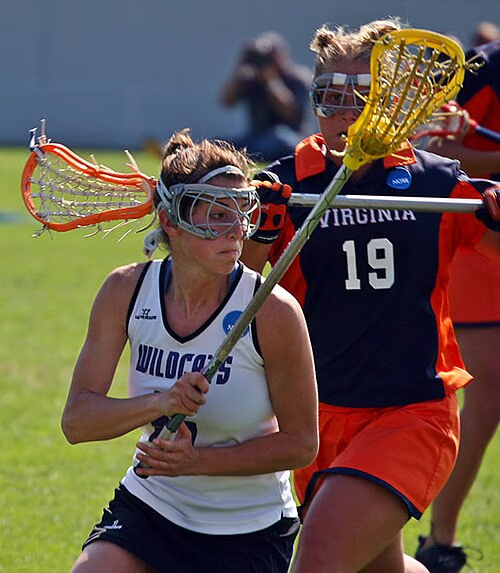
NCAA Women's Lacrosse is the collegiate variant of women's field lacrosse played under the National Collegiate Athletic Association's competition rules. NCAA women's field lacrosse is a fast, twelve-on-twelve field sport in which players use stringed-pocket sticks to catch, carry, pass, and shoot a small rubber ball into a six-foot-square goal defended by a goalkeeper. Women's lacrosse differs from men's lacrosse in significant ways: substantially reduced legal contact, a draw rather than a faceoff to start play, mandatory cards as the central discipline mechanism, and a different stick/equipment profile.
The canonical text is the NCAA Women's Lacrosse Rules Book, published on a two-year cycle by the NCAA Playing Rules Oversight Panel (PROP) with input from the NCAA Women's Lacrosse Rules Committee. The current edition is the 2026 and 2027 NCAA Women's Lacrosse Rules Book, effective with the 2026 season.
The 2026/27 cycle introduced pace-of-play and penalty-structure simplifications: an 8-meter free position is set up only at the two adjacent hashes on each side of the center hash; a 30-second draw setup clock starts on the signal of a goal; shot clock reset rules on saves/post hits below 59 seconds; and expanded video-review parameters for cards.
This entry summarizes the major rule mechanics for educational purposes. It does not reproduce rule text and is not a substitute for the canonical NCAA Rules Book, which is authoritative in any dispute (see source URL in metadata).
Section 2: Equipment
The Ball
- Solid rubber, yellow (official color for NCAA women's lacrosse)
- Circumference: 7¾ to 8 inches
- Weight: 5 to 5¼ ounces
- NCAA-approved/NOCSAE-stamped balls only in competition
Sticks (Crosses)
- Total length (field players): 35½ to 43¼ inches
- Goalkeeper stick: 35½ to 52 inches with a larger head profile
- Stringing: traditional pocket; the top of the ball must be visible above the side wall of the head when the ball is settled in the pocket (the NCAA stick card defines the legal pocket geometry)
- Stick checks are performed by officials at the discretion of the on-field crew and at the request of the opposing head coach; an illegal-stick finding is a violation under Rule 2 with the penalty defined by the card
Protective Equipment
- Field players: mandatory ASTM F3137-compliant women's lacrosse headgear (mandatory at the NCAA level since 2017); mandatory eyewear meeting ASTM F803; mouthpiece
- Goalkeeper: helmet with full face mask, throat protector, chest protector, padded gloves, pads on lower body, optional thigh pads
- Gloves are permitted for field players but not required
Footwear and Uniform
Cleats are appropriate to the surface. Uniform numerals must be legible and distinct from teammates'; the goalkeeper wears a contrasting color permitting clear identification by officials.
Section 3: Playing Area
Field Dimensions
- Rectangular field, 110 yards × 60 yards (a 70-yard width is also permissible where space allows under the 2026/27 rules)
- Center line dividing the field into two halves
- Two restraining lines, each 30 yards from the goal lines (sometimes referred to as the "30-yard arc" framework)
Goals and the Critical Scoring Area
- Two goals, 6 feet wide × 6 feet high, set 99 yards apart from end line to end line measure
- Goal circle (crease): 8.5-foot radius semi-circular goal circle around each goal
- 8-meter arc (free-position arc) extending from each goal line
- 12-meter fan extending farther from the goal
- 15-meter arc (in the critical scoring area; defined in the 2026/27 rules for specific situations)
- Center hash and adjacent hashes — relevant to free-position setups under the 2026 simplification
Draw Circle
Center circle of approximately 9-meter diameter (varies by published spec) at the center of the field; the draw is taken at the center hash by two opposing midfielders. Up to four other players from each team may stand on the center line outside the draw circle.
Section 4: Players & Officials
Players
Each team fields 12 players: 1 goalkeeper, 5 defenders (including 3 close defense and 2 midfielders defensively oriented), 1 center, and 5 attackers (including 3 attackers and 2 midfielders offensively oriented). Position assignments are conventional rather than rule-mandated; the rules constrain offsides (must have at least 4 players on the offensive half — including the goalkeeper count on the defensive side, depending on the draw situation).
Substitutions
- On-the-fly substitutions through the special substitution area at the midfield are permitted during dead-ball situations and (with restrictions) during live play under the 2026 framework
- A substituted player must clear the field of play before the substitute enters
- Goalkeeper substitution requires a brief stoppage of play
Officials
- Standard NCAA crew: three officials for regular-season games; some events use additional officials
- Table crew: scorer, timekeeper, shot-clock operator, penalty timekeeper, and chief bench official
- Video review is operative for clear-and-obvious-error reviews per the 2026 NCAA Women's Lacrosse Video Review Guidelines, including the 2026 expansion to support player identification for cards and confirmation/reversal of yellow or red cards
Coaches and Bench
Each team has a head coach and assistant coaches in the team area during the game. Coaches may not enter the field of play except when authorized by an official.
Section 5: Rules of Play
Game Structure
- Four 15-minute quarters (NCAA women's lacrosse adopted the quartered format in recent rule cycles, replacing the prior 30-minute half format)
- 2-minute breaks between Q1/Q2 and Q3/Q4; 10-minute halftime
- The team in possession at the end of Q1 keeps the ball to start Q2; same for Q3 → Q4 (this is an NCAA women's-specific possession-continuity rule)
- Sudden-victory overtime in 3-minute periods following a regulation tie (regular season and tournament)
Draw
- The game starts with a draw at the center circle; draws also restart play after each goal and to begin each quarter
- Two players (typically center midfielders) hold their sticks above the ground at hip level, back-to-back; the ball is placed in the up-pocket of each stick and pushed against the other
- On the official's whistle, both players pull/lift simultaneously to launch the ball upward; both players must release the ball into the air
- 30-second setup clock (2026/27 addition): a 30-second clock begins with the signal of a goal and concludes at the start of the administration of the draw. If one team is not present at the center circle and ready for the draw by the expiration of the 30 seconds, possession is awarded to the opposing team
Shot Clock
- The offensive team has a 90-second shot clock from gaining possession (note: historically 90 seconds in NCAA women's; verify current edition for any 2026 reduction)
- If the goalie makes a save, if there is a rebound, or the ball hits the post with less than 59 seconds on the clock, and the offense keeps possession, the clock resets to 60 seconds (2026/27 rule)
- Failure to release a shot before expiration of the shot clock results in a turnover
Movement of the Ball
- Players may run with the ball in their stick, pass, and shoot
- Stick-to-stick checks are permitted in a tightly-constrained framework: checks must be directed downward and away from the head of the ball-carrier, with no follow-through across the body, and only in the direction of the stick — not the head/body of the opponent
- Body contact is severely limited compared to men's lacrosse — no body checks; incidental contact is permitted in the legal framework of Rule 7
Free Position
- An 8-meter free position is awarded for major fouls inside the 8-meter arc; the offended player takes a free position on the arc 8 meters from the goal
- 2026/27 simplification: 8-meter free positions are set up only at the two adjacent hashes on both sides of the center hash — no longer at arbitrary points on the arc
- A 12-meter free position is awarded for major fouls outside the 8-meter arc but inside the 12-meter fan
- The clock continues to run during 8-meter free positions, except in the final minute of a quarter or overtime
- Defenders must clear from the 4-meter line in front of the player taking the free position
Goal Circle
- Only the goalkeeper and one defender may stand in the goal circle
- An attacking player who steps into or whose stick contacts the goal circle loses possession
- The goalkeeper may not pick up the ball with the hands inside the goal circle; the stick must be used
- The goalkeeper has 10 seconds to clear the ball from the goal circle
Section 6: Scoring
Goal
A goal is scored when the entire ball passes the goal line into the goal, propelled by an attacking player's stick. The official confirms goals on the field; specific goal/no-goal reviewable situations may be reviewed via NCAA video review.
Goal Value
- Goals from inside the 8-meter arc: 1 point
- Two-point arc: under NCAA women's rules, certain editions and trials have implemented a two-point line at a specified distance — verify the 2026/27 edition for current two-point arc presence and distance
Match Result
- The team scoring more goals at the end of regulation wins
- If regulation ends in a tie, sudden-victory overtime is played in 3-minute periods until a goal is scored
Section 7: Violations & Penalties
Card-Based Discipline
NCAA women's lacrosse uses a card-based discipline framework distinct from the men's penalty-box model. Cards are issued by the officials for fouls of progressive severity:
- Green card: warning for delay-of-game offenses; team accumulates green cards, and the third or fourth green card on the team (per the rule edition) triggers a more serious sanction
- Yellow card: 2-minute non-releasable penalty served by the offending player; the team plays short; multiple yellows on the same player escalate to a red card
- Red card: ejection from the game; the team plays short for the remainder of the penalty (and potentially the game depending on the rule edition); the player is subject to suspension for subsequent matches
The 2026/27 cycle simplified the penalty-structure framework around these cards to improve pace of play and reduce inconsistent calls.
Major Fouls (Inside the 8-Meter Arc)
A major foul committed by a defending player inside the 8-meter arc results in an 8-meter free position for the offended player. Major fouls include:
- Charging, blocking, illegal pick
- Slashing, dangerous propelling, illegal cradling toward the body
- Hitting an opponent's head with a check or stick
- Setting in the goal circle
- Dangerous shot or follow-through into a defender
Minor Fouls
Minor fouls (e.g., offsides, illegal substitution, empty-stick check, sphere violations) result in a free position taken by the offended team where the foul occurred, with no clock stoppage in most cases.
Mandatory Equipment Violations
A player on the field without required equipment (headgear, eyewear, mouthpiece) commits an equipment violation and must be removed for correction; possession is awarded to the opposing team if appropriate.
Video Review Expansion (2026/27)
Video review can be used in NCAA women's lacrosse to determine player identification for cards and to confirm or reverse yellow or red cards. The framework matches the published 2026 NCAA Women's Lacrosse Video Review Guidelines.
Section 8: Safety Considerations
Mandatory Headgear and Eyewear
NCAA women's lacrosse mandates ASTM F3137-compliant women's lacrosse headgear for field players (mandated by the NCAA since 2017) and ASTM F803-compliant eyewear. Mouthpieces are mandatory. Goalkeepers wear a full goalkeeper helmet with face mask, throat protector, and chest protector. The mandatory-headgear rule reflects long-running player-safety concerns and concussion-incidence data from the pre-headgear era of women's lacrosse.
Head and Neck Protections
Stick contact to the head is a major foul (typically yellow card territory), with potential red-card ejection for severe or repeated violations. The 2026 video-review framework permits review of player identification for cards and confirmation/reversal of yellow/red cards, which supports consistent discipline of head-contact incidents.
Concussion Protocol
A player with an actual or suspected concussion is removed from play immediately and is subject to a graduated return-to-play assessment before being cleared for subsequent training and competition. NCAA medical observers and team medical staff have authority to remove a player; the return-to-play decision is independent of the on-field officials.
Heat and Hydration
NCAA championship policy uses WBGT-based thresholds for heat-related modifications and postponement; team athletic trainers are responsible for in-game hydration breaks and heat-related player welfare. Lightning detection halts outdoor activity within the standard radius of detected strikes; play resumes only after the all-clear interval has elapsed.
Stick and Equipment Safety
- Damaged sticks (cracked, gouged, missing parts) must be removed from play
- Stick checks must be directed at the opponent's stick, not the head or body, and away from the head of the ball-carrier
- Body checks are not permitted in NCAA women's lacrosse
Medical Coverage
Each NCAA-sanctioned game requires at least one certified athletic trainer on the sideline; team physicians and emergency-medical responders are required at championship-level competition. An emergency action plan covering on-field cardiac, head/neck, and orthopedic emergencies must be in effect at every venue.