










Section 1: Introduction
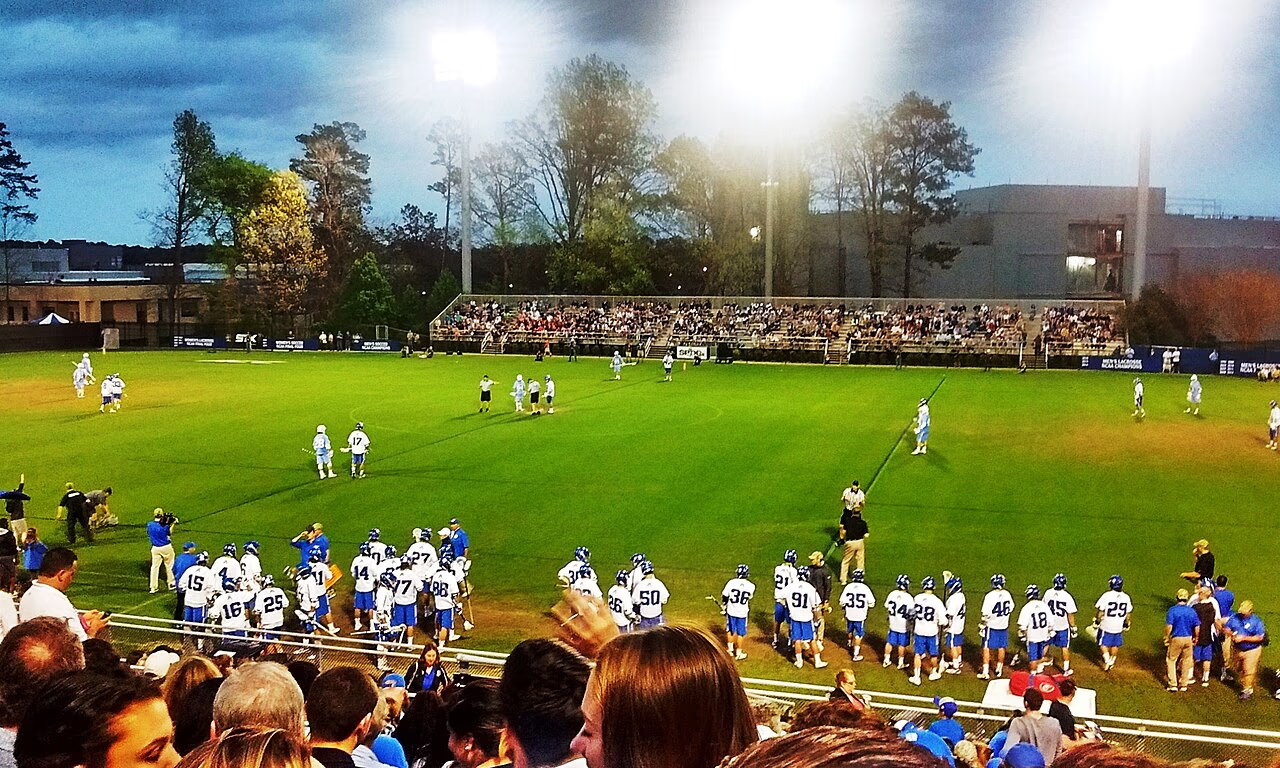
NCAA Men's Lacrosse is the collegiate variant of men's field lacrosse played under the National Collegiate Athletic Association's competition rules. NCAA men's field lacrosse is a fast, full-contact ten-on-ten field sport in which players use long-handled sticks with mesh heads to catch, carry, pass, and shoot a small rubber ball into a six-foot-square goal defended by a goalkeeper.
The canonical text is the NCAA Men's Lacrosse Rules Book, published on a two-year cycle by the NCAA Playing Rules Oversight Panel (PROP) with input from the NCAA Men's Lacrosse Rules Committee. The base text remains the 2025 and 2026 NCAA Men's Lacrosse Rules Book (updated 2025-02-05), but the Division I Men's Lacrosse Rules Subcommittee, the Division II/III Men's Lacrosse Rules Committee, the Division I Men's Lacrosse Oversight Committee, and the Division II/III Playing Rules Oversight Panel approved the 2027 and 2028 Men's Lacrosse Rules Changes in July 2026, effective with the 2027 season: 15-minute overtime periods (Rule 4-31), an expanded coach's video-review challenge for offsides/too-many-players/boundary-line violations, official-initiated video review of head/neck contact, and a fluorescent game-ball color requirement (Rule 1-16). This entry reflects both documents.
NCAA men's lacrosse differs meaningfully from the World Lacrosse men's field rules (the existing sibling entry under this directory) in several aspects: a longer 80-second shot clock with NCAA-specific reset rules, a different faceoff cadence and per-player faceoff-violation framework adopted in the 2025/26 cycle, a stricter stick-specification regime, and NCAA-specific video review parameters.
This entry summarizes the major rule mechanics for educational purposes. It does not reproduce rule text and is not a substitute for the canonical NCAA Rules Book and rules-changes documents, which are authoritative in any dispute (see source URL in metadata).
Section 2: Equipment
The Ball
- Per Rule 1-16, the standard game-ball color is fluorescent green or yellow (similar to hex code #ccff00) — allowable beginning with the 2027 season and required beginning with the 2028 season; balls in white, yellow, orange, lime green, or pink remain usable only if both head coaches agree
- For the 2027 season, if the home team elects to use the fluorescent yellow/green ball, that ball must be used for the game; the game-ball color must be stated in the game contract, or the visiting team must be given at least one week's notice (Rule 1-16)
- Solid rubber, with a smooth or slightly textured surface (Rule 1-16)
- Circumference: 7¾ to 8 inches
- Weight: 5 to 5¼ ounces
- Must meet the current NOCSAE lacrosse ball standard; NCAA-approved/NOCSAE-stamped balls only in competition
Sticks (Crosses)
NCAA men's lacrosse uses three stick length classifications, defined as total length including the head:
- Short stick / attack stick: 40 to 42 inches (offensive stick used by attackmen and midfielders)
- Long pole / defensive stick: 52 to 72 inches (used by defensemen and the long-stick midfielder)
- Goalkeeper's stick: 40 to 72 inches with a larger head profile
The head of a field player's stick must be 6 to 10 inches wide at its widest point. Stick checks are performed by officials at the discretion of the on-field crew and at the request of the opposing head coach; an illegal-stick finding carries a personal foul or technical foul depending on the nature of the violation. Long pole and goalie sticks have their own width and pocket-depth specifications.
Protective Equipment (Required)
- NOCSAE-approved helmet with chinstrap securely fastened, four-point fit, and properly fitted facemask
- Properly fitting mouthpiece (NOCSAE compliance recommended; color must contrast with the field surface)
- Shoulder pads designed for men's lacrosse
- Arm pads / elbow pads
- Gloves designed for men's lacrosse
- Protective cup
- Goalkeeper additional: throat protector (must be NOCSAE-approved), chest protector, shin/leg pads, optional thigh pads, and a goalie-specific stick
Footwear and Uniform
Cleats are appropriate to the surface; metal spikes are prohibited on most NCAA fields. Uniform numerals must be legible and distinct from teammates'; the goalkeeper wears a contrasting color permitting clear identification by officials.
Section 3: Playing Area
Field Dimensions
- Rectangular field, 110 yards × 60 yards
- Midfield line dividing the field into two halves
- Two restraining lines, each 20 yards from the midfield line (one in each half of the field)
- Two attack/defense areas defined by the restraining lines and the end lines
Goals and Creases
- Two goals, one at each end of the field, set 15 yards in from the end line
- Goals are 6 feet wide × 6 feet high
- Each goal is surrounded by a circular crease of 9-foot radius (18-foot-diameter goal crease)
- Only the goalkeeper and defensive players may stand inside their own crease; an attacking player who steps into or whose stick contacts the crease loses possession
Wing, Restraining, and Coaches' Areas
- Wing lines: 20 yards from the midfield line, used to position wing players at faceoffs
- Special substitution area at the midfield line for on-the-fly subs
- Team box / coaches' area along the sideline opposite the press box at each bench
Faceoff Spot
The center of the midfield line is the faceoff spot ("X"), where every faceoff is taken — at the start of each quarter, after each goal, and after specified violations.
Section 4: Players & Officials
Players
Each team fields 10 players at any time: 1 goalkeeper, 3 defensemen, 3 midfielders, and 3 attackmen. The team must have at least 3 players in the offensive half and 4 in the defensive half (including the goalkeeper) at all times except during specified transitions and after a faceoff. Position assignments are not rule-mandated past the offsides constraint, but the conventional alignment is universally observed.
Substitutions
- Unlimited on-the-fly substitutions through the special substitution area at the midfield line during live play
- Dead-ball substitutions are permitted any time the ball is not in play
- A substituted player must clear the field of play before the substitute enters; failure to do so is a too-many-men-on-the-field violation
Officials
- Three-official crew is standard (referee, umpire, field judge) for NCAA-sanctioned regular-season games; some events use four officials
- Table crew: scorer, timekeeper, shot-clock operator, penalty timekeeper, and chief bench official
- Video review is operative for clear-and-obvious-error reviews of designated reviewable plays per the published 2026 NCAA Men's Lacrosse Video Review Parameters, as expanded by the 2027 and 2028 Men's Lacrosse Rules Changes (see Section 7)
Coaches and Bench Conduct
Each team has a head coach and assistant coaches in the team box during the game. Coaches may not enter the field of play except when authorized by an official (e.g., medical timeout, brief team huddles in dead-ball situations). Coach conduct rules apply throughout, including the 2025/26 emphasis on sideline behavior. Beginning with the 2027 season, a head coach may also request a video-review challenge of certain goals under the expanded video-review rule (Section 7).
Section 5: Rules of Play
Game Structure
- Four 15-minute quarters
- 2-minute breaks between Q1/Q2 and Q3/Q4; 10-minute halftime
- Per Rule 4-31, effective with the 2027 season, overtime is played in 15-minute periods, continuing until a goal is scored; timeout and video-challenge rules are unchanged in overtime. (Overtime was previously played in 4-minute sudden-victory periods; that format applied through the 2026 season.)
- Running clock when the difference in score is large near the end of a regular-season game, per the standard NCAA differential rule; in championship play the clock continues to run normally
Faceoff
The faceoff is taken at the center "X" at the start of each quarter and after each goal. The two faceoff midfielders (FOGOs in modern practice) line up on their offensive side of the midfield line; their sticks rest on the ground parallel to the line, the balls of their feet behind the head of the stick.
Per the 2025/26 cadence revision: the official says "Down" and players take position; the official then stands over the faceoff players and may adjust their positions if needed; the official says "Set" and steps back to a safe distance; the official then blows the whistle to start play. The "wind-up" between "Set" and the whistle is variable but does not announce a count.
Shot Clock
- The offensive team must release a shot on goal within 80 seconds of gaining possession
- The shot clock resets to 80 seconds on each new possession
- If the goalkeeper makes a save and possession changes, the offensive team gets a fresh 80 seconds
- If the defensive player is injured, the shot clock resets to 80 or 60 seconds (per NCAA shot-clock injury reset rule)
- At the end of a quarter, the shot clock resets to 80 seconds, except: if the period ended during an extra-man situation with player possession, the existing time on the shot clock remains at the start of the next period
- A shot must hit the goal pipe, hit the goalkeeper, hit a player, or enter the goal to satisfy the shot-clock requirement; a shot that clearly misses everything restarts the shot clock
- Stalling outside the shot clock framework (failure to attempt offense) is a delay-of-game penalty
Movement of the Ball
- Players may run with the ball in their stick, pass between teammates, and shoot at the goal
- Players may use their stick to check an opponent's stick or gloved hand (legal pole check) to dislodge the ball — within Rule 7 (Personal Fouls) limits
- The ball may be played with the stick at any height; body contact is permitted within Rule 7 limits (legal body check on a player with possession or within 5 yards of a loose ball, between waist and shoulders, from the front or front side)
Crease and Goal Rules
- Attacking players may not enter the crease or contact the goalkeeper while the goalkeeper is in the crease
- A goal-mouth-area rule (adopted in recent rule cycles) restricts an attacking player's positioning directly in front of the goal during specific transitions
- The goalkeeper has 4 seconds to clear the crease with the ball; failure is a delay-of-game
Restarts
Out-of-bounds restarts and post-foul restarts are quick — the ball is awarded to the appropriate team and play resumes after a brief whistle. Free-position restarts (after a penalty) and faceoff restarts (after goals or specified violations) follow established alignment rules.
Section 6: Scoring
Goal
A goal is scored when the entire ball passes the goal line into the goal, propelled by an attacking player's stick. The official confirms goals on the field; specific goal/no-goal reviewable situations may be reviewed via NCAA video review (e.g., goal in time, crease violation, attacking player position, and — beginning with the 2027 season — a coach's challenge alleging offsides, too many players on the field, or a boundary-line violation by the scoring team; see Section 7).
Goal Value
- All goals are worth 1 point
- NCAA men's lacrosse does not use a two-point goal line (this distinguishes the NCAA rules from box lacrosse and from certain professional outdoor variants)
Match Result
- The team scoring more goals at the end of regulation wins
- If regulation ends in a tie, overtime is played in 15-minute periods (Rule 4-31, effective with the 2027 season) until a goal is scored, at which point the scoring team wins immediately
- Tournament-format ties follow the championship manual
Section 7: Violations & Penalties
Personal Fouls (Time-Serving)
Personal fouls send the offending player to the penalty box; the team plays short for the duration of the penalty (man-down / extra-man-offense, EMO). Personal fouls and standard durations:
- Slashing: 1 minute (non-releasable in some cases — penalty cannot end early on goal)
- Tripping: 1 minute
- Cross-checking: 1, 2, or 3 minutes depending on severity
- Illegal body check: 1, 2, or 3 minutes depending on severity
- Unnecessary roughness: 1, 2, or 3 minutes
- Unsportsmanlike conduct: 1 minute, non-releasable
- Targeting / blindside / hit to the head or neck: 2 or 3 minutes, non-releasable, with potential ejection under the head/neck protections framework
- Fighting: ejection plus suspension review
Technical Fouls (Loss of Possession or 30-Second)
Technical fouls are infringements that do not warrant time in the penalty box. Resolution:
- If the offended team has possession, the offending team plays the next dead ball as a 30-second loss of possession (e.g., a 30-second penalty box) or the offended team is awarded the ball
- Common technical fouls: holding, pushing from behind, warding (using the off-hand or body to ward off a defender), offsides, illegal procedure, crease violation, illegal substitution, stalling, conduct, illegal stick (specifications)
Faceoff Violations (2025/26 Rule Change)
The 2025/26 cycle replaced the prior "three faceoff violations in a half = 30-second team penalty" framework with a per-player framework. If a faceoff player commits a violation, that player cannot participate in the next faceoff their team takes; the team may replace the violator. The team-aggregate 30-second penalty for accumulated faceoff violations was eliminated.
Stalling
The offensive team is required to keep the ball within the offensive half-field area within the team's restraining box ("stay in the box") and to attempt offense within the shot-clock framework. Stalling can be called when the offensive team is clearly making no attempt to attack the goal; the penalty is a 30-second possession violation (or technical foul depending on the circumstance).
Video Review
The 2026 NCAA Men's Lacrosse Video Review Parameters list the standing reviewable situations: goal in time, goal/no-goal (was the ball entirely past the goal line), attacking player crease violation on a goal, ball touched a player or another stick after being shot, ball thrown by an attacking player who was hit/contacted during the shot, and certain target-hits to the head/neck that warrant review for ejection consideration.
Effective with the 2027 season, the 2027 and 2028 Men's Lacrosse Rules Changes added a coach's challenge: a head coach may request review of a goal that could be negated because the scoring team was offsides, had too many players on the field, or had a player in possession of the ball step on a boundary line (defined as the lines completely surrounding the field, the midline, and the restraining lines). A challenge may be requested only if the goal was scored within 15 seconds of the alleged violation and no whistle sounded between the violation and the goal; if the game clock is not visible in the video feed, officials may time the play at actual speed with a stopwatch to establish the 15-second window.
Also effective with the 2027 season, officials may initiate video review of potential head/neck contact on their own, without having made an original call on the play, and may rescind a previously called head/neck-contact penalty if video review confirms no illegal contact occurred.
Section 8: Safety Considerations
Helmet, Mouthpiece, and Protective Equipment
NCAA men's lacrosse mandates NOCSAE-approved helmets and mouthpieces, properly fitted shoulder pads, arm pads, gloves, and a protective cup; goalkeepers additionally wear a NOCSAE-approved throat protector and chest protector. Helmets must remain properly fitted throughout play — a player whose helmet comes off may not continue in the play and substitution is permitted.
Head and Neck Protections
Targeting an opponent's head or neck — including blindside hits, hits with the crown of the helmet, and hits to a player in a defenseless position — is a non-releasable personal foul of 2 or 3 minutes plus potential ejection. Effective with the 2027 season, officials may initiate video review of potential head/neck contact even when no call was made on the field, and may rescind a head/neck-contact penalty if review shows the contact was not illegal (Section 7).
Concussion Protocol
A player with an actual or suspected concussion is removed from play immediately and is subject to a graduated return-to-play assessment before being cleared for subsequent training and competition. NCAA medical observers and team medical staff have authority to remove a player; the return-to-play decision is independent of the on-field officials.
Heat and Hydration
NCAA championship policy uses WBGT-based thresholds for heat-related modifications and postponement; team athletic trainers are responsible for in-game hydration breaks and heat-related player welfare. Lightning detection halts outdoor activity within the standard radius of detected strikes; play resumes only after the all-clear interval has elapsed.
Stick and Equipment Safety
- Damaged sticks (cracked, gouged, missing parts) must be removed from play
- Stick checks may not target the head/neck of an opponent
- Cross-checking with the shaft (two-hand cross-check) is illegal at all levels
- Slashing (one-hand strike at an opponent with the stick) above the shoulders is a personal foul
- Per Rule 1-16, the game ball itself must meet the current NOCSAE lacrosse ball standard, supporting consistent player safety testing across the fluorescent and legacy ball colors permitted by mutual coach agreement
Medical Coverage
Each NCAA-sanctioned game requires at least one certified athletic trainer on the sideline; team physicians and emergency-medical responders are required at championship-level competition. An emergency action plan covering on-field cardiac, head/neck, and orthopedic emergencies must be in effect at every venue.