Section 1: Introduction
1.1 Overview and Governing Body
Beach volleyball is governed by the Fédération Internationale de Volleyball (FIVB), founded in 1947 and headquartered in Lausanne, Switzerland. The sport operates under the FIVB Official Beach Volleyball Rules 2025–2028. While the FIVB governs both indoor and beach volleyball, the two disciplines have distinct rulebooks reflecting their fundamentally different playing conditions, team sizes, and technical requirements.
1.2 Olympic History
Beach volleyball was introduced as an Olympic sport at the 1996 Atlanta Games, featuring both men's and women's tournaments. It has been contested at every Summer Olympics since and is consistently one of the most popular spectator events. The sport evolved from recreational beach play in 1920s California to a professional circuit starting in the 1970s. The FIVB Beach Volleyball World Tour (now the Beach Pro Tour) has operated since 1987, providing the primary qualification pathway to the Olympics.
1.3 Key Differences from Indoor Volleyball
Beach volleyball differs from indoor volleyball in several fundamental ways that shape its identity:
- Team size: 2 players vs. 6 (no rotation system, no specialised positions, no libero)
- Court size: 16 m x 8 m vs. 18 m x 9 m (smaller court, larger per-player coverage)
- Surface: Sand vs. hardwood/synthetic (sand creates additional physical demands and softer landings)
- Ball: Slightly larger, lighter, and lower-pressure than the indoor ball
- Block contact: Counts as the first of three contacts (indoor block does not count)
- No substitutions: Both players must serve, pass, set, attack, block, and dig
- Open-hand attacks: Tipping or dinking with open fingers is prohibited (indoor allows it)
Section 2: Equipment
2.1 The Ball
- Circumference: 66–68 cm (26–26.8 in) — slightly larger than the indoor ball (65–67 cm)
- Weight: 260–280 g (9.2–9.9 oz) — slightly lighter than the indoor ball (260–280 g overlap, but beach balls tend toward the lighter end) (Rule 3)
- Internal pressure: 0.175–0.225 kg/cm² (171–221 mbar; 2.49–3.20 psi) — lower than indoor to slow the ball slightly in outdoor wind conditions
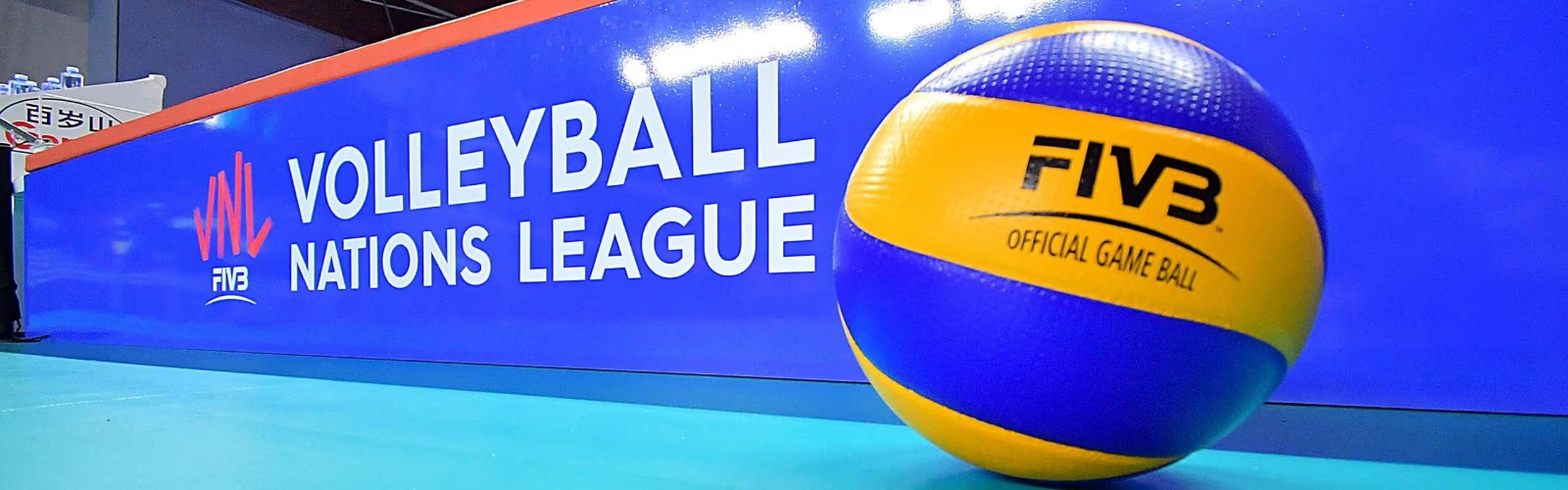
- Exterior: Waterproof synthetic leather cover with brightly coloured panels (typically yellow, blue, and white). The softer feel and lower pressure make the ball easier to control in windy conditions and allow for better passing contact on the forearms (Rule 3).
2.2 The Net
- Width: 8.5 m (27.9 ft), spanning the full court width plus 50 cm overhang on each side (Rule 2)
- Height: Men: 2.43 m (7 ft 11.6 in). Women: 2.24 m (7 ft 4.2 in) — same heights as indoor volleyball (Rule 2)
- Mesh: 10 cm (3.9 in) square openings
- Antennae: Flexible rods attached to the net at each end of the court boundary, extending 80 cm (31.5 in) above the net. The ball must cross the net within the antenna markers for a legal play.
- Posts: Net posts are positioned 0.7–1.0 m outside the sidelines. Posts are padded for safety (Rule 2).
2.3 Uniforms and Personal Equipment
- Clothing: Athletes wear shorts (or bikini bottoms for women, though this is no longer mandatory) and tank tops or t-shirts. Long sleeves and long pants are permitted in all weather conditions. There is no minimum skin-exposure requirement. The previous FIVB mandate for women's bikini bottoms was removed in 2012 (Rule 4).
- Numbering: Jerseys must display the athlete's name and number. Numbers must be 1–2 for each team (player 1 and player 2) (Rule 4).
- Accessories: Sunglasses, hats, and visors are permitted. Compression garments may be worn. No jewellery that could cause injury. Taping and bracing is allowed (Rule 4).
- Footwear: Athletes typically play barefoot but may wear socks or soft sand shoes if desired (Rule 4).
Section 3: Playing Area
3.1 Court Dimensions
- Playing court: 16 m x 8 m (52.5 ft x 26.2 ft), divided into two 8 m x 8 m halves by the net (Rule 1)
- No centre line: Unlike indoor, there is no marked centre line under the net (Rule 1)
- No attack line: Unlike the indoor 3 m attack line, beach volleyball has no restriction on where back-row players can attack (there are no front-row/back-row designations) (Rule 1)
- Boundary lines: Flat elastic bands or rope, 5–8 cm (2–3.1 in) wide, anchored in the sand at the corners. Lines must contrast with the sand colour.
3.2 Sand Requirements
The sand surface is one of the defining features of beach volleyball and is carefully specified:
- Depth: Minimum 40 cm (15.7 in) of loose, levelled sand throughout the playing area and free zone
- Quality: Fine-grained, free of stones, shells, debris, and any objects that could cause injury. Sand is typically washed and screened to meet specifications (Rule 1.2).
- Consistency: Sand must be raked and levelled between matches and at the start of each set to ensure uniform playing conditions (Rule 1.2).
3.3 Free Zone
A free zone of minimum 3 m (9.8 ft) must surround the court on all sides. For FIVB Beach Pro Tour events and the Olympics, the free zone is extended to a minimum of 5 m (16.4 ft) on each side and 6 m (19.7 ft) behind each end line. The free zone must also be sand and meet the same depth and quality requirements as the playing court. No rigid objects (posts, referee stands, walls) may be within the free zone (Rule 1).
3.4 Environmental Factors
Because beach volleyball is played outdoors, environmental conditions significantly affect play. Courts are oriented to minimise sun glare (ideally north-south alignment). Teams switch sides regularly to equalise wind and sun advantages. Sand temperature can exceed 50°C (122°F) in direct sunlight, requiring heat mitigation protocols (Rule 1.5).
Section 4: Players & Officials
4.1 Team Composition
Each team consists of exactly 2 players. There are no substitutions during a match (unlike indoor volleyball's 6 substitutions per set plus libero). If a player is injured and cannot continue, the match is forfeited. At some FIVB events, teams may register an alternate player who can replace an injured partner before a match begins but not during one (Rule 4).
4.2 Player Roles
Both players must perform all skills — serving, passing, setting, attacking, blocking, and digging. There are no specialised positions. However, teams typically develop a preferred tactical arrangement:
- Blocker: The player at the net who attempts to block the opponent's attack. This player's partner signals the blocking assignment from behind their back before each serve (Rule 4).
- Defender: The player who positions themselves in the back court to dig (retrieve) attacks that get past the block (Rule 4).
4.3 Hand Signals
Before each serve, the serving team's non-serving player (positioned at the net) uses hand signals behind their back to communicate the defensive strategy to their partner:
- One finger: Block the line (block the shot down the sideline) (Rule 21)
- Two fingers: Block the angle (block the cross-court shot) (Rule 21)
- Closed fist: No block (both players defend the back court) (Rule 21)
- Open hand / "shaka": Fake block (start at the net but pull back to defend) (Rule 21)
Signals are given for both the left-side and right-side opponent, using the left hand for the left attacker and right hand for the right attacker (Rule 21).
4.4 Coaching
Coaching is permitted only during timeouts and between sets. No coaching is allowed during active play (unlike indoor volleyball where coaches may communicate throughout). Coaches may not stand, walk, or sit within the free zone during play (Rule 5).
4.5 Officials
- First referee: Positioned on an elevated stand at one end of the net. Has overall authority and makes final decisions on all plays (Rule 21).
- Second referee: Positioned at ground level on the opposite side of the net from the first referee. Assists with net violations, centre-line penetration, and timeout management (Rule 21).
- Scorer: Operates the scoring system, tracks service order, and records sanctions (Rule 21).
- Line judges: Typically 2 or 4 line judges positioned at diagonal corners of the court. Signal ball in/out, foot faults on serve, and antenna violations (Rule 21).
Section 5: Rules of Play
5.1 Match Format
A match is played as best of 3 sets:
- Sets 1 and 2: First team to 21 points wins, with a minimum 2-point advantage required (no cap — play continues until one team leads by 2) (Rule 6)
- Set 3 (deciding set): First team to 15 points wins, again with a minimum 2-point advantage (Rule 6)
All sets use rally scoring — a point is awarded on every rally regardless of which team served (Rule 6).
5.2 Side Switches
Teams switch ends of the court at regular intervals to equalise the effects of sun and wind:
- Sets 1 and 2: switch every 7 points (combined score) (Rule 18.2)
- Set 3: switch every 5 points (combined score) (Rule 18.2)
Side switches are made without delay — no rest period. The score, service, and positions remain unchanged after the switch (Rule 18.2).
5.3 Service
The server must stand behind the end line and may serve from any point along the line's full width. The ball must be hit with one hand or any part of the arm after being tossed or released from the hand. The server has 5 seconds from the referee's whistle to execute the serve. Overhand (float, topspin, jump) and underhand serves are all legal. A serve that touches the net and crosses into the opponent's court is a legal "let serve." (Rule 12)
5.4 Contacts
Each team is allowed a maximum of 3 contacts to return the ball over the net. The block counts as the first contact (unlike indoor), so a team effectively has 2 contacts remaining after a block touch (Rule 9).
- Hard-driven ball: A hard-driven first-contact attack may be received with open hands (overhead pass) without being called for a double. This exception applies only to the first contact after an attack (Rule 9).
- Setting: Open-hand overhead setting is legal but judged strictly for double contact and carries. A set that travels over the net must leave the setter's hands perpendicular to the setter's shoulder alignment (i.e., square to the direction the setter faces). Setting the ball across the body over the net is a fault (Rule 9).
5.5 Attack Restrictions
- No open-hand tip: Attacking the ball over the net using fingertips in a soft "dink" or "tip" motion is illegal. Attacks must be made with a closed fist, knuckle, heel of the hand, or with a firm "cobra" (rigid fingers pushing the ball). The roll shot (wrist snap over the ball) is legal (Rule 13).
- No back-row restriction: Since there is no attack line and no positional rotation, both players may attack from anywhere on the court (Rule 13).
5.6 Timeouts
Each team is entitled to 1 timeout per set, lasting 30 seconds. Technical timeouts are applied at 21 combined points in sets 1 and 2 (30 seconds each). There are no technical timeouts in set 3. The FIVB may waive or adjust technical timeout rules for specific events (Rule 15.4).
Section 6: Scoring
6.1 Rally Scoring
Every rally results in a point, regardless of which team served. This replaced the previous sideout scoring system (where only the serving team could score) and was adopted to shorten match times and increase spectator appeal. The winning team of each rally also gains or retains serve (Rule 6.1).
6.2 Winning a Set
A set is won by the first team to reach 21 points (sets 1–2) or 15 points (set 3) with at least a 2-point lead. There is no point cap — a set can theoretically continue indefinitely until the 2-point margin is achieved (scores such as 28–26 occur periodically at the elite level) (Rule 6.2).
6.3 Winning the Match
The team that wins 2 of 3 sets wins the match. Match scores of 2–0 or 2–1 are the only possible outcomes. For tournament seeding purposes, the number of sets won and point ratios may serve as tiebreakers in pool play (Rule 6.3).
6.4 Tournament Formats
Olympic beach volleyball uses pool play (groups of 4 teams) followed by single-elimination knockout rounds. FIVB Beach Pro Tour events may use modified double-elimination brackets or pool-to-bracket formats depending on the tier (Elite 16, Challenge, Futures). Qualification pathways are based on FIVB World Ranking points accumulated over a rolling 12-month period.
Section 7: Violations & Penalties
7.1 Ball-Handling Faults
- Double contact: The ball visibly contacts a player's body in two successive movements (particularly scrutinised on overhead sets). Results in loss of rally (Rule 9).
- Carry / lift: The ball is caught, thrown, or comes to rest momentarily on any part of the body. Results in loss of rally (Rule 9).
- Four contacts: The team uses more than 3 contacts to return the ball. Results in loss of rally (Rule 9).
- Open-hand tip: Using fingertips to softly direct the ball over the net. Results in loss of rally (Rule 9).
- Illegal set over the net: Setting the ball over the net at an angle not perpendicular to the setter's shoulders. Results in loss of rally (Rule 9).
7.2 Net and Centre-Line Violations
- Net touch: Any player contact with the net during play results in loss of rally. Exception: incidental contact with hair, or contact that does not affect play and occurs away from the ball action (Rule 11).
- Reaching over the net: A player may reach over the net to block only after the opponent has completed their attack hit. Reaching over before the attack is interference — loss of rally (Rule 11).
- Penetration under the net: A player may partially cross under the net into the opponent's court as long as they do not interfere with the opponent's play. Complete crossing (both feet or any body part fully in the opponent's court) is a fault (Rule 11).
7.3 Service Faults
- Foot fault: Server steps on or beyond the end line before contacting the ball. Loss of rally (Rule 12).
- Service order violation: Serving out of the team's established alternating order. Loss of rally and correction of service order (Rule 12).
- Service delay: Failing to serve within 5 seconds of the referee's whistle. Loss of rally (Rule 12).
- Screen: A player or team intentionally obscuring the server from the receiving team's view is prohibited, though screening is rare in beach volleyball with only 2 players (Rule 12).
7.4 Sanctions
The FIVB uses a progressive sanctions system for misconduct:
- Warning (yellow card): No penalty, recorded for the match. Verbal warning for minor misconduct (Rule 20).
- Penalty (red card): Point and service awarded to the opponent. For repeated or more serious misconduct (Rule 20).
- Expulsion (yellow + red cards together): The player is removed for the remainder of the set but may return for subsequent sets (Rule 20).
- Disqualification (yellow + red cards separately): The player is removed for the remainder of the match. The team forfeits (Rule 20).
Section 8: Safety Considerations
8.1 Sand Safety
- Sand must be inspected and raked before each match to remove debris, glass, shells, or sharp objects (Rule 1.2).
- Sand depth must be maintained at a minimum of 40 cm to provide adequate cushioning for dives and landings (Rule 1.2).
- No rigid objects (anchors, stakes, pipes) may protrude above the sand surface within the playing area or free zone (Rule 1.2).
- Boundary lines must be flat and flexible (elastic bands or soft rope), not rigid or raised (Rule 1.2).
8.2 Heat and Weather Protocols
The FIVB implements specific heat-stress protocols for outdoor beach volleyball:
- WBGT monitoring: Wet Bulb Globe Temperature is measured regularly during competition. If WBGT exceeds 32°C (89.6°F), additional hydration breaks are provided.
- Cooling towels and ice: Teams are provided with cooling towels, ice bags, and cold water at the bench area (Rule 1.5).
- Schedule adjustments: In extreme heat, the FIVB may delay matches, extend breaks between sets, or reschedule to cooler periods of the day (Rule 1.5).
- Rain: Play continues during light rain. Heavy rain, lightning, or dangerous wind conditions result in match suspension. Play resumes when conditions are deemed safe (Rule 1.5).
8.3 UV Protection
Athletes competing in direct sunlight for extended periods face significant UV exposure. The FIVB recommends sunscreen application (SPF 30+), sunglasses with UV protection, and hats or visors when possible. Athletes with a history of sun sensitivity may wear long-sleeved shirts and leggings without penalty.
8.4 Medical Provisions
A qualified medical team must be on-site at all FIVB-sanctioned events. First aid facilities and emergency transport must be available within the venue. Common injuries include ankle sprains (landing in soft sand), shoulder impingement (overhead hitting), and knee injuries. A blood rule applies: any player who is bleeding must leave the court immediately and may return only after the wound is treated and covered (Rule 17).