


🏛️Official — NCAA
Loading OpenSourceSports…
Team Sports
4 players
outdoor
volleyball, net, post
10 essential rules
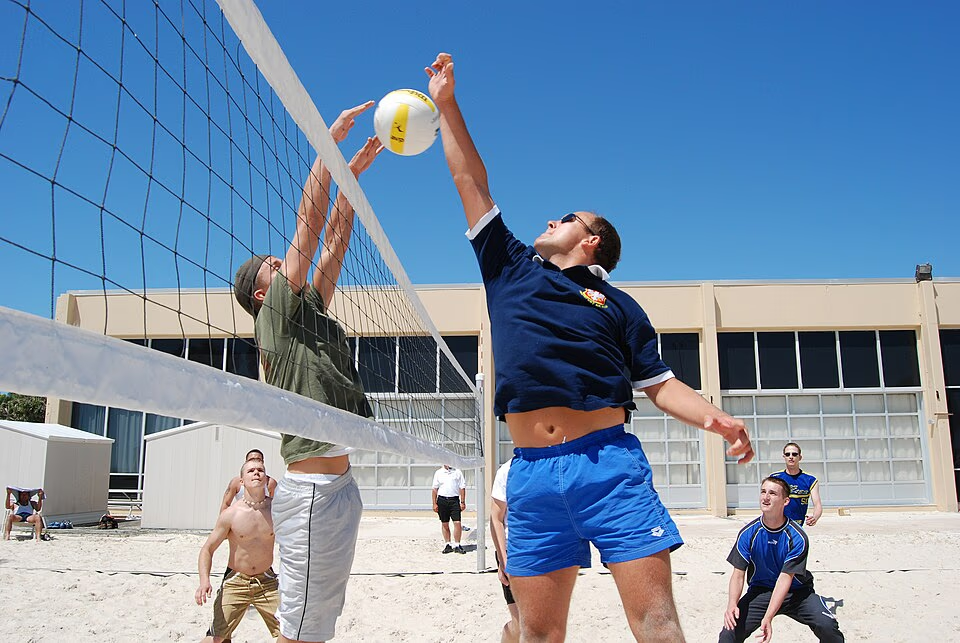
NCAA Beach Volleyball is the collegiate variant of beach volleyball played as a dual-team competition between paired student-athletes. Each NCAA dual-meet contest is a head-to-head competition between two universities, scored by individual pairs matches contested simultaneously on adjacent courts...
NCAA Beach Volleyball does not currently use video review in the same manner as indoor volleyball or some FIVB events. Officiating decisions are final on the court; appeals are limited to the lineup-form challenge process described in Section 4.
Coaching from the bench is permitted in NCAA beach volleyball within the team area; coaches may not enter the court during a rally or interfere with the officials' line of sight. The NCAA Modifications document specifies bench-conduct expectations.
Rectangular court, 16 m × 8 m (smaller than the 18 m × 9 m indoor court); No center line on the sand court — players may move freely under the net into the opponent's court space as long as they do not interfere with the opponent's play; Sand surface: minimum 40 cm depth of clean, sifted sand fre...
The team that wins 3 of the 5 pairs matches wins the dual meet; The dual-meet score is reported as the team-vs-team pairs-matches won (e.g., "3-2 dual"); Goal difference, set difference, and point difference are not used to break ties in NCAA beach volleyball dual-meet scoring at the dual level —...
Each dual meet consists of 5 pairs matches contested simultaneously on adjacent courts; The first team to win 3 of the 5 pairs matches wins the dual meet; Each pairs match is worth 1 point in the dual-meet score
Ball lands out of bounds (outside the court boundary; the boundary line counts as in); Four contacts by the same pair (block contact counts in beach); Catch or throw — extended contact with the ball (not a clean hit)
Beach volleyball applies a stricter standard than indoor volleyball to overhand finger-tip "sets": An overhead set must be clean — no extended contact (no "throw"), no spin imparted to the ball, hands must be square to the target; Setting the ball over the net is permitted only on a clean overhea...
Each head coach submits a lineup form before the dual meet listing the 5 pairs in order 1-5; The opposing head coach may challenge the lineup via the NCAA Challenge Form within a defined window if the lineup appears to violate the order-of-ability requirement; The Championship Lineup Form and Cha...
FIVB misconduct sanctions apply, with NCAA-specific publications elaborating on dual-meet bench discipline: Warning (verbal; not recorded); Penalty (yellow card; loss of rally + point to opposing pair); Expulsion (red card; player removed for remainder of the set; replacement allowed in beach is ...
NCAA dual-meet competitions are typically played on five adjacent courts simultaneously to support the 5-pair format. Each court has its own officiating crew and scoring table; the dual-meet result is determined by the count of pairs-matches won across the five courts.
Call Your Own Faults Honestly
Beach volleyball's self-officiating tradition requires players to call their own carries, lifts, double contacts, and net touches without prompting. Because matches at many levels lack line judges or referees for every fault, personal integrity in fault-calling is considered the foundation of the sport's culture and a point of pride among serious players.
More critical at recreational and amateur levels where officials are absent, but the expectation of honest self-reporting persists even in officiated NCAA matches when a fault is unambiguous to the player.
Meet Opponents at the Net After the Match
Regardless of outcome, both pairs meet at the net immediately after the final point for a handshake, fist bump, or high-five with each opponent and the opposing partner. Skipping or rushing through this ritual is widely viewed as disrespectful and poor sportsmanship in the beach volleyball community.
Never Publicly Blame or Undermine Your Partner
Two-player beach volleyball depends entirely on partnership trust. Visibly expressing frustration at a partner's error—through gestures, body language, or words audible to opponents—is considered a serious breach of team culture. Partners are expected to absorb mistakes together and present a unified front regardless of internal difficulty.
The two-person format makes partner dynamics uniquely visible compared to indoor volleyball; the stakes of public blame are correspondingly higher.
Ready to dive deeper?
Honest Line Calls — Give Benefit of the Doubt to Opponents
On balls that are genuinely too close to call, the longstanding custom is to award the point to the hitting team rather than calling it out. This is especially expected when officiating your own lines. Consistently making marginal calls in your own favor is seen as cheating the spirit of the game.
Applies most forcefully in recreational and amateur play; in fully officiated NCAA matches the obligation shifts to referees, but players are still expected to volunteer that a ball landed in when they are certain.