


🏛️Official — World Archery
Loading OpenSourceSports…
Pay to replace an arrow you Robin Hood
If your arrow splits or destroys another archer's arrow by striking it nock-to-point (a 'Robin Hood'), you are expected to pay for a replacement. The rare achievement carries a social obligation: the archer who caused the damage compensates the owner, even when entirely accidental.
Stay silent and still when a fellow archer is at full draw
Once an archer has drawn to anchor, observers and line-mates go silent and avoid movement until the arrow is released. Interrupting concentration at full draw — speaking, walking nearby, or making sudden noise — is a serious breach of range courtesy.
Never touch another archer's equipment without explicit permission
A bow is a precisely tuned, deeply personal instrument. Picking up, drawing, or adjusting another archer's bow, arrows, or accessories without asking first violates one of the sport's strongest cultural norms — regardless of how casual the setting appears.
Wait for the full end to complete before advancing to the target
Even after finishing your own arrows, you do not walk toward the target until all archers on the line have shot and the advance signal is given. Walking early disrupts concentration and is considered unsafe and discourteous.
The recurve bow is the only bow type permitted in Olympic competition. It consists of a riser (the central handle section, typically aluminium or carbon) and two detachable limbs that curve away from the archer at their tips, storing and releasing energy efficiently.
Why people argue about this
People often assume that all archers can use recurve bows in Olympic competitions simply because they're the most common type of bow. However, the official verdict clarifies that while recurves are indeed permitted, only this specific type is officially sanctioned for Olympic competition, distinguishing it from other types like compound or traditional bows.
The compound bow uses a system of cables and eccentric pulleys (cams) to provide let-off, reducing the holding weight at full draw to roughly 60–80% less than peak draw weight. This allows the archer to hold steadily for longer.
Why people argue about this
People often assume that the let-off feature of compound bows is solely about making shots easier for beginners by reducing holding weight, but in reality, it's designed to allow for more precise aiming over longer periods without tiring the arm too quickly. They overlook how crucial this adjustment is for precision and consistency in competitive archery.
Barebow archery uses a recurve-style bow stripped of most accessories. No sights, no stabilizers, no clicker, and no marks on the bow that could serve as aiming references are permitted.
Why people argue about this
People often assume that barebow means no sights at all are allowed, forgetting about clickers which can still be used for aiming in this category. The true confusion arises because they overlook the fact that a clicker is a mechanical device and not an "aiming reference," thus technically compliant with the rule's stipulation of no marks on the bow.
All arrows used in competition must conform to WA specifications: Shaft: Aluminium, carbon, or aluminium-carbon composite. Maximum outer diameter of 9.3 mm (0.37 in). All arrows in a set must be identical in length, weight, and construction.; Nock: The plastic fitting at the rear of the arrow tha...
Why people argue about this
People often assume that only equipment used during competition needs inspection, so they skip pre-competition checks thinking it's a waste of time. Actually, the rule mandates thorough inspections before the competition starts to ensure all participants are playing fairly and safely with compliant gear.
Finger tab or glove: Worn on the drawing hand to protect the fingers and provide a smooth string release.; Arm guard (bracer): Worn on the inside of the bow arm's forearm to prevent string slap.; Chest guard: Optional; prevents clothing from catching the string.
Why people argue about this
People often assume that only the equipment they personally use needs inspection, forgetting about shared components like scoring pins or target stands which are also under scrutiny as part of the comprehensive "Personal Protective Equipment" check before competitions in archery.
Before competition, all equipment undergoes mandatory inspection by WA judges. Bows, arrows, and accessories are checked for compliance with the division's rules.
Why people argue about this
People often assume that only visible equipment is inspected during the mandatory equipment check, forgetting about hidden components like bow strings or arrow nocks that could be out of compliance with rules. The confusion arises because they overlook the comprehensive nature and scope of what's actually being scrutinized under this rule.
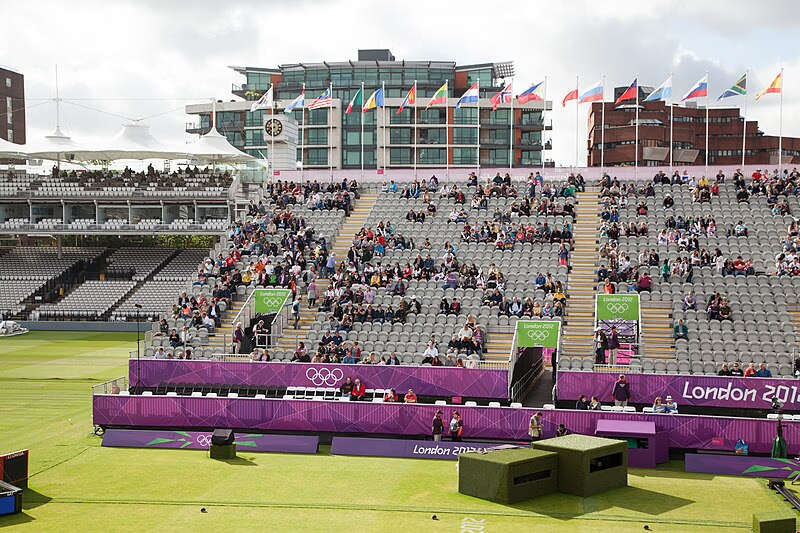
International outdoor target archery takes place on a flat, level field (the Field of Play) with clearly defined zones: Shooting line: A marked line on the ground from which all archers shoot. Archers must straddle or stand immediately behind this line.; Waiting line: Located approximately 5 metr...
Why people argue about this
People often assume that these wind flags are meant to indicate gusts of wind at each shooting position, leading them to argue over their placement and interpretation. However, in reality, they serve as a general guide for archers to estimate wind conditions throughout the range, not pinpointing specific gusts or directions at individual stations.
Olympic recurve: 70 metres (229.7 ft) from shooting line to target face.; Compound: 50 metres (164 ft) from shooting line to target face.; 122 cm target face: Used for the 70 m ranking round. Features 10 concentric scoring zones in five colours (gold, red, blue, black, white), each colour divided...
Why people argue about this
People often assume that these wind flags are used by archers to determine their own shot adjustments based on wind speed and direction, which is incorrect. In reality, they serve as reference points for range officials who measure consistency across different shots rather than individual archers adjusting their technique in real-time.
Lane width: Minimum 5 metres (16.4 ft) per target butt, ensuring adequate spacing between adjacent archers.; Overshoot area: A minimum of 110 metres (361 ft) of clear, controlled space behind the target line to safely arrest any arrows that miss or pass through the buttresses.; Lateral safety zon...
Why people argue about this
People often assume that the small wind flags are used as a way for archers to adjust their shots based on wind speed and direction, which is incorrect. In reality, these flags serve merely to indicate where wind conditions might be changing along the range, allowing archers to observe them but not modify their aim or strategy in response to flag movements.
Small wind flags are placed at regular intervals along the range (typically at the shooting line and at the target line) so archers can read wind speed and direction. Flags are lightweight fabric, usually 25 cm × 80 cm.
Why people argue about this
People often assume that wind flags are only placed at the shooting line for good visibility, forgetting about their importance at the target line where archers can gauge wind direction more accurately from a distance. The confusion arises because they believe all archers need is one flag to read wind conditions, overlooking how different positions offer varying levels of accuracy and convenience.
In the Olympic format, up to 64 archers per gender qualify for the individual event. Each archer competes independently.
Why people argue about this
People often assume that archers in the Olympic individual event are pitted against each other directly, like in a head-to-head match, which leads to confusion about how their scores contribute to overall qualification. Actually, they compete independently and only the top 64 scores from all genders combined qualify for the final round, not necessarily by defeating one another.
Team event: 3 archers from the same nation. Each team member shoots 2 arrows per end (6 arrows total per team end). Teams are seeded by the combined ranking round scores of their three members.; Mixed team event: 1 man and 1 woman from the same nation. Each archer shoots 2 arrows per end (4 arrow...
Why people argue about this
People often assume that coaches can communicate with archers during actual shooting ends too, which is a common misunderstanding since the official rule explicitly states they can only talk between ends. The confusion arises because it's easy to overlook or misinterpret "between ends" as meaning anytime outside of active shooting.
Director of Shooting (DOS): Controls the flow of competition using light signals and audio signals. Responsible for starting and stopping shooting, managing the shot clock, and ensuring the schedule is followed.; Judges: Qualified World Archery judges positioned on the field. They score arrows, r...
Why people argue about this
People often assume coaches can freely communicate with archers at any time during a match, not just between ends, leading to misunderstandings about when they're allowed to talk. The confusion arises because the specific timing restrictions are not always clearly understood or remembered by all teams and officials.
Each team is permitted one coach in the designated coaches' area adjacent to the waiting line. Coaches may communicate with their archers between ends but not during active shooting.
Why people argue about this
People often assume that coaches can communicate with their archers at any time during competition, thinking it's merely a restriction on when they can talk, but actually, the key is understanding the distinction between communication allowed and active shooting periods, where no coaching is permitted to prevent unfair advantages.
The competition begins with the ranking round (also called the qualification round). Each archer shoots 72 arrows at 70 metres, fired in 12 ends of 6 arrows each.
Why people argue about this
People often assume that in the ranking round of archery competitions, each shooter shoots all 72 arrows at once for their total score, but actually, they shoot in manageable sets of 6 arrows per end over 12 ends to keep scores current and fair throughout the competition.
Olympic individual matches use the set system. Each match consists of up to 5 sets of 3 arrows per archer: The archer with the higher 3-arrow total in a set wins that set and receives 2 set points.; If both archers score the same total, each receives 1 set point.; The first archer to accumulate 6...
Why people argue about this
People often assume that a shoot-off means each archer gets 3 shots instead of just 1, leading to confusion about how many arrows are actually fired in a tiebreaker scenario under World Archery's Individual Elimination (Set System).
If the score is tied 5–5 after 5 sets, the match goes to a shoot-off. Each archer shoots 1 arrow within 20 seconds.
Why people argue about this
People often assume that in a shoot-off, both archers get 10 seconds to shoot their arrow instead of just 20 seconds each as stated. They mistakenly think it's like a regular round where they have more time per shot, leading to misunderstandings about the actual rule.
Team matches also use the set system with up to 4 sets of 6 arrows per team (2 arrows per archer per set). Teams have 2 minutes per end (the three archers rotate to the shooting line and each shoots 2 arrows).
Why people argue about this
People often assume that each team only gets 2 minutes for all 6 arrows in a set, forgetting that they have to rotate through three archers, meaning each archer shoots two arrows per set within those 2-minute limits. This misunderstanding leads to arguments about time management and strategy adjustments during matches.
Mixed team matches follow the same set system with up to 4 sets of 4 arrows (2 per archer per set). The two archers alternate shots, with each archer shooting one arrow at a time.
Why people argue about this
People often assume that archers shoot all 4 arrows in a set before switching, which leads them to think they have to wait for both team members to finish their shots before passing the target back. Actually, each archer shoots one arrow at a time, so the confusion arises because they miss this key detail about alternating shots between the two team members.
Compound individual matches do not use the set system. Instead, each archer shoots 5 ends of 3 arrows (15 arrows total), and the match is decided by cumulative score.
Why people argue about this
People often assume that compound matches use a set system like in recurve archery, where each competitor shoots 12 arrows total for a match. But they misunderstand that in compound individual matches, it's actually 5 ends of 3 arrows each (totaling 15 shots), and the winner is decided by who scores more points across all these rounds.
The Director of Shooting controls all activity on the range using a standardized signal system: Two whistle blasts (or two audible signals): Archers may move from the waiting line to the shooting line and prepare to shoot.; One whistle blast: Shooting may begin. The shot clock starts.; Three whis...
Why people argue about this
People often think that the amber light only means you have 10 seconds left before time is up, forgetting that in alternating format it signifies a full minute of shooting remaining. This confusion stems from the specific wording about "alternating format" not being widely understood or practiced at all competitions.
The target face is divided into 10 concentric scoring rings arranged in five colour bands, from the centre outward: Gold (innermost): X-ring (inner 10) and 10-ring. The X-ring has no higher point value than 10 but is used as a tiebreaker in ranking rounds. On a 122 cm face, the X-ring diameter is...
Why people argue about this
People often think that the scoring zones are just those 10 rings themselves, forgetting about the white outer band that surrounds them entirely. But actually, it's the entire target face including the white outer band that counts as valid scoring areas in World Archery rules for this event.
If an arrow shaft touches the line dividing two scoring zones, the arrow is awarded the higher value. This is determined by visual inspection; if doubt exists, judges use a magnifying loupe or a mechanical scoring device to determine whether the arrow shaft breaks the line.
Why people argue about this
People often assume that if an arrow touches the line dividing scoring zones, it's automatically awarded the higher value based solely on visual inspection. However, they misunderstand that judges use magnifying tools or mechanical devices to ensure accuracy when there’s a doubt about whether the shaft broke the line, thus avoiding any potential disputes.
Per end (3 arrows): 30 points (three 10s).; Per end (6 arrows): 60 points (six 10s).; Ranking round (72 arrows): 720 points. A perfect 720 is exceptionally rare; scores above 690 are considered world-class for recurve.
Why people argue about this
People often assume that scores are tallied in a random order, thinking they might get their results sooner if they're at the bottom of the list. But actually, archers must wait until all scores have been recorded before any arrows can be removed from the targets, ensuring fairness and accuracy across the board.
After each end, archers (or designated scorers) approach the targets and record scores before any arrows are removed. Scores are called from highest to lowest.
Why people argue about this
People often assume that scorers should start by checking scores from lowest to highest to ensure no mistakes are made before moving on, but in fact, the official procedure is to go from highest to lowest as it allows for quicker verification of top scores and prevents tampering with lower-scoring arrows.
If two or more archers have the same 72-arrow total in the ranking round, ties are broken in order by: (1) number of 10s (including Xs), (2) number of Xs. If still tied, archers receive the same ranking and are placed into the bracket accordingly.
Why people argue about this
People often assume that if two archers have identical scores in the ranking round, they automatically get different rankings just based on their Xs (bullseyes), but actually, it's more complex - they need to compare both 10s and Xs together before deciding who gets a higher ranking.
Shooting after time expires: Any arrow released after the red light activates or the time signal sounds is not scored (recorded as M/0). Judges observe the shooting line and the clock to enforce this rule.; Shooting before the signal: An arrow released before the start signal is declared void and...
Why people argue about this
People often assume that they have unlimited time to lodge an appeal after hearing a decision, which leads to misunderstandings about when exactly appeals must be made. The confusion arises because this rule specifically states appeals should be lodged "promptly" before the next end begins, not allowing for extended deliberation periods outside of this window.
Too many arrows: If an archer shoots more arrows than permitted in an end, the highest-scoring arrow(s) in that end are removed from the score until the correct number remains.; Shooting another archer's target: An arrow shot at the wrong target is scored as M/0 for the offending archer and is no...
Why people argue about this
People often assume that they have until after a game ends to lodge an appeal against a judge's decision regarding arrow and shooting violations, but actually, the official time frame is before the next end begins, which can lead to misunderstandings and missed opportunities for appeal.
Non-compliant equipment: Use of equipment that does not meet the division's rules (e.g., a magnifying sight in recurve) results in immediate exclusion from the event.; Equipment failure: If a bow or other equipment breaks during an end, the archer may request a time allowance of up to 15 minutes ...
Why people argue about this
People often assume that they have unlimited time to lodge an appeal after hearing a judge's decision in archery, which can lead to misunderstandings about when exactly appeals must be filed before the next end begins. The rule is clear and specific on timing, but some still miss the promptness requirement, leading to confusion and potential disputes.
Unsportsmanlike conduct: Includes deliberate distraction of opponents, verbal abuse, disrespect toward officials, or any behaviour bringing the sport into disrepute. A first offence receives a yellow card (warning). A second offence results in a red card and the deduction of the highest-scoring a...
Why people argue about this
People often assume that they have until after the match ends to lodge an appeal against a judge's decision, which can lead to misunderstandings about timing. The confusion arises because the official verdict specifies appeals must be made promptly before the next end begins, not post-match as one might initially think.
An archer or team manager may lodge a formal appeal with the Jury of Appeal against a judge's decision. Appeals must be lodged promptly (typically before the next end begins).
Why people argue about this
People often assume that they have unlimited time to lodge an appeal after hearing a judge's decision, misunderstanding that appeals must be filed promptly before the next end begins, typically within minutes of receiving the result. This confusion stems from not fully grasping the specific timing requirement outlined in Rule 7.5 for archery competitions.
Archery ranges are controlled environments where strict safety protocols are enforced at all times. The Director of Shooting has absolute authority over range safety, and all archers and officials must comply with their signals immediately.
Why people argue about this
People often assume that range safety protocols are just a formality, something to be checked off before shooting. They misunderstand the absolute authority of the Director of Shooting; they think compliance is optional or only applies during inspections, but in reality, it's an ongoing, strict requirement enforced at every moment on the range.
The whistle (or audible signal) system is the primary safety communication tool: 2 blasts: Archers may approach the shooting line.; 1 blast: Shooting may commence.; 3 blasts: Shooting stops; archers move forward to score and collect arrows.
Why people argue about this
People often assume that the whistle signal system is only for signaling when a competitor needs immediate attention due to danger, forgetting that it's also used for routine communication like indicating which end of the target is up next or reminding competitors about their turn. This oversight can lead to misunderstandings and arguments during matches.
When a red flag is raised at the target line, no person may approach the targets. This indicates that the range is active and arrows may be in flight.
Why people argue about this
People often assume that seeing a red flag means they should immediately stop all their own activities at the range, thinking it's a signal for them to leave entirely. However, the actual intent is much more nuanced: the flag indicates the shooting area is active and in use by other archers, not that the entire facility is closed off.
A qualified medical team must be present on-site at all WA-sanctioned events, with first aid equipment and emergency transport capability.; Arrow removal from targets: Archers must pull arrows straight out of the buttress to avoid injury. One hand is placed flat on the target face beside the arro...
Why people argue about this
People often assume that spectators are only at risk from falling arrows, so they argue why physical barriers are necessary when all they see is an archery range with a few targets. Actually, the confusion arises because these barriers also prevent other potential hazards like equipment malfunctions or projectiles flying off-target and potentially injuring people in closer proximity to the action.
Spectators must remain behind the designated spectator line at all times. At major events, physical barriers, fencing, or netting separate the public from the field of play.
Why people argue about this
People often assume that they can stand close to the field without barriers simply because archery targets are small and hard to miss, but actually, the rule is about maintaining a safe distance for everyone's safety in case of an accident or injury on the field. The confusion arises because spectators might overlook the potential severity of accidents involving arrows and projectiles.
The recurve bow is the only bow type permitted in Olympic competition. It consists of a riser (the central handle section, typically aluminium or carbon) and two detachable limbs that curve away from the archer at their tips, storing and releasing energy efficiently.
Why people argue about this
People often assume that all types of bows are permitted in Olympic archery just because recurve is mentioned first. However, the official verdict clearly states that only recurve bows are allowed in Olympic competition, leaving other bow types like compound and traditional out of bounds.
International outdoor target archery takes place on a flat, level field (the Field of Play) with clearly defined zones: Shooting line: A marked line on the ground from which all archers shoot. Archers must straddle or stand immediately behind this line.; Waiting line: Located approximately 5 metr...
Why people argue about this
People often assume that these wind flags are meant to indicate weather conditions for spectators, rather than providing crucial information about wind speed and direction for archers aiming at precise distances. The confusion arises because the official purpose of these flags is directly related to improving accuracy by helping archers gauge wind conditions on their shots.
In the Olympic format, up to 64 archers per gender qualify for the individual event. Each archer competes independently.
Why people argue about this
People often assume that archers from different countries can compete in the same round if they're of the same gender, which isn't true according to World Archery rules. The confusion arises because the official statement only mentions individual event qualifiers based on gender, not specifying that each country must have its own set of 64 qualifiers for the final rounds.
The competition begins with the ranking round (also called the qualification round). Each archer shoots 72 arrows at 70 metres, fired in 12 ends of 6 arrows each.
Why people argue about this
People often assume that each archer shoots all 72 arrows in one sitting over a single session, forgetting about the structure of the competition which divides it into 12 ends of 6 arrows each. The confusion arises because they miss the detail about how the ranking round is actually structured.
The target face is divided into 10 concentric scoring rings arranged in five colour bands, from the centre outward: Gold (innermost): X-ring (inner 10) and 10-ring. The X-ring has no higher point value than 10 but is used as a tiebreaker in ranking rounds. On a 122 cm face, the X-ring diameter is...
Why people argue about this
People often assume that each ring represents a different scoring value, thinking it's like rings on a target where each is worth more points as you move outward. But actually, in World Archery’s Scoring Section 6, each of those concentric rings (from the inner to outer) are all worth 10 points, with color bands indicating different zones but not altering the point value within them.
An archer or team manager may lodge a formal appeal with the Jury of Appeal against a judge's decision. Appeals must be lodged promptly (typically before the next end begins).
Why people argue about this
People often assume that they have unlimited time to lodge an appeal after hearing a decision, thinking it's as flexible as other sports where appeals are made post-game. But in archery, there’s a strict timeframe—typically before the next end begins—that clearly delineates when appeals must be filed, creating confusion about timing and procedure.
Archery ranges are controlled environments where strict safety protocols are enforced at all times. The Director of Shooting has absolute authority over range safety, and all archers and officials must comply with their signals immediately.
Why people argue about this
People often assume that just because archery ranges are controlled environments doesn't mean they're always safe, leading them to misunderstand that compliance with signals is a matter of life and death due to the precision and power of arrows in this sport, not just about following directions but understanding the gravity of potential injury.