


🏛️Official — World Archery
Loading OpenSourceSports…
Individual Sports
1 players
both
bow, arrow, bowstring
10 essential rules
Archery is one of the oldest competitive disciplines in human history, evolving from a survival skill into a precision sport governed by exacting technical standards. Target archery first appeared at the Olympic Games in Paris in 1900, was contested intermittently through the 1920 Antwerp Games, ...
The recurve bow is the only bow type permitted in Olympic competition. It consists of a riser (the central handle section, typically aluminium or carbon) and two detachable limbs that curve away from the archer at their tips, storing and releasing energy efficiently.
The compound bow uses a system of cables and eccentric pulleys (cams) to provide let-off, reducing the holding weight at full draw to roughly 60–80% less than peak draw weight. This allows the archer to hold steadily for longer.
Barebow archery uses a recurve-style bow stripped of most accessories. No sights, no stabilizers, no clicker, and no marks on the bow that could serve as aiming references are permitted.
All arrows used in competition must conform to WA specifications: Shaft: Aluminium, carbon, or aluminium-carbon composite. Maximum outer diameter of 9.3 mm (0.37 in). All arrows in a set must be identical in length, weight, and construction.; Nock: The plastic fitting at the rear of the arrow tha...
Finger tab or glove: Worn on the drawing hand to protect the fingers and provide a smooth string release.; Arm guard (bracer): Worn on the inside of the bow arm's forearm to prevent string slap.; Chest guard: Optional; prevents clothing from catching the string.
Before competition, all equipment undergoes mandatory inspection by WA judges. Bows, arrows, and accessories are checked for compliance with the division's rules.
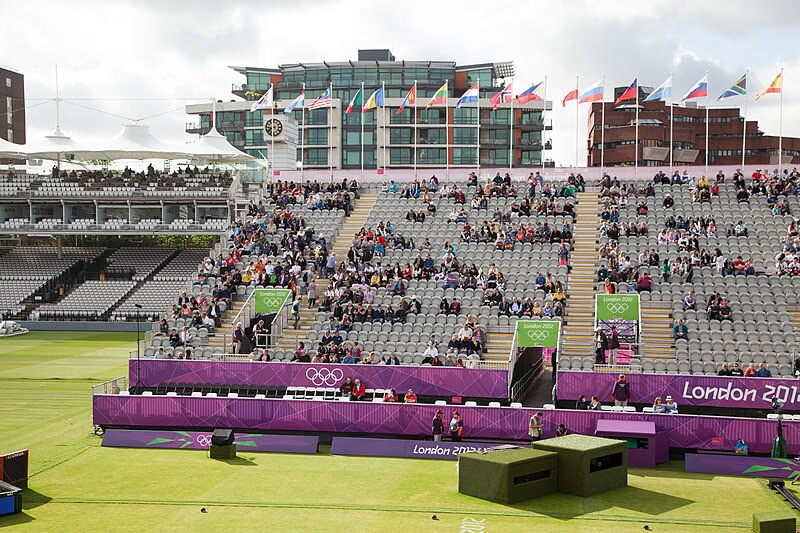
International outdoor target archery takes place on a flat, level field (the Field of Play) with clearly defined zones: Shooting line: A marked line on the ground from which all archers shoot. Archers must straddle or stand immediately behind this line.; Waiting line: Located approximately 5 metr...
Olympic recurve: 70 metres (229.7 ft) from shooting line to target face.; Compound: 50 metres (164 ft) from shooting line to target face.; 122 cm target face: Used for the 70 m ranking round. Features 10 concentric scoring zones in five colours (gold, red, blue, black, white), each colour divided...
Lane width: Minimum 5 metres (16.4 ft) per target butt, ensuring adequate spacing between adjacent archers.; Overshoot area: A minimum of 110 metres (361 ft) of clear, controlled space behind the target line to safely arrest any arrows that miss or pass through the buttresses.; Lateral safety zon...
Small wind flags are placed at regular intervals along the range (typically at the shooting line and at the target line) so archers can read wind speed and direction. Flags are lightweight fabric, usually 25 cm × 80 cm.
Pay to replace an arrow you Robin Hood
If your arrow splits or destroys another archer's arrow by striking it nock-to-point (a 'Robin Hood'), you are expected to pay for a replacement. The rare achievement carries a social obligation: the archer who caused the damage compensates the owner, even when entirely accidental.
Applies most often in practice and club settings; in formal competition written damage rules govern scoring, but the replacement payment norm extends beyond any rulebook.
Stay silent and still when a fellow archer is at full draw
Once an archer has drawn to anchor, observers and line-mates go silent and avoid movement until the arrow is released. Interrupting concentration at full draw — speaking, walking nearby, or making sudden noise — is a serious breach of range courtesy.
Never touch another archer's equipment without explicit permission
A bow is a precisely tuned, deeply personal instrument. Picking up, drawing, or adjusting another archer's bow, arrows, or accessories without asking first violates one of the sport's strongest cultural norms — regardless of how casual the setting appears.
Wait for the full end to complete before advancing to the target
Even after finishing your own arrows, you do not walk toward the target until all archers on the line have shot and the advance signal is given. Walking early disrupts concentration and is considered unsafe and discourteous.
Ready to dive deeper?
Some aspects are codified in World Archery written rules, but the cultural expectation to wait patiently — rather than hovering at the line's edge — is an unwritten standard.