Section 1: Introduction
1.1 Overview and History
Alpine skiing is one of the flagship winter Olympic disciplines, first contested at the 1936 Garmisch-Partenkirchen Winter Games where only a combined event was held. The sport has since expanded into five individual Olympic events and a team event. Competitors race down snow-covered mountain courses, navigating gates at speeds that can exceed 150 km/h (93 mph) in speed events, making it one of the most demanding and dangerous sports in the world.
1.2 Governing Body
The Fédération Internationale de Ski et de Snowboard (FIS), founded on 2 February 1924 in Chamonix, France, is the international governing body for alpine skiing, cross-country skiing, ski jumping, Nordic combined, freestyle skiing, snowboard, and other snow sports. FIS is headquartered in Oberhofen am Thunersee, Switzerland, and comprises over 140 national ski associations. FIS publishes the International Competition Rules (ICR), Book IV — Alpine Skiing, which is updated annually and serves as the definitive rulebook for all sanctioned competitions.
1.3 Olympic Disciplines
Alpine skiing features six Olympic events for both men and women:
- Downhill (DH): The longest and fastest event. A single timed run on a steep, high-speed course with widely spaced gates. Racers reach speeds of 130–150 km/h (80–93 mph).
- Super-G (SG): A speed event combining the velocity of downhill with more frequent turns. A single timed run with no course inspection on foot — competitors study the course visually or by skiing alongside it.
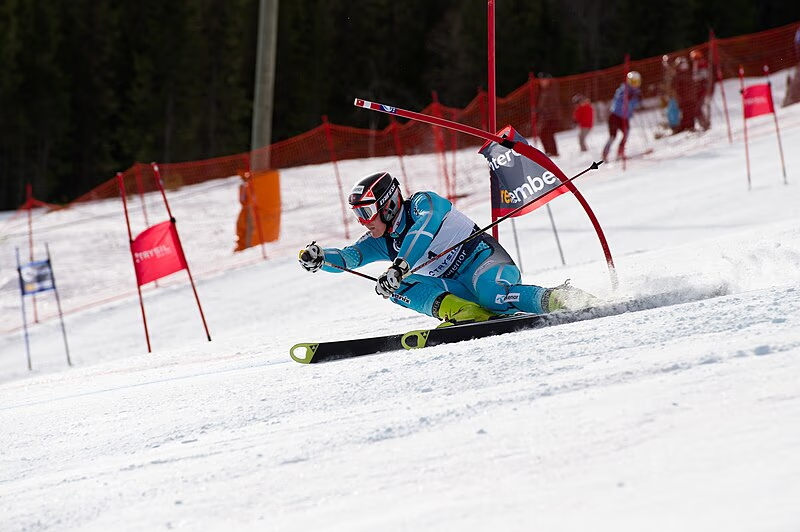
- Giant Slalom (GS): A technical event with two runs on different course sets. Gates are offset at moderate distances, requiring smooth arcing turns at speeds of 60–80 km/h (37–50 mph).
- Slalom (SL): The most technical event with the shortest, steepest courses. Two runs on different course sets with closely spaced gates and hinged breakaway panels that racers strike with their shins and hands.
- Alpine Combined: One downhill run and one slalom run. The lowest combined time wins. The format was revised in 2019 to use a shortened Super-G run in some World Cup events.
- Alpine Team Event: Introduced at the 2018 PyeongChang Olympics. Nations field teams of two men and two women who race head-to-head in a parallel slalom bracket format.
1.4 Competition Levels
FIS sanctions competitions at multiple tiers: the FIS Alpine Ski World Cup (the premier annual circuit), the FIS Alpine World Ski Championships (biennial), the Winter Olympic Games (quadrennial), FIS Continental Cups (Europa Cup, Nor-Am Cup, South American Cup, Far East Cup, Australia/New Zealand Cup), and national-level FIS races. Each tier has specific entry requirements based on FIS points.
Section 2: Equipment
2.1 Skis
FIS specifies minimum ski lengths and sidecut radius values per discipline to balance performance and safety (ICR Article 222). Minimum ski lengths:
- Downhill: Men 218 cm (85.8 in), Women 210 cm (82.7 in)
- Super-G: Men 210 cm (82.7 in), Women 205 cm (80.7 in)
- Giant Slalom: Men 193 cm (76.0 in), Women 188 cm (74.0 in)
- Slalom: Men 165 cm (65.0 in), Women 155 cm (61.0 in)
Minimum sidecut radius values prevent excessively aggressive turning geometry:
- DH: ≥50 m (men), ≥45 m (women)
- SG: ≥35 m (men), ≥30 m (women)
- GS: ≥30 m (men), ≥30 m (women)
- SL: ≥13 m (men), ≥11 m (women)
Skis must not have asymmetric profiles or irregularities in their running surface. Maximum ski width at the waist is also regulated per event.
2.2 Boots and Bindings
Ski boots must not exceed a sole length of 43% of the competitor's body height. Maximum boot sole height is 45 mm (1.77 in) at the toe and 55 mm (2.17 in) at the heel, measured without the binding plate. Binding release settings (DIN values) are at the discretion of the competitor and their service technician; however, bindings must be certified and functional. Platform height (combined boot sole and binding riser) is limited to 50 mm for all events.
2.3 Helmets
FIS-approved helmets are mandatory for all events. Helmets must conform to EN 1077: Class A (full-shell with ear and temple coverage) is required for speed events (DH, SG); either Class A or Class B is acceptable for technical events (GS, SL). Helmets with integrated visors are permitted. Aerodynamic modifications, fairings, or attachments that alter the helmet profile are prohibited.
2.4 Poles
Poles must be non-collapsible with a fixed length. In DH and SG, hand guards (protective shields around the basket area) and aerodynamic pole guards are permitted to deflect gates and reduce air resistance. In SL and GS, hand guards are permitted but must not create an aerodynamic advantage. No additional aerodynamic attachments (such as fairings) may be affixed to poles.
2.5 Speed Suits and Protective Gear
Competition suits must pass FIS air permeability tests: a minimum of 30 litres per square metre per second (l/m²/s) to prevent skin-tight, non-porous suits that provide unfair aerodynamic advantages. Suit material thickness must not exceed 6 mm at any point. Back protectors are mandatory in DH and SG and strongly recommended in GS and SL. Airbag vests (inflatable upon impact) are permitted and increasingly common in speed events. Shin guards are standard in SL to withstand repeated gate contact.
Section 3: Playing Area
3.1 Course Homologation
All courses for FIS-sanctioned competitions must be homologated (officially inspected and approved) by a FIS Technical Delegate. Homologation certificates specify the approved vertical drop, course length, and safety infrastructure. Certificates are valid for a limited period and must be renewed through re-inspection. The homologation process evaluates terrain gradient, course width, run-out areas, safety net placement, and snow preparation standards.
3.2 Vertical Drop Requirements
- Downhill: 800–1100 m (2625–3609 ft) for men; 450–800 m (1476–2625 ft) for women. Olympic and World Championship courses aim for the upper range.
- Super-G: 400–650 m (1312–2133 ft) for men; 400–600 m (1312–1969 ft) for women.
- Giant Slalom: 300–450 m (984–1476 ft) for men; 300–400 m (984–1312 ft) for women.
- Slalom: 180–220 m (591–722 ft) for men; 140–200 m (459–656 ft) for women.
3.3 Course Width and Terrain
Minimum course width is 40 m (131 ft) for DH, 30 m (98 ft) for SG, and 40 m (131 ft) for GS and SL at the widest points. The finish area must be flat or slightly uphill to allow safe deceleration, with a minimum width of 20 m (66 ft) and a recommended run-out of at least 60 m (197 ft) beyond the finish line for speed events. The course must be prepared with machine-groomed, packed, or injected snow to ensure a consistent and durable surface.
3.4 Gates and Course Setting
Gates are defined by pairs of poles with attached fabric panels. Gate colours alternate between red and blue throughout the course. Gate specifications vary by discipline:
- DH gates: Rectangular panels approximately 75 cm wide, mounted on flexible poles. Gates are spaced widely apart (minimum 8 m horizontal distance between consecutive gates). Directional gates mark the racing line through high-speed terrain.
- SG gates: Similar panel size to DH, with a minimum horizontal distance of 6 m between turning poles of successive gates and a minimum of 25 m measured directly along the fall line between gates.
- GS gates: Two pairs of poles (four total) with rectangular panels, minimum 4 m gate width. The offset (horizontal distance between successive gates) must be at least 10% of the course width to ensure meaningful direction changes.
- SL gates: Single-pole turning gates with hinged breakaway panels that flex on impact. The gate consists of one turning pole and one outside pole (or two poles forming the gate). Gate width is 4–6 m, with a minimum vertical distance of 0.75 m and maximum of 13 m between gates.
Common gate combinations in SL include: open gates (set across the fall line), closed/vertical gates (set along the fall line), hairpin (two consecutive closed gates in opposite directions), flush (three or more vertical gates), and delay (an offset gate that forces the racer to pause before the next turn).
3.5 Start and Finish Areas
The start area must be flat or gently sloping with a start gate (wand system) connected to the electronic timing system. Competitors stand in a start house that shields them from wind. The finish area features electronic timing beams (photocells) set at knee and chest height, connected to a certified timing system. A photo-finish camera records each competitor crossing the finish line for dispute resolution.
Section 4: Players & Officials
4.1 Competitors
Alpine skiing is an individual timed competition (except for the Team Event). Competitors must hold a valid FIS licence issued through their national ski association. Entry to World Cup, World Championship, and Olympic events requires meeting minimum FIS points thresholds, which vary by discipline and gender. Nations are allocated a maximum number of start quotas per event based on national ranking.
4.2 Competition Jury
The competition jury oversees all aspects of the race and has final authority on decisions. The jury consists of:
- Technical Delegate (TD): Appointed by FIS. Responsible for ensuring the competition complies with ICR rules, inspecting the course, approving the course set, and chairing the jury. The TD files a detailed report to FIS after each event.
- Referee: A qualified official who assists the TD and adjudicates protests and disputes.
- Assistant Referee: Supports the Referee in monitoring the competition.
- Chief of Race: Appointed by the organising committee. Responsible for all logistical and operational aspects of the event including course preparation, volunteer coordination, and venue management.
- Start Referee: Oversees the start area, ensures correct start order, monitors start timing, and manages start interval enforcement.
- Finish Referee: Oversees the finish area, confirms finish times, and manages the finish recording system.
4.3 Course Officials
- Gate Judges: Positioned along the course (typically one per 3–5 gates), each gate judge monitors whether competitors correctly pass through assigned gates. They record gate faults and report to the Referee via radio or written cards.
- Course Workers: Responsible for maintaining gate poles during the race (resetting knocked-down gates), course surface repair (filling ruts), and ensuring spectator safety barriers are intact.
- Timing Personnel: Certified operators who manage the electronic timing system, ensure backup timing is operational, and record split times at intermediate checkpoints.
- Video Controllers: Review video footage of gate passages to verify or overturn gate judge reports. Video review is standard at World Cup level and above.
4.4 Coaching and Service Teams
Each national team travels with coaches, ski technicians, and medical staff. Coaches may not communicate with competitors during a run. Ski technicians prepare equipment in designated waxing areas and are subject to random equipment checks by FIS officials before and after races.
Section 5: Rules of Play
5.1 Course Inspection
Course inspection rules differ by discipline:
- Downhill: Competitors must complete a minimum of one official training run (typically three training runs are scheduled over preceding days). Inspection is conducted by skiing the course at reduced speed.
- Super-G: No course inspection on foot and no training runs. Competitors may visually inspect the course from alongside or study video footage. This “one-look” format demands exceptional reading of terrain at speed.
- Giant Slalom: Competitors inspect the course on foot (side-slipping alongside the gates) for a defined inspection period before each run.
- Slalom: Competitors inspect the course on foot before each run, studying gate placement, snow conditions, and line choices.
5.2 Start Procedure
Competitors start individually at fixed intervals. The start referee calls the racer into the start gate approximately 10 seconds before their start time. A countdown sequence of audible beeps (at 10 seconds, 5, 4, 3, 2, 1, and a start tone) signals the racer. The racer must leave the start gate within 5 seconds of the start signal; failure to do so results in a time penalty or DSQ at the jury's discretion.
Typical start intervals are: DH 60 seconds (minimum), SG 60 seconds, GS 60 seconds (or variable based on conditions), SL variable (typically immediately after the previous racer clears the course or a fixed interval).
5.3 Start Order and Bib Numbers
Start order is determined by FIS points ranking in the relevant discipline. In World Cup events, the top-ranked competitors (typically the top 7–15 by FIS points) draw start positions from a random draw within their group. Lower-ranked competitors start in descending order of FIS points after the seeded group. In two-run events (GS, SL), the second run start order is the reverse of first-run results: the 30th-placed racer after run one starts first in run two, with the run-one leader starting last — a format known as the “bib flip” or reverse-30 rule.
5.4 Gate Passage
A competitor must pass through every gate on the course. A gate is correctly passed when both ski tips and both feet have crossed the gate line (the imaginary line between the turning pole and the outside pole, or between the two pairs of poles in GS). In slalom, physical contact with the gate panel is expected and normal — racers deliberately strike the hinged panel with their shins, arms, or hands to maintain a tight line.
5.5 Run Format
- Downhill: One timed run. Fastest time wins.
- Super-G: One timed run. Fastest time wins.
- Giant Slalom: Two runs on different course sets (the course setter changes gate positions between runs). Lowest combined time wins.
- Slalom: Two runs on different course sets. Lowest combined time wins.
- Alpine Combined: One speed run (DH or shortened SG) plus one SL run. Lowest combined time wins.
- Team Event: Nations field teams of four (two men, two women). Competitors race head-to-head in parallel slalom. Each matchup is decided by the combined time advantage of the team's four racers. The tournament uses a single-elimination bracket format.
5.6 DNF, DNS, and DSQ
DNF (Did Not Finish): A competitor who stops or falls and does not cross the finish line. DNS (Did Not Start): A competitor who does not appear in the start gate for their run. DSQ (Disqualified): A competitor who is disqualified for a rule violation (gate fault, equipment infraction, or unsportsmanlike conduct). A competitor who misses a gate may hike back up and re-pass the gate correctly to avoid DNF, provided they do so without outside assistance.
Section 6: Scoring
6.1 Timing System
All FIS-sanctioned competitions use electronic timing to 1/100th of a second (0.01 s). The primary timing system uses photocell beams at the start and finish lines. A fully independent backup system (typically a second set of photocells or transponder-based timing) runs in parallel. Intermediate split times are recorded at designated checkpoints along the course. In the event of a timing system failure, the backup time becomes the official result. If both systems fail, hand timing (1/100th s precision) may be used as a last resort at the jury's discretion.
6.2 Race Results
Rankings are determined by total elapsed time. For two-run events (GS, SL, Combined), the sum of both run times determines the final result. In the event of an exact tie (identical times to 1/100th s), competitors share the same ranking position. World Cup points are awarded to the top 30 finishers: 100 points for 1st place, 80 for 2nd, 60 for 3rd, decreasing to 1 point for 30th.
6.3 FIS Points System
FIS points quantify a competitor's performance relative to the race winner and serve as the basis for start order seeding and competition entry eligibility. The penalty calculation formula is:
Race Points (P) = (Tx / T0 − 1) × F
Where Tx is the competitor's time, T0 is the winner's time, and F is a discipline-specific factor (DH: 1280, SG: 1190, GS: 1010, SL: 730). A race penalty is then applied based on the top-5 starters' and top-5 finishers' FIS points to normalize across races of varying strength. Lower FIS points indicate better performance (0.00 being a theoretical perfect score matching the winner of a penalty-free race).
6.4 Photo Finish and Disputes
A photo-finish system records every finish crossing. If a competitor or team coach disputes a result or gate call, they must file a formal protest with the jury within a defined time window (typically 15 minutes after the provisional results are posted). The jury reviews video evidence and gate judge reports before rendering a final decision. A protest fee applies, refundable if the protest is upheld.
Section 7: Violations & Penalties
7.1 Gate Faults
- Straddling a gate: Passing with one foot on each side of the turning pole (i.e., not both feet passing on the correct side) results in DSQ.
- Missing a gate: Failing to pass through a gate entirely results in DNF. However, a competitor may hike back up the course and re-pass the missed gate before continuing — the clock continues running during this correction.
- Incorrect gate passage in GS: Both ski tips and both feet must pass between the inner (turning) pair of poles. Passing outside the outer pair constitutes a gate fault (DSQ).
7.2 Start Infractions
- False start: Leaving the start gate before the start signal. The competitor may be recalled and allowed to restart with a time correction, or may be disqualified at the jury's discretion.
- Late start: Failing to leave the start gate within 5 seconds of the start signal. The jury may apply a time penalty or issue a DSQ.
- Missing start time: A competitor who fails to appear at the start within the prescribed time is recorded as DNS.
7.3 Equipment Violations
- Ski length below minimum: DSQ. Equipment is measured with a tolerance of ±1 cm to account for wax and base material.
- Sidecut radius below minimum: DSQ. Radius is measured using certified FIS gauges.
- Speed suit air permeability below 30 l/m²/s: DSQ. Suits are tested before and/or after races using a calibrated permeability meter.
- Boot sole height exceeding limits: DSQ.
- Platform height exceeding 50 mm: DSQ.
- Unapproved helmet: DSQ. The helmet must bear a valid FIS sticker for the current season.
7.4 Conduct Violations
- Receiving outside assistance: Any physical or verbal coaching assistance during a run results in DSQ.
- Unsportsmanlike conduct: Verbal abuse of officials, deliberate obstruction of another competitor, or refusal to submit to equipment checks may result in DSQ, suspension, or further disciplinary action by FIS.
- Doping: Alpine skiing falls under WADA (World Anti-Doping Agency) regulations. Violations result in disqualification, result annulment, and suspension per the WADA Code.
7.5 Sanctions and Appeals
The competition jury may impose DSQ, time penalties, or written warnings. Competitors may appeal jury decisions to the FIS Legal & Safety Committee. Repeat offenders may face season-long suspensions or bans from FIS events. Financial penalties may also apply for conduct violations or failure to fulfil media obligations at World Cup events.
Section 8: Safety Considerations
8.1 Course Safety Infrastructure
FIS mandates extensive safety infrastructure along every competition course:
- A-net (inner safety net): High-tensile nylon netting installed at the immediate course edge in high-risk zones (compressions, jumps, sharp turns). Designed to catch a racer who leaves the course at speed.
- B-net (outer safety net): A secondary net installed behind the A-net to provide additional deceleration distance. Required at all locations where the A-net alone does not provide sufficient stopping distance.
- Airbag fencing: Inflatable barriers placed in front of hard objects (lift towers, timing huts, trees, rocks) that cannot be removed. Airbags absorb impact energy and are required at all World Cup and Olympic courses.
- Padding: Foam padding on all rigid structures within 5 m of the course edge, including timing equipment, camera positions, and fence posts.
- Fencing: Spectator fencing separates the public from the course. Officials-only zones are marked and enforced.
8.2 Personal Protective Equipment
- Helmets: Mandatory for all events (EN 1077 Class A for speed events).
- Back protectors: Mandatory in DH and SG. Must meet EN 1621-2 standards. Increasingly worn in all events.
- Airbag vests: Wearable inflatable vests that deploy on impact via accelerometer trigger. Permitted and increasingly common in speed events.
- Shin guards: Integral to slalom racing; protect against repeated high-force gate contact.
- Cut-resistant undergarments: Recommended to protect against ski edge lacerations in crashes.
8.3 Medical and Emergency Protocols
A fully equipped medical team must be on-site for every competition, including physicians, paramedics, and at minimum one ambulance positioned at the finish area. For DH and SG events, a helicopter must be available on standby (or within a response time specified by the TD, typically under 5 minutes) for emergency evacuation. Medical sleds with immobilisation equipment are positioned at intervals along the course. If a competitor crashes and does not immediately rise, the race is stopped (red flag) and medical personnel are dispatched. The competitor may not be moved until cleared by medical staff.
8.4 Weather and Visibility Conditions
The competition jury has authority to delay, interrupt, or cancel a race based on weather conditions:
- Wind: Sustained winds exceeding 8 m/s (29 km/h, 18 mph) at exposed sections of the course may trigger a delay. Higher gusts may warrant cancellation.
- Visibility: Flat light, fog, or heavy snowfall that prevents competitors from reading terrain safely is grounds for delay or cancellation. The TD and jury assess visibility from multiple points on the course.
- Temperature: Extreme cold (below −20 °C / −4 °F) or warm conditions causing dangerous surface softening may trigger delays. Snow temperature and air temperature are monitored.
- Snowfall: Heavy snowfall during a race may necessitate interruption to allow course workers to clear gates and maintain visibility. The jury determines whether conditions allow a fair competition.
If a race is stopped after a significant number of competitors have started, the jury may declare the partial results valid, re-run the event, or cancel entirely, depending on the circumstances and the proportion of the field that completed their runs.
8.5 Course Maintenance During Competition
Course workers continuously maintain the racing surface between competitors. In SL and GS, workers reset dislodged gate poles and repair ruts caused by turning. In DH and SG, workers may apply salt or water injection to harden the surface in warm conditions. The jury may institute “course holds” (temporary breaks) to allow major surface repairs without disadvantaging later starters.