


🏛️Official — FIS
Loading OpenSourceSports…
Winter Sports
1 players
outdoor
ski, pole, helmet
10 essential rules
Alpine skiing is one of the flagship winter Olympic disciplines, first contested at the 1936 Garmisch-Partenkirchen Winter Games where only a combined event was held. The sport has since expanded into five individual Olympic events and a team event. Competitors race down snow-covered mountain cou...
FIS specifies minimum ski lengths and sidecut radius values per discipline to balance performance and safety (ICR Article 222). Minimum ski lengths: Downhill: Men 218 cm (85.8 in), Women 210 cm (82.7 in); Super-G: Men 210 cm (82.7 in), Women 205 cm (80.7 in); Giant Slalom: Men 193 cm (76.0 in), W...
Ski boots must not exceed a sole length of 43% of the competitor's body height. Maximum boot sole height is 45 mm (1.77 in) at the toe and 55 mm (2.17 in) at the heel, measured without the binding plate.
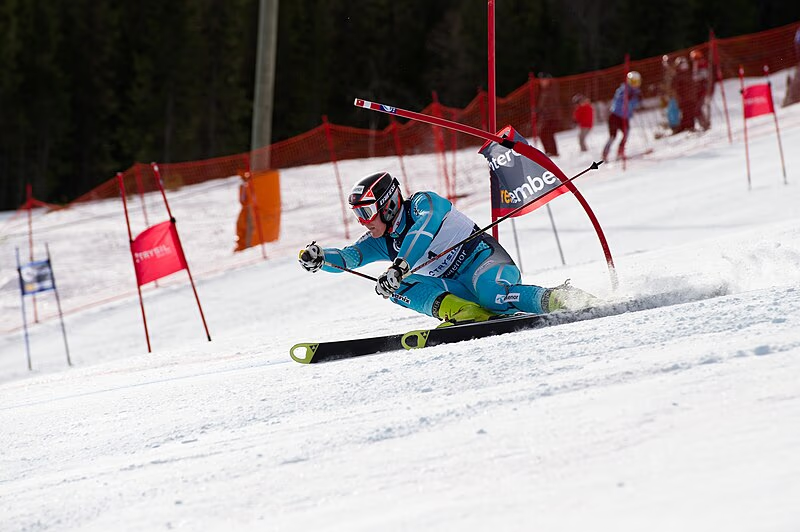
FIS-approved helmets are mandatory for all events. Helmets must conform to EN 1077: Class A (full-shell with ear and temple coverage) is required for speed events (DH, SG); either Class A or Class B is acceptable for technical events (GS, SL).
Poles must be non-collapsible with a fixed length. In DH and SG, hand guards (protective shields around the basket area) and aerodynamic pole guards are permitted to deflect gates and reduce air resistance.
Competition suits must pass FIS air permeability tests: a minimum of 30 litres per square metre per second (l/m²/s) to prevent skin-tight, non-porous suits that provide unfair aerodynamic advantages. Suit material thickness must not exceed 6 mm at any point.
All courses for FIS-sanctioned competitions must be homologated (officially inspected and approved) by a FIS Technical Delegate. Homologation certificates specify the approved vertical drop, course length, and safety infrastructure.
Downhill: 800–1100 m (2625–3609 ft) for men; 450–800 m (1476–2625 ft) for women. Olympic and World Championship courses aim for the upper range.; Super-G: 400–650 m (1312–2133 ft) for men; 400–600 m (1312–1969 ft) for women.; Giant Slalom: 300–450 m (984–1476 ft) for men; 300–400 m (984–1312 ft) ...
Minimum course width is 40 m (131 ft) for DH, 30 m (98 ft) for SG, and 40 m (131 ft) for GS and SL at the widest points. The finish area must be flat or slightly uphill to allow safe deceleration, with a minimum width of 20 m (66 ft) and a recomme...
Gates are defined by pairs of poles with attached fabric panels. Gate colours alternate between red and blue throughout the course.
The start area must be flat or gently sloping with a start gate (wand system) connected to the electronic timing system. Competitors stand in a start house that shields them from wind.
Never touch another team's skis or equipment in the service area
Handling a rival team's skis, boots, or bindings in the service zone — even out of curiosity — is taboo. Given the culture of wax secrecy and the history of equipment tampering allegations, uninvited contact with another team's gear is treated with extreme suspicion and can cause serious diplomatic incidents between national federations.
Equipment sabotage accusations have surfaced multiple times in World Cup history, making physical proximity to rivals' gear a cultural minefield.
Guard ski preparation and wax secrets absolutely
Ski tuning formulas, wax cocktails, and boot-binding setups are treated as proprietary team intelligence at the World Cup level. Discussing preparation specifics with rival teams or media is a serious breach. Service technicians operate under informal omertà; defecting to share prep secrets is considered a betrayal of team trust.
This custom intensified as ski technology became a decisive competitive factor in the 1980s–90s. Major sponsors invest heavily in tuning R&D, reinforcing the secrecy norm.
Maintain restrained celebration when a competitor was seriously injured
If a rival suffers a significant crash or injury during the same race, exuberant celebration on the podium is considered disrespectful. Racers are expected to acknowledge the injury and moderate their public displays, particularly in press conferences. Empathy for injured competitors is a strong cultural expectation.
Ready to dive deeper?
Downhill racing carries genuine physical risk; the community is small enough that competitors often know each other personally, reinforcing this norm.