


🏛️Official — FIS
Loading OpenSourceSports…
Never touch another team's skis or equipment in the service area
Handling a rival team's skis, boots, or bindings in the service zone — even out of curiosity — is taboo. Given the culture of wax secrecy and the history of equipment tampering allegations, uninvited contact with another team's gear is treated with extreme suspicion and can cause serious diplomatic incidents between national federations.
Guard ski preparation and wax secrets absolutely
Ski tuning formulas, wax cocktails, and boot-binding setups are treated as proprietary team intelligence at the World Cup level. Discussing preparation specifics with rival teams or media is a serious breach. Service technicians operate under informal omertà; defecting to share prep secrets is considered a betrayal of team trust.
Maintain restrained celebration when a competitor was seriously injured
If a rival suffers a significant crash or injury during the same race, exuberant celebration on the podium is considered disrespectful. Racers are expected to acknowledge the injury and moderate their public displays, particularly in press conferences. Empathy for injured competitors is a strong cultural expectation.
FIS specifies minimum ski lengths and sidecut radius values per discipline to balance performance and safety (ICR Article 222). Minimum ski lengths: Downhill: Men 218 cm (85.8 in), Women 210 cm (82.7 in); Super-G: Men 210 cm (82.7 in), Women 205 cm (80.7 in); Giant Slalom: Men 193 cm (76.0 in), W...
— Article 222
Why people argue about this
People often assume that the rule only applies to ski design during downhill events, forgetting that it covers all alpine skiing disciplines including giant slalom, where irregularities in the ski's running surface can still give an unfair advantage.
Ski boots must not exceed a sole length of 43% of the competitor's body height. Maximum boot sole height is 45 mm (1.77 in) at the toe and 55 mm (2.17 in) at the heel, measured without the binding plate.
Why people argue about this
People often assume that the sole length limit is purely about safety, thinking it's to prevent boots from slipping off their feet during turns. However, the actual intent of limiting boot sole height to 45 mm is more about aerodynamics and minimizing drag, ensuring skiers can maintain optimal speed and control without excess weight or bulk affecting performance.
FIS-approved helmets are mandatory for all events. Helmets must conform to EN 1077: Class A (full-shell with ear and temple coverage) is required for speed events (DH, SG); either Class A or Class B is acceptable for technical events (GS, SL).
Why people argue about this
People often assume that all alpine skiing events require full-shell helmets with ear coverage for safety, which is why they argue about it. However, the actual rule allows for a more flexible helmet type depending on the event's difficulty level, with speed events mandating full protection and technical events accepting either full or partial protection as long as they meet basic standards.
Poles must be non-collapsible with a fixed length. In DH and SG, hand guards (protective shields around the basket area) and aerodynamic pole guards are permitted to deflect gates and reduce air resistance.
Why people argue about this
People often assume that pole guards are only for aesthetic purposes, forgetting they're crucial for reducing air resistance and deflecting gates, leading to unnecessary arguments about their necessity in downhill (DH) and slalom (SG) events where aerodynamics play such a significant role.
Competition suits must pass FIS air permeability tests: a minimum of 30 litres per square metre per second (l/m²/s) to prevent skin-tight, non-porous suits that provide unfair aerodynamic advantages. Suit material thickness must not exceed 6 mm at any point.
Why people argue about this
People often assume that the air permeability requirement is solely about keeping skiers cool during races, forgetting that it's meant to level the playing field by preventing aerodynamic advantages from overly tight or non-porous suits. In reality, the rule aims to ensure all racers have a fair chance regardless of their suit design and material, not just for comfort.
All courses for FIS-sanctioned competitions must be homologated (officially inspected and approved) by a FIS Technical Delegate. Homologation certificates specify the approved vertical drop, course length, and safety infrastructure.
Why people argue about this
People often assume that only the skiers have a say in what courses are homologated for competitions, forgetting that it's actually the FIS Technical Delegate who conducts the inspection and approves them based on safety standards. This oversight leads to misunderstandings about who decides which courses can be used, causing confusion among athletes and organizers alike.
Downhill: 800–1100 m (2625–3609 ft) for men; 450–800 m (1476–2625 ft) for women. Olympic and World Championship courses aim for the upper range.; Super-G: 400–650 m (1312–2133 ft) for men; 400–600 m (1312–1969 ft) for women.; Giant Slalom: 300–450 m (984–1476 ft) for men; 300–400 m (984–1312 ft) ...
Why people argue about this
People often assume that the minimum width requirements for the finish area are solely about safety, forgetting that these dimensions also impact the overall course design and can influence skiers' performance strategies. The misconception arises because they overlook how varying the width could affect the flow of the race and the strategic positioning on the final descent.
Minimum course width is 40 m (131 ft) for DH, 30 m (98 ft) for SG, and 40 m (131 ft) for GS and SL at the widest points. The finish area must be flat or slightly uphill to allow safe deceleration, with a minimum width of 20 m (66 ft) and a recomme...
Why people argue about this
People often assume that the minimum course width of 40 meters for downhill (DH) races is solely about maximizing speed, but actually it's crucial for safety, ensuring skiers have enough space to navigate and avoid collisions on the narrowest parts of the course. The confusion arises because they overlook how critical this width is in preventing crashes during high-speed descents.
Gates are defined by pairs of poles with attached fabric panels. Gate colours alternate between red and blue throughout the course.
Why people argue about this
People often assume that the alternating red and blue gate colors are for aesthetic purposes only, when in reality, they serve as crucial navigation markers for skiers, helping them maintain their speed and rhythm throughout the course. The confusion arises because the visual pattern is not just decorative but integral to ensuring fair racing conditions across different skill levels.
The start area must be flat or gently sloping with a start gate (wand system) connected to the electronic timing system. Competitors stand in a start house that shields them from wind.
Why people argue about this
People often assume that the start house is just for privacy from spectators, forgetting that its primary function is to protect skiers from wind gusts which can affect their performance and visibility in the gate system. The confusion arises because they overlook how crucial this protection is for ensuring fair competition under the rule's stipulations.
Alpine skiing is an individual timed competition (except for the Team Event). Competitors must hold a valid FIS licence issued through their national ski association.
Why people argue about this
People often assume that just having a national ski association license is enough for participation in alpine skiing competitions, forgetting that it must be issued through their national ski association, leading to confusion about who qualifies as a "competitor" under this rule.
The competition jury oversees all aspects of the race and has final authority on decisions. The jury consists of: Technical Delegate (TD): Appointed by FIS. Responsible for ensuring the competition complies with ICR rules, inspecting the course, approving the course set, and chairing the jury. Th...
Why people argue about this
People often assume that coaches are allowed brief, non-verbal instructions during a run, thinking it's just about verbal communication being prohibited. However, the real confusion here is rooted in the interpretation of what constitutes "communication," leading to misunderstandings about whether subtle cues or gestures would be considered too.
Gate Judges: Positioned along the course (typically one per 3–5 gates), each gate judge monitors whether competitors correctly pass through assigned gates. They record gate faults and report to the Referee via radio or written cards.; Course Workers: Responsible for maintaining gate poles during ...
Why people argue about this
People often assume that coaches can only communicate with competitors before a run starts, thinking it's about communication during the descent. But actually, the rule is strictly about prohibited communications during the actual race run itself, not pre-race or between runs.
Each national team travels with coaches, ski technicians, and medical staff. Coaches may not communicate with competitors during a run.
Why people argue about this
People often assume that coaches can only communicate with competitors in between runs, thinking they're banned from talking during actual runs too. But actually, the rule restricts communication during a run, not just between them - so there's still room for coaching and tech support to be involved before and after each run.
Course inspection rules differ by discipline: Downhill: Competitors must complete a minimum of one official training run (typically three training runs are scheduled over preceding days). Inspection is conducted by skiing the course at reduced speed.; Super-G: No course inspection on foot and no ...
Why people argue about this
People often assume that the start interval is strictly 10 seconds for all racers, forgetting that it's a fixed time from each racer’s designated start moment, not a countdown timer for when they should be at the gate. This leads to misunderstandings about when exactly they need to arrive and can cause frustration if they feel rushed or wait too long.
Competitors start individually at fixed intervals. The start referee calls the racer into the start gate approximately 10 seconds before their start time.
Why people argue about this
People often assume that competitors start at exactly 10 seconds before their designated time, which can lead to misunderstandings about when they should be warming up or how long they have until they're supposed to enter the gate. In reality, the official says it's approximately 10 seconds, allowing for slight variations in timing and positioning within the start gate.
Start order is determined by FIS points ranking in the relevant discipline. In World Cup events, the top-ranked competitors (typically the top 7–15 by FIS points) draw start positions from a random draw within their group.
Why people argue about this
People often assume that bib numbers are randomly assigned within each group based solely on a draw, forgetting that start order is primarily determined by FIS points ranking. This leads to misunderstandings about how the actual drawing of bibs works in relation to the established start positions.
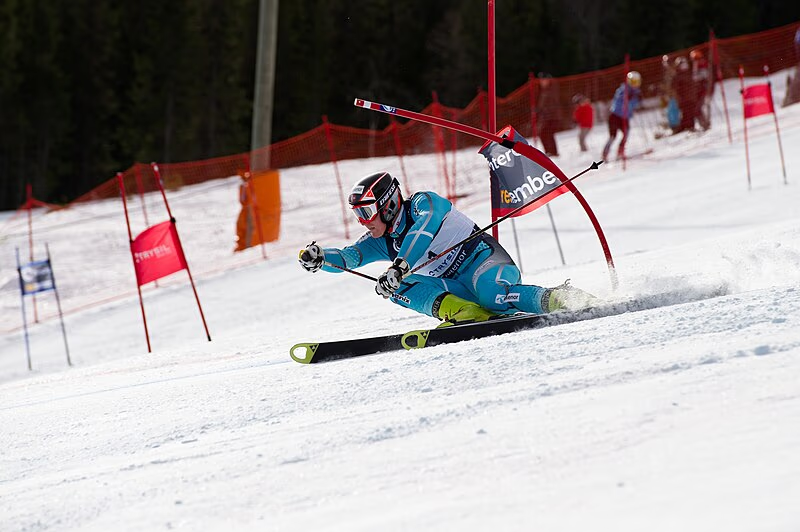
A competitor must pass through every gate on the course. A gate is correctly passed when both ski tips and both feet have crossed the gate line (the imaginary line between the turning pole and the outside pole, or between the two pairs of poles in GS).
Why people argue about this
People often think that passing through a gate means just their skis touch it, but they misunderstand that both ski tips and both feet must cross the imaginary line for it to be considered correctly passed in alpine skiing under the "5.4 Gate Passage" rule. The confusion arises because this detail isn't always immediately obvious from watching the race unfold.
Downhill: One timed run. Fastest time wins.; Super-G: One timed run. Fastest time wins.; Giant Slalom: Two runs on different course sets (the course setter changes gate positions between runs). Lowest combined time wins.
Why people argue about this
People often assume that if a skier stops partway down the course due to an injury, they're automatically DNF (Did Not Finish), but actually, it's only considered a DNF if they don't cross the finish line at all. They might miss the finish by just a few meters and still be eligible for consideration based on their overall run time.
DNF (Did Not Finish): A competitor who stops or falls and does not cross the finish line. DNS (Did Not Start): A competitor who does not appear in the start gate for their run.
Why people argue about this
People often assume that if a skier falls during their run, they automatically get a DNS (Did Not Start) instead of a DNF (Did Not Finish). However, the confusion arises because falling is part of skiing; it's expected and doesn't mean you didn’t start your run. The rule applies when someone fails to even begin their race, not when they encounter an obstacle mid-run.
All FIS-sanctioned competitions use electronic timing to 1/100th of a second (0.01 s). The primary timing system uses photocell beams at the start and finish lines.
Why people argue about this
People often assume that electronic timing is used for all alpine skiing competitions simply because it's mentioned in FIS rules, but actually, the rule specifies only FIS-sanctioned competitions use it to 1/100th of a second precision. They overlook the fact that many non-FIS events might not adhere to this high-tech standard.
Rankings are determined by total elapsed time. For two-run events (GS, SL, Combined), the sum of both run times determines the final result.
Why people argue about this
People often assume that only the second run's time is considered for ranking in two-run events like GS and SL, which leads them to overlook how crucial their first run actually is in determining overall placement. The confusion arises because they fail to realize that both runs' times are summed up equally in calculating final rankings.
Where Tx is the competitor's time, T0 is the winner's time, and F is a discipline-specific factor (DH: 1280, SG: 1190, GS: 1010, SL: 730). A race penalty is then applied based on the top-5 starters' and top-5 finishers' FIS points to normalize across races of varying strength.
Why people argue about this
People often assume that the FIS points system is solely about awarding points based on competitors' times alone, forgetting that it's actually a complex mix of their actual race time relative to others in the top five and discipline-specific factors, leading to varied outcomes even for identical performances across different disciplines like downhill versus slalom.
A photo-finish system records every finish crossing. If a competitor or team coach disputes a result or gate call, they must file a formal protest with the jury within a defined time window (typically 15 minutes after the provisional results are posted).
Why people argue about this
People often assume that they can contest a result at any time after seeing it posted, which is incorrect. The official time frame for filing a protest is strictly 15 minutes after provisional results are announced, and this rule applies only to gate calls or competitor disputes, not to personal opinions or late revelations about the race's outcome.
Straddling a gate: Passing with one foot on each side of the turning pole (i.e., not both feet passing on the correct side) results in DSQ.; Missing a gate: Failing to pass through a gate entirely results in DNF. However, a competitor may hike back up the course and re-pass the missed gate before...
Why people argue about this
People often assume that gate fault penalties are just fines for missing gates, which they can easily avoid by simply skiing around them. However, the reality is that these faults can occur even if a skier has taken the correct line through the gates and hit every single one perfectly - it's about maintaining proper speed and timing as dictated by the course design.
False start: Leaving the start gate before the start signal. The competitor may be recalled and allowed to restart with a time correction, or may be disqualified at the jury's discretion.; Late start: Failing to leave the start gate within 5 seconds of the start signal. The jury may apply a time ...
Why people argue about this
People often assume that if they touch another skier during their start, it's just a warning—after all, touching is part of skiing. But actually, under 7.2 Start Infractions in alpine skiing, even minor contact can be considered an infraction severe enough to warrant disqualification or time penalties, highlighting the strictness and precision required for this rule.
Ski length below minimum: DSQ. Equipment is measured with a tolerance of ±1 cm to account for wax and base material.; Sidecut radius below minimum: DSQ. Radius is measured using certified FIS gauges.; Speed suit air permeability below 30 l/m²/s: DSQ. Suits are tested before and/or after races usi...
Why people argue about this
People often assume that if their ski pole is even slightly bent or their bindings are a tiny bit loose, they'll get a DSQ for equipment violations in alpine skiing. But actually, it's much more severe issues like broken parts of the ski, severely damaged poles, or improperly adjusted bindings that trigger this rule, not minor imperfections.
Receiving outside assistance: Any physical or verbal coaching assistance during a run results in DSQ.; Unsportsmanlike conduct: Verbal abuse of officials, deliberate obstruction of another competitor, or refusal to submit to equipment checks may result in DSQ, suspension, or further disciplinary ...
Why people argue about this
People often assume that if they argue their DSQ (Disqualification) decision in court, they can overturn it by proving unfairness. However, the reality is that once a competition jury imposes a DSQ, there's no appeal process; instead, competitors have to accept or challenge the decision as presented, with options for time penalties or warnings.
The competition jury may impose DSQ, time penalties, or written warnings. Competitors may appeal jury decisions to the FIS Legal & Safety Committee.
Why people argue about this
People often assume that appealing a decision is as simple as submitting an appeal form, forgetting that they must also provide evidence and rationale for their case before the FIS Legal & Safety Committee, leading to misunderstandings about the complexity of the process and what's required from them.
FIS mandates extensive safety infrastructure along every competition course: A-net (inner safety net): High-tensile nylon netting installed at the immediate course edge in high-risk zones (compressions, jumps, sharp turns). Designed to catch a racer who leaves the course at speed.; B-net (outer s...
Why people argue about this
People often assume that just having a medical team present is enough, without realizing they need to be fully equipped with doctors, paramedics, at least one ambulance, and for downhill and slalom events, even a helicopter on standby or within quick response range. They overlook the specific requirements of what constitutes "fully equipped.
Helmets: Mandatory for all events (EN 1077 Class A for speed events).; Back protectors: Mandatory in DH and SG. Must meet EN 1621-2 standards. Increasingly worn in all events.; Airbag vests: Wearable inflatable vests that deploy on impact via accelerometer trigger. Permitted and increasingly comm...
Why people argue about this
People often assume that having a fully equipped medical team is only for safety during competitions, forgetting that they're also there in case of an emergency after races end. They overlook the fact that these teams are crucial for immediate care and transport to hospitals post-race, not just for race-day safety.
A fully equipped medical team must be on-site for every competition, including physicians, paramedics, and at minimum one ambulance positioned at the finish area. For DH and SG events, a helicopter must be available on standby (or within a respons...
Why people argue about this
People often assume that having a fully equipped medical team at every competition is just about logistics and budgeting, forgetting that it's crucial for immediate care in case of serious injuries during high-speed skiing events like DH and SG. The confusion arises because they underestimate how critical timely medical intervention can be in such extreme conditions.
The competition jury has authority to delay, interrupt, or cancel a race based on weather conditions: Wind: Sustained winds exceeding 8 m/s (29 km/h, 18 mph) at exposed sections of the course may trigger a delay. Higher gusts may warrant cancellation.; Visibility: Flat light, fog, or heavy snowfa...
Why people argue about this
People often assume that if a race is stopped mid-way through due to weather issues, it will simply be restarted from where it was halted. However, they misunderstand that the jury has the discretion to declare partial results valid and cancel the entire event based on how many skiers completed their runs, leading to varied outcomes depending on the circumstances.
Course workers continuously maintain the racing surface between competitors. In SL and GS, workers reset dislodged gate poles and repair ruts caused by turning.
Why people argue about this
People often assume course workers are only fixing visible damage like gate poles and ruts, forgetting they also meticulously smooth out imperceptible grooves in snow that can affect aerodynamics and speed, which is crucial for alpine skiing's high-speed turns and descents. They overlook the unseen work of keeping every millimeter of the course perfectly groomed to ensure fair racing conditions.
FIS specifies minimum ski lengths and sidecut radius values per discipline to balance performance and safety (ICR Article 222). Minimum ski lengths: Downhill: Men 218 cm (85.8 in), Women 210 cm (82.7 in); Super-G: Men 210 cm (82.7 in), Women 205 cm (80.7 in); Giant Slalom: Men 193 cm (76.0 in), W...
— Article 222
Why people argue about this
People often assume that ski width is a fixed measurement throughout the entire length of the ski, leading to arguments about whether an irregularity at the waist violates the rule when it's actually referring only to the maximum width at the narrowest part of the ski, which is typically near the bindings.
All courses for FIS-sanctioned competitions must be homologated (officially inspected and approved) by a FIS Technical Delegate. Homologation certificates specify the approved vertical drop, course length, and safety infrastructure.
Why people argue about this
People often assume that homologation is solely about aesthetic approval of a course design, when in fact it's a comprehensive inspection covering safety infrastructure like barriers, lighting, and emergency response systems, ensuring skiers' safety throughout their descent.
Alpine skiing is an individual timed competition (except for the Team Event). Competitors must hold a valid FIS licence issued through their national ski association.
Why people argue about this
People often assume that alpine skiing is a team event like in ski jumping when it's clearly stated as individual timed. The confusion arises because they overlook the clarification that Team Event is the only exception to competitors needing an FIS license, not the norm for regular races.
Course inspection rules differ by discipline: Downhill: Competitors must complete a minimum of one official training run (typically three training runs are scheduled over preceding days). Inspection is conducted by skiing the course at reduced speed.; Super-G: No course inspection on foot and no ...
Why people argue about this
People often assume that the 10-second interval is strictly for competitors to get their skis on and ready at the gate, but actually, it's more about ensuring a smooth flow of racers without collisions or delays in the start sequence, allowing each racer to be called into the gate as close to their scheduled time as possible.
All FIS-sanctioned competitions use electronic timing to 1/100th of a second (0.01 s). The primary timing system uses photocell beams at the start and finish lines.
Why people argue about this
People often assume that electronic timing only measures down to whole hundredths of a second (0. 01 s), thinking it's rounding up or down for precision. But in reality, FIS-sanctioned competitions use electronic timing to an even finer degree: 1/100th of a second (0. 01 s). The confusion arises because they might not realize the difference between "hundredths" and "tenthousandths.
The competition jury may impose DSQ, time penalties, or written warnings. Competitors may appeal jury decisions to the FIS Legal & Safety Committee.
Why people argue about this
People often assume that DSQ (Disqualification) is automatically handed out for every infraction, forgetting that time penalties and written warnings are also options given by the jury in alpine skiing competitions governed by FIS. This oversight leads to misunderstandings about the full spectrum of disciplinary actions available under Section 7.
FIS mandates extensive safety infrastructure along every competition course: A-net (inner safety net): High-tensile nylon netting installed at the immediate course edge in high-risk zones (compressions, jumps, sharp turns). Designed to catch a racer who leaves the course at speed.; B-net (outer s...
Why people argue about this
People often assume that having a fully equipped medical team is just about doctors and paramedics on-site, forgetting the importance of an ambulance for transporting seriously injured skiers directly from the slopes to hospital care. They overlook how crucial it is to have this vehicle available in case a racer needs immediate evacuation due to severe injuries.