Section 1: Introduction
Overview
Rugby Union is a full-contact team sport governed by World Rugby (formerly the International Rugby Board, IRB), headquartered in Dublin, Ireland. The sport is played under the World Rugby Laws of the Game, the current edition of which is the 2024 edition (effective January 1, 2024), incorporating all amendments approved by the World Rugby Council. This rulebook references the 2024 World Rugby Laws of the Game as the authoritative source.
Rugby Union is played between two teams of fifteen players on a rectangular grass or artificial turf field. The objective is to score more points than the opposing team by carrying, passing, or kicking an oval ball across the opponent's try line or through their goalposts. The ball may be carried forward but may only be passed laterally or backward by hand. The ball may be kicked in any direction.
History and Governing Body
The game traces its origins to Rugby School in England (circa 1823) and was formally codified in 1871 when the Rugby Football Union (RFU) was established. The International Rugby Football Board (IRFB) was founded in 1886 to oversee international play; this body was renamed the International Rugby Board (IRB) in 1997 and rebranded as World Rugby in November 2014. World Rugby is recognised by the International Olympic Committee (IOC) and governs Rugby Sevens, which has been an Olympic sport since the 2016 Rio de Janeiro Games. The standard fifteen-a-side format is commonly referred to as Rugby Union or simply "rugby."
Scope of the Laws
The World Rugby Laws of the Game contain 21 Laws numbered sequentially. They govern all aspects of the game from the dimensions of the playing enclosure (Law 1) through to the conduct of penalty and free kicks (Law 21). All affiliated unions, associations, and match officials are required to apply the Laws as published. World Rugby may issue Regulations in Relation to the Laws (RRL) to permit trials of experimental law variations (ELVs) at specified levels of the game.
Section 2: Equipment
The Ball (Law 2 – World Rugby Laws of the Game 2024)
The ball used in Rugby Union must be oval and made of four panels. Law 2.1 specifies the following dimensions and properties for the match ball:
- Length (long axis): 280–300 mm (approximately 11–11¾ inches)
- Circumference (end to end, long axis): 740–770 mm (approximately 29–30¼ inches)
- Circumference (in width, short axis): 580–620 mm (approximately 22¾–24½ inches)
- Weight: 410–460 g (approximately 14½–16¼ oz)
- Air pressure at the start of play: 65.71–68.75 kPa (0.67–0.70 kgf/cm², equivalent to 9.5–10.0 lbs per square inch)
- Material: Leather or a material that has a similar texture; must not be easily slippery
Under Law 2.2, the referee must inspect the ball(s) before the match. In wet conditions the referee may order the ball to be dried and, if necessary, replaced with a dry ball. Teams may nominate a ball person to supply the match ball during play.
Law 2.3 permits up to 6 additional balls to be available at designated positions around the field during international matches, subject to the agreement of both teams and the referee, to speed up play.
Players' Dress (Law 4 – World Rugby Laws of the Game 2024)
Law 4.1 specifies the mandatory items of players' dress:
- A jersey (shirt) with a collar and long or short sleeves
- Shorts
- Underwear (optional but must not protrude below shorts)
- Socks
- Boots (shoes)
Law 4.4 permits the following optional protective equipment, provided it is of soft and thin material:
- Shin guards
- Ankle supports worn under socks
- Shoulder pads (must meet World Rugby Specification 12 – max 1 cm foam thickness at 45 kg/m³)
- Fingerless mitts (must not have padding on the palm)
- Headgear (must meet World Rugby Specification 12)
- Mouthguard
- Compression shorts/tights worn under playing shorts
- Studs/cleats on boots (must comply with Law 4.5)
Law 4.5 governs studs. Studs must be made of leather, rubber, aluminium, nylon, or a similar material. They must not have burrs or sharp edges. Circular studs must not be less than 13 mm (½ inch) in diameter at the base. Moulded rubber studs on soles must conform to the same material requirements. Blade studs and non-circular studs are permitted subject to compliance with British Standard BS6366 or equivalent World Rugby approved specifications. Players wearing non-conforming studs may not take part in a match (Law 4.6).
Law 4.2 prohibits any item of dress that is dangerous to any player. This includes glass or hard buckles, rings, jewellery, zips exposed on the outside, and rigid or sharp items. Under Law 4.3, the referee may order a player to leave the field to change non-compliant dress. The player may return when the referee is satisfied the item has been changed or removed.
Section 3: Playing Area
The Ground (Law 1 – World Rugby Laws of the Game 2024)
Law 1 defines the playing enclosure, which consists of the playing area and any area beyond the playing area that is required for player safety (the run-off area). The playing area is divided into the field of play and the two in-goal areas.
Field of Play Dimensions (Law 1.3)
- Maximum length of field of play (excluding in-goal areas): 100 m
- Maximum width of field of play: 70 m
- In-goal area depth: Between 10 m and 22 m (both in-goal areas)
- Total maximum playing area length (including both in-goal areas): 144 m
- Where a pitch does not meet maximum dimensions, the minimum acceptable dimensions are set by the relevant union; World Rugby strongly recommends adherence to the maxima for Test match venues.
Lines on the Field (Law 1.4)
The field of play is marked with the following lines:
- Touchlines: Lines along the two long sides of the field. They are in touch (outside the field of play); a ball or player in contact with a touchline is in touch.
- Goal lines (try lines): Lines at each end of the field of play, on the boundary between the field of play and the in-goal area. A player touching or beyond the goal line is in the in-goal area.
- Dead-ball lines: Lines marking the outer boundary of each in-goal area. They are outside the playing enclosure.
- Touch-in-goal lines: Lines at the sides of each in-goal area connecting the touchlines and the dead-ball lines. They are outside the playing enclosure.
- 22-metre lines: Parallel to the goal lines, 22 m from each goal line.
- 10-metre lines: Parallel to and 10 m from the halfway line, on each side.
- Halfway line: Parallel to the goal lines at the midpoint of the field of play.
- 5-metre lines (broken): Parallel to each touchline, 5 m from it, used for lineout formation guidance.
- 15-metre lines (broken): Parallel to each touchline, 15 m from it, used for lineout guidance.
Goal Posts (Law 1.6)
The goal posts are H-shaped and positioned on each goal line at the midpoint of the width of the field. Specifications under Law 1.6:
- Distance between uprights: 5.6 m (approximately 18 ft 4 in)
- Height of crossbar above the ground: 3.0 m (approximately 9 ft 10 in)
- Minimum height of uprights above the crossbar: 3.4 m (approximately 11 ft 2 in); in Test matches the uprights should extend to at least 3.4 m above the crossbar (no maximum height specified)
- The base of each post must be padded for player safety
- A post protector pad must extend to a minimum height of 2 m above the ground
Surface (Law 1.2)
The playing area must be grass. Where grass is unavailable, artificial turf may be used provided it meets World Rugby Regulation 22 (Artificial Rugby Turf). Sand, clay, ice, and asphalt surfaces are prohibited. The playing area must be free of dangerous objects.
Section 4: Players & Officials
Number of Players (Law 3 – World Rugby Laws of the Game 2024)
Under Law 3.1, a match is played between two teams each consisting of a maximum of fifteen (15) players. A team may start a match with fewer than fifteen players only with the agreement of the opposing team.
Law 3.3 permits a maximum of eight (8) replacements (substitutes) per team to be nominated before the match. These players may take the field only to replace an injured player or to serve as a tactical replacement, subject to Law 3.4–3.10.
Player Numbering and Positions (Law 3.1)
Players are numbered 1–15, with numbers 16–23 assigned to replacements. Conventional positional groupings are:
- Forwards (Nos. 1–8): Loosehead prop (1), hooker (2), tighthead prop (3), left lock/second row (4), right lock/second row (5), blindside flanker (6), openside flanker (7), number eight (8)
- Backs (Nos. 9–15): Scrum-half (9), fly-half/outside-half (10), left wing (11), inside centre (12), outside centre (13), right wing (14), fullback (15)
Replacements (Law 3.4–3.10)
A player who has been replaced may not return to the field except to replace a player with a blood injury (Law 3.5, temporary blood replacement) or as a front-row replacement when no other suitably trained front-row player is available (Law 3.7). A player replaced for a head injury assessment (HIA) under the Concussion Management Protocols may return subject to World Rugby HIA protocols. Tactical replacements are permanent; a tactically replaced player may not return (Law 3.6).
Under Law 3.9, if a team is reduced to fewer than fifteen players due to red cards, the match continues but the opposing team does not reduce its numbers. The match may not be abandoned solely because a team has fewer than fifteen players on the field.
Team Officials on the Pitch
Water carriers and medical personnel may enter the field of play only with the referee's permission (except in a genuine medical emergency) and must leave immediately when instructed (Law 3.10).
Match Officials (Law 6 – World Rugby Laws of the Game 2024)
Law 6.1 defines the match officials for a rugby union match:
- Referee (1): The sole judge of fact and law during the match. Has full authority over all match officials and players from the moment of arrival at the ground until departure. Keeps time, keeps score, and controls the game.
- Assistant Referees (2): Formerly called "touch judges." Positioned along the touchlines. Primary duties include indicating when the ball or player is in touch, assisting the referee with foul play observation, and assisting with decisions at goal (Law 6.2).
- Television Match Official (TMO): Used in matches where television replays are available. The TMO may be consulted by the referee to review certain decisions under the TMO Protocol published by World Rugby. The TMO may initiate a review for a Try/No Try decision or foul play involving a yellow or red card (as of the 2022 World Rugby TMO Protocol update).
- Match Commissioner/Fourth Official: May be appointed for high-level matches to assist with administrative duties.
Under Law 6.5, a referee must not be a member of either team's union. Referees must wear a distinctive colour jersey that does not conflict with either team's colours.
Law 6.6 states that the referee's decisions are final. Players must not dispute a referee's decision; disputing may constitute misconduct under Law 9.
Section 5: Rules of Play
Duration of the Match (Law 5 – World Rugby Laws of the Game 2024)
Law 5.1: A match consists of two halves of 40 minutes of playing time each. The half-time interval must not exceed 15 minutes. The referee is the timekeeper. Time may be stopped for injuries to players at the referee's discretion; it is also stopped automatically when a try is scored, a penalty or free kick is awarded, or a conversion is attempted.
Law 5.4: If the ball is in play when time expires, play continues until the ball next goes dead. If a penalty or free kick is awarded after time has expired, the opposing team must be given the opportunity to take the kick; play continues until the ball next goes dead. A team that is awarded a lineout, scrum, or other restart after time expires is entitled to take it.
Law 5.7 (Extra Time): Where a match must have a definitive result and the scores are level at the end of normal time, the competition organiser's rules determine the method of play (e.g., two 10-minute periods of extra time, then sudden death, then kicking competition).
Kick-off and Restart Kicks (Law 13 – World Rugby Laws of the Game 2024)
Law 13.1: The match begins with a kick-off: a drop kick taken from the centre of the halfway line. The kicking team must be on or behind the halfway line. Opponents must be on or behind the 10-metre line. The ball must reach the opponents' 10-metre line. If the ball fails to reach the 10-metre line, the opponents may have the kick retaken or accept a scrum at the centre.
Law 13.2: After a score, play is restarted with a drop kick by the team that conceded the points, from the centre of the halfway line.
Law 13.4 (22-metre drop-out): When the ball is made dead in the in-goal area by a defender (or the attacking team takes the ball into the in-goal area and a defender makes it dead without a try being scored), the defending team restarts with a drop kick from behind the 22-metre line.
Mode of Play (Law 7 – World Rugby Laws of the Game 2024)
Law 7.1 describes the general modes of play: players may run with the ball, pass the ball (laterally or backward only), kick the ball (in any direction), and make contact with opponents who have the ball. Players may not throw or pass the ball forward; a knock-on or throw-forward results in a scrum to the non-offending team (Law 12).
Offside and Onside in General Play (Law 11 – World Rugby Laws of the Game 2024)
Law 11.1: A player is offside in general play if they are in front of a team-mate who is carrying the ball or who last played the ball. An offside player must not interfere with play, move toward the ball, or be within 10 metres of an opponent waiting to play the ball.
Law 11.3: A player who is in an offside position is put onside when: the player who carried the ball has run in front of them; a team-mate who was behind the ball at the time it was played has run in front of them; or an opponent carrying the ball has run 5 metres. An offside player who is put onside by an opponent may then play the ball.
Law 11.5 (Accidental offside): If an offside player cannot avoid being touched by the ball or a team-mate carrying the ball, the player is accidentally offside. The referee orders a scrum unless there is no advantage to the opposing team.
Knock-on or Throw-forward (Law 12 – World Rugby Laws of the Game 2024)
Law 12.1: A knock-on occurs when a player, in attempting to catch or pick up the ball or to fend off a tackle, loses possession of the ball and the ball travels forward (toward the opposing team's dead-ball line), hits the ground or another player, or is hit or propelled forward by an arm or hand. A throw-forward occurs when a player throws or passes the ball forward (toward the opposing team's dead-ball line).
Law 12.2: Sanction – The referee orders a scrum at the place of the knock-on or throw-forward. The non-offending team throws in. If a knock-on or throw-forward occurs in the in-goal area, the referee orders a 5-metre scrum.
Law 12.3 (Exception – accidental knock-on into own in-goal): If a player accidentally knocks on and the ball goes into that player's in-goal area, where it is touched down by a defender, a 5-metre scrum is awarded to the attacking team. A clean knock-on that is caught by another player before it reaches the ground does not constitute a knock-on.
Tackle: Ball Carrier Brought to Ground (Law 15 – World Rugby Laws of the Game 2024)
Law 15.1 (Definition): A tackle occurs when a ball carrier is held by one or more opponents and is brought to ground (i.e., has one or both knees on the ground, is sitting on the ground, or is on top of another player on the ground). The tackled player must immediately release the ball and move away from it. The tackler must immediately release the tackled player and move away from the ball and tackled player or get to their feet.
Law 15.2: Players who are on their feet may play the ball at the tackle. A player may not be tackled once they have released the ball. A player may not seize an opponent's legs in a tackle when that opponent is in the air. The tackle must be made below the line of the shoulders (World Rugby high-tackle framework – see Section 7 and Section 8).
Law 15.3: After a tackle, the ball must be made available to both teams. Players joining the tackle from the tackler's side must approach from behind the tackler. Players joining from the ball carrier's side must approach from behind the ball carrier's feet. This zone is called the "gate."
Ruck (Law 16 – World Rugby Laws of the Game 2024)
Law 16.1 (Definition): A ruck is a phase of play where one or more players from each team are in contact on their feet and over the ball on the ground. Players in a ruck must be on their feet; they may use their bodies to push opponents, but they may not handle the ball. Players joining a ruck must do so from behind the hindmost foot of their own team's players in the ruck (the "gate").
Law 16.3 (Successful ruck): A ruck is successful when the ball has been won by one team and has emerged from the ruck. The team that does not have possession of the ball at a ruck must not handle the ball and must not fall to the ground in a dangerous manner.
Law 16.4: Players who are offside at a ruck must not interfere with play. The offside line for players not in the ruck runs through the hindmost foot of their own team's players in the ruck, parallel to the goal lines.
Maul (Law 17 – World Rugby Laws of the Game 2024)
Law 17.1 (Definition): A maul occurs when a ball carrier is held by one or more opponents, and one or more of the ball carrier's team-mates bind on the ball carrier, with all the players on their feet and moving toward a goal line. A maul begins when a player carrying the ball is held by an opponent and both players are on their feet and moving toward a goal line.
Law 17.2: Players joining a maul must do so from their own side of the offside line (behind the hindmost foot of the last player of their own team in the maul). A maul ends when the ball is on the ground, a ruck has formed, the ball has been played out, or a player carrying the ball has grounded the ball in an in-goal area.
Law 17.4 (Collapsed maul): If a maul collapses (all players lose their footing), a scrum is formed at the point of the collapse. The team that was in possession of the ball at the time of the collapse throws in.
Mark (Law 18 – World Rugby Laws of the Game 2024)
Law 18.1: A player may make a mark when: the player is in the field of play; catches a kick directly from an opponent (not a kick-off or restart kick in open play); and simultaneously calls "mark." If a fair catch is judged valid by the referee, the player is awarded a free kick at the place of the catch.
Touch and Lineout (Law 19 – World Rugby Laws of the Game 2024)
Law 19.1: The ball is in touch when it (or a player carrying it) touches or crosses a touchline. When the ball goes into touch, a lineout is formed. The team that did not put the ball into touch throws in; exceptions apply (e.g., a team knocks the ball into touch from a penalty – that team's opponents throw in).
Law 19.4 (Lineout): A lineout is formed at the line of touch (the point on the touchline where the ball crossed). Both teams form parallel lines, at least two players from each team. Players must stand at least 1 m from the lineout. The line of touch is perpendicular to the touchline. The throwing team throws the ball in straight along the line of touch. Lineout players may jump and support a jumper. Players who are not taking part in the lineout must remain at least 10 m from the line of touch or on or behind their goal line if within 10 m of it.
Scrum (Law 20 – World Rugby Laws of the Game 2024)
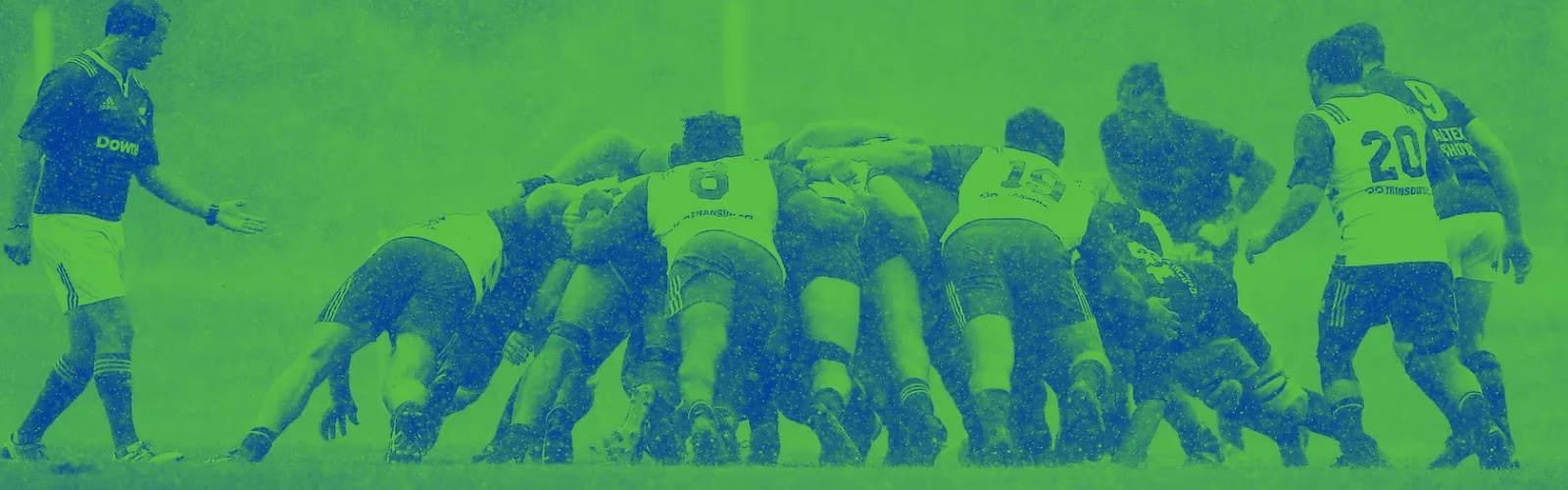
Law 20.1 (Definition): A scrum is a means of restarting play. Eight players from each team bind together in three rows and engage with their opponents. The front rows of each team interlock such that each hooker has their head between the opposition's loosehead prop and tighthead prop.
Law 20.5 (Binding): All front-row players must bind on the back or side of the jersey from the armpit downward. A front-row player must not grasp the collar, the arm below the level of the armpit, the sleeve, or the shorts.
Law 20.6 (The put-in): The scrum-half of the team awarded the scrum puts the ball into the scrum from the left side of the scrum (the hooker's left). The ball must be put in straight along the middle line of the scrum. The ball must be put in with a single forward movement immediately when the scrum is set. Both hookers must have their weight evenly distributed on both feet when the ball is put in.
Law 20.9 (Scrum collapse): If a scrum collapses or a player in the scrum is lifted from the ground, the referee must immediately stop play and order a reset scrum. If a scrum repeatedly collapses, the referee may warn the team and award a penalty.
Penalty and Free Kick (Law 21 – World Rugby Laws of the Game 2024)
Law 21.1: A penalty kick may be taken from the mark of the infringement or from any point behind the mark on a line through the mark parallel to the touchlines. A penalty kick may be taken by any form of kick. The kicker may score a goal (penalty goal) from a penalty kick by any form of drop kick or place kick.
Law 21.2: For a free kick, a goal may not be scored. A free kick may be taken by any form of kick. If a player catches the ball directly from a free kick and calls "mark," the mark is not valid.
Law 21.4 (Quick tap): A penalty or free kick may be taken as a quick tap – a tap of the ball with the foot. The kicker must tap the ball themselves; it must travel at least 1 metre. The kicker may run with the ball after tapping. A quick tap is a running option that allows rapid restart.
Section 6: Scoring
Methods of Scoring (Law 8 – World Rugby Laws of the Game 2024)
Law 8.1 lists the methods by which points may be scored in rugby union, together with their points values:
| Method |
Points |
| Try |
5 |
| Penalty Try |
7 (automatic; no conversion attempt) |
| Conversion (after a try) |
2 |
| Penalty Goal |
3 |
| Dropped Goal (in general play) |
3 |
The Try (Law 8.1)
A try is scored when an attacking player is first to ground the ball in the opponents' in-goal area (on or beyond the goal line, short of the dead-ball line and touch-in-goal lines). Grounding the ball requires downward pressure with the hand, arm, or upper body (chest and front of the shoulder). A player may score a try by pushing the ball over the goal line using the hand or arm. A try also results if: (a) a player in possession is momentum-carried into the in-goal area and grounds the ball there; or (b) a player falls short of the goal line but slides over it while maintaining downward pressure.
Under Law 8.3, if a defending player is in the in-goal area and grounds the ball before an attacker, a try is not scored (a 22-metre dropout follows instead).
Penalty Try (Law 8.3)
A penalty try is awarded when a try would probably have been scored had it not been for foul play by the defending team. A penalty try is worth 7 points automatically and no conversion attempt is made. This change from the previous rule (which awarded 5 points plus a conversion attempt from in front of the posts) was introduced by World Rugby and has been in effect since July 1, 2017. The effect is that a penalty try always yields exactly 7 points, removing uncertainty about the conversion outcome.
In awarding a penalty try, the referee may also yellow-card or red-card the offending player(s) where warranted by the severity of the foul play, independently of the penalty try itself.
Conversion (Law 8.2)
After a try is scored, the scoring team is awarded a conversion attempt. The kick may be a place kick or a drop kick, taken from a point on a line through the spot where the try was grounded, perpendicular to the goal line (and thus parallel to the touchlines). The kicking team nominates the spot; there is no limit on how far back the kicker may stand. The kick must be taken within 90 seconds of the try being scored. The conversion is successful when the ball passes over the crossbar and between (or above the extension of) the uprights. Opponents must stand on or behind the goal line and must not move until the kicker begins their run-up or approach to kick.
Penalty Goal (Law 8.4)
A penalty goal is scored by any form of drop kick or place kick at goal from a penalty kick awarded under Law 21. The ball must pass over the crossbar and between (or above) the uprights. Opponents must retire 10 metres from the mark or to the goal line if it is closer.
Dropped Goal in General Play (Law 8.5)
A dropped goal is scored by a player who drop kicks the ball through the opponents' goalposts (over the crossbar and between or above the uprights) during general play. A drop kick requires the player to drop the ball from their hands and kick it as it rises from the ground. A dropped goal from a free kick is not valid (Law 21.2).
Result of the Match (Law 8.6)
The team that has scored the greater number of points is the winner. If the scores are equal, the match is a draw. In knockout competitions where a result is required, the organiser may apply extra time, sudden death, or a kicking competition as determined by the competition regulations.
Section 7: Violations & Penalties
Foul Play (Law 9 – World Rugby Laws of the Game 2024)
Law 9.1 defines foul play as any action by a player that is contrary to the Laws of the Game and includes, but is not limited to:
- Obstruction
- Unfair play
- Repeated infringements
- Dangerous play
- Misconduct before, during, or after a match
Sanctions for foul play range from a penalty kick (Law 21) to a yellow card (temporary suspension, 10 minutes) or a red card (permanent dismissal).
Obstruction (Law 9.4)
A player must not obstruct an opponent who does not have the ball. This includes blocking, shepherding (running in front of a ball carrier to obstruct a chasing defender), or screening. Sanction: Penalty kick.
Unfair Play (Law 9.8–9.10)
- Time wasting (Law 9.8): A player must not intentionally waste time. Sanction: Penalty kick.
- Handling the ball in the ruck or scrum (Law 9.9): A player must not pick up the ball in a ruck with their hands while on their feet. Sanction: Penalty kick.
- Handling the ball in a ruck or scrum while on the ground (Law 9.10): A player must not handle the ball while on the ground in a ruck or scrum. Sanction: Penalty kick.
Dangerous Play (Law 9.11–9.28)
World Rugby prohibits multiple forms of dangerous play. Key provisions:
- Law 9.11 – Charging or obstructing without the ball: A player must not charge into or collide with an opponent who does not have the ball. Sanction: Penalty kick.
- Law 9.12 – Striking: A player must not strike an opponent with the fist or open hand. Sanction: Yellow or red card.
- Law 9.13 – Stamping or trampling: A player must not stamp on or trample on an opponent, whether the opponent is on the ground or not. Sanction: Yellow or red card.
- Law 9.14 – Kicking: A player must not kick an opponent. Sanction: Yellow or red card.
- Law 9.15 – Tripping: A player must not trip an opponent with the foot or leg. Sanction: Yellow or red card.
- Law 9.16 – Early or late tackle: A player must not tackle an opponent who does not have the ball or who has kicked the ball and has not yet had the opportunity to land. Sanction: Penalty kick. Where there is recklessness or danger, a yellow or red card applies.
- Law 9.17 – High tackle (World Rugby High Tackle Framework): A player must not tackle, or attempt to tackle, an opponent above the line of the shoulders. The tackle must not make contact with the head or neck of an opponent. Under the World Rugby High Tackle Framework (introduced and progressively strengthened since 2017, most recently updated in 2023), contact with the head or neck is categorised by the degree of danger and the player's actions (low, medium, high end of the range), and sanctions range from a penalty kick to a red card. This framework applies at all levels of the game as a mandatory Law application guideline.
- Law 9.18 – Dangerous play in a tackle: A player must not tackle an opponent dangerously or recklessly, e.g., by lifting and dropping them, or spearing them into the ground. Sanction: Yellow or red card.
- Law 9.19 – Dangerous play in the ruck: A player must not charge into a ruck with their head or shoulder first. Sanction: Penalty kick.
- Law 9.20 – Dangerous play in a lineout: A player must not charge, obstruct, or use any other form of dangerous play in a lineout. Sanction: Penalty kick or yellow/red card.
- Law 9.26 – Crocodile roll: A player must not pull a player across or through a lineout (the "crocodile roll"). Sanction: Penalty kick.
- Law 9.27 – Sealing off: A player in a ruck or maul must not prevent an opponent from winning the ball by lying on or over the ball. Sanction: Penalty kick.
- Law 9.28 – Collapsing a maul: A player must not intentionally collapse a maul (except in a manner permitted by Law). Sanction: Penalty kick.
Repeated Infringements (Law 9.7)
If a player, or a team as a whole, repeatedly infringes the Laws, the referee may warn the player or team that the next infringement will result in a yellow card. If the infringements continue, the referee must issue a yellow card. Repeated team infringements can result in the captain of the offending team being yellow-carded.
Yellow Card – Temporary Suspension (Law 9.5)
A yellow card results in a player being temporarily suspended from the field of play for a period of ten (10) minutes of playing time. The player may return after the suspension has elapsed. The team plays with one fewer player during the suspension period. A player who receives two yellow cards in a match is dismissed from the field (effectively a red card).
Red Card – Dismissal (Law 9.6)
A red card results in permanent dismissal from the match. The offending player must leave the playing enclosure immediately and may not be replaced (except in specific front-row safety provisions). The team plays with one fewer player for the remainder of the match. Dismissed players are automatically referred to the relevant disciplinary committee.
Penalty Kick Procedure (Law 21)
When a penalty kick is awarded, the non-offending team may choose to:
- Attempt a goal (place kick or drop kick at the posts – scores 3 points if successful)
- Kick to touch (opposition throws in at lineout; attacking team retains territorial gain)
- Take a quick tap and run
- Take a scrum at the place of the infringement
Opponents must retreat 10 metres from the mark of the infringement until the kick has been taken. They must not move toward the kicker until the kicker begins their approach. Failure to comply is itself a penalty offence.
Offside – Penalty (Law 11)
A player who is persistently offside or gains an advantage from an offside position is penalised with a penalty kick to the opposing team at the place of the infringement. Accidental offside that gives no advantage is penalised with a scrum (Law 11.5).
Section 8: Safety Considerations
World Rugby Player Welfare Framework
World Rugby has established a comprehensive Player Welfare Framework to mitigate risks of injury at all levels of the game. The framework includes mandatory protocols, law amendments, equipment standards, and educational programs. Key components are referenced below.
Head Contact and High Tackle Framework
In response to growing evidence on the risks of repeated head trauma, World Rugby progressively strengthened the High Tackle Framework beginning in 2017. Under the current framework (updated 2023, applying to all levels from elite to community rugby):
- Any contact with the head or neck of a ball carrier during a tackle is a potential infringement, regardless of the height of the tackle's point of contact, if the tackler's body position could have been avoided.
- Referees apply a three-part assessment: (1) was there head contact?; (2) what was the tackler's body position?; (3) what was the degree of danger?
- A tackle that makes direct contact with the head or neck, where the tackler is in a bent/low position, is considered reckless and warrants a yellow or red card depending on degree of danger.
- Contact with the head or neck from a standing position (upright body) where genuine mitigation exists (e.g., ball carrier dropped suddenly) may be penalised with a penalty kick rather than a card, but only in genuinely mitigated circumstances.
Concussion Management – Head Injury Assessment (HIA)
World Rugby's Head Injury Assessment (HIA) Protocol mandates that any player showing visible signs of concussion or suspected concussion must be immediately and permanently removed from play (the "If in doubt, sit it out" principle). In elite matches, a structured HIA process allows:
- HIA1: Immediate pitch-side assessment. A player showing signs on the HIA1 checklist (loss of consciousness, visible motor incoordination, convulsion/tonic posturing, etc.) is permanently removed.
- HIA2/HIA3: Players whose status is uncertain at HIA1 may be temporarily removed and assessed off-field using validated neurological tools. They may return only if assessed as HIA-negative by a trained team doctor.
- A player who has been diagnosed with concussion under the HIA protocol must pass the Graduated Return to Play (GRTP) protocol – a minimum of 7 days for adults (21 days for under-19 players) – before returning to full contact training or match play.
These protocols apply mandatorily in all World Rugby Tier 1 international matches and are strongly recommended at all levels.
Scrum Safety (Law 20)
The scrum engagement sequence mandated by World Rugby – Crouch, Bind, Set – was introduced to reduce the risk of neck and spinal injuries during scrum engagement. Under this sequence:
- Crouch: Both front rows adopt a crouched position at arm's length from each other.
- Bind: Props bind on the opposition prop (left hand for loosehead, right hand for tighthead) before engagement.
- Set: The referee calls "set" and the two front rows engage under control.
Law 20.3 requires the scrum to be set at a place agreed by the referee. Law 20.9 requires the referee to stop play immediately if the scrum collapses to prevent injury. Consistent non-compliance with scrum laws or intentional collapse may result in a penalty or yellow card.
Law 20.2: Front-row players must be suitably trained and experienced. If a team has insufficient trained front-row players due to injury or dismissal and cannot safely form a scrum, uncontested scrums must be played. Under uncontested scrums, neither team may push the other off the ball; the team that put the ball in always wins the ball.
Lifting in Lineouts (Law 19)
Lifting of lineout jumpers is permitted but must be performed safely. Law 19.12 mandates that lifters must not drop a supported player from a height, and the player being supported must be lowered to the ground safely. Deliberately dropping a supported jumper is a dangerous act and is penalised by a penalty kick; depending on severity it may also result in a yellow or red card.
Player Equipment Safety (Law 4)
As noted in Section 2, all equipment worn by players must not be dangerous. The referee has authority to require a player to leave the field to change or remove any item that poses a risk (Law 4.3). World Rugby Specification 12 governs all padded and protective equipment to ensure materials are soft and energy-absorbing rather than rigid or sharpening impact.
Playing Surface Safety (Law 1)
World Rugby Regulation 22 requires artificial turf surfaces used for sanctioned matches to undergo testing and certification to ensure adequate player protection against abrasion injuries ("turf burn"), head impact, and ankle/knee stability. All certified artificial turfs must meet the World Rugby Preferred Products Scheme requirements. Natural grass pitches must be inspected by match officials and may not be used for play if deemed unsafe (e.g., due to extreme hardness, standing water, or debris).
Medical Personnel and Stoppage for Injury
Under Law 6.7, the referee may stop play for a player who appears to be seriously injured. Medical personnel may enter the field only with the referee's permission. In the event of a suspected spinal injury, the referee must immediately stop play and allow medical personnel to manage the player without time pressure. Players who are bleeding must leave the field and may only return once the bleeding has been controlled and covered (blood replacement – Law 3.5).