


🏛️Official — World RugbyIn Season
Loading OpenSourceSports…
Only the captain may address the referee
No player other than the designated captain may approach or speak directly to the referee about a decision. This reflects rugby's foundational respect for authority and distinguishes the sport from association football's collective dissent culture. Referees may penalize formal dissent, but cultural self-policing predates and exceeds the written law.
Do not deliberately target an opponent's known injury
Repeatedly targeting a body part an opponent is visibly nursing to exploit the vulnerability is considered a fundamental breach of rugby's fair-play ethos. Physical dominance through skill, power, and fitness is celebrated; exploiting injury for tactical gain is not, even when the contact itself is technically legal.
The Third Half: mandatory post-match hospitality with opponents
After every match, both teams are expected to share food, drink, and companionship in the clubhouse or a designated venue. The 'third half' is considered as important to the sport's identity as the match itself, fostering mutual respect across fierce rivalries. The hosting side provides the hospitality; declining without good cause is deeply unsportsmanlike.
Return possession after kicking out for an injured opponent
If a team kicks the ball into touch to allow an injured opponent to receive treatment, the team that gains the lineout throw is expected to return possession to the side that made the concession. Exploiting an injury stoppage to gain field position or possession is widely condemned across all levels.
Never feign injury or simulate contact
Rugby culture holds simulation — diving to win a penalty, exaggerating contact, or faking injury — in contempt. The sport's identity is built on physical honesty; players caught simulating face intense peer and public condemnation, often exceeding any formal sanction. Rugby explicitly contrasts itself with association football on this point.
These protocols apply mandatorily in all World Rugby Tier 1 international matches and are strongly recommended at all levels.
Why people argue about this
People often assume that only Tier 1 international matches need to follow these concussion management protocols, but they are actually recommended for all levels of rugby, from amateur clubs right up to national teams. This leads to confusion because many coaches and players don’t realize how widely the HIA process is encouraged across the sport’s spectrum.
After a try is scored, the scoring team is awarded a conversion attempt. The kick may be a place kick or a drop kick, taken from a point on a line through the spot where the try was grounded, perpendicular to the goal line (and thus parallel to the touchlines).
Why people argue about this
People often assume that a conversion kick must always be taken from directly in front of where the try was scored, when in fact it can be anywhere along the line perpendicular to the goal line, which runs parallel to the touchlines. This oversight leads to misunderstandings about the exact positioning for the kick.
World Rugby prohibits multiple forms of dangerous play. Key provisions: Law 9.11 – Charging or obstructing without the ball: A player must not charge into or collide with an opponent who does not have the ball. Sanction: Penalty kick.; Law 9.12 – Striking: A player must not strike an opponent wit...
— Law 9.11, Law 9.12, Law 9.13, Law 9.14, Law 9.15, Law 9.16, Law 9.17, Law 9.18, Law 9.19, Law 9.20, Law 9.26, Law 9.27, Law 9.28
Why people argue about this
People often assume that a yellow card in rugby means immediate ejection from the game, which is why they argue; however, the official verdict clarifies it's only a temporary suspension of ten minutes, allowing them to return after the penalty clock runs out.
A dropped goal is scored by a player who drop kicks the ball through the opponents' goalposts (over the crossbar and between or above the uprights) during general play. A drop kick requires the player to drop the ball from their hands and kick it as it rises from the ground.
— Law 21.2
Why people argue about this
People often assume that a dropped goal can be scored at any time during play, which is incorrect. The confusion arises because they overlook the crucial requirement of dropping the ball from their hands before kicking it as it rises off the ground, not just releasing it freely or hitting it with their foot.
Law 5.1: A match consists of two halves of 40 minutes of playing time each. The half-time interval must not exceed 15 minutes.
— Law 5.1, Law 5.4, Law 5.7
Why people argue about this
People often assume that the 40-minute halves mean each team gets a full hour of playing time throughout the match, but actually, it's divided into two separate halves with no break in between, so teams get exactly an hour total if they manage to score enough points within those halves.
Maximum length of field of play (excluding in-goal areas): 100 m; Maximum width of field of play: 70 m; In-goal area depth: Between 10 m and 22 m (both in-goal areas)
Why people argue about this
People often assume that the dimensions of the field are strictly defined by World Rugby's official lines alone, without considering other factors like end zones or boundary markers which can vary between different stadiums. The confusion arises because these additional elements aren't explicitly part of Law 1.3 and can lead to disputes over where exactly the boundaries lie during games.
Law 9.1 defines foul play as any action by a player that is contrary to the Laws of the Game and includes, but is not limited to: Obstruction; Unfair play; Repeated infringements
— Law 9.1, Law 21
Why people argue about this
People often assume that foul play in rugby is solely about physical contact, forgetting that it encompasses a broader range of misconduct like dissent, unsporting behavior, or deliberate injury. The confusion arises because they overlook the fact that fouls can be committed verbally as well as physically, and include actions not directly related to tackling or scoring.
The goal posts are H-shaped and positioned on each goal line at the midpoint of the width of the field. Specifications under Law 1.6: Distance between uprights: 5.6 m (approximately 18 ft 4 in); Height of crossbar above the ground: 3.0 m (approximately 9 ft 10 in); Minimum height of uprights abov...
— Law 1.6
Why people argue about this
People often assume that the goal posts are positioned at the center of the field rather than at the midpoint of the width, which leads to misunderstandings about where exactly they should be aiming for a try. The confusion arises because they misinterpret "midpoint" as referring to the centerline rather than half the width of the pitch from side to side.
In response to growing evidence on the risks of repeated head trauma, World Rugby progressively strengthened the High Tackle Framework beginning in 2017.
Why people argue about this
People often assume that the High Tackle Framework is solely about banning high tackles outright, which they misunderstand as a complete ban on tackling in general. In reality, it's more nuanced: it penalizes dangerous high tackles and encourages safer forms of tackling to protect players' heads.
Law 13.2: After a score, play is restarted with a drop kick by the team that conceded the points, from the centre of the halfway line.
— Law 13.1, Law 13.2, Law 13.4
Why people argue about this
People often assume that a team restarts play by kicking from where they scored instead of the halfway line after conceding points, which leads to arguments about whether it's fair or if it violates the spirit of the game. The confusion arises because Law 13 clearly states that play is restarted at the centre of the halfway line, not where the score was made.
Law 12.1: A knock-on occurs when a player, in attempting to catch or pick up the ball or to fend off a tackle, loses possession of the ball and the ball travels forward (toward the opposing team's dead-ball line), hits the ground or another player...
— Law 12.1, Law 12.2, Law 12.3
Why people argue about this
People often assume that a knock-on happens only when the ball hits the ground, forgetting that it can occur if the ball is propelled forward by an arm or hand during a tackle attempt, leading to confusion about what exactly constitutes a knock-on in Rugby World Cup matches.
Lifting of lineout jumpers is permitted but must be performed safely. Law 19.12 mandates that lifters must not drop a supported player from a height, and the player being supported must be lowered to the ground safely.
— Law 19.12
Why people argue about this
People often assume that lifting in lineouts is strictly prohibited, which leads to arguments. In reality, it's allowed as long as it’s done safely, but many coaches and players mistakenly believe lifting is completely off-limits, misunderstanding the "must be performed safely" part of Law 19.
The field of play is marked with the following lines: Touchlines: Lines along the two long sides of the field. They are in touch (outside the field of play); a ball or player in contact with a touchline is in touch.; Goal lines (try lines): Lines at each end of the field of play, on the boundary ...
Why people argue about this
People often assume that all lines marked on a rugby field are for boundary markers, leading them to argue about where they should be placed or what their purpose is when in fact, these lines serve specific tactical and safety purposes within the game, like indicating touch zones or goal line areas. They're not just there as decorative elements but crucial parts of how the game unfolds.
" If a fair catch is judged valid by the referee, the player is awarded a free kick at the place of the catch.
— Law 18.1
Why people argue about this
People often assume that a player can only call "mark" if they catch a direct kick from an opponent in open play, but actually, it's when a player catches a kick directly from an opponent (not a restart kick like a penalty or drop goal) and makes the mark simultaneously. This oversight leads to confusion about which kicks qualify for calling "mark.
Law 6.1 defines the match officials for a rugby union match: Referee (1): The sole judge of fact and law during the match. Has full authority over all match officials and players from the moment of arrival at the ground until departure. Keeps time, keeps score, and controls the game.; Assistant R...
— Law 6.1, Law 6.2, Law 6.5, Law 6.6, Law 9
Why people argue about this
People often assume that once a referee makes a decision, it's set in stone and can't be challenged by other officials or players, but actually, while decisions are final for the match as played, appeals to specific interpretations of laws can still occur, especially if there’s ambiguity or new evidence comes up.
Law 17.1 (Definition): A maul occurs when a ball carrier is held by one or more opponents, and one or more of the ball carrier's team-mates bind on the ball carrier, with all the players on their feet and moving toward a goal line. A maul begins w...
— Law 17.1, Law 17.2, Law 17.4
Why people argue about this
People often assume that a maul is when players bind together without moving forward, which isn't accurate according to World Rugby Laws of 2024. Actually, for it to be considered a maul, all players must move toward a goal line while on their feet and binding onto the ball carrier simultaneously. This subtle detail can lead to confusion in officiating calls.
Under Law 6.7, the referee may stop play for a player who appears to be seriously injured. Medical personnel may enter the field only with the referee's permission.
— Law 6.7, Law 3.5
Why people argue about this
People often assume that if a referee stops play for an injury under Law 6.7, it means the injured player must be taken off the field immediately. However, actually, the law states the referee can stop play and assess the situation, including potentially allowing the player to continue with medical assistance on the fly.
Law 8.1 lists the methods by which points may be scored in rugby union, together with their points values:
— Law 8.1
Why people argue about this
People often think that a player can score a try by simply touching the ball down anywhere in their opponent's in-goal area, but actually, they must ground it with downward pressure using their hand, arm, or upper body (chest and front of the shoulder) to ensure it's officially scored.
Law 7.1 describes the general modes of play: players may run with the ball, pass the ball (laterally or backward only), kick the ball (in any direction), and make contact with opponents who have the ball. Players may not throw or pass the ball for...
— Law 7.1, Law 12
Why people argue about this
People often assume that passing the ball forward is allowed as long as it's a lateral pass, which leads to misunderstandings about what constitutes a foul play in rugby. Actually, according to Law 7, only backward and lateral passes are permitted; anything else is considered a forward pass, which can result in penalties or even sin-binning for the offending team.
Under Law 3.1, a match is played between two teams each consisting of a maximum of fifteen (15) players. A team may start a match with fewer than fifteen players only with the agreement of the opposing team.
— Law 3.1, Law 3.3, Law 3.4
Why people argue about this
People think that they can play with more than fifteen players, but actually, Law 3 clearly states a match is played between two teams each consisting of exactly fifteen players, so adding or taking away even one player makes them ineligible to participate.
A player must not obstruct an opponent who does not have the ball. This includes blocking, shepherding (running in front of a ball carrier to obstruct a chasing defender), or screening.
Why people argue about this
People often assume that a yellow card in rugby means a player is ejected from the game for ten minutes, which they mistakenly believe leads to automatic replacement by their team. Actually, it’s just a temporary suspension where the player returns after 10 minutes and can be replaced during this time if needed.
A player who is persistently offside or gains an advantage from an offside position is penalised with a penalty kick to the opposing team at the place of the infringement. Accidental offside that gives no advantage is penalised with a scrum (Law 11.5).
— Law 11.5
Why people argue about this
People often think that if a player is just slightly offside by accident without gaining an advantage for their team, they should still be penalized with a scrum. Actually, under Law 11 of World Rugby, accidental offside doesn't warrant such a severe penalty; instead, it results in a simple penalty kick to the opposing team at the spot of the infringement.
Law 11.1: A player is offside in general play if they are in front of a team-mate who is carrying the ball or who last played the ball. An offside player must not interfere with play, move toward the ball, or be within 10 metres of an opponent waiting to play the ball.
— Law 11.1, Law 11.3, Law 11.5
Why people argue about this
People often assume that being offside means you're in front of a teammate simply by virtue of them having possession of the ball, but actually, it's about who last played the ball—so if your teammate just kicked or passed it to their marker, you can still be onside even if they're ahead of you.
Law 21.2: For a free kick, a goal may not be scored. A free kick may be taken by any form of kick.
— Law 21.1, Law 21.2, Law 21.4
Why people argue about this
People often assume that a free kick is just like a penalty kick in soccer—where you can score directly from it. But in rugby, while you can score points with a successful conversion after a try (which involves kicking the ball between the uprights), a free kick doesn't allow for scoring; it's all about moving the ball forward and putting pressure on the opposition.
A penalty goal is scored by any form of drop kick or place kick at goal from a penalty kick awarded under Law 21. The ball must pass over the crossbar and between (or above) the uprights.
— Law 21
Why people argue about this
People often assume that a penalty goal can be scored by any type of kick, including running with the ball in hand (carrying). However, according to World Rugby's Law 8.4, only drop kicks or place kicks are allowed from a penalty position; carrying is strictly prohibited for scoring a penalty goal.
When a penalty kick is awarded, the non-offending team may choose to: Attempt a goal (place kick or drop kick at the posts – scores 3 points if successful); Kick to touch (opposition throws in at lineout; attacking team retains territorial gain); Take a quick tap and run
Why people argue about this
People often assume that choosing whether to kick for goal or go for a penalty try is solely up to the captain's personal preference, but actually, it must be decided by the team as a whole during a timeout, and they can only make this decision once per half of play. They cannot change their mind later in the game based on how the ball might move.
A penalty try is awarded when a try would probably have been scored had it not been for foul play by the defending team. A penalty try is worth 7 points automatically and no conversion attempt is made.
Why people argue about this
People often assume that a penalty try is awarded simply because of foul play by the defending team without considering if it would have been a legitimate try otherwise. The confusion arises because they overlook the condition that the try should have been scored, making them miss the nuance that it's only given when it was almost certain to happen.
As noted in Section 2, all equipment worn by players must not be dangerous. The referee has authority to require a player to leave the field to change or remove any item that poses a risk (Law 4.3).
— Section 2, Law 4.3
Why people argue about this
People often assume that referees only intervene when a player's equipment is visibly dangerous, like spikes on cleats, rather than questioning if it poses an underlying risk, such as a helmet that could cause injury during collisions. The confusion arises because the rule emphasizes safety in terms of potential harm rather than just visual appearance.
Players are numbered 1–15, with numbers 16–23 assigned to replacements. Conventional positional groupings are: Forwards (Nos. 1–8): Loosehead prop (1), hooker (2), tighthead prop (3), left lock/second row (4), right lock/second row (5), blindside flanker (6), openside flanker (7), number eight (8...
Why people argue about this
People often assume that all 15 players must be numbered from 1 to 15, forgetting that numbers 16 through 23 are reserved for replacements, which leads to confusion about who can wear what number in a match.
Law 4.1 specifies the mandatory items of players' dress: A jersey (shirt) with a collar and long or short sleeves; Shorts; Underwear (optional but must not protrude below shorts)
— Law 4.1, Law 4.4, Law 4.5, Law 4.6, Law 4.2, Law 4.3
Why people argue about this
People often think that Law 4.4 only allows players to wear soft, thin protective gear like mouthguards and knee pads, but actually it's broader than just those items - it includes anything as long as it fits within the spirit of being "soft and thin," which can encompass things like lightweight gloves or even certain types of socks designed for protection.
World Rugby Regulation 22 requires artificial turf surfaces used for sanctioned matches to undergo testing and certification to ensure adequate player protection against abrasion injuries ("turf bu...
— Regulation 22
Why people argue about this
People often assume that if a player is just slightly injured, they should keep playing to avoid stopping the game unnecessarily. However, the actual intent of Law 6.7 is for the referee to stop play when there's a serious risk of injury, not just minor discomfort or pain, ensuring both safety and fairness in every situation.
A red card results in permanent dismissal from the match. The offending player must leave the playing enclosure immediately and may not be replaced (except in specific front-row safety provisions).
Why people argue about this
People often assume that a red card just means you get sent off for the rest of the game, but actually, it's about leaving the field immediately and can't be replaced unless in specific safety situations involving front rows. This confusion stems from the immediate nature of the punishment versus the potential ongoing impact on team strategy.
If a player, or a team as a whole, repeatedly infringes the Laws, the referee may warn the player or team that the next infringement will result in a yellow card. If the infringements continue, the referee must issue a yellow card.
Why people argue about this
People often assume that a yellow card in rugby means a player is sent off for ten minutes, which they mistakenly believe results in immediate ejection from the game. However, the actual consequence is just a temporary suspension from playing on the field for ten minutes, allowing them to return after their timeout.
A player who has been replaced may not return to the field except to replace a player with a blood injury (Law 3.5, temporary blood replacement) or as a front-row replacement when no other suitably trained front-row player is available (Law 3.7). ...
— Law 3.5, Law 3.7, Law 3.6, Law 3.9
Why people argue about this
People often assume that a player can only be replaced if they have a blood injury, which leads them to overlook the second exception where a replacement is allowed for a front-row position when no other suitable candidate is available. This oversight stems from the rule's specificity and the lack of emphasis on the broader context of needing a suitably trained player in that scenario.
The team that has scored the greater number of points is the winner. If the scores are equal, the match is a draw.
Why people argue about this
People often assume that a try is worth more points than a conversion simply because it happens faster, forgetting that both are indeed worth 2 points each under World Rugby's Law 8.6. They overlook the fact that if scores are tied after all plays have been completed and no penalties or yellow cards affect the outcome, the game ends as a draw regardless of try-scoring prowess.
Law 16.1 (Definition): A ruck is a phase of play where one or more players from each team are in contact on their feet and over the ball on the ground. Players in a ruck must be on their feet; they may use their bodies to push opponents, but they may not handle the ball.
— Law 16.1, Law 16.3, Law 16.4
Why people argue about this
People often assume that a ruck forms when players simply touch the ball with their hands, which is incorrect. Actually, it's defined by both teams having at least one player in contact on the ground over the ball, regardless of how they initially touched it down. This rule can lead to confusion because different interpretations might consider any form of physical engagement as forming a ruck.
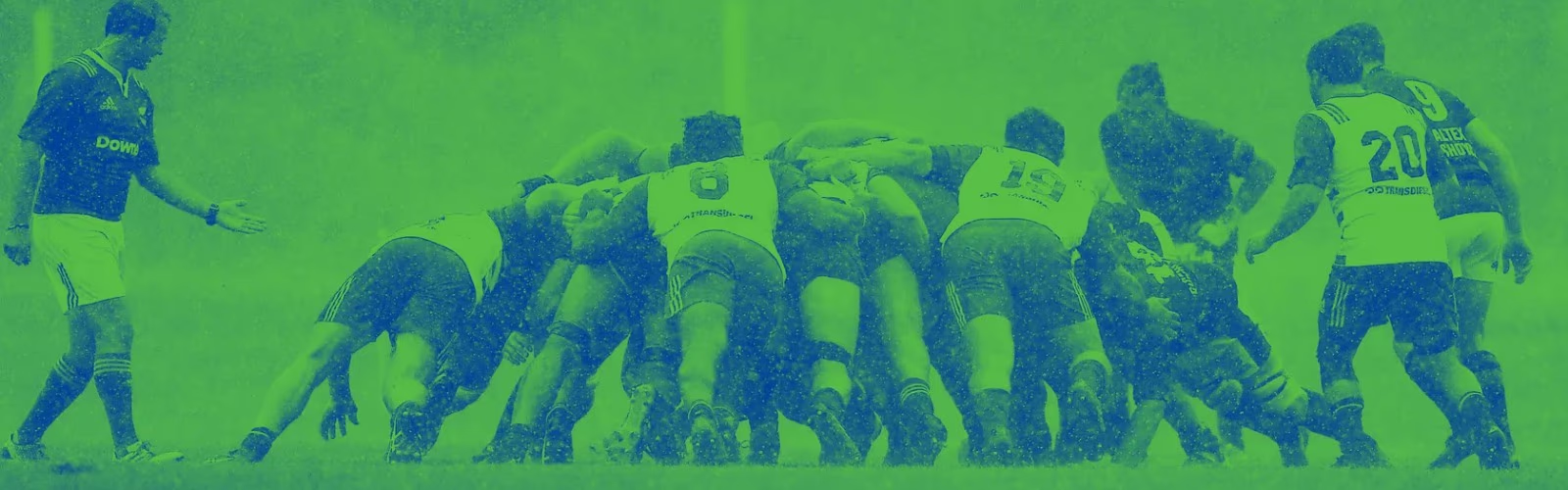
Law 20.1 (Definition): A scrum is a means of restarting play. Eight players from each team bind together in three rows and engage with their opponents.
— Law 20.1, Law 20.5, Law 20.6, Law 20.9
Why people argue about this
People often assume that a scrum is just about getting the ball back in play after it's out of bounds, forgetting that it involves both teams competing for possession by using their feet against each other. The confusion arises because they overlook the intricate mechanics and strategy involved in creating and winning a scrum, focusing instead on its primary function as a restart.
The scrum engagement sequence mandated by World Rugby – Crouch, Bind, Set – was introduced to reduce the risk of neck and spinal injuries during scrum engagement.
— Law 20.3, Law 20.9, Law 20.2
Why people argue about this
People often assume that lifting lineout jumpers is only about safety for them, forgetting that it's also crucial for maintaining balance in the scrum formation. The confusion arises because they overlook how a safe lift can prevent the scrum from collapsing or getting out of alignment.
The ball used in Rugby Union must be oval and made of four panels. Law 2.1 specifies the following dimensions and properties for the match ball: Length (long axis): 280–300 mm (approximately 11–11¾ inches); Circumference (end to end, long axis): 740–770 mm (approximately 29–30¼ inches); Circumfer...
— Law 2, Law 2.1, Law 2.2, Law 2.3, Law 4, Law 4.1, Law 4.4, Law 4.5, Law 4.6, Law 4.2, Law 4.3
Why people argue about this
People often assume that Law 4.4's mention of optional protective equipment only applies to players on the field who want to wear it for safety reasons. However, the confusion arises because this law also extends to referees and match officials, who are permitted to use such soft, thin materials as part of their gear if they choose to do so for comfort or visibility purposes during games.
Law 1 defines the playing enclosure, which consists of the playing area and any area beyond the playing area that is required for player safety (the run-off area). The playing area is divided into the field of play and the two in-goal areas.
— Law 1, Law 1.3, Law 1.4, Law 1.6, Law 1.2, Regulation 22
Why people argue about this
People often assume that just because Law 1 defines a playing area doesn't mean it's all they need to know about boundaries. They might think there are only two in-goal areas defined by Law 1, when actually, the entire enclosure including the run-off and field of play is delineated as per this law, leading to misunderstandings about what constitutes part of the game area.
Under Law 3.1, a match is played between two teams each consisting of a maximum of fifteen (15) players. A team may start a match with fewer than fifteen players only with the agreement of the opposing team.
— Law 3, Law 3.1, Law 3.3, Law 3.4, Law 3.5, Law 3.7, Law 3.6, Law 3.9, Law 3.10, Law 6, Law 6.1, Law 6.2, Law 6.5, Law 6.6, Law 9
Why people argue about this
People often assume that a team can only have 15 players out on the field at once, forgetting that substitutions are allowed throughout the game, which means teams typically carry more than fifteen players in their squad. The confusion arises because they mix up the number of active players with the total number of substitutes and full squad members.
Law 5.1: A match consists of two halves of 40 minutes of playing time each. The half-time interval must not exceed 15 minutes.
— Section 7, Section 8, Law 5, Law 5.1, Law 5.4, Law 5.7, Law 13, Law 13.1, Law 13.2, Law 13.4, Law 7, Law 7.1, Law 12, Law 11, Law 11.1, Law 11.3, Law 11.5, Law 12.1, Law 12.2, Law 12.3
Why people argue about this
People often assume that the 40-minute halves mean each team gets a full 40 minutes of playing time, but actually, due to stoppages for substitutions, injuries, and other delays, teams only play about half that time in each half. They might think they have more control over their clock, when in reality, it's often controlled by the referee’s timing.
A try is scored when an attacking player is first to ground the ball in the opponents' in-goal area (on or beyond the goal line, short of the dead-ball line and touch-in-goal lines). Grounding the ball requires downward pressure with the hand, arm, or upper body (chest and front of the shoulder).
— Law 8, Law 8.1, Law 8.3, Law 8.2, Law 8.4, Law 21, Law 8.5, Law 21.2, Law 8.6
Why people argue about this
People often argue that a try is scored if ANY part of the player's body touches the ground in the opponents' in-goal area, thinking it could be an arm or leg rather than just the hand or upper body as stated. The confusion arises because they misinterpret "downward pressure with the hand, arm, or upper body" to mean any part of their body can touch the ground.
Law 9.1 defines foul play as any action by a player that is contrary to the Laws of the Game and includes, but is not limited to: Obstruction; Unfair play; Repeated infringements
— Law 9, Law 9.1, Law 21, Law 9.4, Law 9.8, Law 9.9, Law 9.10, Law 9.11, Law 9.12, Law 9.13, Law 9.14, Law 9.15, Law 9.16, Law 9.17, Law 9.18, Law 9.19, Law 9.20, Law 9.26, Law 9.27, Law 9.28
Why people argue about this
People often assume that foul play in rugby is solely about physical contact like tackles, when in fact, it encompasses a much broader range of behaviors including dissenting from officials, using excessive force during scrums or rucks, and even deliberately injuring an opponent, which they mistakenly believe are only tackled-related fouls.
World Rugby has established a comprehensive Player Welfare Framework to mitigate risks of injury at all levels of the game. The framework includes mandatory protocols, law amendments, equipment standards, and educational programs.
— Section 2, Law 20, Law 20.3, Law 20.9, Law 20.2, Law 19, Law 19.12, Law 4, Law 4.3, Law 1, Law 6.7, Law 3.5, Regulation 22
Why people argue about this
People often assume that the safety protocols in Section 8 are only about avoiding physical contact during games, but actually, they encompass a wide range of considerations including proper tackling techniques, concussion management, equipment maintenance, and comprehensive medical support systems to ensure players' welfare throughout their careers.
The playing area must be grass. Where grass is unavailable, artificial turf may be used provided it meets World Rugby Regulation 22 (Artificial Rugby Turf).
— Regulation 22
Why people argue about this
People often assume that rugby can only be played on grass fields, misunderstanding that while grass is preferred, artificial turf as long as it meets World Rugby's standards is acceptable for matches. This confusion stems from a misinterpretation of the rule allowing for alternative surfaces when grass isn't available.
, has one or both knees on the ground, is sitting on the ground, or is on top of another player on the ground). The tackled player must immediately release the ball and move away from it.
— Section 7, Section 8, Law 15.1, Law 15.2, Law 15.3
Why people argue about this
People often think that a tackle is called when the ball carrier simply touches the ground, which isn't entirely accurate according to World Rugby's Law 15. Actually, it's about being held by one or more opponents and then brought to the ground, emphasizing the role of the tackler in holding rather than just the contact with the ground.
Water carriers and medical personnel may enter the field of play only with the referee's permission (except in a genuine medical emergency) and must leave immediately when instructed (Law 3.10).
— Law 3.10
Why people argue about this
People often assume that team officials have a say in decisions made by the referee on the pitch, which is why they argue. However, Law 6. 6 clearly states that the referee's decisions are final, leaving no room for further debate or intervention from team officials.
The ball used in Rugby Union must be oval and made of four panels. Law 2.1 specifies the following dimensions and properties for the match ball: Length (long axis): 280–300 mm (approximately 11–11¾ inches); Circumference (end to end, long axis): 740–770 mm (approximately 29–30¼ inches); Circumfer...
— Law 2.1, Law 2.2, Law 2.3
Why people argue about this
People often assume that players are required to wear protective gear like mouthguards or helmets, which isn't explicitly stated in Law 4.4. However, they misunderstand that it's optional and only permits soft, thin materials as per World Rugby’s guidelines, not mandating its use at all. This leads to confusion about whether certain equipment is mandatory versus simply allowed for safety.
Law 1 defines the playing enclosure, which consists of the playing area and any area beyond the playing area that is required for player safety (the run-off area). The playing area is divided into the field of play and the two in-goal areas.
— Law 1
Why people argue about this
People often assume that the run-off area is just for passing players safely around the goal posts, forgetting that it's also where referees can stand during play to ensure safety. The confusion arises because they overlook the fact that this area extends beyond the in-goal areas and plays a crucial role in maintaining game integrity by allowing officials to oversee the action from safe positions.
A try is scored when an attacking player is first to ground the ball in the opponents' in-goal area (on or beyond the goal line, short of the dead-ball line and touch-in-goal lines). Grounding the ball requires downward pressure with the hand, arm, or upper body (chest and front of the shoulder).
— Law 8.3
Why people argue about this
People often believe that a try can be scored by simply touching the ball down anywhere in the in-goal area without grounding it with their body, but actually, it requires downward pressure using the hand, arm, or upper body to make contact with the ground first.
Law 19.1: The ball is in touch when it (or a player carrying it) touches or crosses a touchline. When the ball goes into touch, a lineout is formed.
— Law 19.1, Law 19.4
Why people argue about this
People often assume that a player can only touch the ball out of play when it's directly in their possession, forgetting that the ball itself is what gets declared 'in touch' if it crosses the line, regardless of who was holding it at the moment. The confusion arises because they overlook the fact that the law considers the ball’s position rather than whose hands are touching it.
Time wasting (Law 9.8): A player must not intentionally waste time. Sanction: Penalty kick.; Handling the ball in the ruck or scrum (Law 9.9): A player must not pick up the ball in a ruck with their hands while on their feet. Sanction: Penalty kick.; Handling the ball in a ruck or scrum while on ...
— Law 9.8, Law 9.9, Law 9.10
Why people argue about this
People often assume that a yellow card means immediate expulsion from the game, which is why they argue—actually, it's just a temporary suspension for 10 minutes, designed to penalize but still allow players time to cool off or make amends on the field.
World Rugby has established a comprehensive Player Welfare Framework to mitigate risks of injury at all levels of the game. The framework includes mandatory protocols, law amendments, equipment standards, and educational programs.
Why people argue about this
People often assume that the Player Welfare Framework is just about medical care after injuries, when in reality it encompasses a holistic approach including mandatory protocols for safer tackling techniques, law amendments like banning dangerous high tackles, stricter equipment standards to prevent player harm, and educational programs for coaches on proper training methods.
A yellow card results in a player being temporarily suspended from the field of play for a period of ten (10) minutes of playing time. The player may return after the suspension has elapsed.
Why people argue about this
People often assume that a player gets immediately sent off after receiving a yellow card in rugby, forgetting that they're only suspended for ten minutes and can return to the game at any point during those 10 minutes. The confusion arises because the duration of the suspension isn't always clear or emphasized enough compared to the immediate impact of being sent off.