


🏛️Official — FIFA
Loading OpenSourceSports…
Kick the ball out when an opponent is seriously injured
When an opposing player goes down with a serious injury, the team in possession is expected to kick the ball out of play to allow medical treatment. Failing to do so—especially scoring while a player is down—draws fierce condemnation from players, managers, and fans alike. One of football's most deeply held informal codes.
Return the ball after an injury-stoppage throw-in
After the ball is kicked out for an injury and play restarts, the receiving team is expected to return possession to the side that kicked it out. Scoring directly from such a return is considered a severe breach of fair play and typically triggers immediate apology and outrage from all parties.
Only the captain addresses the referee
When a contentious decision is disputed, the expectation—especially at professional and senior amateur levels—is that only the team captain approaches the official. Several players surrounding and haranguing a referee simultaneously is seen as intimidating and disrespectful to match authority.
Shake hands with opponents and officials at full-time
Acknowledging opponents and the match referee with a handshake or brief exchange at the final whistle is a foundational sportsmanship norm. Refusing or visibly avoiding the post-match handshake—especially between specific individuals—is treated as a notable display of poor grace and attracts criticism from commentators and administrators.
The 2026 FIFA World Cup (hosted across the United States, Canada, and Mexico) expands from 32 to 48 teams for the first time. The new format features 12 groups of 4 teams each.
Why people argue about this
People often assume that GLT is used in every game for automatic goal determination, thinking it's a universal feature of all matches. However, the official verdict clarifies that GLT is only implemented in major FIFA competitions and approved leagues to definitively call goals or no-goals, not in every single match across the board.
The referee may allow play to continue when a team against which an offense has been committed would benefit from the advantage. If the anticipated advantage does not materialize within a few seconds, the referee penalizes the original offense.
— Law 12
Why people argue about this
People often assume that if an advantage isn't immediately apparent after a foul is committed, it means the referee will automatically penalize right away. But in reality, the referee waits for a few seconds to see if play would naturally benefit from allowing the initial offense to stand, before deciding whether to enforce the rule or not.
Where artificial turf is used, it must meet the requirements of the FIFA Quality Programme. The surface must be green and meet specific criteria for shock absorption, ball bounce, ball roll, and rotational resistance to protect player safety and preserve the quality of play.
Why people argue about this
People often assume that as long as the surface is green, it meets all FIFA requirements for artificial turf, which leads to misunderstandings about its shock absorption, ball bounce, and roll performance needed to protect players safely. They overlook the specific criteria for these aspects outlined in the FIFA Quality Programme.
The ball is out of play when it has wholly passed over the goal line or touchline, whether on the ground or in the air, or when play has been stopped by the referee. The ball is in play at all other times, including when it rebounds off a match of...
Why people argue about this
People often assume that if a ball rebounds off a player's body during play, it goes out of play. However, according to Law 9 in football (soccer), as long as the referee hasn't stopped play and the ball is still within the field boundaries, it remains in play regardless of where or how it bounces off a player.
Competitions may adopt the optional "captain only" rule, which restricts communication with the referee to the team captain only. Implemented in the Premier League and endorsed by FIFA for the 2025-2026 season, this rule aims to reduce referee harassment and improve match flow.
Why people argue about this
People often assume that the green color requirement for artificial turf is purely aesthetic, forgetting that it's crucial for maintaining consistent ball bounce and roll, which are essential for fair play under FIFA standards. They overlook how uniform surface conditions help ensure all players receive a level playing field, regardless of their position or team.
FIFA competitions use various formats: Group stage: 3 points for a win, 1 point for a draw, 0 points for a loss; Knockout stage: Extra time and penalty shootout if required; Tiebreakers in groups: Points, goal difference, goals scored, head-to-head record, fair play points, drawing of lots
Why people argue about this
People often assume that goal-line technology (GLT) is a new invention for major competitions, when in reality it's been around since 2012 and was first used in the English Premier League. The confusion arises because they don't realize GLT has been part of many leagues' rules for years before becoming standard in FIFA competitions.
IFAB has established a permanent concussion substitution protocol. If a player is suspected of sustaining a concussion, the team doctor may request that the player be substituted using the additional concussion substitution allowance.
Why people argue about this
People often assume that the concussion substitution protocol is only for severe head injuries like concussions, when in fact it's designed to cover any situation where a player might be at risk of sustaining a concussion — from feeling dizzy after a fall to having a brief loss of consciousness. They overlook the broader interpretation and flexibility built into this rule to ensure player safety.
IFAB has made the concussion substitution rule permanent (no longer a trial). Each team is permitted one additional "concussion substitution" when a player has an actual or suspected concussion.
Why people argue about this
People often assume that the concussion substitution only applies in trials until it's made permanent, forgetting that once IFAB declares a rule permanent, it becomes a standard part of the game, allowing teams to make one additional concussion substitution per match.
While primarily governed by competition regulations rather than the Laws of the Game, the safety of spectators is a consideration. The referee has the authority to suspend or abandon a match if crowd behavior endangers players, officials, or spectators.
Why people argue about this
People often assume that crowd safety is solely a responsibility of stadium management rather than the referee, misunderstanding that the referee does indeed have authority to suspend or abandon a match if it's deemed unsafe due to behavior from fans, players, or officials.
The team that scores the most goals during a match wins. If the number of goals scored is equal, the match is a draw.
Why people argue about this
People often think that if a match ends with both teams scoring exactly the same number of goals, it should be decided by extra time or penalties instead of being declared a draw. But actually, according to FIFA rules, when scores are equal at full-time, the game is considered tied and no further attempts to break a tie are made.
Touchline (length): Minimum 90 m (100 yards), Maximum 120 m (130 yards); Goal line (width): Minimum 45 m (50 yards), Maximum 90 m (100 yards); International matches: Length 100–110 m, Width 64–75 m
Why people argue about this
People often assume that the goal lines themselves are where goals are scored, rather than at their center. This misunderstanding stems from a literal interpretation of the term "center" in the official verdict, leading to confusion about exactly where the goal is located on the field.
A direct free kick (or penalty kick if inside the offender's penalty area) is awarded if a player commits any of the following offenses against an opponent in a manner considered by the referee to be careless, reckless, or using excessive force:
Why people argue about this
People often assume that a direct free kick is only awarded for deliberate, obvious fouls like tripping or kicking an opponent. They forget about indirect offenses like sliding tackles that might seem careless but aren't always clearly defined as such by referees, leading to arguments over whether the offense was indeed reckless and forceful enough to warrant a direct free kick.
Yellow Card (Caution): Issued for unsporting behavior, dissent, persistent infringement, delaying the restart of play, failing to respect the required distance at set pieces, entering/leaving the field without permission, or deliberate handball to stop a promising attack (if outside the penalty a...
Why people argue about this
People often assume that if play continues without immediate benefit for the team that committed an offense, the referee will simply ignore it and no punishment is given. But actually, the referee can still penalize the initial offense even if they decide not to stop play right away, as long as there wasn't a clear anticipated advantage within seconds.
A match consists of two equal halves of 45 minutes each, with a half-time interval not exceeding 15 minutes. The referee adds time at the end of each half for all time lost due to substitutions, assessment and/or removal of injured players, wastin...
Why people argue about this
People often assume that the 45-minute halves are strictly fixed periods without adjustments for time lost during matches, leading to misunderstandings about how much actual playing time will be covered if substitutions or injuries occur frequently. The confusion arises because the rule states the referee adds this time at the end of each half, not altering the initial 45-minute structure itself.
Center circle: Radius of 9.15 m (10 yards) from the center mark; Penalty area: 16.5 m (18 yards) from each goal post and 16.5 m into the field; Goal area: 5.5 m (6 yards) from each goal post and 5.5 m into the field
Why people argue about this
People often assume that goals are placed closer to the corner flag posts than they actually are, thinking it's a strategic advantage by placing them there. In reality, the official placement ensures symmetry and fairness across all fields, regardless of where the goalposts might be positioned relative to the corners.
Goalkeepers may wear tracksuit bottoms and gloves. Goalkeepers must wear a jersey color distinct from all other players and the match officials.
Why people argue about this
People often assume that goalkeepers must wear traditional goalkeeper gear like gloves and a specialized jersey, forgetting they can also opt for regular tracksuit bottoms instead of the usual shorts. This leads to misunderstandings about what exactly constitutes acceptable goalkeeper attire under FIFA rules.
Goalkeepers now have a maximum of 8 seconds to release the ball from their hands. If the goalkeeper holds the ball for longer than 8 seconds, the opposing team is awarded a corner kick.
Why people argue about this
People think they can still hold onto the ball for as long as they want without penalty, but actually, if a goalkeeper holds it for more than 8 seconds, their team gets a corner kick, leading to confusion about when exactly that 8-second limit kicks in during a play.
It is an offense when a player deliberately touches the ball with their hand/arm (including moving the hand/arm toward the ball), scores directly from their hand/arm (even if accidental), or creates a goal-scoring opportunity after the ball touche...
Why people argue about this
People often assume that handball is only about scoring directly with a deliberate hand touch, forgetting that it also includes creating goal-scoring opportunities by touching the ball with their hand/arm in a way that deceives or distracts an opponent, even if unintentional. They overlook how subtle and varied this interpretation can be.
In matches played in extreme heat conditions, the referee may authorize cooling breaks (separate from the half-time interval) of up to three minutes, typically around the 30th and 75th minutes of play. These are medical recommendations implemented...
Why people argue about this
People often assume that these cooling breaks are a form of halftime, which they see as an unfair advantage since it's longer than usual. In reality, these breaks are meant to be short medical interventions during gameplay to prevent players from overheating and dehydrating, not as extended time off like halftime.
An indirect free kick is awarded when a player plays in a dangerous manner, impedes the progress of an opponent without contact, or commits any offense for which play is stopped to caution or dismiss a player. Specific goalkeeper indirect free kic...
Why people argue about this
People often assume that an indirect free kick is only awarded for dangerous play or deliberate fouls, forgetting that it can also be given for impeding without contact. The confusion arises because they overlook the category of offenses where a player commits an infraction during play but doesn't necessarily make physical contact with another player.
The referee has the authority to suspend or abandon a match due to dangerous weather conditions, including lightning, extreme heat, or poor visibility. Matches may be suspended temporarily and resumed if conditions improve, or abandoned if conditions do not improve within a reasonable time.
Why people argue about this
People often assume that the green color requirement for artificial turf is purely aesthetic, forgetting that it's crucial for maintaining consistent ball bounce and roll across all playing conditions, including lightning strikes or extreme weather. They overlook how a non-green surface could drastically affect gameplay unpredictably, leading to confusion about its necessity beyond appearance.
The competition organizer must ensure adequate medical facilities and personnel are available at the match venue. A stretcher and medical personnel must be present at all official matches.
Why people argue about this
People often assume that just having medical personnel is enough under this rule, forgetting they need to be present at all official matches. The actual requirement is for a stretcher and dedicated medical staff to be available throughout every fixture, not merely on standby or during halftime.
A match is played by two teams, each with a maximum of 11 players, one of whom must be the goalkeeper. A match may not start or continue if either team has fewer than 7 players.
Why people argue about this
People often assume that a team can only have 10 players out on the field at one time, forgetting about the goalkeeper who counts towards the total of 11. This leads to misunderstandings when they argue that their team should be allowed to start or continue playing if they think they just need 7 players available in reserve, not necessarily all on the pitch simultaneously.
A player is in an offside position if any part of their head, body, or feet is nearer to the opponents' goal line than both the ball and the second-last opponent. A player is not in an offside position if they are in their own half of the field or...
Why people argue about this
People often think that if a player is in an offside position, they can never be involved in play by being caught interfering with play, preventing an opponent, or winning the ball. However, this isn't true; a player in an offside position can still be penalized for these actions, even though their positioning makes them ineligible to receive the ball directly from a pass.
Assistant Referees (2): Positioned along each touchline, they assist with offside decisions, throw-in direction, corner/goal kicks, and fouls near their position.; Fourth Official: Assists the referee with administrative duties, manages substitutions, and controls the technical areas.; Video Assi...
Why people argue about this
People often assume that they can use as many substitutes as they want, thinking FIFA's limit is merely a suggestion rather than a hard-and-fast rule, thus leading to arguments about when or if substitutions are allowed beyond five.
Player safety is a fundamental principle underlying the Laws of the Game. The referee must stop play if a player is seriously injured and ensure the player is removed from the field.
Why people argue about this
People commonly argue that the referee should only stop play if a player is seriously injured, when in fact, they often misunderstand the term "seriously." The confusion arises because while "serious injury" implies immediate medical attention, some players and coaches believe it means play must be stopped for even minor injuries to ensure safety.
The basic compulsory equipment of a player consists of: Jersey/shirt: Must have sleeves. Each team wears distinguishing colors. Goalkeepers must wear colors distinct from all other players, the referee, and assistant referees.; Shorts: If undershorts or tights are worn, they must be the same colo...
Why people argue about this
People often assume that only visible jewelry like necklaces or rings is prohibited, forgetting about less obvious items like leather bands or rubber bands which can still pose a risk if they get caught on something during play. The confusion arises because these smaller details are easily overlooked in the rush to ensure safety for all players.
A player must not use equipment or wear anything that is dangerous, including any jewelry (necklaces, rings, bracelets, earrings, leather bands, rubber bands). Taping over jewelry is not permitted.
Why people argue about this
People think they can tape over jewelry to make it safe, but the official verdict clearly states taping is not permitted, leading to misunderstandings about what constitutes acceptable safety measures.
A goal is scored when the whole of the ball passes over the goal line, between the goal posts and under the crossbar, provided no offense has been committed by the scoring team. The team scoring the greater number of goals wins.
Why people argue about this
People often assume that a goal is scored as soon as the ball crosses the line, without considering if it was done unfairly. The actual confusion arises because they overlook the crucial part about no offense having been committed by the scoring team, which can lead to disputes over whether an apparent goal should count or not.
The basic compulsory equipment of a player consists of: Spherical, made of suitable material (leather or equivalent); Circumference: 68–70 cm (27–28 inches); Weight at the start of the match: 410–450 g (14–16 oz)
— Law 2, Law 4
Why people argue about this
People often assume that jewelry is only a problem if it can be seen by opponents, forgetting that even taped-over pieces are still considered dangerous under the rule. They overlook the fact that taping over jewelry isn't allowed, leading to misunderstandings about what constitutes compliance with the equipment rules.
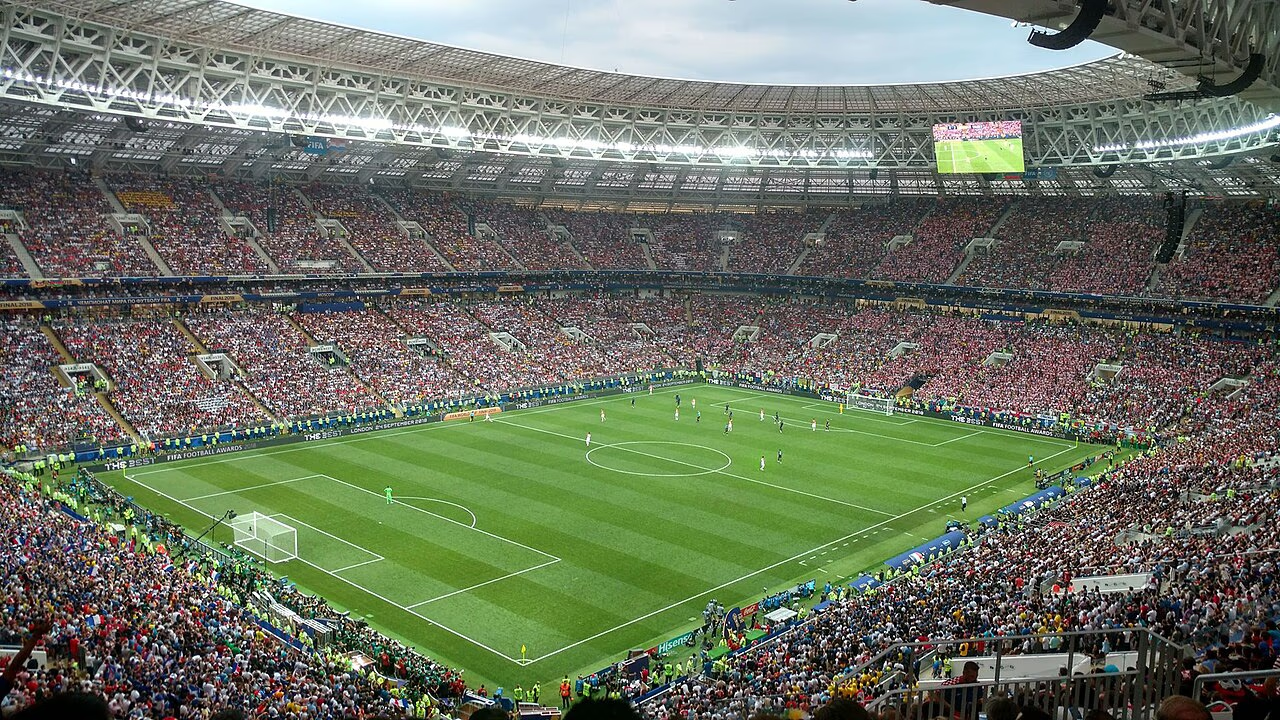
The field must be a rectangular natural or artificial turf surface, green in color. The field is defined by boundary lines: two longer touchlines and two shorter goal lines.
Why people argue about this
People often assume that the field must be a perfect rectangle with all sides exactly 90 meters long, which leads to misunderstandings when fields vary slightly in size or have dimensions like 60x45 meters. The confusion arises because the rule specifies rectangular shape and green color without detailing exact measurements or uniformity requirements.
A match is played by two teams, each with a maximum of 11 players, one of whom must be the goalkeeper. A match may not start or continue if either team has fewer than 7 players.
— Law 3, Law 5, Law 6
Why people argue about this
People often assume that a team can just replace players as they see fit during a match without regard for the minimum number of players required by law, but actually, substitutions are strictly regulated within specific limits to ensure fair play and game continuity, with only seven players allowed off the field at once due to this rule.
A match consists of two equal halves of 45 minutes each, with a half-time interval not exceeding 15 minutes. The referee adds time at the end of each half for all time lost due to substitutions, assessment and/or removal of injured players, wastin...
— Law 7, Law 8, Law 9, Law 11, Law 10, Law 13, Law 14, Law 15, Law 16, Law 17
Why people argue about this
People often assume that if a half is 45 minutes long and there's no time added for injuries or substitutions, then they'll have exactly 90 minutes of game play. But the confusion arises because the referee does indeed add time at the end of each half to account for all those interruptions, making the total match duration longer than just two halves.
The team that scores the most goals during a match wins. If the number of goals scored is equal, the match is a draw.
Why people argue about this
People often assume that if a match ends with an equal number of goals scored by both teams, it must go straight into extra time or penalty shootout for a winner, but in soccer (football), when scores are tied at full-time, the game is officially declared a draw regardless of how many goals were scored.
A direct free kick (or penalty kick if inside the offender's penalty area) is awarded if a player commits any of the following offenses against an opponent in a manner considered by the referee to be careless, reckless, or using excessive force:
— Law 12
Why people argue about this
People often argue that they didn't mean to use 'excessive force,' so they shouldn't get a penalty kick when it's really about whether their action was careless or reckless enough to warrant such severe punishment. The confusion arises because 'excessive force' is subjective and judges can interpret it differently, leading to disputes over whether an incident falls under this category.
Player safety is a fundamental principle underlying the Laws of the Game. The referee must stop play if a player is seriously injured and ensure the player is removed from the field.
Why people argue about this
People often assume that if a player is injured during a match, they can simply be helped back on the field by medical staff, even if it means continuing play. However, the true intent of this rule is for the referee to immediately stop play and ensure serious injuries are addressed properly off the field, prioritizing safety over game continuity.
Free Kicks (Law 13): Awarded for fouls and misconduct. Direct free kicks allow a goal to be scored directly; indirect free kicks require the ball to touch another player before a goal can be scored.; Penalty Kick (Law 14): Awarded when a foul punishable by a direct free kick is committed inside t...
— Law 13, Law 14, Law 15, Law 16, Law 17
Why people argue about this
People often assume that a goalkeeper can hold onto the ball for as long as they want during set pieces, which leads to misunderstandings when they're instructed to release it within 8 seconds or face a corner kick penalty. The rule is clear and enforced, but its application sometimes sparks debate about timing and intent.
A kick-off starts both halves and restarts play after a goal. The team that wins the coin toss decides which goal to attack in the first half; the other team takes the kick-off.
Why people argue about this
People often assume that if a ball goes out of play at either touchline or goal line, it's automatically in play again once it bounces back into play on the other side, which is incorrect. Actually, the ball remains out until the referee restarts play by throwing it in, kicking it from the field, dropping it, or using any other method specified in Law 8.
A substitute may only enter the field at the halfway line during a stoppage of play and after receiving the referee's signal. The player being replaced must leave the field before the substitute enters.
Why people argue about this
People often assume that substitutes can enter the field at any time during play when signaled by the referee, which leads to misunderstandings about when substitutions are actually allowed under FIFA rules. The confusion arises because they overlook the specific timing and location constraints for entering the pitch, as dictated by the rule requiring players to leave before new ones arrive.
Spherical, made of suitable material (leather or equivalent); Circumference: 68–70 cm (27–28 inches); Weight at the start of the match: 410–450 g (14–16 oz)
Why people argue about this
People often assume that only visible jewelry like necklaces can be a problem, so they argue about rings being allowed when they see players wearing them. In reality, the rule extends to all types of jewelry and even suggests taping over it is not permissible, leading to misunderstandings about what exactly constitutes "dangerous" equipment.
The field must be a rectangular natural or artificial turf surface, green in color. The field is defined by boundary lines: two longer touchlines and two shorter goal lines.
Why people argue about this
People often assume that the field must be exactly rectangular with no variation in shape allowed, which leads to arguments about slight irregularities or odd-shaped pitches. However, the official rule only specifies a rectangular shape; it doesn't mandate an exact rectangle where all sides are perfectly equal and all angles are precisely 90 degrees.
Goals are placed at the center of each goal line. They consist of two vertical posts equidistant from the corner flag posts, joined at the top by a horizontal crossbar.
Why people argue about this
People often assume that the goalposts are placed at the corner flags instead of the center of the goal line, which leads to misunderstandings about where exactly a goal is scored. The confusion arises because they confuse the visual positioning with the official rule's technical definition of goal placement.
Each match is controlled by a referee who has full authority to enforce the Laws of the Game. The referee's decisions regarding facts connected with play are final.
Why people argue about this
People often assume that once a referee makes a decision, it's set in stone and can't be challenged, which is why they argue - but actually, while decisions are final, disputes over their application or interpretation continue to occur among players, coaches, and sometimes even spectators due to the complexity of football laws.
Goal-line technology (GLT) is used in all major FIFA competitions and approved leagues to determine definitively whether the ball has wholly crossed the goal line. The system provides an instantaneous signal to the referee's watch within one second of a goal/no-goal situation.
Why people argue about this
People often assume that VAR is used for every goal-line decision, which leads them to misunderstand its role as merely confirming what GLT already determined automatically within a second. The confusion arises because they mix up the real-time confirmation of GLT with the delayed review process of VAR for other contentious decisions.