


🏛️Official — FIFA
Loading OpenSourceSports…
Team Sports
11 players
both
soccer ball, goal, jersey
10 essential rules
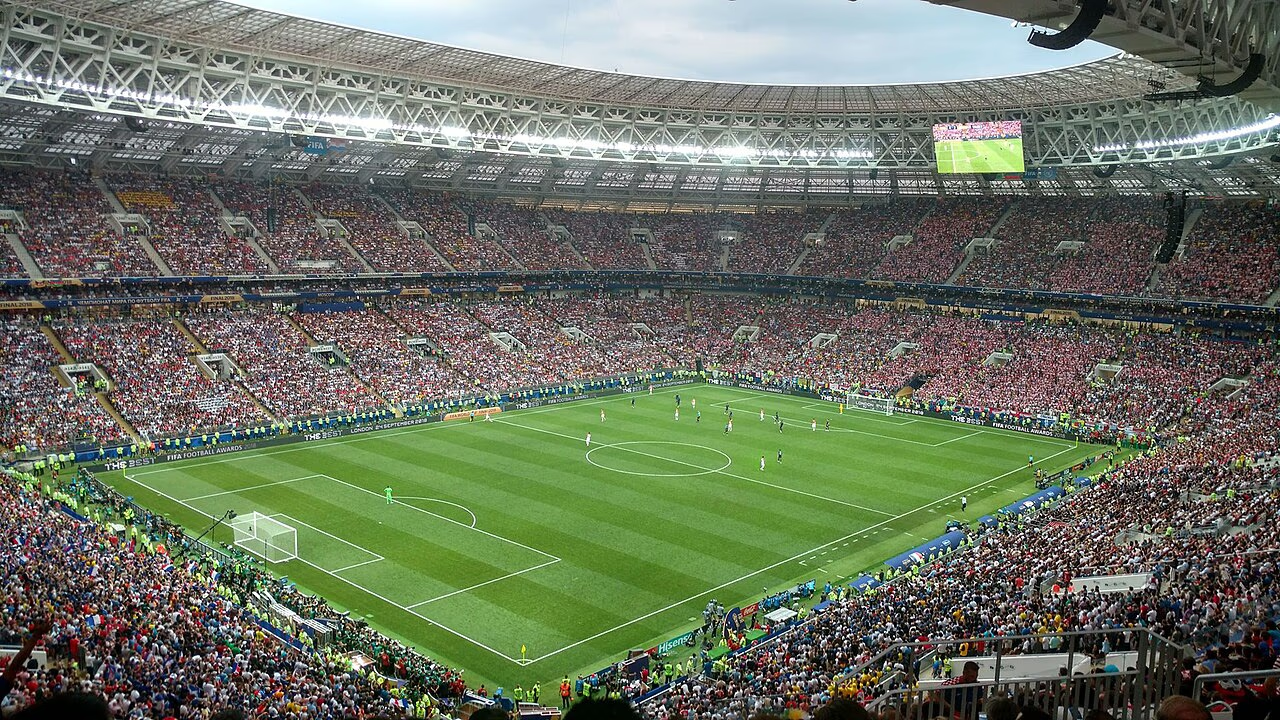
Association football, known as soccer in several countries, is the world's most popular sport, played by an estimated 250 million players in over 200 countries. The Laws of the Game are maintained by the International Football Association Board (IFAB), which was founded in 1886 and consists of FI...
The 2026 FIFA World Cup (hosted across the United States, Canada, and Mexico) expands from 32 to 48 teams for the first time. The new format features 12 groups of 4 teams each.
The referee may allow play to continue when a team against which an offense has been committed would benefit from the advantage. If the anticipated advantage does not materialize within a few seconds, the referee penalizes the original offense.
Where artificial turf is used, it must meet the requirements of the FIFA Quality Programme. The surface must be green and meet specific criteria for shock absorption, ball bounce, ball roll, and rotational resistance to protect player safety and preserve the quality of play.
The ball is out of play when it has wholly passed over the goal line or touchline, whether on the ground or in the air, or when play has been stopped by the referee. The ball is in play at all other times, including when it rebounds off a match of...
Competitions may adopt the optional "captain only" rule, which restricts communication with the referee to the team captain only. Implemented in the Premier League and endorsed by FIFA for the 2025-2026 season, this rule aims to reduce referee harassment and improve match flow.
FIFA competitions use various formats: Group stage: 3 points for a win, 1 point for a draw, 0 points for a loss; Knockout stage: Extra time and penalty shootout if required; Tiebreakers in groups: Points, goal difference, goals scored, head-to-head record, fair play points, drawing of lots
IFAB has established a permanent concussion substitution protocol. If a player is suspected of sustaining a concussion, the team doctor may request that the player be substituted using the additional concussion substitution allowance.
IFAB has made the concussion substitution rule permanent (no longer a trial). Each team is permitted one additional "concussion substitution" when a player has an actual or suspected concussion.
While primarily governed by competition regulations rather than the Laws of the Game, the safety of spectators is a consideration. The referee has the authority to suspend or abandon a match if crowd behavior endangers players, officials, or spectators.
The team that scores the most goals during a match wins. If the number of goals scored is equal, the match is a draw.
Kick the ball out when an opponent is seriously injured
When an opposing player goes down with a serious injury, the team in possession is expected to kick the ball out of play to allow medical treatment. Failing to do so—especially scoring while a player is down—draws fierce condemnation from players, managers, and fans alike. One of football's most deeply held informal codes.
The norm applies most strongly to serious-looking injuries; minor knocks or suspected simulation are typically played through.
Return the ball after an injury-stoppage throw-in
After the ball is kicked out for an injury and play restarts, the receiving team is expected to return possession to the side that kicked it out. Scoring directly from such a return is considered a severe breach of fair play and typically triggers immediate apology and outrage from all parties.
Arsenal voluntarily offered a replay of their 1999 FA Cup tie against Sheffield United after Nwankwo Kanu inadvertently scored from a returned ball, cementing the episode as the defining case study for this norm.
Only the captain addresses the referee
When a contentious decision is disputed, the expectation—especially at professional and senior amateur levels—is that only the team captain approaches the official. Several players surrounding and haranguing a referee simultaneously is seen as intimidating and disrespectful to match authority.
Scottish grassroots football codified this as a written rule in 2014 under its 'Respect' campaign, indicating how widely the cultural norm was already recognized.
Shake hands with opponents and officials at full-time
Acknowledging opponents and the match referee with a handshake or brief exchange at the final whistle is a foundational sportsmanship norm. Refusing or visibly avoiding the post-match handshake—especially between specific individuals—is treated as a notable display of poor grace and attracts criticism from commentators and administrators.
Handshake refusals after highly charged derbies or controversial matches generate disproportionate media attention precisely because the norm is so universally expected.
Ready to dive deeper?