Section 1: Introduction
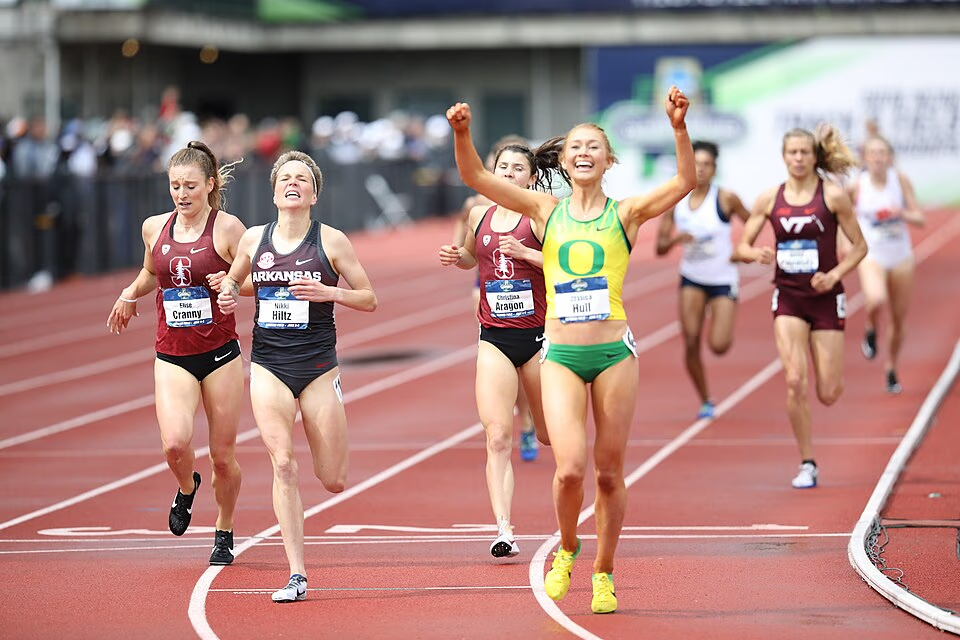
NCAA Outdoor Track & Field is the collegiate competition pipeline for track and field events in the United States, culminating in the NCAA Division I, II, and III Outdoor Track & Field Championships each June. The 2026 NCAA Division I championship runs the East and West first rounds May 27-30, 2026, and the championship finals June 10-13, 2026.
The underlying technical rules — track dimensions, event-specific procedures, equipment specifications, performance measurement, and event protocols — derive from the World Athletics Competition Rules (the sibling World Athletics Competition Rules entry in this directory is the canonical text for the underlying technical rules). The NCAA layer covers qualifying criteria, championship selection, division-specific procedures, and competition modifications specific to U.S. collegiate competition.
The canonical NCAA reference is the NCAA Division I Outdoor Track & Field Championships Technical Manual and the joint 2025-26 NCAA Track and Field Championships Qualifying Criteria published annually by the NCAA Track and Field/Cross Country Committee. This entry models the 2025-26 cycle, in effect for the 2026 championship.
This entry summarizes the major NCAA-specific mechanics for educational purposes. It does not reproduce rule text and is not a substitute for the canonical NCAA Technical Manual and Qualifying Criteria, which are authoritative in any dispute. For the underlying track-and-field technical rules consult the World Athletics entry in this directory.
Section 2: Equipment
Implements (Throws)
All throwing implements must conform to NCAA-published weight and specification standards, which follow World Athletics specifications with NCAA-specific certification requirements:
- Shot put: men 7.26 kg, women 4.00 kg
- Discus: men 2.00 kg, women 1.00 kg
- Hammer: men 7.26 kg, women 4.00 kg
- Javelin: men 800 g, women 600 g
Each implement used in competition must be on the NCAA-approved implements list, certified at the meet by the implement inspection team. Personal implements may be inspected and used if they meet specifications.
Hurdles
- Men's 110 m high hurdles: hurdle height 1.067 m, 10 hurdles
- Men's 400 m hurdles: hurdle height 0.914 m, 10 hurdles
- Women's 100 m hurdles: hurdle height 0.838 m, 10 hurdles
- Women's 400 m hurdles: hurdle height 0.762 m, 10 hurdles
Steeplechase Barriers
Men's 3,000 m steeplechase: 28 fixed barriers (0.914 m height) + 7 water-jump barriers. Women's 3,000 m steeplechase: 28 fixed barriers (0.762 m height) + 7 water-jump barriers.
Pole Vault and High Jump
- Pole vault: poles are personal equipment; pole specifications follow World Athletics standards; pole inspection is conducted at the meet
- High jump: bar specification per World Athletics; meet uses approved standards and crossbars
Shoes and Spikes
- Spike length restrictions per NCAA technical rules: typically maximum spike length 9 mm for outdoor track and field events on most surfaces
- Christmas-tree spikes prohibited on Mondo and similar synthetic tracks
- Field-event shoes may have different spike configurations (e.g., high jump, javelin) per the World Athletics specifications
- Shoe checks may be conducted by officials at the start of each event
Apparel
- School uniform with team logo/colors and assigned numbers (bib or jersey-mounted)
- NCAA logo placement and advertising restrictions per the championship manual
- Religious head coverings permitted; jewelry that may cause injury restricted
Section 3: Playing Area
Track
- 400 m oval track with 8 or 9 lanes (championship requires 8 lanes minimum)
- Lane width: 1.22 m
- Track surface: Mondo, polyurethane, or other World Athletics-approved synthetic outdoor track surface
- Track markings: lane lines, hurdle marks at standard distances, relay exchange zones, starting blocks positions
Field Event Areas
- Shot put: 2.135 m diameter circle with 40-degree throwing sector
- Discus: 2.5 m diameter circle with cage and 34.92-degree throwing sector
- Hammer: 2.135 m diameter circle with cage and 34.92-degree throwing sector
- Javelin: runway 30-36.5 m long, throwing arc and 28.96-degree sector
- Long jump: runway 40-45 m, takeoff board, sand landing pit 9 m long × 2.75 m wide
- Triple jump: runway plus takeoff board, hop-step-jump sequence ends in same landing pit
- High jump: D-shaped runway, takeoff area, landing mat 5 m × 3 m × 0.65 m
- Pole vault: runway 40-45 m, takeoff box, landing mat with safety pad
Venue Standards
- NCAA championship venues must meet "Class A" certification per the NCAA Track and Field/Cross Country Committee
- Wind gauges at each sprint and jumping event for wind-aided reading
- FAT (Fully Automatic Timing) electronic timing required at championship events
- Photo finish equipment, transponder timing, and shoot-the-line equipment at championship-level meets
Meet Eligibility Standards
Per NCAA qualifying criteria, performance marks are only accepted for championship qualifying at meets where a minimum of 10 events are open to collegiate student-athletes for outdoor track and field, per gender. This requirement prevents one-off "fast" meets from being used solely to chase a qualifying mark.
Section 4: Players & Officials
Field Composition
NCAA Division I championship qualification:
- Individual events: the top 48 declared student-athletes by national descending-order list at the close of the qualifying window are accepted into the first-round competitions
- Relay events: the top 24 declared relay teams by national list are accepted into the first-round competitions
- Combined events (Heptathlon and Decathlon): the top 24 declared student-athletes by national descending-order list are accepted directly into the championships (no first round)
Division II: top 22 individual + top 16 relay + top 16 combined.
Division III qualifying criteria are similar in structure but published separately by the DIII committee.
First Round Advancement
- The first rounds are split into East and West regions
- The top 12 competitors from each individual event and the top 12 teams from each relay event advance from each first round to the championship finals
- First-round dates 2026: Wednesday May 27 through Saturday May 30
- Championship finals 2026: June 10-13
Officials
- Referee for each event group (track, field, multi-events, relays)
- Starters, recall starters, finish judges, lap counters, judges of walking, umpires
- Timekeepers and photo-finish officials
- Field-event judges, implement inspectors, wind-gauge operators
- Jury of Appeal for the meet, handling protest decisions
- Meet director and the championship-meet committee for administrative oversight
Coaches and Athletes
Coaches in the credentialed area during the meet may communicate with athletes between rounds at the standard pre-staging areas; on-field coaching during running events is not permitted. NCAA-specific bench/box rules for field events permit coaches in the marshaled coach box.
Section 5: Rules of Play
Qualifying Window
- Qualifying performances for the 2026 first rounds begin March 1, 2026
- Qualifying window closes Sunday May 17, 2026 (non-conference-championship meets)
- Qualifying window closes Monday May 18, 2026 (conference championship meets)
Track Event Procedures
- Starts: starting blocks required for sprints (100 m through 400 m, plus relays and hurdles); commands "On your marks" — "Set" — gun, with electronic false-start detection
- False starts: a false start results in the athlete's disqualification from the event (zero-tolerance rule, consistent with World Athletics 2009-onward standard)
- Lane assignments: assigned per NCAA seeding for events run in lanes (100 m, 200 m, 400 m, hurdles, 800 m start); 800 m breaks for inside-lane running after the first turn; 1500 m and longer race in pack
- Relay exchanges: must be completed within the 20 m exchange zone; baton may be dropped only by the receiving runner without DQ; outgoing runner may begin the run up to 10 m before the exchange zone
Field Event Procedures
- Shot put / discus / hammer / javelin: each finalist receives 3 trials in the qualifying round; the top finalists (typically 9) receive 3 additional trials in the final
- Long jump / triple jump: same 3+3 procedure for qualifying and final
- High jump: incremental bar heights set by the meet; 3 attempts at each height; missing 3 in a row eliminates the athlete
- Pole vault: same 3-attempts-per-height structure as high jump
- Combined events (decathlon men, heptathlon women): event order and scoring per World Athletics specifications
Wind Readings
Wind readings are recorded for sprints up to 200 m (including hurdles to 110/100 m) and for horizontal jumps. A wind reading at or below +2.0 m/s tailwind is "wind-legal" — the performance is eligible for NCAA list and record purposes. Wind readings above +2.0 m/s are "wind-aided" and the mark is not record-eligible (though it may still count for meet placement).
Conference Championship Path
The conference championship meet is the typical entry path for NCAA championship qualification. Each conference's championship meet is run by the conference; performances at conference championships count toward the NCAA descending-order list. Some conference championships have specific entry standards or limitations published by the conference.
Section 6: Scoring
Team Scoring (NCAA Standard)
NCAA team scoring at the championship typically follows the 10-8-6-5-4-3-2-1 scale:
- 1st place: 10 points
- 2nd place: 8 points
- 3rd place: 6 points
- 4th place: 5 points
- 5th place: 4 points
- 6th place: 3 points
- 7th place: 2 points
- 8th place: 1 point
Relay events typically score double (20-16-12-10-8-6-4-2). Some conference meets use different scoring scales (e.g., 10-8-6-5-4-3-2-1 for individual + double for relays; or 10-deep with different distribution).
Individual Event Result
- Sprints / hurdles / middle distance / distance running: lowest time wins (FAT to 0.01 second)
- Horizontal jumps / vertical jumps / pole vault: highest mark wins (best of trials)
- Throws: longest valid throw wins (best of trials)
- Combined events: highest total score across all events wins (scored per World Athletics tables)
- Relays: lowest team time wins
Tiebreakers
- Track events: photo finish; same time = co-place
- Field events with same mark: second-best mark is the tiebreaker; if still tied, third-best, and so on
- High jump / pole vault: fewer misses at the winning height; then fewer total misses; if still tied, jump-off (extra attempts at progressively higher/lower heights)
Team Championship
The team with the highest total team score across all scoring events wins the team championship (men's team and women's team championships are awarded separately; combined-gender team championships are sometimes awarded by major conferences but not the NCAA championship).
Section 7: Violations & Penalties
False Start
A false start results in disqualification from the event (zero-tolerance rule, consistent with World Athletics 2009-onward standard). This applies to all sprints and hurdles, plus the start of the 800 m. False starts in the relays disqualify the relay team.
Lane Infringement
- Running on or inside the inner lane line (stepping on the inner line is permitted in most cases; stepping inside the lane on a curve is DQ-worthy)
- Crossing into another lane in a lane-restricted event causing impeding contact = DQ
- Crossing in pack-running events (800 m after the break-in, 1500 m, 5000 m, 10,000 m) is governed by the impeding rule — DQ only if the runner physically impeded another
Relay Exchange Violations
- Exchange outside the 20 m exchange zone: relay DQ
- Outgoing runner starting more than 10 m before the exchange zone: relay DQ
- Outgoing runner running past the exchange-zone exit before receiving the baton: DQ
- Baton being dropped by anyone other than the receiving runner during the exchange = DQ (the receiving runner may pick up a baton they dropped only on their own without aid)
Throwing Event Violations
- Stepping on or over the front edge of the circle / front line of the runway: foul (no mark recorded)
- Leaving the circle improperly (must exit from the back half of the circle, balance demonstrated): foul
- Implement landing outside the throwing sector: foul
- Implement landing in wrong sector for hammer/discus due to safety cage breach: foul + safety review
- Javelin not landing tip-first (within scoring contact): foul under current World Athletics standard
Jumping Event Violations
- Crossing the takeoff board (long jump, triple jump): foul (no mark recorded)
- Knocking the bar off the standards (high jump, pole vault): a miss
- Three consecutive misses at the same or progressive heights: eliminated from the event
- Running through the standards without attempting to clear: a foul
Implement / Equipment Violations
- Using an unapproved implement: results disqualified retroactively if discovered
- Wearing prohibited spike configuration: warning + correction; subsequent violation = DQ
Unsporting Conduct
The standard track-and-field unsporting conduct framework applies: warning, then disqualification for repeat or egregious violations. The Jury of Appeal handles protest of officiating decisions.
Section 8: Safety Considerations
Throwing Event Safety
- Throwing cages required for discus and hammer (cage netting designed to contain mis-throws)
- Sector marshals positioned to keep the sector clear of personnel during throws
- Implement inspection prevents injury from damaged implements
- Javelin events use a strict landing-area protocol with marshals positioned to prevent personnel from entering the sector
Pole Vault and High Jump Safety
- Pole-vault landing mats must meet NCAA-approved dimensions and minimum 65 cm thickness for the championship
- High jump landing mats must meet NCAA-approved dimensions and thickness
- Standards and crossbars must be approved equipment; safety pads on the standards prevent ankle-strike injuries
- Pole-vault pole inspection prior to use; broken poles must be removed from service
Heat and Weather
- NCAA outdoor track and field championship policy uses WBGT-based heat thresholds for event modifications
- Heat-related modifications can include start-time changes, additional water stations, mandatory cooling breaks for distance events, and event postponement in extreme cases
- Lightning detection halts outdoor competition within the standard radius of detected strikes; competition resumes only after the all-clear interval has elapsed
- High wind affecting event safety (especially pole vault, javelin) may cause event delay or postponement at the discretion of the meet referee
Distance Event Safety
Distance events (5,000 m, 10,000 m, steeplechase) require medical monitoring during competition. Athletic trainers stationed at strategic points around the track; ambulance access to the track entrance maintained throughout the event. Heat illness in the 10,000 m and steeplechase requires immediate evaluation and removal from competition.
Medical Coverage
- Each NCAA-sanctioned meet requires certified athletic trainers on site
- Championship-level meets require a physician on site plus EMT/ambulance coverage
- Emergency action plan covering on-field cardiac, head/neck, orthopedic, and heat-related emergencies must be in effect at every venue
- Defibrillators (AEDs) positioned strategically around the track and at field-event sites
Concussion Protocol
Pole-vault head/neck-impact incidents and field-event implement-strike incidents are the primary head-injury risks in track and field. Concussion protocol: athlete with actual or suspected concussion is removed from competition immediately and is subject to a graduated return-to-play assessment before being cleared for subsequent training and competition.