Section 1: Introduction
1.1 Origins of Taekwondo
Taekwondo is a Korean martial art that emerged in the mid-20th century, drawing on indigenous Korean kicking traditions and various martial arts influences. The name translates roughly as "the way of the foot and fist" — tae (foot), kwon (fist), do (way or discipline). General Choi Hong-hi is credited with founding the International Taekwon-Do Federation (ITF) in 1966, codifying many of the art's patterns and principles. Separately, the Kukkiwon (World Taekwondo Headquarters) was established in Seoul in 1972 as the global center for sport taekwondo, and World Taekwondo (WT) was founded in 1973 to govern international competition.
1.2 World Taekwondo and Olympic Status
World Taekwondo (WT), formerly known as the World Taekwondo Federation (WTF) until a 2017 rebrand, is the sole governing body recognized by the International Olympic Committee (IOC) for taekwondo. The sport was a demonstration event at the 1988 Seoul Olympics and 1992 Barcelona Olympics before achieving full medal status at the 2000 Sydney Games. It has featured at every Summer Olympics since, with four weight categories per gender contested at the Games. WT oversees the biennial World Taekwondo Championships, the Grand Prix Series, and continental championships under the WT Competition Rules and Interpretation.
1.3 Distinctive Character of WT Taekwondo
Olympic-style taekwondo under WT rules is distinguished by its emphasis on dynamic, high-amplitude kicking techniques. Unlike ITF-style taekwondo (which uses a semi-contact continuous sparring format), WT competition is full-contact and awards higher points for technically difficult kicks — particularly spinning and head kicks. The adoption of electronic scoring technology (the Protector and Scoring System, or PSS) since 2009 has transformed the sport, ensuring objective point registration based on impact force and target accuracy. WT taekwondo is a fast-paced, explosive combat sport that rewards speed, timing, flexibility, and tactical intelligence.
1.4 Competition Structure
WT governs a structured calendar of international events. The World Taekwondo Championships are held biennially and serve as the sport's premier non-Olympic competition. The Grand Prix Series consists of four annual events that contribute to Olympic qualification rankings. Continental championships are organized by the five continental unions: the Asian Taekwondo Union (ATU), European Taekwondo Union (ETU), Pan American Taekwondo Union (PATU), African Taekwondo Union (AFTU), and Oceania Taekwondo Union (OTU). WT also oversees the World Taekwondo Grand Slam, the World Para Taekwondo Championships (para taekwondo debuted at the Tokyo 2020 Paralympics), and various youth and cadet championships. All events follow the unified WT Competition Rules.
Section 2: Equipment
2.1 Dobok (Uniform)
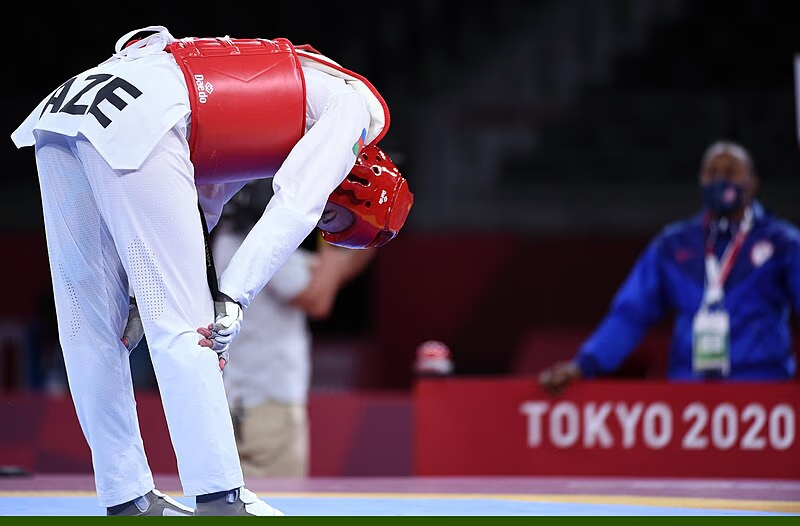
Competitors wear a WT-approved dobok (uniform). The dobok consists of a V-neck pullover top and elastic-waist pants, both made of lightweight, breathable fabric. The standard dobok is white. Black-collar V-neck doboks denote dan (black belt) rank holders. The competitor's name and national abbreviation are displayed on the back. The dobok must be clean, free of tears, and properly fitted — neither excessively loose (which could obscure the trunk protector) nor excessively tight.
2.2 Trunk Protector (Hogu)
The trunk protector (hogu) is the primary scoring target for body techniques. In WT-sanctioned events, electronic trunk protectors integrated into the PSS are mandatory. These protectors contain sensors that register the impact force and location of strikes. One competitor is designated Chung (blue) and the other Hong (red), and the scoring area of the trunk protector is the blue or red coloured portion (Article 12.1.1). Permitted attacks are limited to the areas covered by the trunk protector and may not be made on the spine (Article 11.2.1).
2.3 Head Protector
The electronic head protector is worn over the head and covers the scoring areas above the collarbone. Since the 2020 rule cycle, WT has mandated electronic head protectors with embedded sensors at all major competitions, replacing the previous system where head kicks were scored solely by corner judges. The head protector registers valid kicks that meet the required force threshold. Red or blue head protector covers match the assigned trunk protector color.
2.4 Electronic Gloves and Foot Socks
Competitors wear electronic sensing socks (e-foot protectors) that contain transmitters corresponding to the PSS. Only strikes delivered by the portion of the foot below the ankle bone (instep, ball of foot, sole) register on the electronic system. Electronic gloves with embedded sensors are also worn at WT events; only the knuckle area of the closed fist is registered for valid punches to the trunk protector.
2.5 Additional Protective Equipment
- Forearm guards: Mandatory padding covering the forearm from wrist to elbow, worn under the dobok sleeves.
- Shin guards: Mandatory padding covering the shin from ankle to below the knee, worn under the dobok pants.
- Groin guard: Mandatory for male competitors; optional but recommended for female competitors. Worn inside the dobok pants.
- Mouthguard: Mandatory for all competitors. Must be properly fitted and in good condition.
- Female chest protector: Mandatory for female competitors, worn under the trunk protector.
All protective equipment must be WT-approved and in serviceable condition. The referee may instruct a competitor to replace damaged or non-compliant equipment before the match continues.
Section 3: Playing Area
3.1 Competition Mat
The Contest Area must have a flat surface free of obstructing projections and be covered with an elastic, non-slip mat. It may be installed on a platform 0.6–1 m high, in which case the outer part of the Outer Line is inclined at a gradient of less than 30 degrees for contestant safety (Article 3.1). Two shapes are permitted — square and octagonal (Article 3.1). The square Contest Area is 8 m × 8 m including a 60 cm boundary line (Article 3.1.1). The octagonal Contest Area measures approximately 8 m in diameter, each side of the octagon approximately 3.3 m (Article 3.1.2).
3.2 Boundary and Safety Zone
The Competition Area envelopes both the Contest Area and the surrounding Safety Area, and shall be no smaller than 10 m × 10 m and no larger than 12 m × 12 m (Article 3.1.1). The Safety Area is therefore the margin between the outer line of the Competition Area and the boundary line of the Contest Area (Article 3.1.2) — roughly 1 m per side at the minimum Competition Area size and up to 2 m per side at the maximum. Where the Contest Area sits on a platform, the Safety Area may be increased as needed to ensure contestant safety (Article 3.1.1). The Contest Area and Safety Area may be different colours, as specified in the relevant competition's Operational Manual (Article 3.1.1).
3.3 Markings and Positions
Two starting positions are marked on the mat: one for the blue (chung) competitor and one for the red (hong) competitor, each approximately 4 m from the center and 1 m apart. The referee's position is marked at the center edge of the mat. Corner judge positions are designated at four corners of the competition area. An athlete designation area for each competitor (including their coach) is located outside the safety zone on opposite sides of the mat.
3.4 Multiple Court Layouts
At World Championships and Grand Prix events, multiple competition courts operate simultaneously. Each court is designated by number and operates with its own independent set of officials, PSS equipment, and IVR system. Courts are separated by sufficient distance (minimum 2 m between safety zones) to prevent interference between adjacent matches. A central results area displays live scores from all active courts.
3.5 Venue Requirements
The competition venue must provide adequate lighting (minimum 1,500 lux at mat level for televised events), temperature control, and ventilation. A scoreboard visible to competitors, officials, and spectators must be positioned prominently. Medical facilities and personnel must be accessible within 30 seconds of the competition area. An Instant Video Replay (IVR) system with multiple camera angles is required at WT-promoted events. For Olympic and World Championship events, a minimum of six camera positions per court are mandated for IVR coverage.
Section 4: Players & Officials
4.1 Competitors
Taekwondo is an individual combat sport. Competitors must hold a valid WT Global Athlete License (GAL) and possess a Kukkiwon-recognized dan certificate. At the Olympic Games, competitors must be at least 17 years old in the year of competition. All athletes must pass weigh-in on the day before competition; the weigh-in window is typically 2 hours for official events.
4.2 Olympic Weight Categories
The Olympic Games feature four weight divisions per gender:
- Men: 58 kg, 68 kg, 80 kg, +80 kg
- Women: 49 kg, 57 kg, 67 kg, +67 kg
World Championships and Grand Prix events use a broader range of eight weight categories per gender, providing finer divisions. Continental and national events may adopt WT-approved weight categories appropriate to their level of competition.
4.3 The Referee
One center referee controls the match on the mat. The referee starts and stops the contest with Korean commands: si-jak (begin), kal-yeo (break/stop), kye-sok (continue), and keu-man (end). The referee declares penalties (gam-jeom), issues warnings, orders medical timeouts, and has authority to stop the match for safety reasons. The referee also declares the winner at the conclusion of the bout.
4.4 Corner Judges and Review Jury
Historically, four corner judges sat at corners of the mat and scored techniques using electronic handheld devices. With the adoption of the full PSS (electronic trunk, head, gloves, and socks), the role of corner judges has shifted primarily to supplementary scoring — awarding points for valid techniques that the electronic system may not register (such as certain close-range punches). A review jury of one or more officials supervises the match, adjudicates IVR challenges, and can correct scoring errors. At major WT events, the Technical Delegate oversees all officiating procedures.
4.5 Coaches
Each competitor is permitted one coach in the designated athlete area. The coach may provide verbal instruction during the match and signal for an Instant Video Replay (IVR) challenge by raising the designated signal card during a break in the action. Coaches may not enter the competition area or physically interfere with the contest. Unsportsmanlike conduct by a coach may result in a gam-jeom against their athlete or removal from the venue.
Section 5: Rules of Play
5.1 Match Format
A standard match consists of 3 rounds of 2 minutes each, with a 1-minute rest period between rounds (Article 7.1.1). If the score is tied after the 3rd round, a 4th round of one minute is contested as the Golden Round, after a one-minute rest following the 3rd round (Article 7.1.1). Under the best-of-three system the same three-round, two-minute structure applies, but no Golden Round is contested — a tied round is instead decided under Article 15 (Article 7.1.2). During the rest period, the competitor returns to their designated area, where their coach may provide instructions, water, and tactical advice. The clock stops during referee interventions (penalties, equipment adjustments, medical checks, IVR reviews).
5.2 Valid Techniques
WT taekwondo permits two categories of striking techniques:
- Kicks: Any kicking technique delivered with the part of the foot below the ankle bone (instep, ball of foot, sole, heel). Kicks may target both the trunk protector and the head protector. Common scoring kicks include the roundhouse kick (dollyo chagi), back kick (dwi chagi), spinning hook kick (dwi huryeo chagi), axe kick (naeryeo chagi), and push kick (mireo chagi).
- Punches: Only the straight punch (jireugi) delivered with the front of a properly clenched fist to the trunk protector is permitted. Punches to the head are strictly prohibited and result in a penalty. Backfist strikes, hammer fists, and open-hand techniques are not permitted.
5.3 Valid Scoring Areas
The two valid target areas are:
- Trunk protector: The front and side areas of the electronic trunk protector (hogu), from the base of the neck to the hipbone. Strikes to the spine or back of the protector do not score.
- Head: All areas of the head protector above the collarbone, including the sides and back of the head. Only kicks (not punches) may target the head.
5.4 The Golden Round
If the score is tied at the end of 3 rounds, a Golden Round (4th round) of 1 minute is contested. The first competitor to score any valid point wins immediately (sudden death). If neither competitor scores during the Golden Round, the winner is determined by superiority decision: the referee and judges evaluate which competitor demonstrated greater initiative, more valid technique attempts, and more aggressive attacking throughout the entire match, including the Golden Round.
5.5 Point Gap Victory
Where there is a 20-point difference between the two athletes at the completion of the 2nd round and/or at any time during the 3rd round, the referee stops the contest and declares the winner by point gap, PTG (Article 16, Explanation #3). The gap is therefore not applied earlier than the end of round 2. Under the best-of-three system the threshold is a 15-point difference per round, and in the twelve-point variant a 12-point difference per round, each decided for the corresponding round (Article 16, Explanation #3). Win by point gap shall not be applied in senior-division semi-finals and finals where the tournament outline so provides (Article 16, Explanation #3). The rule prevents unnecessary continuation when the outcome is no longer in doubt and protects the trailing competitor from sustained one-sided action.
5.6 Knockout and Referee Stop Contest
If a competitor is knocked down by a valid technique and cannot resume within a 10-second count by the referee, the standing competitor wins by knockout (KO). If the referee determines a competitor is unfit to continue due to injury or accumulated damage, the match is stopped (RSC — Referee Stop Contest). A competitor who is knocked down three times in a single round from scoring techniques also loses by RSC.
Section 6: Scoring
6.1 Protector and Scoring System (PSS)
WT competition uses the Protector and Scoring System (PSS), an electronic scoring platform that registers valid strikes based on impact force, target location, and striking tool. The trunk protector, head protector, electronic socks, and electronic gloves all communicate wirelessly with the central scoring computer. A valid score is registered when the correct striking area (foot sensor or glove sensor) impacts the correct target (trunk or head protector sensor) with force exceeding the calibrated threshold. The force threshold is adjustable and is set by the Technical Delegate based on the competition level, weight category, and gender.
6.2 Point Values
- Punch to trunk protector: 1 point (Article 12.3.1) — delivered with the front of a closed fist (glove sensor) to the trunk protector.
- Kick to trunk protector: 2 points (Article 12.3.2) — any valid kick (foot sensor) to the trunk protector.
- Kick to head: 3 points (Article 12.3.3) — any valid kick to the head.
- Turning kick to trunk protector: 4 points (Article 12.3.4) — a valid turning kick doubles the awarded points.
- Turning kick to the head: 6 points (Article 12.3.4) — a valid turning kick to the head doubles the three-point head value. This is the highest-scoring single technique in taekwondo.
- Opponent penalised: 1 point awarded when a Gam-jeom is given to the opponent (Article 12.3.5).
Turning kicks are scored by doubling the value of the technique's target: four points to the trunk protector and six to the head (Article 12.3.4). Entries citing five points for a turning head kick reflect an edition superseded by the rules in force as of June 1, 2026.
6.3 Supplementary Scoring by Judges
Corner judges may award points for valid techniques that the PSS does not register electronically. This typically applies to techniques delivered at close range or unusual angles where sensor contact may be incomplete. A majority of judges must agree for a supplementary point to be awarded. The review jury may also correct obvious scoring errors identified during or after a round.
6.4 Scoring Technology Calibration
The PSS force thresholds are calibrated before each competition by the Technical Delegate and equipment officials. Different thresholds are set for different weight categories and genders to ensure that valid techniques register appropriately across divisions. For example, lighter weight categories use lower force thresholds than heavier divisions. The head protector threshold is typically set lower than the trunk protector threshold, reflecting the greater difficulty and risk of head kicks. Calibration tests are conducted using standardized impact tools, and the settings are documented in the competition technical report.
6.5 Determining the Winner
The competitor with the higher total score (including penalty points awarded from the opponent's gam-jeom) at the end of 3 rounds wins by final score. The complete hierarchy of victory conditions, in order of precedence, is:
- Knockout (KO): Opponent cannot rise within the 10-count.
- Referee Stop Contest (RSC): Referee determines a competitor is unable to continue safely.
- Point gap (PTG): 20-point difference at the completion of the 2nd round or any time during the 3rd (Article 16, Explanation #3).
- Referee's punitive declaration (PUN): Accumulation of ten Gam-jeom (Article 14.7).
- Disqualification (DSQ): An instant-disqualification offence, such as manipulating PSS sensor sensitivity (Article 14).
- Withdrawal: Competitor or coach voluntarily withdraws.
- Final score: Higher total at the end of 3 rounds.
- Golden Round: First to score in the 4th round (1 minute).
- Superiority decision: Judges evaluate initiative and technique quality if the Golden Round produces no score. This decision is final and cannot be appealed.
Section 7: Violations & Penalties
7.1 Gam-jeom: a Single Penalty Class
Penalties are declared by the referee (Article 14.1), and every prohibited act described in Article 14 is penalised with a “Gam-jeom” (Article 14.2). There is no separate warning tier: the Kyong-go warning, and the arithmetic by which two warnings converted into one penalty point, belong to a superseded edition of the rules and appear nowhere in the rules in force as of June 1, 2026.
A Gam-jeom is counted as one point for the opposing contestant (Article 14.3). The one exception is passive behaviour in the last ten seconds of a round, for which two points are awarded to the opponent (Article 14.3.1, applying Article 12.3.5.1).
7.2 Prohibited Acts
The following are classified as prohibited acts, each declared with a Gam-jeom (Article 14.4.1):
- Crossing the Boundary Line (Article 14.4.1.1)
- Falling down (Article 14.4.1.2)
- Avoiding or delaying the match (Article 14.4.1.3)
- Grabbing or pushing the opponent (Article 14.4.1.4)
- Lifting the leg to block; kicking the opponent's leg to impede a kicking attack; aiming a kick below the waist; lifting the leg above the waist to kick in the air four or more times; or lifting a leg or kicking in the air for more than three seconds to impede the opponent (Article 14.4.1.5)
- Kicking below the waist (Article 14.4.1.6)
- Attacking the opponent after Kal-yeo (Article 14.4.1.7)
- Hitting the opponent's head with the hand (Article 14.4.1.8)
- Butting or attacking with the knee (Article 14.4.1.9)
- Attacking the fallen opponent (Article 14.4.1.10)
- Attacking the trunk PSS with the side or bottom of the foot in a clinch position (Article 14.4.1.11)
A Gam-jeom is recorded to the previous round if the action occurred within five seconds of that round's conclusion; misconduct by a contestant or coach during a rest period past those five seconds is declared immediately (Article 14.4).
7.3 Accumulation and Punitive Declaration
When a contestant receives ten Gam-jeom, the referee declares that contestant the loser by referee's punitive declaration (PUN) (Article 14.7) — the rules classify this outcome as PUN rather than as a disqualification (Article 16). Under the best-of-three system, a contestant who receives five Gam-jeom in a round loses that round to the opponent (Article 14.7.1). Since each Gam-jeom awards a point to the opponent, an opponent will have accrued at least ten penalty points by the time a punitive declaration is reached.
7.4 Instant Disqualification
Certain severe offenses result in immediate disqualification without progressive penalties:
- Intentional violent attack after the kal-yeo or keu-man command
- Extreme unsportsmanlike conduct (verbal abuse, spitting, threatening officials)
- Deliberate manipulation or tampering with PSS electronic equipment
- Third-party interference (unauthorized person entering the competition area)
- Failure to comply with the referee's instructions after repeated warnings
7.5 Instant Video Replay (IVR)
The Instant Video Replay (IVR) system allows coaches to challenge referee decisions or request review of scoring. The coach raises the designated signal card during a break in action to request an IVR review. The review jury examines multi-angle video footage and may overturn or confirm the original decision. If the challenge is successful, the coach retains the right to make additional challenges. If the challenge is unsuccessful, no further challenges are permitted for that match. IVR may be used to contest: point awards, penalty calls, boundary decisions, or situations where a technique was scored but should not have been (or vice versa).
Section 8: Safety Considerations
8.1 Mandatory Protective Equipment
The full complement of WT-approved electronic and traditional protective equipment (trunk protector, head protector, forearm guards, shin guards, groin guard, mouthguard, electronic gloves, electronic socks, and female chest protector where applicable) must be worn and inspected before every match. Equipment that is damaged, improperly fitted, or non-compliant is replaced before the match begins. The referee conducts a pre-match equipment check at the entrance to the competition area.
8.2 Medical Personnel and Facilities
Qualified medical personnel (at minimum one competition doctor) must be present at all WT-sanctioned events and positioned with direct access to the competition area. A fully equipped medical room with first aid supplies, stretcher, and emergency transport arrangements is mandatory. Medical staff may enter the competition area only when called by the referee.
8.3 Injury and Knockout Protocols
When a competitor is injured, the referee stops the match and allows a 1-minute medical timeout for assessment and treatment. Each competitor is allowed one medical timeout per match. If the competitor cannot continue after the medical timeout, the outcome depends on whether the injury was caused by a valid technique (opponent wins by RSC) or a prohibited action (injured competitor wins by disqualification of the opponent, or the match result is determined by score at the time of stoppage).
8.4 Concussion and Knockout Suspension
A competitor who loses by knockout (KO) or referee stop contest (RSC) due to head contact must undergo a mandatory medical examination immediately after the match. The athlete is subject to a minimum 30-day competition suspension and must receive written medical clearance before returning to competition. If a competitor suffers two KO/RSC losses due to head contact within a 90-day period, the suspension extends to 90 days. WT follows World Medical Association and IOC concussion management guidelines.
8.5 Blood and Open Wound Protocol
If a competitor sustains a cut or nosebleed, the referee stops the match for medical treatment. Minor bleeding may be controlled and the match resumed. If bleeding cannot be controlled within the medical timeout period, the referee may stop the contest. Blood on the mat, dobok, or equipment must be cleaned before the match resumes.
8.6 Age and Development Safeguards
WT establishes separate competition rules for cadets (12–14 years), juniors (15–17 years), and seniors (17+ years). Cadet and junior competitions use modified rules including lower PSS force thresholds, prohibition of certain techniques (e.g., spinning kicks to the head in some cadet categories), and stricter referee intervention standards. These modifications prioritize athlete safety and age-appropriate competition intensity.
8.7 Anti-Doping
All WT-sanctioned competitions operate under the World Anti-Doping Agency (WADA) Code. Competitors are subject to in-competition and out-of-competition testing. Athletes must maintain accurate whereabouts information through WADA's Anti-Doping Administration and Management System (ADAMS). Violations result in sanctions ranging from warnings to multi-year bans, with results from the relevant competition period annulled. WT cooperates with National Anti-Doping Organizations (NADOs) and the Court of Arbitration for Sport (CAS) for adjudication of doping cases.
8.8 Environmental and Mat Safety
Competition mats must be inspected before each session for damage, gaps between sections, moisture, or uneven surfaces that could cause slipping or tripping injuries. The venue temperature should be maintained between 20°C and 25°C (68°F to 77°F) to prevent heat-related illness and ensure optimal athletic performance. Adequate hydration stations must be accessible to competitors in the athlete preparation area. In the event of a power failure affecting the PSS or scoreboard, the match is suspended until systems are restored; round time is paused and scores are preserved by the backup system.