


🏛️Official — World Taekwondo
Loading OpenSourceSports…
Bow sincerely to your opponent, not just perfunctorily
While WT rules require a bow before and after a match, the depth, eye contact, and genuine sincerity of the bow carry deep cultural weight rooted in Korean martial arts tradition. A quick, dismissive nod is widely seen as disrespectful regardless of its technical compliance with the written requirement.
No excessive celebration after scoring or winning
Taekwondo's five tenets—especially self-control and integrity—create a strong cultural expectation of humility in victory. Taunting, prolonged fist-pumping, or theatrical celebrations are broadly condemned as violations of the art's spirit, even when not formally penalized by referees.
Do not 'gamjeom fish' — baiting fouls is dishonorable
Provoking an opponent into a penalty (gamjeom) through exaggerated reactions, feigned injury, or manufactured situations rather than winning through technique is widely condemned as contrary to the martial arts ethic of honest competition. A single gamjeom can decide a close match, making the temptation real at elite level.
Competitors wear a WT-approved dobok (uniform). The dobok consists of a V-neck pullover top and elastic-waist pants, both made of lightweight, breathable fabric.
Why people argue about this
People often assume that the dobok must be black, forgetting that World Taekwondo allows for other colors as long as they are WT-approved. This leads to misunderstandings about uniform color choices among athletes and officials.
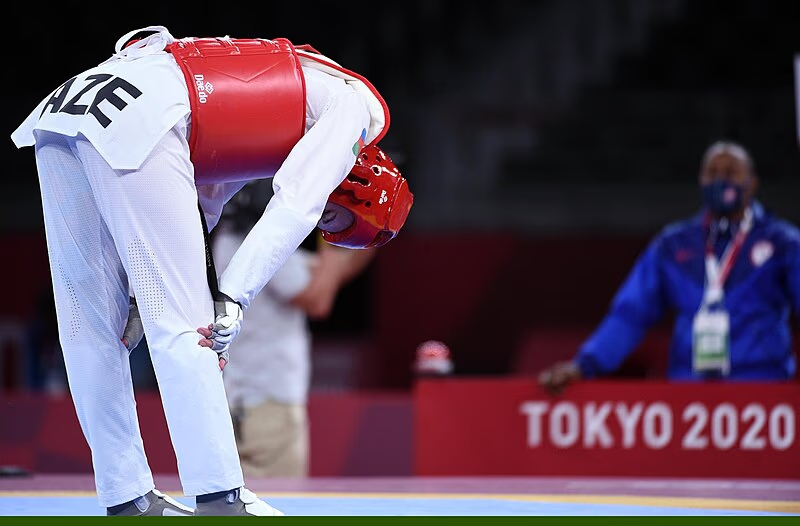
The trunk protector (hogu) is the primary scoring target for body techniques. In WT-sanctioned events, electronic trunk protectors integrated into the PSS are mandatory.
— Article 12.1.1, Article 11.2.1
Why people argue about this
People often assume that the hogu is only for show, a decorative piece of equipment, when in fact it's crucial as the primary scoring target for body techniques, and its electronic integration makes it essential for fair judging in sanctioned World Taekwondo events.
The electronic head protector is worn over the head and covers the scoring areas above the collarbone. Since the 2020 rule cycle, WT has mandated electronic head protectors with embedded sensors at all major competitions, replacing the previous sy...
Why people argue about this
People often assume that the electronic head protector in Taekwondo is just a fancy piece of gear for show, when in reality it's crucial for accurately measuring hits to the head during competitions, as mandated by the World Taekwondo rule 2.3. The confusion arises because they overlook how vital these sensors are for judging and fairness in scoring complex head techniques.
Competitors wear electronic sensing socks (e-foot protectors) that contain transmitters corresponding to the PSS. Only strikes delivered by the portion of the foot below the ankle bone (instep, ball of foot, sole) register on the electronic system.
Why people argue about this
People often assume that electronic foot protection only allows for strikes from the instep and ball of the foot, which they mistakenly believe is limited to kicks. However, the confusion arises because the rule actually permits strikes delivered by any portion of the foot below the ankle bone, including the sole, as long as it's not a palm strike or knee strike.
All protective equipment must be WT-approved and in serviceable condition. The referee may instruct a competitor to replace damaged or non-compliant equipment before the match continues.
Why people argue about this
People often assume that just having approved equipment is enough, without considering its condition. They misunderstand that even if their gear is officially approved, it must also be in good working order for safety purposes, leading to arguments about whether a competitor's damaged or improperly fitted equipment should be replaced before the match resumes.
The Contest Area must have a flat surface free of obstructing projections and be covered with an elastic, non-slip mat. It may be installed on a platform 0.6–1 m high, in which case the outer part of the Outer Line is inclined at a gradient of les...
— Article 3.1, Article 3.1.1, Article 3.1.2
Why people argue about this
People often assume that the octagonal shape of the mat is purely aesthetic, but in fact, it's crucial for ensuring fair play by evenly distributing impact forces across different areas, which helps prevent injuries and ensures a more consistent scoring environment.
The Competition Area envelopes both the Contest Area and the surrounding Safety Area, and shall be no smaller than 10 m × 10 m and no larger than 12 m × 12 m (Article 3.1.1). The Safety Area is therefore the margin between the outer line of the Co...
— Article 3.1.1, Article 3.1.2
Why people argue about this
People often assume that the safety zone extends only 2 meters beyond the boundary line, thinking it's a literal measurement from the edge of the competition area. However, the confusion arises because "the safety zone" actually refers to an additional space around the entire competition area, not just along the perimeter where the boundary is marked.
Two starting positions are marked on the mat: one for the blue (chung) competitor and one for the red (hong) competitor, each approximately 4 m from the center and 1 m apart. The referee's position is marked at the center edge of the mat.
Why people argue about this
People often assume that the referee's position is marked at the very center of the mat, which they believe means exactly in the middle - 2 meters from each edge. However, the actual rule specifies it should be "at the center edge," meaning closer to one side than the other, effectively making it about 1 meter away from both sides and only 4 meters from the center point.
At World Championships and Grand Prix events, multiple competition courts operate simultaneously. Each court is designated by number and operates with its own independent set of officials, PSS equipment, and IVR system.
Why people argue about this
People often assume that all courts at a World Championship are identical in setup and operation, which leads them to misunderstand how multiple courts can function simultaneously with their own unique systems and officials. The confusion arises because they overlook the detail about each court having its distinct set-up for independent management during multi-court events.
The competition venue must provide adequate lighting (minimum 1,500 lux at mat level for televised events), temperature control, and ventilation. A scoreboard visible to competitors, officials, and spectators must be positioned prominently.
Why people argue about this
People often assume that adequate lighting is solely about brightness levels for televised events, forgetting that competitors need clear vision during matches too. The confusion arises because they overlook the importance of consistent light conditions throughout all competition sessions to prevent glare and shadows affecting performance and safety.
Taekwondo is an individual combat sport. Competitors must hold a valid WT Global Athlete License (GAL) and possess a Kukkiwon-recognized dan certificate.
Why people argue about this
People often assume that anyone can compete in Taekwondo as long as they know how to kick and punch, which leads them to misunderstand that a valid World Taekwondo Global Athlete License (GAL) is required along with a dan certificate from the Kukkiwon to ensure proper skill level and ethical conduct.
The Olympic Games feature four weight divisions per gender: Men: 58 kg, 68 kg, 80 kg, +80 kg; Women: 49 kg, 57 kg, 67 kg, +67 kg
Why people argue about this
People often assume that having a coach in the area means they can whisper instructions at will, which is technically against the spirit of the rule allowing only verbal instruction during matches. The actual confusion arises because some coaches might misinterpret "verbal" to mean anything but silent gestures or quick whispers, leading to potential disputes with officials.
One center referee controls the match on the mat. The referee starts and stops the contest with Korean commands: si-jak (begin), kal-yeo (break/stop), kye-sok (continue), and keu-man (end).
Why people argue about this
People often assume that coaches can only signal for an IVR challenge during a break in play when they see something questionable, but actually, they're allowed to do so at any time during their designated area as long as it's not interfering with other athletes or officials. The rule is clear about the timing and context of these signals, yet many coaches misinterpret its scope.
Historically, four corner judges sat at corners of the mat and scored techniques using electronic handheld devices. With the adoption of the full PSS (electronic trunk, head, gloves, and socks), th...
Why people argue about this
People often assume that a coach can signal for an IVR challenge at any point during the match, which is incorrect. Actually, the coach can only raise the designated signal card during a break in the action to request an Instant Video Replay challenge, as per the rule's stipulation.
Each competitor is permitted one coach in the designated athlete area. The coach may provide verbal instruction during the match and signal for an Instant Video Replay (IVR) challenge by raising the designated signal card during a break in the action.
Why people argue about this
People often assume that having a coach means they can give their athlete physical guidance, which isn't allowed in Taekwondo under these rules. The actual confusion arises because coaches are only permitted verbal instructions during matches and must signal for IVR challenges by raising the designated card – not by physically interacting with their athletes at all.
A standard match consists of 3 rounds of 2 minutes each, with a 1-minute rest period between rounds (Article 7.1.1). If the score is tied after the 3rd round, a 4th round of one minute is contested as the Golden Round, after a one-minute rest following the 3rd round (Article 7.1.1).
— Article 7.1.1, Article 15, Article 7.1.2
Why people argue about this
People often assume that a Golden Round is just an extra round where points are scored normally, forgetting that it's essentially sudden death with no second chances - if you don't score within that minute, it goes to overtime until someone does.
WT taekwondo permits two categories of striking techniques: Kicks: Any kicking technique delivered with the part of the foot below the ankle bone (instep, ball of foot, sole, heel). Kicks may target both the trunk protector and the head protector. Common scoring kicks include the roundhouse kick ...
Why people argue about this
People often assume that if a Golden Round ends in a tie score, another round would be played until someone scores, but they forget about the sudden death clause which allows for immediate victory on the first valid point scored by either competitor. The confusion arises because this rule is not explicitly stated as applying to the Golden Round and can easily be overlooked.
The two valid target areas are: Trunk protector: The front and side areas of the electronic trunk protector (hogu), from the base of the neck to the hipbone. Strikes to the spine or back of the protector do not score.; Head: All areas of the head protector above the collarbone, including the side...
Why people argue about this
People often assume that if a Golden Round starts with neither competitor scoring, it automatically goes into sudden death until one does score, but actually, once the round begins, points can only be scored in specific areas like head and body targets, not just any part of the opponent's body. This leads to confusion about when exactly the sudden death rule kicks in.
If the score is tied at the end of 3 rounds, a Golden Round (4th round) of 1 minute is contested. The first competitor to score any valid point wins immediately (sudden death).
Why people argue about this
People often assume that if a Golden Round starts and no one scores for 1 minute, it's automatically over in favor of the competitor who was ahead at the end of the third round. But actually, if neither competitor scores during the entire 4th round, they continue to compete until someone lands a valid point, effectively making it sudden death regardless of score differences from earlier rounds.
Where there is a 20-point difference between the two athletes at the completion of the 2nd round and/or at any time during the 3rd round, the referee stops the contest and declares the winner by point gap, PTG (Article 16, Explanation #3). The gap...
— Article 16
Why people argue about this
People often assume that if one competitor is ahead by 20 points, the match should be stopped immediately without considering other factors like time remaining or potential comeback strategies. However, the confusion arises because this rule only applies when there's a clear and significant gap in scores, not necessarily at every single point difference of 20.
If a competitor is knocked down by a valid technique and cannot resume within a 10-second count by the referee, the standing competitor wins by knockout (KO). If the referee determines a competitor is unfit to continue due to injury or accumulated...
Why people argue about this
People often assume that if a competitor is knocked down in Taekwondo and can't get up within 10 seconds, it automatically means they're out. But actually, the referee must determine whether the fallen athlete is unfit to continue due to injury or exhaustion before declaring a knockout. This rule allows for a more nuanced assessment of the situation rather than just relying on time alone.
WT competition uses the Protector and Scoring System (PSS), an electronic scoring platform that registers valid strikes based on impact force, target location, and striking tool. The trunk protector, head protector, electronic socks, and electroni...
Why people argue about this
People often assume that the electronic scoring system in Taekwondo only measures force of impact without considering where on the body it hits, but actually, PSS registers valid strikes based on both the location on the body and the force applied, ensuring fairness regardless of how hard a strike is delivered.
Turning kicks are scored by doubling the value of the technique's target: four points to the trunk protector and six to the head (Article 12.3.4). Entries citing five points for a turning head kick reflect an edition superseded by the rules in force as of June 1, 2026.
— Article 12.3.1, Article 12.3.2, Article 12.3.3, Article 12.3.4, Article 12.3.5
Why people argue about this
People often assume that the PSS force thresholds are set once and for all by World Taekwondo headquarters, forgetting that they're actually calibrated on a case-by-case basis by local officials before each competition, tailored to specific weight categories and genders. This personalization leads to confusion about how these force measurements can vary so drastically from one event to another.
Corner judges may award points for valid techniques that the PSS does not register electronically. This typically applies to techniques delivered at close range or unusual angles where sensor contact may be incomplete.
Why people argue about this
People often assume that the force thresholds are set randomly for each competition without proper calibration, which leads them to believe these settings don't reflect actual performance but rather arbitrary adjustments made by officials. In reality, they're meticulously calibrated beforehand based on weight categories and genders to ensure fair scoring across different divisions.
The PSS force thresholds are calibrated before each competition by the Technical Delegate and equipment officials. Different thresholds are set for different weight categories and genders to ensure that valid techniques register appropriately across divisions.
Why people argue about this
People often assume that the calibration of scoring technology is done just once at the start of a competition, forgetting that different weight categories and genders require their own adjusted force thresholds for fair play. This oversight leads to misunderstandings about how these settings are updated throughout each event.
The competitor with the higher total score (including penalty points awarded from the opponent's gam-jeom) at the end of 3 rounds wins by final score.
— Article 16, Article 14.7, Article 14
Why people argue about this
People often assume that Taekwondo matches end based solely on who lands more kicks, forgetting about penalty points from missed blocks (gam-jeom). They overlook how crucial it is for a competitor to minimize these penalties and focus only on their scoring sparring rounds, leading to misunderstandings of the final score determination.
Penalties are declared by the referee (Article 14.1), and every prohibited act described in Article 14 is penalised with a “Gam-jeom” (Article 14.2). There is no separate warning tier: the Kyong-go warning, and the arithmetic by which two warnings...
— Article 14.1, Article 14, Article 14.2, Article 14.3, Article 14.3.1, Article 12.3.5.1
Why people argue about this
People often assume that a Kyong-go warning is still necessary before receiving a Gam-jeom, which leads them to argue that a referee should issue a warning first instead of directly handing out a single penalty for prohibited acts. However, this rule explicitly states there's no separate warning tier and penalties are declared straight away based on Article 14 violations.
The following are classified as prohibited acts, each declared with a Gam-jeom (Article 14.4.1): Crossing the Boundary Line (Article 14.4.1.1); Falling down (Article 14.4.1.2); Avoiding or delaying the match (Article 14.4.1.3)
— Article 14.4.1, Article 14.4.1.1, Article 14.4.1.2, Article 14.4.1.3, Article 14.4.1.4, Article 14.4.1.5, Article 14.4.1.6, Article 14.4.1.7, Article 14.4.1.8, Article 14.4.1.9, Article 14.4.1.10, Article 14.4.1.11, Article 14.4
Why people argue about this
People often assume that falling down during a match is automatically considered a prohibited act in Taekwondo, forgetting that it's only flagged as such if it happens intentionally or delays the match. They overlook the fact that falling accidentally while executing an attack or defense isn't penalized under this rule.
When a contestant receives ten Gam-jeom, the referee declares that contestant the loser by referee's punitive declaration (PUN) (Article 14.7) — the rules classify this outcome as PUN rather than as a disqualification (Article 16). Under the best-...
— Article 14.7, Article 16, Article 14.7.1
Why people argue about this
People often assume that a referee declaring a contestant as the loser due to receiving ten Gam-jeom means they are disqualified, but actually, in Taekwondo, it's considered a punitive declaration (PUN), which is distinct from a disqualification and carries its own set of consequences outlined in Article 14.7 of the World Taekwondo rules.
Certain severe offenses result in immediate disqualification without progressive penalties: Intentional violent attack after the kal-yeo or keu-man command; Extreme unsportsmanlike conduct (verbal abuse, spitting, threatening officials); Deliberate manipulation or tampering with PSS electronic eq...
Why people argue about this
People often assume that if a coach raises their designated signal card during a break in action for an IVR review, it means the referee's decision is definitively incorrect or questionable. Actually, it just indicates they believe there might be grounds for reconsideration based on video evidence, even though the initial call was made by the on-field officials.
The Instant Video Replay (IVR) system allows coaches to challenge referee decisions or request review of scoring. The coach raises the designated signal card during a break in action to request an IVR review.
Why people argue about this
People often assume that IVR is a quick fix for all referee errors, thinking it can instantly correct every missed call or foul. However, the truth is that IVR only allows coaches to challenge specific decisions like scoring and fouls, not general refereeing calls or disputes over tactics. It's designed to be used sparingly and strategically during breaks in play.
The full complement of WT-approved electronic and traditional protective equipment (trunk protector, head protector, forearm guards, shin guards, groin guard, mouthguard, electronic gloves, electronic socks, and female chest protector where applic...
Why people argue about this
People often assume that just wearing a mouthguard is enough for protection in Taekwondo matches, but they misunderstand that the full complement of equipment listed includes everything from head protectors to electronic gloves, each serving different protective purposes and required by World Taekwondo's standards.
Qualified medical personnel (at minimum one competition doctor) must be present at all WT-sanctioned events and positioned with direct access to the competition area. A fully equipped medical room with first aid supplies, stretcher, and emergency transport arrangements is mandatory.
Why people argue about this
People often assume that having a medical room with basic supplies is enough, but actually, the rule requires a fully equipped medical room with first aid supplies, a stretcher, and emergency transport arrangements to be mandatory at all World Taekwondo-sanctioned events.
When a competitor is injured, the referee stops the match and allows a 1-minute medical timeout for assessment and treatment. Each competitor is allowed one medical timeout per match.
Why people argue about this
People often assume that the medical timeout is only for assessing injuries, forgetting that it's also a chance for competitors to strategize their next moves or prepare mentally, leading to arguments about whether they're using this time productively and fairly.
A competitor who loses by knockout (KO) or referee stop contest (RSC) due to head contact must undergo a mandatory medical examination immediately after the match. The athlete is subject to a minimum 30-day competition suspension and must receive ...
Why people argue about this
People often assume that the mandatory medical examination is solely for the athlete's safety and forgets it might also be a way for competitors to potentially get out of their suspension by proving they're fit enough to compete again. They overlook how this rule aims to ensure athletes are not risking further injury, especially those who may have suffered concussions or experienced knockouts.
If a competitor sustains a cut or nosebleed, the referee stops the match for medical treatment. Minor bleeding may be controlled and the match resumed.
Why people argue about this
People often assume that the blood and open wound protocol in Taekwondo is about doping tests, thinking it's a WADA code issue, but actually, it pertains specifically to injuries during matches where bleeding or visible wounds require immediate attention and possibly disqualification if not properly managed.
WT establishes separate competition rules for cadets (12–14 years), juniors (15–17 years), and seniors (17+ years). , spinning kicks to the head in some cadet categories), and stricter referee intervention standards.
Why people argue about this
People often assume that age restrictions in Taekwondo competitions are purely about safeguarding young athletes from physical harm, but actually, the "8.6 Age and Development Safeguards" rule is more focused on preventing doping by ensuring competitors are not under 16 years old for certain categories to avoid performance-enhancing substances being used illegally.
All WT-sanctioned competitions operate under the World Anti-Doping Agency (WADA) Code. Competitors are subject to in-competition and out-of-competition testing.
Why people argue about this
People often assume that anti-doping rules only apply during competition rounds, thinking out-of-competition testing is optional for athletes. But actually, these tests can happen anywhere outside of official matches, catching athletes who might be trying to cheat in their own time.
Competition mats must be inspected before each session for damage, gaps between sections, moisture, or uneven surfaces that could cause slipping or tripping injuries. The venue temperature should be maintained between 20°C and 25°C (68°F to 77°F) ...
Why people argue about this
People often assume that mats are inspected only before a competition starts, forgetting they need to be checked again after halftime or during longer events where players might move around more. The confusion arises because the official statement specifies inspections should happen "before each session," not just at the beginning of play.
Competitors wear a WT-approved dobok (uniform). The dobok consists of a V-neck pullover top and elastic-waist pants, both made of lightweight, breathable fabric.
— Article 12.1.1, Article 11.2.1
Why people argue about this
People often assume that the dobok color must be black, which is a common misconception since World Taekwondo does not specify the color of the dobok in its equipment guidelines. The confusion arises because many taekwondo practitioners and observers have internalized this cultural norm without realizing it's not mandated by the official rules.
The Contest Area must have a flat surface free of obstructing projections and be covered with an elastic, non-slip mat. It may be installed on a platform 0.6–1 m high, in which case the outer part of the Outer Line is inclined at a gradient of les...
— Article 3.1, Article 3.1.1, Article 3.1.2
Why people argue about this
People often assume that the octagonal mat dimensions are given in meters, leading to misunderstandings about whether they should be converted to feet for their own system of measurement. The confusion arises because the official description uses metric measurements without explicitly stating it's in meters, which isn't always clear to everyone.
Taekwondo is an individual combat sport. Competitors must hold a valid WT Global Athlete License (GAL) and possess a Kukkiwon-recognized dan certificate.
Why people argue about this
People often assume that anyone can compete in Taekwondo as long as they have a black belt certificate from their local dojo, but actually, the World Taekwondo organization requires competitors to hold both a valid Global Athlete License (GAL) and a Kukkiwon-recognized dan certificate to ensure fair play and adherence to international standards.
A standard match consists of 3 rounds of 2 minutes each, with a 1-minute rest period between rounds (Article 7.1.1). If the score is tied after the 3rd round, a 4th round of one minute is contested as the Golden Round, after a one-minute rest following the 3rd round (Article 7.1.1).
— Article 7.1.1, Article 15, Article 7.1.2, Article 16
Why people argue about this
People often assume that if a Golden Round ends in a tie score, another round would be played until someone scores, forgetting that it's called "sudden death," meaning they win on the very first valid point scored, not necessarily after another full minute of play.
WT competition uses the Protector and Scoring System (PSS), an electronic scoring platform that registers valid strikes based on impact force, target location, and striking tool. The trunk protector, head protector, electronic socks, and electroni...
— Article 12.3.1, Article 12.3.2, Article 12.3.3, Article 12.3.4, Article 12.3.5, Article 16, Article 14.7, Article 14
Why people argue about this
People often assume that just hitting hard enough is all it takes for a point in Taekwondo, forgetting about the crucial role of accuracy and target location as dictated by Section 6's Scoring System. They overlook how electronic socks and the Protector and Scoring System (PSS) ensure fair play by registering only valid strikes based on impact force and precise targeting zones.
Penalties are declared by the referee (Article 14.1), and every prohibited act described in Article 14 is penalised with a “Gam-jeom” (Article 14.2). There is no separate warning tier: the Kyong-go warning, and the arithmetic by which two warnings...
— Article 14.1, Article 14, Article 14.2, Article 14.3, Article 14.3.1, Article 12.3.5.1, Article 14.4.1, Article 14.4.1.1, Article 14.4.1.2, Article 14.4.1.3, Article 14.4.1.4, Article 14.4.1.5, Article 14.4.1.6, Article 14.4.1.7, Article 14.4.1.8, Article 14.4.1.9, Article 14.4.1.10, Article 14.4.1.11, Article 14.4, Article 14.7
Why people argue about this
People often assume that a kyong-go is just a casual warning with no real impact on the score, forgetting that two of these actually equal one gam-jeom—a significant point for their opponent. This oversight can lead to arguments because it's easy to overlook how cumulative these warnings are in terms of scoring.
The full complement of WT-approved electronic and traditional protective equipment (trunk protector, head protector, forearm guards, shin guards, groin guard, mouthguard, electronic gloves, electronic socks, and female chest protector where applic...
Why people argue about this
People often assume that the mandatory equipment list is only for safety during matches, thinking it's a requirement for training sessions too. However, the actual intent of this rule is to ensure athletes are fully protected in all competitive scenarios across different environments and surfaces, not just within the confines of competition mats.