









Section 1: Introduction
1.1 Overview of Table Tennis
Table tennis is a sport in which two or four players hit a lightweight ball back and forth across a table using small rackets. The game takes place on a hard table divided by a net. Players must allow the ball to bounce once on their side of the table before striking it. The sport is governed internationally by the International Table Tennis Federation (ITTF), founded in 1926 and headquartered in Lausanne, Switzerland.
The rules contained in this document are sourced from the ITTF Handbook 2024 (effective 2024–2025 season), specifically the "Laws of Table Tennis" as ratified by the ITTF Board of Directors. The ITTF updates its Laws periodically; references herein cite the numbered Laws as published in that document. Any amendments effective for the 2025–2026 season are noted where applicable.
1.2 History and Olympic Status
Table tennis became an Olympic sport at the 1988 Seoul Games. It has been a fixture of every Summer Olympics since, with singles and doubles (later team) events for both men and women. The sport is played competitively at World Championships, World Team Championships, World Cup, and the WTT (World Table Tennis) circuit series operated by the ITTF's commercial subsidiary World Table Tennis.
1.3 Scope of These Rules
These rules apply to all ITTF-sanctioned events including World Championships, World Team Championships, Olympic Games, Paralympic Games, and all events under ITTF or Continental Federation jurisdiction. National associations may apply these rules to their own competitions with only minor local variations permitted under ITTF guidelines.
Section 2: Equipment
2.1 The Table (Law 2.1)
Per Law 2.1 of the ITTF Laws of Table Tennis:
- The upper surface of the table, known as the "playing surface," shall be rectangular, 2.74 m (9 ft) long and 1.525 m (5 ft) wide.
- It shall lie in a horizontal plane 76 cm (2 ft 6 in) above the floor.
- The playing surface shall be made of any material and shall yield a uniform bounce of approximately 23 cm (9 in) when a standard ball is dropped onto it from a height of 30 cm (11.8 in).
- The playing surface shall be uniformly dark coloured and matt, with a white side line 2 cm (0.79 in) wide along each 2.74 m edge and a white end line 2 cm wide along each 1.525 m edge.
- The playing surface is divided into two equal courts by a vertical net running parallel to the end lines and shall be continuous across the whole area of each court.
- For doubles, each court shall be divided into two equal half-courts by a white centre line 3 mm (0.12 in) wide running parallel to the side lines.
2.2 The Net Assembly (Law 2.2)
Per Law 2.2:
- The net assembly consists of the net, its suspension and the supporting posts, including the clamps attaching them to the table.
- The net shall be suspended by a cord attached at each end to an upright post 15.25 cm (6 in) high; the post and the clamp shall not be more than 15.25 cm outside the side line.
- The top of the net, along its whole length, shall be 15.25 cm (6 in) above the playing surface.
- The bottom of the net, along its whole length, shall be as close as possible to the playing surface and the ends of the net shall be as close as possible to the supporting posts.
2.3 The Ball (Law 2.3)
Per Law 2.3:
- The ball shall be spherical, with a diameter of 40 mm (1.57 in).
- The ball shall weigh 2.7 g (0.095 oz).
- The ball shall be made of celluloid or similar plastics material and shall be white or orange, and matt.
- Note: The ITTF transitioned from 38 mm celluloid balls to 40 mm plastic (poly) balls effective July 1, 2015. All current ITTF-approved balls are 40 mm plastic.
- For competition, only balls carrying the ITTF approval mark (three-star rating) may be used.
2.4 The Racket (Law 2.4)
Per Law 2.4:
- The racket may be of any size, shape, or weight, but the blade shall be flat and rigid.
- At least 85% of the blade by thickness shall be of natural wood; an adhesive layer within the blade may be reinforced with fibrous material such as carbon fibre, glass fibre, or compressed paper.
- A side of the blade used for striking the ball shall be covered with either ordinary pimpled rubber with pimples outward having a total thickness including adhesive of not more than 2.0 mm, or sandwich rubber consisting of a layer of cellular rubber surfaced by pimpled rubber, turned inward or outward, with a total thickness including adhesive of not more than 4.0 mm.
- The covering material shall extend up to but not beyond the limits of the blade, except that the part nearest the handle and gripped by the fingers may be left uncovered or covered with any material.
- The blade, any layer within the blade, and any layer of covering material or adhesive shall each be continuous and of even thickness.
- The surface of the covering material on a side of the blade, or of a side of the blade if it is left uncovered, shall be matt, bright red on one side and black on the other.
- Slight deviations from uniformity of colour or continuity of surface may be allowed if they do not significantly change the playing characteristics of the surface.
- The racket covering shall appear on the ITTF approved list of racket coverings. Both sides of a blade must be covered even if one side is not used for play.
2.5 Approved Equipment
The ITTF maintains an Equipment Database listing all approved balls, blades, rubbers, and tables. Only equipment listed in this database may be used in ITTF-sanctioned events. National associations may use approved equipment lists for their own events.
Section 3: Playing Area
3.1 Definition of the Playing Area (Law 2.6)
Per Law 2.6, the playing area is defined as the space allocated for one table. The ITTF specifies minimum space requirements for competition to ensure player safety and fair play.
3.2 Minimum Space Requirements
The ITTF Regulations for International Competitions specify the following minimum playing area dimensions:
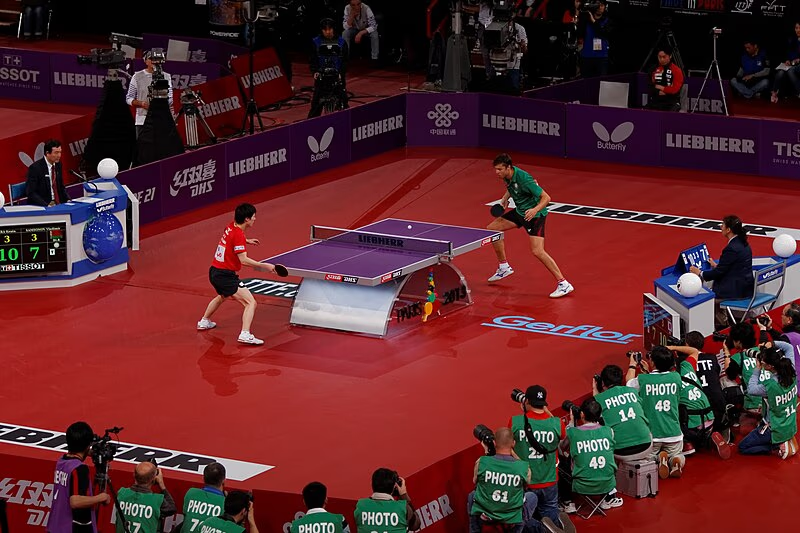
- World Championships and Olympic Games: Each playing area shall be at least 14 m long, 7 m wide, and 5 m high (approximately 46 ft × 23 ft × 16 ft).
- Other ITTF-sanctioned events: A minimum playing area of 12 m × 6 m × 4 m is required.
- Playing areas for major championships are typically enclosed by barriers approximately 75 cm (29.5 in) high, uniformly dark coloured.
3.3 Lighting
Per ITTF Regulations:
- The illuminance at the playing surface shall be at least 1000 lux uniformly distributed over it.
- The illuminance at other parts of the playing area shall be at least 500 lux.
- For World Championships, Olympic Games, and World Team Championships, minimum playing surface illuminance is 1500 lux.
- The light source shall be at least 5 m (16.4 ft) above the floor.
3.4 Floor
The floor of the playing area should be of a dark colour, non-slippery, and not too hard. Concrete or stone floors are not permitted for World and Olympic level play. The preferred floor surface is wood or a sports synthetic material that provides appropriate cushioning.
3.5 Barriers
Playing areas at major competitions are separated by barriers to define each court and prevent interference between adjacent matches. Barriers must be uniform in colour (typically dark blue or dark green) and shall be approximately 75 cm high. Barriers must be stable and positioned to allow players safe movement around the table.
Section 4: Players & Officials
4.1 Players and Teams
Table tennis is played as singles (one player per side) or doubles (two players per side). In team competitions, a team consists of two to three players, competing in matches comprising singles and/or doubles rubbers as determined by the competition format (e.g., the Swaythling Cup format or the Olympic team format).
4.2 Player Eligibility
Players must be registered with their National Association and, for international competition, with the ITTF. Players must comply with the ITTF's eligibility regulations regarding nationality and age. Para table tennis is governed by the International Paralympic Committee (IPC) in conjunction with ITTF classification rules for players with physical impairments.
4.3 Clothing (Law 2.5 and ITTF Regulations)
Per Law 2.5 and ITTF Clothing Regulations:
- Playing clothing shall consist primarily of a shirt, shorts or skirt, and playing shoes; a sweatsuit may also be worn.
- The main colour of the shirt, shorts, or skirt (but not the sleeves or collar of the shirt) shall be clearly different from the colour of the ball in use.
- Any clothing worn during play may carry advertising, but no advertising or message that could be considered offensive or contrary to the spirit of the sport is permitted.
- Clothing shall comply with ITTF Sponsorship Regulations; the ITTF reserves designated areas on clothing for its own sponsors at certain events.
- Footwear must be appropriate for the sport; playing barefoot or in outdoor shoes is not permitted at ITTF events.
4.4 Match Officials
ITTF-sanctioned events are officiated by trained and certified officials:
- Umpire: The primary match official. The umpire decides all questions of fact, keeps score, calls faults and let, and ensures the Laws of Table Tennis are applied. The umpire's decision on matters of fact is final.
- Assistant Umpire: Positioned at the side of the table opposite the umpire, primarily responsible for deciding whether the ball or racket touches the playing surface or touches the net assembly, and whether the ball crosses the end line or side line.
- Stroke Counter: Counts strokes during the Expedite System (see Section 6).
- Referee: The overall competition official responsible for applying and interpreting the Laws and Regulations. The referee may overrule an umpire on matters of law but not on matters of fact. Players may appeal to the referee if they believe the umpire has made an error of law.
4.5 Player Conduct
Players are expected to conduct themselves in a sportsmanlike manner. Verbal or physical abuse, racket abuse, deliberate time-wasting, or any conduct contrary to the spirit of the game may result in point penalties, game penalties, or disqualification as determined by the referee. Players must remain in the playing area except during authorized intervals.
4.6 Coaching During Play
Per ITTF Regulations, coaching from the sideline is permitted only during authorized intervals (between games and during time-outs). Coaching during a rally or between rallies within a game (other than a time-out) is not permitted and may result in a warning or penalty point being awarded.
4.7 Time-Out
Each player or pair is entitled to request one time-out of up to 60 seconds per match (not per game). A time-out may be requested only when the ball is not in play, by the player or coach. Time-outs do not carry over between matches.
Section 5: Rules of Play
5.1 A Good Service (Law 2.6)
Per Law 2.6, service shall proceed as follows:
- Service shall start with the ball resting freely on the open palm of the server's stationary free hand.
- The server shall then project the ball near vertically upward, without imparting spin, so that it rises at least 16 cm (6.3 in) after leaving the palm, and then falls without touching anything before being struck.
- As the ball is falling, the server shall strike it so that it touches first the server's court and then, after passing over or around the net assembly, touches directly the receiver's court; in doubles, the ball shall touch successively the server's right half-court and then the receiver's right half-court.
- From the start of service until the ball is struck, it shall be above the level of the playing surface and behind the server's end line, and it shall not be hidden from the receiver by the server or the server's doubles partner or by anything they wear or carry.
- As soon as the ball has been projected, the server's free arm and hand shall be removed from the space between the ball and the net.
- It is the responsibility of the player to serve so that the umpire or assistant umpire can be satisfied that the service conforms with the Laws. If either umpire is not sure of the legality of a service, they may warn the server on the first occasion in a match; any subsequent such service shall result in a point to the receiver.
- Whenever there is a genuine inability to comply (e.g., due to physical disability), the umpire may relax requirements relating to the free hand.
5.2 A Good Return (Law 2.7)
Per Law 2.7, the ball, having been served or returned, shall be struck so that it passes over or around the net assembly and touches the opponent's court, either directly or after touching the net assembly.
5.3 The Order of Play (Law 2.8)
Per Law 2.8:
- In singles, the server shall first make a good service, the receiver shall then make a good return, and thereafter server and receiver shall alternately make a good return.
- In doubles, the server shall first make a good service, the receiver shall then make a good return, the server's partner shall then make a good return, the receiver's partner shall then make a good return, and thereafter each player shall make a good return in sequence.
5.4 A Let (Law 2.9)
Per Law 2.9, a rally is a let if:
- In service, the ball touches the net assembly, provided the service is otherwise good or the ball is obstructed by the receiver or the receiver's partner.
- Service is delivered when the receiving player or pair is not ready, provided neither the receiver nor the receiver's partner attempts to strike the ball.
- A player fails to make a good service or a good return, or otherwise infringes the Laws, as a result of a disturbance outside the player's control.
- Play is interrupted by the umpire or assistant umpire.
- The rally is interrupted to correct an error in the order of serving, receiving, or ends.
- The rally is interrupted to introduce the Expedite System.
- A let is replayed without any change to the score.
5.5 A Point (Law 2.10)
Per Law 2.10, a player scores a point unless a let is called, if the opponent:
- Fails to make a good service.
- Fails to make a good return.
- Strikes the ball twice successively (double hit).
- Strikes the ball with a side of the racket blade whose surface does not comply with Law 2.4.
- Moves the playing surface or net assembly while the ball is in play (Law 2.10.1.7 and 2.10.1.8).
- Touches the playing surface with the free hand while the ball is in play.
- In doubles, strikes the ball out of the proper sequence.
- Is wearing, carries, or touches the ball while wearing or using a racket that does not conform.
- As a receiver under the Expedite System, the receiver's side completes 13 returns in a rally (the server scores one point).
5.6 A Game (Law 2.11)
Per Law 2.11, a game is won by the player or pair first scoring 11 points, unless both players or pairs score 10 points (deuce), when the game shall be won by the first player or pair subsequently gaining a lead of 2 points.
5.7 A Match (Law 2.12)
Per Law 2.12, a match shall consist of the best of any odd number of games. At top-level competition, matches are typically best-of-7 games for World Championships and Olympic Games, and best-of-5 or best-of-7 for WTT events. National competitions may use best-of-3 or best-of-5.
5.8 The Order of Serving, Receiving, and Ends (Law 2.13)
Per Law 2.13:
- The right to choose initial order of serving, receiving, or ends shall be decided by lot (coin toss or similar); the winner may choose to serve or to receive first, or to start at a particular end.
- Service shall change after every 2 points until the end of the game or the score reaches 10-all, after which service shall change after every point.
- In the deciding game of a doubles match, the pair that is due to serve shall change its order of service when either pair first scores 5 points.
- The player or pair serving first in a game shall receive first in the next game of the match.
- In the last possible game of a doubles match, the receiving pair shall change its order of receiving when either pair first scores 5 points.
- The player or pair starting at one end in a game shall start at the other end in the next game, and in the last possible game players or pairs shall change ends when either player or pair first scores 5 points.
5.9 Out of Order of Serving, Receiving, or Ends
Per Law 2.14, if a player serves or receives out of turn, or fails to change ends when required, play shall be interrupted by the umpire as soon as the error is discovered. Play shall resume with the service being made by the player whose turn it is to serve according to the sequence established at the beginning of the match. In all circumstances, all points scored before the error was discovered shall be counted.
5.10 The Expedite System (Law 2.15)
Per Law 2.15:
- The Expedite System shall come into operation if a game is unfinished after 10 minutes of play, or at any earlier time at the request of both players or pairs.
- If the ball is in play when the time limit is reached, play shall be interrupted by the umpire and the rally is replayed as a let.
- Thereafter, each player shall serve for 1 point in turn.
- Under the Expedite System, if the serving player or pair makes 13 returns in a rally, the receiver scores a point.
- Introduction of the Expedite System does not alter the order of serving and receiving.
- Once introduced, the Expedite System remains in operation for the remainder of the match.
Section 6: Scoring
6.1 Game Scoring
Per Law 2.11, a game is won by the first player or pair to reach 11 points. If the score reaches 10–10, the game continues until one player or pair leads by exactly 2 points. There is no upper point limit at deuce; play continues until the 2-point advantage is achieved.
6.2 Match Scoring
Matches are decided on a best-of format:
- Best-of-7: First to win 4 games. Used at Olympic Games, World Championships, and major WTT events.
- Best-of-5: First to win 3 games. Common at many national and international events.
- Best-of-3: First to win 2 games. Used at some national league and recreational competitions.
6.3 Scoring During Service Changes
Service alternates every 2 points during normal play (Laws 2.13.4). Once the score reaches 10–10, service changes every 1 point. The umpire announces the score after each rally, calling the server's score first (e.g., "5–3" means the current server leads 5–3).
6.4 Recording the Score
The umpire keeps the official score and announces it aloud after each point. Scoreboards at major venues display the running score. In team matches, the overall team score (sets won) and individual match score (games and points) are tracked separately.
6.5 Team Match Scoring Formats
At the Olympic Games, team events use the following format (the "Olympic Team Format"):
- Each tie consists of 4 singles and 1 doubles rubber.
- The first team to win 3 rubbers wins the tie.
- Each rubber is best-of-5 games.
- The order of rubbers is: Singles 1, Singles 2, Doubles, Singles 3, Singles 4 (if needed).
The World Team Championships uses the Swaythling Cup format (men) and Corbillon Cup format (women), each consisting of 9 singles rubbers with no doubles, best-of-5 games each.
6.6 Ranking Points
ITTF World Rankings are determined by a points system based on results at ITTF-sanctioned events. WTT events carry varying points values based on event tier (WTT Grand Smash, WTT Champions, WTT Contender, WTT Star Contender). Detailed ranking formulas are published in the ITTF Ranking Regulations.
Section 7: Violations & Penalties
7.1 Service Faults
Per Law 2.6, the following constitute service violations, resulting in a point to the receiver:
- Projecting the ball less than 16 cm (6.3 in) upward from the free hand.
- Imparting deliberate spin on the ball during the toss.
- The ball not being above table level and behind the end line at the moment of service.
- Hiding the ball from the receiver with the body, arm, or clothing at the moment of contact.
- Failing to strike the ball so that it first bounces on the server's side and then on the receiver's side.
- In doubles, failing to serve from the right half-court to the opponent's right half-court.
- After a formal warning for a suspected illegal service, any subsequent service that the umpire is not satisfied is fully legal shall result in a point being awarded to the receiver (no benefit of the doubt after a warning).
7.2 Return Faults
Per Law 2.7 and Law 2.10, the following are return faults resulting in a point to the opponent:
- Failing to strike the ball so that it passes over or around the net and into the opponent's court.
- Striking the ball into the net (net fault).
- Striking the ball wide (past the side line) or long (past the end line) without touching the table.
- Letting the ball bounce twice on one's own side before striking it.
- Volleying the ball (striking it before it bounces on one's own side) except when the player obstructs the ball as defined under obstruction (Law 2.10.1.6).
- Striking the ball with the wrong side of the racket (the side not meeting the colour/covering requirements for that stroke).
- Double-hitting the ball (striking it twice in one motion or with both sides of the racket in one swing).
7.3 Obstruction (Law 2.10.1.6)
A player obstructs the ball if the player or anything the player wears or carries touches the ball in play when it is above or travelling towards the playing surface, before it has passed over the end line of the player's side (not having previously touched the player's court in that rally). Obstruction results in a point to the opponent. Obstruction is distinct from a volley; it includes situations where the ball hits a player's body or clothing before it would have landed out.
7.4 Moving the Table or Net (Law 2.10.1.7–2.10.1.8)
A player loses a point if, while the ball is in play:
- The player's free hand touches the playing surface.
- The player moves the playing surface (e.g., by leaning on or bumping the table).
- The player touches the net assembly.
These rules apply equally to clothing or equipment the player is wearing or carrying.
7.5 Conduct Penalties (ITTF Regulations for International Competitions)
The ITTF Regulations specify a progressive penalty system for misconduct:
- Warning (Yellow Card): Issued for the first offence (e.g., racket abuse, verbal outburst, unsportsmanlike conduct, delaying play). No point penalty on first warning.
- Penalty Point (Red Card): One point is awarded to the opponent for a second or subsequent offence within the same match.
- Disqualification: A player who commits a serious offence, or repeatedly offends after a red card, may be disqualified from the match or competition by the referee.
- Penalty points are added to the opponent's score in the current game. If the current game ends as a result of a penalty point, that point is also added to the next game.
7.6 Illegal Equipment
Using a racket with covering or blade material not conforming to Law 2.4 or not on the ITTF approved list is a violation. Per ITTF regulations, racket inspections may be carried out at any point during a competition. If illegal equipment is discovered after a match has begun, the referee determines the appropriate penalty, which may include forfeiture of the match.
7.7 Anti-Doping
The ITTF is a signatory to the World Anti-Doping Code. Players are subject to ITTF Anti-Doping Regulations. Violations are handled in accordance with WADA and ITTF procedures, with sanctions ranging from temporary suspension to lifetime bans depending on the substance and circumstances.
7.8 Illegal Coaching
If a coach provides coaching during unauthorized periods (i.e., not during a time-out or between games), the umpire shall issue a warning to the offending team. Repeated violations may result in the coach being removed from the playing area for the remainder of the match, as determined by the referee.
Section 8: Safety Considerations
8.1 Facility and Playing Surface Safety
The ITTF Regulations for International Competitions specify safety requirements for competition venues:
- The playing surface and surrounding floor must be non-slippery. Surfaces shall be cleaned and maintained before and during competition to prevent slipping hazards.
- Concrete, stone, or outdoor-grade surfaces are not permitted for ITTF-sanctioned events; approved sports floors (wood, approved synthetic) must be used.
- The playing area must be free from obstructions, protruding fixtures, or hazards within the barrier perimeter.
- Barriers must be stable and shall not present sharp edges or corners that could injure players.
- Adequate space outside the barriers must be maintained; ITTF recommends that spectators and officials not directly involved be kept clear of the playing area.
8.2 Lighting Safety
- Lighting must be uniform with no flickering or stroboscopic effect that could disorient players.
- Light fixtures must be securely mounted and positioned at a minimum height of 5 m above the floor to avoid glare or collision risk.
- Emergency lighting must be available and tested at major venues.
8.3 Equipment Safety
- Tables must be stable, with locking mechanisms engaged during play to prevent collapse or movement.
- Net posts and clamps must be securely attached and positioned so they do not protrude in ways that could injure players during movement.
- Balls must not be left loose on the floor of the playing area; ball holders or collection baskets should be provided at each court.
- Rackets with chipped, cracked, or separated rubber are considered potentially hazardous (sharp edges) and should be replaced.
8.4 Player Warm-Up and Injury Protocol
Players are entitled to a warm-up period of up to 2 minutes on the match table immediately before competition (ITTF Regulations). Adequate warm-up helps prevent muscle strains and repetitive stress injuries common in racket sports (wrist, elbow, shoulder).
If a player is injured during play, the umpire may allow a medical time-out of up to 10 minutes for treatment by an authorized medical official. Only one medical time-out may be granted per match for the same injury. If the player cannot continue after the medical time-out, the opponent wins the match.
8.5 Para Table Tennis Safety
For para table tennis (players in wheelchairs or with standing impairments), additional safety considerations apply:
- Playing areas must be accessible for wheelchairs, with adequate turning radius outside the table area.
- Flooring must be suitable for wheelchair use (no loose mats or uneven surfaces).
- Tables may be adjusted for class-specific height requirements as defined by the IPC/ITTF Para classification system.
- Classification regulations ensure players compete in appropriate classes based on functional ability, promoting fair and safe competition.
8.6 General Health and Hygiene
- Towelling is permitted only at the end of each game and at every 6 points within a game (when the total points in the game reaches a multiple of 6, e.g., 6, 12, 18).
- Players must not spit on or near the playing area.
- In events with infectious disease protocols (as may be determined by ITTF or local health authorities), additional hygiene measures such as ball handling restrictions, mask requirements, or reduced audience capacity may be implemented.
- First aid must be available at all ITTF-sanctioned events, with trained medical personnel on site for World and Olympic level competitions.