


🏛️Official — ITTF
Loading OpenSourceSports…
Shake hands (or bow) with opponent and umpire after every match
Immediately after a match concludes, players shake hands across the table with their opponent and, where present, the umpire. Declining or giving a limp, dismissive handshake is one of the most serious breaches of conduct in table tennis culture.
Acknowledge edge and net balls with a hand gesture or apology
When a player wins a point due to a ball clipping the edge of the table or catching the net, it is expected to raise the free hand, paddle, or briefly say 'sorry' to the opponent. This acknowledges the luck involved and is one of the most universally observed customs in the sport at every level.
Do not exploit obviously illegal serves against an inexperienced opponent without correction
In recreational and club play, a player who knowingly uses serves that violate the toss-height or visibility rules against a novice who cannot identify the infraction is seen as unsporting. The culture expects more experienced players to hold themselves to legal service standards even when umpires are absent.
Per Law 2.1 of the ITTF Laws of Table Tennis: The upper surface of the table, known as the "playing surface," shall be rectangular, 2.74 m (9 ft) long and 1.525 m (5 ft) wide.; It shall lie in a horizontal plane 76 cm (2 ft 6 in) above the floor.; The playing surface shall be made of any material...
— Law 2.1
Why people argue about this
People often assume that Law 2.1 of Table Tennis only applies when the ball hits the table for the first time during a serve, but they overlook the fact that it also covers all subsequent bounces on the table throughout the entire game. This oversight leads to arguments about whether a particular bounce was allowed under the rule or not.
The net assembly consists of the net, its suspension and the supporting posts, including the clamps attaching them to the table.; The net shall be suspended by a cord attached at each end to an upright post 15.25 cm (6 in) high; the post and the clamp shall not be more than 15.25 cm outside the s...
— Law 2.2
Why people argue about this
People often assume that any table tennis equipment can be used in ITTF-sanctioned events as long as it's high-quality, but actually, only items listed in their comprehensive Equipment Database are officially allowed for sanctioned matches to ensure consistent quality and fairness across all competitions.
The ball shall be spherical, with a diameter of 40 mm (1.57 in).; The ball shall weigh 2.7 g (0.095 oz).; The ball shall be made of celluloid or similar plastics material and shall be white or orange, and matt.
— Law 2.3
Why people argue about this
People often assume that any table tennis ball can be used in ITTF-sanctioned events as long as it's round and bouncy, but actually, only balls listed in the Equipment Database approved by the ITTF are allowed, leading to arguments about which specific brands or types of balls are permitted.
The racket may be of any size, shape, or weight, but the blade shall be flat and rigid.; At least 85% of the blade by thickness shall be of natural wood; an adhesive layer within the blade may be reinforced with fibrous material such as carbon fibre, glass fibre, or compressed paper.; A side of t...
— Law 2.4
Why people argue about this
People often assume that as long as their equipment is high-quality and looks good, they can use it in official ITTF events without checking if it's on the approved list. However, the confusion arises because only items explicitly listed in the ITTF Equipment Database are allowed for sanctioned matches, regardless of quality or design.
The ITTF maintains an Equipment Database listing all approved balls, blades, rubbers, and tables. Only equipment listed in this database may be used in ITTF-sanctioned events.
Why people argue about this
People often assume that any equipment can be used as long as it's safe and doesn't break rules of play, but in fact, they must be explicitly approved by ITTF through their Equipment Database to use them in sanctioned events, which leads to confusion about what exactly is allowed.
Per Law 2.6, the playing area is defined as the space allocated for one table. The ITTF specifies minimum space requirements for competition to ensure player safety and fair play.
— Law 2.6
Why people argue about this
People often argue that the playing area is just a small rectangle around one table when in fact, it encompasses the entire space designated for two tables side by side, including their borders and the net connecting them. This oversight leads to disputes over whether an action occurred within the official defined area or not.
The ITTF Regulations for International Competitions specify the following minimum playing area dimensions: World Championships and Olympic Games: Each playing area shall be at least 14 m long, 7 m wide, and 5 m high (approximately 46 ft × 23 ft × 16 ft).; Other ITTF-sanctioned events: A minimum p...
Why people argue about this
People often assume that the flooring color is just for aesthetic purposes and argue about whether it should be dark or light based on preference, but in reality, the key points are ensuring a non-slippery surface to prevent injuries and not using hard materials like concrete or stone which could cause players to slip.
Per ITTF Regulations: The illuminance at the playing surface shall be at least 1000 lux uniformly distributed over it.; The illuminance at other parts of the playing area shall be at least 500 lux.; For World Championships, Olympic Games, and World Team Championships, minimum playing surface illu...
Why people argue about this
People often assume that the color of the floor is just for aesthetics and forget its practical importance in preventing injuries. They misunderstand that the rule about flooring materials isn't just about appearance but also safety, especially crucial at World and Olympic levels where players are expected to perform under optimal conditions without slipping or risking injury on a hard surface.
The floor of the playing area should be of a dark colour, non-slippery, and not too hard. Concrete or stone floors are not permitted for World and Olympic level play.
Why people argue about this
People often assume that the floor color is just for aesthetic purposes, forgetting that it must also be non-slippery and not too hard, which can lead to misunderstandings about why concrete or stone floors are banned—because they could pose a safety hazard on such slippery surfaces.
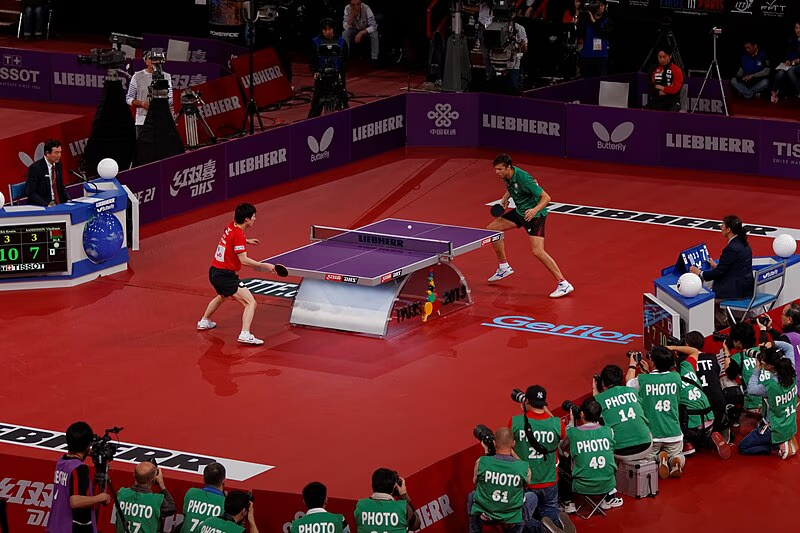
Playing areas at major competitions are separated by barriers to define each court and prevent interference between adjacent matches. Barriers must be uniform in colour (typically dark blue or dark green) and shall be approximately 75 cm high.
Why people argue about this
People often assume that the barriers are purely for aesthetic reasons, deciding which color looks better on TV, when in fact their primary function is to clearly define each table tennis court and prevent players from interfering with those playing adjacent tables. The height specification also ensures visibility without obstructing play or spectators' views.
Table tennis is played as singles (one player per side) or doubles (two players per side). , the Swaythling Cup format or the Olympic team format).
Why people argue about this
People often assume that in team competitions, each player from a team must play both singles and doubles matches, which isn't explicitly stated. Actually, teams can decide their own format for matches comprising singles and/or doubles as determined by competition rules, allowing flexibility rather than forcing every member to participate in all formats.
Players must be registered with their National Association and, for international competition, with the ITTF. Players must comply with the ITTF's eligibility regulations regarding nationality and age.
Why people argue about this
People often assume that being a registered player is enough for international competitions, forgetting about ITTF's additional requirement of registering with them as well. The confusion arises because they overlook the dual registration necessity: first with their national association and secondly with ITTF itself for participation in international events.
Per Law 2.5 and ITTF Clothing Regulations: Playing clothing shall consist primarily of a shirt, shorts or skirt, and playing shoes; a sweatsuit may also be worn.; The main colour of the shirt, shorts, or skirt (but not the sleeves or collar of the shirt) shall be clearly different from the colour...
— Law 2.5
Why people argue about this
People often assume that only players' clothing is regulated by Law 2.5 of Table Tennis, when in reality, it extends to all attire including officials’ uniforms as well. The confusion arises because many overlook how ITTF regulations apply not just to competitors but also to the officiating teams who ensure fair play and adherence to rules.
ITTF-sanctioned events are officiated by trained and certified officials: Umpire: The primary match official. The umpire decides all questions of fact, keeps score, calls faults and let, and ensures the Laws of Table Tennis are applied. The umpire's decision on matters of fact is final.; Assistan...
— Section 6
Why people argue about this
People often assume that only top-tier tournaments have certified officials, so they argue why their local club games don't need trained referees when it comes to this rule about ITTF-sanctioned events. The confusion arises because they interpret "ITTF-sanctioned" as limited to the highest-level competitions rather than encompassing all official table tennis matches organized by the ITTF.
Players are expected to conduct themselves in a sportsmanlike manner. Verbal or physical abuse, racket abuse, deliberate time-wasting, or any conduct contrary to the spirit of the game may result in point penalties, game penalties, or disqualification as determined by the referee.
Why people argue about this
People often assume that if they're just verbally arguing with their opponent during a match, it's only about winning or losing and doesn't count as "conduct contrary to the spirit of the game." But in reality, even brief, heated exchanges can be seen as disrespectful, which is why this rule exists – to prevent such interruptions from derailing fair play.
Per ITTF Regulations, coaching from the sideline is permitted only during authorized intervals (between games and during time-outs). Coaching during a rally or between rallies within a game (other than a time-out) is not permitted and may result in a warning or penalty point being awarded.
Why people argue about this
People often assume that coaching is allowed during a game's breaks or time-outs, thinking they can subtly guide their player without being penalized, but in fact, even brief coaching between rallies is strictly prohibited as per ITTF regulations and will result in immediate consequences like warnings or penalty points.
Each player or pair is entitled to request one time-out of up to 60 seconds per match (not per game). A time-out may be requested only when the ball is not in play, by the player or coach.
Why people argue about this
People often assume that a time-out can be requested at any point during play, which is why they argue; however, the official verdict clearly states that it must occur when the ball is out of play, and only one per match, not per game, leading to confusion about its timing and frequency.
Per Law 2.6, service shall proceed as follows: Service shall start with the ball resting freely on the open palm of the server's stationary free hand.; The server shall then project the ball near vertically upward, without imparting spin, so that it rises at least 16 cm (6.3 in) after leaving the...
— Law 2.6
Why people argue about this
People often assume that a rally automatically becomes a let if the server's ball touches the net and goes over on their first serve attempt, but actually, it only counts as a let if the ball lands out of bounds or hits the net post-impact before crossing the net. The confusion arises because they overlook the specific conditions under Law 2.9 that must be met for it to count as such an error.
The Expedite System shall come into operation if a game is unfinished after 10 minutes of play, or at any earlier time at the request of both players or pairs.; If the ball is in play when the time limit is reached, play shall be interrupted by the umpire and the rally is replayed as a let.; Ther...
— Law 2.15
Why people argue about this
People often assume that the Expedite System in table tennis is about speeding up the entire game rather than just service execution, which leads them to argue it should apply more broadly. The confusion arises because they misinterpret Law 2.6 as a blanket rule for quicker gameplay instead of recognizing it specifically pertains to how serves are handled during play.
Per Law 2.7, the ball, having been served or returned, shall be struck so that it passes over or around the net assembly and touches the opponent's court, either directly or after touching the net assembly.
— Law 2.7
Why people argue about this
People often assume that a let occurs anytime the server returns the ball directly back to their own side of the table, forgetting that it's only when the return is clearly out or illegal according to Law 2.9 that it counts as a let under this specific clause about "Good Return". They overlook the fact that a good return must be in play and not immediately returned by the server themselves.
In singles, the server shall first make a good service, the receiver shall then make a good return, and thereafter server and receiver shall alternately make a good return.; In doubles, the server shall first make a good service, the receiver shall then make a good return, the server's partner sh...
— Law 2.8
Why people argue about this
People often assume that a rally being declared a let means the ball was hit out of bounds, when in fact it's about the serve order or receiver error causing an immediate switch of sides, leading to confusion with what exactly constitutes a "let" in table tennis.
Per Law 2.9, a rally is a let if: In service, the ball touches the net assembly, provided the service is otherwise good or the ball is obstructed by the receiver or the receiver's partner.; Service is delivered when the receiving player or pair is not ready, provided neither the receiver nor the ...
— Law 2.9
Why people argue about this
People often assume that a let occurs only when the ball hits the net first before landing on the opponent's side, which is incorrect. The true confusion arises because they overlook other scenarios like the ball hitting the table and bouncing twice before reaching the receiver or if it touches the net cord while in play, both of which can also result in a let under Law 2.9.
Per Law 2.10, a player scores a point unless a let is called, if the opponent: Fails to make a good service.; Fails to make a good return.; Strikes the ball twice successively (double hit).
— Law 2.10, Law 2.4, Law 2.10.1.7
Why people argue about this
People often argue that if their opponent commits a fault during their serve, they should automatically score a point instead of waiting for the next ball. However, the confusion arises because under Law 2.10, only when an opponent makes a fault on their own serve does the server get a point; otherwise, it's not until after the receiver has had their chance to return that any scoring happens.
Per Law 2.11, a game is won by the player or pair first scoring 11 points, unless both players or pairs score 10 points (deuce), when the game shall be won by the first player or pair subsequently gaining a lead of 2 points.
— Law 2.11
Why people argue about this
People often assume that a game ends as soon as either player reaches 10 points, leading to arguments about when exactly a game is won. The actual confusion arises because they overlook the crucial part where if both players are tied at 10-10, the game continues until one player gains a lead of 2 points, not just reaching 11 points as initially thought.
Per Law 2.12, a match shall consist of the best of any odd number of games. At top-level competition, matches are typically best-of-7 games for World Championships and Olympic Games, and best-of-5 or best-of-7 for WTT events.
— Law 2.12
Why people argue about this
People often assume that a match must always be an even number of games, so they argue about why a 5-game match is valid under Law 2.12 when they expect it to be 3 or 4 games instead. The confusion arises because this rule specifically allows for any odd number of games in a match, not just the common expectations of even numbers like 3 and 4.
The right to choose initial order of serving, receiving, or ends shall be decided by lot (coin toss or similar); the winner may choose to serve or to receive first, or to start at a particular end.; Service shall change after every 2 points until the end of the game or the score reaches 10-all, a...
— Law 2.13
Why people argue about this
People often assume that if they serve out of turn in table tennis, it's just a minor mistake that can be corrected without stopping play. But actually, the official ruling is clear: such an error necessitates immediate interruption by the umpire to maintain game flow and fairness.
Per Law 2.14, if a player serves or receives out of turn, or fails to change ends when required, play shall be interrupted by the umpire as soon as the error is discovered. Play shall resume with the service being made by the player whose turn it ...
— Law 2.14
Why people argue about this
People often assume that if they notice a mistake in serving or receiving out of turn, they should simply correct it themselves without involving the umpire, thinking play can continue as long as they catch it early enough. However, the rule clearly states that the umpire must interrupt play immediately upon discovering these errors to ensure fairness and adherence to the flow of the game.
Per Law 2.11, a game is won by the first player or pair to reach 11 points. If the score reaches 10–10, the game continues until one player or pair leads by exactly 2 points.
— Law 2.11
Why people argue about this
People often assume that a game ends as soon as either player reaches 10 points, leading to arguments when scores get closer like 10-9 or 11-10. The confusion arises because Table Tennis scoring is based on reaching 11 points first, not just any even number, and the rule specifically states games are won by the first to reach 11, regardless of the score before that point.
Matches are decided on a best-of format: Best-of-7: First to win 4 games. Used at Olympic Games, World Championships, and major WTT events.; Best-of-5: First to win 3 games. Common at many national and international events.; Best-of-3: First to win 2 games. Used at some national league and recrea...
Why people argue about this
People often assume that table tennis matches go straight to a best-of-five format (best of 5 games), forgetting that it can also be decided by a best-of-seven system (best of 7 games). This confusion stems from the ITTF's flexibility in allowing different match formats, leading some players and spectators to expect one over the other.
Service alternates every 2 points during normal play (Laws 2.13.4). Once the score reaches 10–10, service changes every 1 point.
Why people argue about this
People often assume that service alternates every 2 points regardless of who won the rally, leading to arguments about whether a point should be counted towards alternating or if it resets after a win. The confusion arises because the rule specifically states "during normal play," implying that this scoring system only applies when switching servers, not during each point's outcome.
The umpire keeps the official score and announces it aloud after each point. Scoreboards at major venues display the running score.
Why people argue about this
People often assume that the umpire's score announcements are just for show and don't affect gameplay, but in reality, they're crucial for keeping track of who serves and receives during each point, which is a key part of table tennis strategy and fairness.
At the Olympic Games, team events use the following format (the "Olympic Team Format"): Each tie consists of 4 singles and 1 doubles rubber.; The first team to win 3 rubbers wins the tie.; Each rubber is best-of-5 games.
Why people argue about this
People often assume that WTT events directly determine ITTF World Rankings without realizing that only certain WTT events with varying point values count towards rankings based on overall performance in sanctioned tournaments. The confusion arises because they mix up event tiers' points with the actual ranking system used by ITTF.
ITTF World Rankings are determined by a points system based on results at ITTF-sanctioned events. WTT events carry varying points values based on event tier (WTT Grand Smash, WTT Champions, WTT Contender, WTT Star Contender).
Why people argue about this
People often assume that only WTT Grand Smash events are worth ranking points, which is a misconception. The confusion arises because they overlook the fact that all WTT-sanctioned tournaments contribute to rankings through their respective point values, not just the highest-tier event.
Per Law 2.6, the following constitute service violations, resulting in a point to the receiver: Projecting the ball less than 16 cm (6.3 in) upward from the free hand.; Imparting deliberate spin on the ball during the toss.; The ball not being above table level and behind the end line at the mome...
— Law 2.6
Why people argue about this
People often assume that a ball touching the net only once before crossing is acceptable under Law 2, forgetting that it must touch the net postion (the imaginary line above the net) at least once to be considered valid service. They overlook this crucial detail about the ball's path over the net.
Per Law 2.7 and Law 2.10, the following are return faults resulting in a point to the opponent: Failing to strike the ball so that it passes over or around the net and into the opponent's court.; Striking the ball into the net (net fault).; Striking the ball wide (past the side line) or long (pas...
— Law 2.7, Law 2.10, Law 2.10.1.6
Why people argue about this
People often assume that a ball touching the net only once is acceptable as long as it lands in the opponent's court, but actually, the ball must clear the net vertically before landing for it to be considered good and not result in a return fault under Law 2.7 of Table Tennis.
A player obstructs the ball if the player or anything the player wears or carries touches the ball in play when it is above or travelling towards the playing surface, before it has passed over the end line of the player's side (not having previous...
Why people argue about this
People often think that just touching the ball with their body is enough for a call of obstruction, forgetting that it must be something they're wearing or carrying. However, the confusion arises because the official wording specifies that the player's touch must happen before the ball crosses over to their side, not simply when their clothing brushes against it.
A player loses a point if, while the ball is in play: The player's free hand touches the playing surface.; The player moves the playing surface (e.g., by leaning on or bumping the table).; The player touches the net assembly.
Why people argue about this
People often assume that moving just a tiny bit of the table or net is enough to lose a point, forgetting that it must be significant movement affecting gameplay for it to be penalized under Law 2.10.1.7–2.10.1.8. The rule's wording can lead to misunderstandings about what constitutes "significant" movement.
The ITTF Regulations specify a progressive penalty system for misconduct: Warning (Yellow Card): Issued for the first offence (e.g., racket abuse, verbal outburst, unsportsmanlike conduct, delaying play). No point penalty on first warning.; Penalty Point (Red Card): One point is awarded to the op...
Why people argue about this
People often assume that simply having a non-approved racket is enough for a penalty, forgetting that it must also be used in play. They misunderstand that merely owning or possessing an unauthorized racket isn't penalized; it's only when they use it during a match that it becomes a violation under the rule.
Using a racket with covering or blade material not conforming to Law 2.4 or not on the ITTF approved list is a violation. Per ITTF regulations, racket inspections may be carried out at any point during a competition.
— Law 2.4
Why people argue about this
People often assume that just having a non-approved material on their racket is enough for a violation, but in fact, it must be visible coverage or blade material that doesn't comply with ITTF standards to trigger this rule; they might overlook the requirement of the material being part of the racket's structure.
The ITTF is a signatory to the World Anti-Doping Code. Players are subject to ITTF Anti-Doping Regulations.
Why people argue about this
People often assume that only athletes are affected by anti-doping rules in table tennis, forgetting that all staff members, including coaches and officials, must adhere to these regulations as well. The confusion arises because this specific detail isn't always highlighted or widely publicized alongside the ITTF's commitment to anti-doping globally.
, not during a time-out or between games), the umpire shall issue a warning to the offending team. Repeated violations may result in the coach being removed from the playing area for the remainder of the match, as determined by the referee.
Why people argue about this
People often argue that they didn't realize their coaching was happening during an unauthorized period, thinking it's okay as long as they're in the room with the players. But actually, the rule specifies these unauthorized periods are strictly defined and enforced to keep matches fair.
The ITTF Regulations for International Competitions specify safety requirements for competition venues: The playing surface and surrounding floor must be non-slippery. Surfaces shall be cleaned and maintained before and during competition to prevent slipping hazards.; Concrete, stone, or outdoor-...
Why people argue about this
People often assume that they can use their full 2 minutes of warm-up on any table in the room, not just the one they'll be playing on. But actually, the rule specifies it's specifically for the match table, ensuring all players start on equal footing and safety is prioritized over personal preference or convenience.
Lighting must be uniform with no flickering or stroboscopic effect that could disorient players.; Light fixtures must be securely mounted and positioned at a minimum height of 5 m above the floor to avoid glare or collision risk.; Emergency lighting must be available and tested at major venues.
Why people argue about this
People often assume that they can use their full 2-minute warm-up period on any table in the room, not just the match table where competition will take place. The confusion arises because of a misinterpretation of what constitutes "the match table," leading to disputes over which tables qualify for this crucial pre-competition preparation time.
Tables must be stable, with locking mechanisms engaged during play to prevent collapse or movement.; Net posts and clamps must be securely attached and positioned so they do not protrude in ways that could injure players during movement.; Balls must not be left loose on the floor of the playing a...
Why people argue about this
People often assume that they can use their full 2-minute warm-up period on a table outside of competition time, which could lead to disputes with officials if they see it as misuse or delay. The confusion arises because this rule specifically applies only during the match itself, not before or after, even though players need adequate preparation.
Players are entitled to a warm-up period of up to 2 minutes on the match table immediately before competition (ITTF Regulations). Adequate warm-up helps prevent muscle strains and repetitive stress injuries common in racket sports (wrist, elbow, shoulder).
Why people argue about this
People often assume that they can use their entire 2-minute warm-up period just standing at the table, which leads to misunderstandings about how active or passive the warming up actually is - in reality, players are supposed to actively engage in exercises like wrist circles and shoulder rolls within those 2 minutes.
For para table tennis (players in wheelchairs or with standing impairments), additional safety considerations apply: Playing areas must be accessible for wheelchairs, with adequate turning radius outside the table area.; Flooring must be suitable for wheelchair use (no loose mats or uneven surfac...
Why people argue about this
People often assume that the safety guidelines for para table tennis only apply during matches, forgetting that they also cover practices in training sessions. However, the actual rule states these safety measures must be implemented throughout all activities related to the sport, including practice, which can lead to misunderstandings about when and how to adhere to them.
Towelling is permitted only at the end of each game and at every 6 points within a game (when the total points in the game reaches a multiple of 6, e.g., 6, 12, 18).; Players must not spit on or near the playing area.; In events with infectious disease protocols (as may be determined by ITTF or l...
Why people argue about this
People often assume that just keeping the table clean is enough under 8.6, forgetting about the non-slippery requirement for surfaces, leading to misunderstandings about what exactly constitutes a safe playing environment. The confusion arises because they overlook the necessity of ensuring the table itself doesn't pose any slipping hazards during play.
Per Law 2.1 of the ITTF Laws of Table Tennis: The upper surface of the table, known as the "playing surface," shall be rectangular, 2.74 m (9 ft) long and 1.525 m (5 ft) wide.; It shall lie in a horizontal plane 76 cm (2 ft 6 in) above the floor.; The playing surface shall be made of any material...
— Law 2.1, Law 2.2, Law 2.3, Law 2.4
Why people argue about this
People often assume that the color of their paddles doesn't matter as long as they're approved by ITTF, but in reality, the official rules state that both paddles must be white or yellow to ensure fairness and consistency across all matches. They might not realize this detail until a match is underway and someone's paddle suddenly isn’t the right shade.
Per Law 2.6, the playing area is defined as the space allocated for one table. The ITTF specifies minimum space requirements for competition to ensure player safety and fair play.
— Law 2.6
Why people argue about this
People often assume that the entire area around a table is part of the playing area when it's actually just the space directly under the table top where players are allowed to hit the ball. The confusion arises because they overlook the fact that only the immediate vicinity below the net and along the side rails, as defined by Law 2.6, constitutes the official playing area for a match.
Table tennis is played as singles (one player per side) or doubles (two players per side). , the Swaythling Cup format or the Olympic team format).
— Section 6, Law 2.5
Why people argue about this
People often assume that in team competitions, each player from a team must play both singles and doubles matches, which is incorrect. Actually, teams can decide their own format for matches comprising singles and/or doubles based on competition rules, not all players have to participate in every type of match.
Per Law 2.6, service shall proceed as follows: Service shall start with the ball resting freely on the open palm of the server's stationary free hand.; The server shall then project the ball near vertically upward, without imparting spin, so that it rises at least 16 cm (6.3 in) after leaving the...
— Law 2.6, Law 2.7, Law 2.8, Law 2.9, Law 2.10, Law 2.4, Law 2.10.1.7, Law 2.11, Law 2.12, Law 2.13, Law 2.14, Law 2.15
Why people argue about this
People often assume that a let happens when the ball hits the net first before landing on the opponent's side, which is incorrect according to the ITTF rules. Actually, it's about the ball hitting the net and then bouncing twice on the server’s side before reaching the receiver – not just once as they might expect from other sports where a single bounce means a let.
Per Law 2.11, a game is won by the first player or pair to reach 11 points. If the score reaches 10–10, the game continues until one player or pair leads by exactly 2 points.
— Law 2.11
Why people argue about this
People often assume that a game ends as soon as either player reaches 10 points, which leads them to miss the crucial part of Law 2. 11 stating it's actually 11 points, not 10, that win the game in table tennis. This oversight stems from a misunderstanding of how the scoring system works within this specific sport.
Per Law 2.6, the following constitute service violations, resulting in a point to the receiver: Projecting the ball less than 16 cm (6.3 in) upward from the free hand.; Imparting deliberate spin on the ball during the toss.; The ball not being above table level and behind the end line at the mome...
— Law 2.6, Law 2.7, Law 2.10, Law 2.10.1.6, Law 2.10.1.7, Law 2.4
Why people argue about this
People often assume that if a ball touches the net assembly on its way over, it's automatically a fault, but in reality, as long as the ball clears the table without touching anything except the net or the receiver’s side of the table, it's considered good and play continues. The confusion arises because they might not fully grasp how close to the rules' edge some interpretations can be.
The ITTF Regulations for International Competitions specify safety requirements for competition venues: The playing surface and surrounding floor must be non-slippery. Surfaces shall be cleaned and maintained before and during competition to prevent slipping hazards.; Concrete, stone, or outdoor-...
Why people argue about this
People often assume that the 2-minute warm-up period is strictly mandatory for every match, forgetting that it's only a guideline meant to prevent injuries, thus arguing about whether they need to use all 2 minutes or if some quick stretching before their game suffices.