Section 1: Introduction
1.1 Overview of the Sport
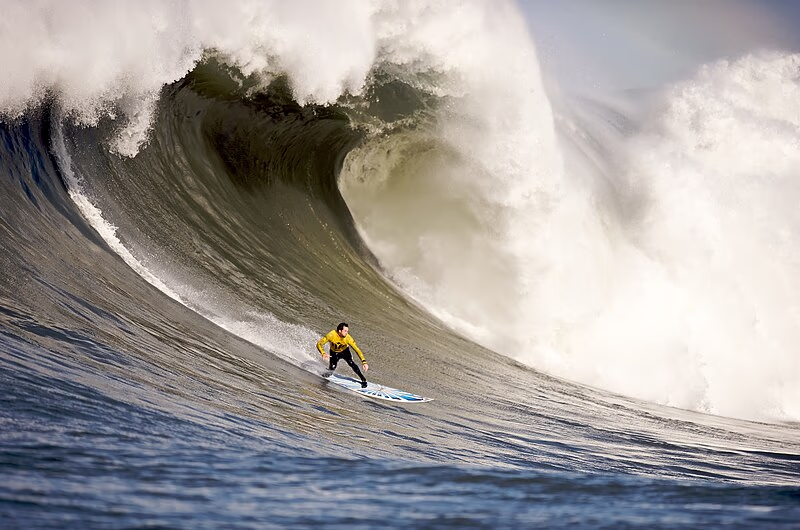
Surfing is the art and athletic discipline of riding ocean waves on a surfboard. Competitive surfing evaluates a surfer's ability to select quality waves, execute maneuvers with speed, power, and flow, and demonstrate progressive skill in variable ocean conditions. The Olympic discipline is shortboard surfing, conducted in the open ocean on natural waves.
1.2 Governing Body
The International Surfing Association (ISA), founded in 1964 and headquartered in La Jolla, California, is the world governing authority for surfing as recognized by the International Olympic Committee (IOC). The ISA oversees Olympic qualification, the ISA World Surfing Games, the ISA World Junior Surfing Championship, and all ISA-sanctioned international competitions. The ISA currently has over 100 member national federations.
The World Surf League (WSL) operates the professional Championship Tour (CT) and Challenger Series (CS) independently. While the WSL governs professional prize-money competition, the ISA holds exclusive authority over Olympic surfing, amateur international competition, and the global development of the sport. ISA and WSL rankings both factor into Olympic qualification pathways.
1.3 Olympic History
Surfing made its Olympic debut at the Tokyo 2020 Games (held in 2021), with competition at Tsurigasaki Beach in Chiba, Japan. The sport returned for Paris 2024, with the surfing event held at the legendary reef break of Teahupo'o, Tahiti, French Polynesia — approximately 15,700 km from Paris. This marked the first time an Olympic event was held so far from the host city, selected for the world-class quality of its waves. The Olympic program features 20 men and 20 women competing in individual shortboard events.
1.4 Scope of This Rulebook
This rulebook covers the ISA competition rules as applied to Olympic and ISA-sanctioned shortboard surfing events. It addresses heat format, scoring criteria, priority rules, interference penalties, equipment regulations, venue requirements, and safety protocols. Rules are based on the ISA Competition Rulebook with Olympic-specific adaptations as approved by the IOC.
Section 2: Equipment
2.1 Surfboard Specifications
- Board type: Shortboard. Typically 5'6" to 6'6" (168–198 cm) in length, though the ISA does not enforce strict minimum or maximum dimensions. The board must be deemed safe by the Head Judge and equipment inspectors.
- Fin configuration: Three-fin (thruster) setup is standard, though quad-fin and twin-fin configurations are permitted. Fins must not have sharp or dangerous edges. Fin screws must be flush with the board surface.
- Construction: Polyurethane (PU) or expanded polystyrene (EPS) foam core with fiberglass or epoxy resin lamination. No metallic or otherwise hazardous materials on exterior surfaces.
- Leash plug: Board must have a secure leash attachment point (leash plug) near the tail.
- No motorized assistance: Boards must not contain any motorized, jet-propulsion, or hydrofoil mechanisms. The surfer must rely entirely on wave power and paddling.
- Traction pad: Rear traction pads are permitted. Wax may be applied to the deck for grip.
2.2 Leash
A leg rope (leash) is mandatory in all ISA competition. The leash connects the surfboard to the surfer's ankle or calf via a Velcro strap. The leash must be in serviceable condition with no significant fraying, and its length should be appropriate for the board size (typically 5'–7'). A broken leash during a heat requires the surfer to retrieve the board before continuing; the clock does not stop.
2.3 Competition Jersey (Rashguard)
- Color-coded lycra rashguard jerseys are provided by the organizer and must be worn at all times during the heat.
- Standard colors: Red, White, Blue, Yellow (in 4-person heats) or Red and Blue (in 2-person heats).
- The jersey must be worn as the outermost layer over any wetsuit or rashguard.
- Surfers may not alter, modify, or obscure the competition jersey.
2.4 Wetsuit and Personal Gear
- Wetsuit: Optional, dependent on water temperature. No restrictions on thickness, style, or brand. Full suits, spring suits, and vests are all permitted.
- Helmet: Optional for most conditions, but may be required by the Competition Director at reef break venues (e.g., Teahupo'o) where shallow reef poses a head injury risk.
- Sunscreen: Permitted. Reef-safe sunscreen is encouraged at environmentally sensitive venues.
- Ear plugs and nose clips: Permitted at the surfer's discretion.
2.5 Equipment Inspection
All surfboards and leashes are subject to inspection by the Equipment Inspector prior to competition. Boards deemed unsafe (sharp edges, damaged fins, protruding hardware) will not be permitted. Surfers typically prepare multiple boards and may switch boards between heats but not during a heat.
Section 3: Playing Area
3.1 Ocean Venue Selection
Competition takes place in the open ocean on natural waves. Venue selection is a critical process that considers wave quality, consistency, safety, spectator access, and logistical feasibility. Venues may be beach breaks (waves breaking over sand), point breaks (waves breaking along a headland), or reef breaks (waves breaking over coral or rock reef). Olympic venues are selected years in advance by the IOC and ISA.
3.2 Competition Zone
- Boundaries: The competition area is defined by colored flags on the beach and buoys or markers in the water. Surfers must stay within the designated zone during heats.
- Lineup area: The zone where surfers wait for and paddle into waves, typically 50–200 meters offshore depending on the break.
- Takeoff zone: The area where waves begin to break and surfers stand up on the board.
- Ride zone: The area along the wave face where maneuvers are performed and judged.
- Channel: A designated deep-water area for paddling out without interference from breaking waves.
3.3 Wave Conditions
- Minimum wave height: Approximately 1 meter (3.3 ft) face height for competition to proceed. Conditions below this threshold result in a hold or postponement.
- Ideal range: 1.5–3 meters (5–10 ft) for shortboard competition. Larger waves are permissible if deemed safe by the Competition Director.
- Maximum wave size: There is no strict maximum, but the Competition Director may place competition on hold if conditions exceed the safety threshold for the competitors and water safety team.
- Wave quality assessment: The Competition Director evaluates wave shape, consistency, frequency of sets, wind conditions (offshore wind preferred), and current strength before calling competition on.
3.4 Waiting Period
ISA and Olympic surfing events operate within a waiting period — a window of approximately 8–16 days during which competition can be called on any day when conditions are suitable. The Competition Director has sole authority to call the competition on, place it on hold, or postpone it based on wave conditions, weather, tides, and safety considerations. Surfers must be available on short notice (typically 1–2 hours) throughout the waiting period.
3.5 Backup Venues
Major ISA events may designate an alternate competition site within reasonable distance in case the primary venue becomes unsuitable for an extended period due to persistent flat conditions, dangerous swells, or environmental hazards.
Section 4: Players & Officials
4.1 Competitors
- Olympic field: 20 men and 20 women, qualified through ISA World Surfing Games, WSL Championship Tour rankings, continental quota, and host nation allocation.
- ISA World Surfing Games: Teams of up to 4 men and 4 women per member nation. Nations enter as teams; individual and team medals are awarded.
- Age eligibility: No minimum age for ISA events (governed by national federation). Olympic eligibility follows IOC age rules and national Olympic committee selection criteria.
- Nationality: Surfers represent their nation of citizenship. Dual-nationality athletes must declare their representing nation and observe any applicable stand-down periods if switching.
4.2 Seeding
Competitors are seeded based on a combination of ISA rankings, WSL rankings, and prior event results. Top-seeded surfers are separated in the draw to avoid early-round matchups. Seeding determines jersey color assignment in each heat (highest seed typically receives first color choice).
4.3 Officials
- Competition Director: The highest authority on-site. Responsible for calling competition on or off, determining heat schedules, managing the waiting period, and making final decisions on safety holds. Has authority to modify heat duration based on conditions.
- Head Judge: Oversees the judging panel, ensures scoring consistency, and may intervene to recalibrate scores if panel drift is detected. Reviews and confirms all interference calls.
- Judging Panel: Five (5) judges score each wave independently. Judges are positioned on an elevated platform or scaffolding on the beach with a clear view of the competition zone. Each judge assigns a score from 0.0 to 10.0 for every wave ridden.
- Priority Judge: Monitors and enforces the priority system. Determines which surfer has priority at any given moment during the heat. Signals priority status to surfers via a flag or electronic display system.
- Beach Marshall: Manages the competitor area on the beach, ensures surfers are ready for their heats, enforces jersey and equipment rules, and coordinates surfer transitions between heats.
- Water Safety Director: Commands the jet ski water safety team. Responsible for surfer rescue, clearing the lineup of hazards, and communicating conditions to the Competition Director.
- Scorer / Tabulator: Records judges' scores, applies the drop-highest/drop-lowest calculation, computes heat totals, and publishes results in real time.
4.4 Judge Qualifications
ISA judges must hold current ISA judging certification and demonstrate experience across multiple competition levels. The ISA conducts annual judging seminars and calibration workshops. Panel composition aims for geographic diversity to minimize cultural bias in wave assessment.
Section 5: Rules of Play
5.1 Heat Format
- Heat duration: Standard heats are 30 minutes. The Competition Director may shorten heats to 20 or 25 minutes or extend to 35 minutes based on wave frequency and conditions.
- Surfers per heat: Early rounds may feature 3–4 surfers per heat. From the Round of 16 onward (and all Olympic rounds from Round 3), heats are man-on-man (2 surfers).
- Wave count: There is no limit on the number of waves a surfer may catch during a heat. However, only the best 2 wave scores count toward the heat total.
- Heat start: A horn or siren signals the start and end of each heat. Surfers are in the water and positioned in the lineup before the start signal.
5.2 Priority System
The priority system is the most critical rule in competitive surfing, governing the right of way on waves:
- Establishing priority: At the start of a heat, priority is determined by paddle position relative to the peak (curl) of the wave. The surfer closest to the breaking part of the wave has priority.
- Priority rotation: After a surfer catches and rides a wave (stands up and makes a deliberate ride), that surfer moves to lowest priority. The remaining surfer(s) move up in priority order.
- Paddling for a wave: A surfer with priority who paddles for and commits to a wave claims that wave. The non-priority surfer must yield.
- Split peaks: If a wave breaks in two directions (A-frame), one surfer may take the left and another the right without interference, as they are riding different sections of the wave.
- Priority indicator: An electronic or flag-based display on the beach and/or in the water shows which surfer currently holds priority.
5.3 Wave Selection Strategy
With only the best 2 waves counting, surfers must balance quality versus quantity. Catching many waves provides more scoring opportunities but consumes paddling energy and resets priority. Experienced competitors often sit deep in the lineup, waiting for the largest set waves to maximize individual wave scores rather than accumulating marginal attempts.
5.4 Competition Format
- Olympic format: Initial seeding rounds, followed by main rounds leading to elimination rounds with a repechage (second-chance) system. Surfers who lose in early main rounds drop to the repechage bracket, where they can re-enter the competition. The repechage ensures a loss in one heat does not mean immediate elimination.
- ISA World Surfing Games: Round-robin group stages followed by single-elimination knockout rounds. Both individual and team standings are tracked simultaneously.
- Advancement: In multi-surfer heats (3–4 surfers), typically the top 1 or 2 surfers advance. In man-on-man heats, the winner advances and the loser is eliminated (or enters repechage).
- Medal matches: Semifinals determine the Gold Medal match and the Bronze Medal match. There is no bronze medal playoff between losing semifinalists in some formats — the Olympic format uses direct semifinals-to-final progression.
5.5 Conduct During Heats
- Surfers must remain within the designated competition zone throughout the heat.
- Coaching from the beach, channel, or any external source is prohibited during heats.
- Surfers may not receive any electronic communication (radio, earpiece) during a heat.
- A surfer who loses their board must retrieve it by swimming; no external assistance is permitted unless a safety issue arises.
Section 6: Scoring
6.1 Wave Scoring
Each wave ridden is scored individually by the 5-judge panel on a scale of 0.0 to 10.0 in increments of 0.1. For each wave, the highest and lowest judge scores are dropped, and the remaining 3 scores are averaged to produce the wave score. This trimmed-mean system reduces the impact of outlier scores.
6.2 Scoring Criteria
Judges evaluate each wave ride based on five key criteria, weighted holistically:
- Commitment and degree of difficulty: The risk taken relative to wave size, section difficulty, and the critical nature of the maneuvers. Surfing in the most critical part of the wave (closest to the curl/pocket) scores higher.
- Innovative and progressive maneuvers: New or technically advanced maneuvers (aerials, full-rotation maneuvers, tube rides with variations) score higher than conventional turns.
- Combination of major maneuvers: Linking multiple high-quality maneuvers in a single wave ride. A wave with 3–4 strong turns scores higher than one with a single maneuver, assuming execution quality is maintained.
- Variety of maneuvers: Demonstrating a diverse repertoire — carving turns, aerials, tube rides, floaters, cutbacks — rather than repeating the same maneuver.
- Speed, power, and flow: The overall aesthetic and functional quality of the ride. Speed through turns, power in rail engagement, and smooth flow between maneuvers without stalling or loss of momentum.
6.3 Scoring Scale
| Score Range | Rating | Description |
|---|
| 0.0 – 1.9 | Poor | Minimal maneuvers, lack of commitment, low-quality wave selection |
| 2.0 – 3.9 | Fair | Basic maneuvers with limited difficulty or combination |
| 4.0 – 5.9 | Average | Competent surfing with moderate difficulty and some combination |
| 6.0 – 7.9 | Good | Strong performance with notable maneuvers and good wave usage |
| 8.0 – 10.0 | Excellent | Exceptional commitment, progressive maneuvers, masterful execution in the critical section of the wave |
6.4 Heat Total
A surfer's heat total is the sum of their best 2 wave scores. The maximum possible heat total is 20.00 (two perfect 10.0 waves). The surfer with the highest heat total wins the heat and advances. In the event of a tie, the surfer with the single highest individual wave score wins. If still tied, the third-best wave score is compared, and so on.
6.5 Score Examples
- Tube ride with exit: A deep barrel ride with a clean exit on a critical section typically scores 8.0–10.0, depending on duration, depth, and difficulty of the wave.
- Progressive aerial: A full-rotation aerial (360 or higher) with a clean landing on the wave face scores 7.0–9.5 depending on height, rotation, and landing quality.
- Single carving turn: A single powerful turn on an average wave typically scores 3.0–5.0 unless executed with extraordinary power and commitment.
Section 7: Violations & Penalties
7.1 Interference
Interference is the most common and significant violation in competitive surfing. It occurs when a surfer without priority impedes, obstructs, or hinders the scoring potential of the priority surfer. Specific interference scenarios include:
- Dropping in: Paddling into and riding a wave that the priority surfer is already riding or has committed to paddling for.
- Paddling interference: Paddling in front of or into the path of the priority surfer as they ride a wave, even if the offending surfer does not stand up.
- Snaking: Paddling around the priority surfer to gain inside position at the last moment before a wave arrives. If this causes the priority surfer to lose the wave, interference is called.
- Blocking in the channel: Deliberately obstructing a surfer's paddle-out path to gain a tactical time advantage.
7.2 Interference Penalties
- First interference: The offending surfer's second-best wave score is halved. If the surfer has not yet caught a second scoring wave, the penalty applies when they do. This can be devastating, as the heat total is the sum of only 2 waves.
- Second interference (same heat): The offending surfer's second-best wave score is reduced to zero, effectively forcing them to compete on a single wave score for the remainder of the heat.
- Third interference (same heat): The surfer is disqualified from the heat and receives last place.
7.3 Unsportsmanlike Conduct
- Verbal abuse, intimidation, or aggressive behavior toward other surfers, officials, or water safety personnel.
- Deliberately damaging another surfer's equipment.
- Refusing to wear the assigned competition jersey or comply with official instructions.
- Penalties range from a score deduction to heat disqualification, or in severe cases, removal from the event.
7.4 Other Infractions
- Late to the water: Surfers who are not in the lineup by the heat start signal may receive a time deduction (the clock runs regardless).
- Outside competition zone: Waves caught outside the designated competition area are not scored.
- External coaching: Receiving coaching signals from the beach during a heat may result in a warning or score penalty at the Head Judge's discretion.
- Equipment violation: Using a board that fails equipment inspection results in heat disqualification if discovered after the heat has begun.
Section 8: Safety Considerations
8.1 Water Safety Team
A dedicated water safety team operates during all competition hours. This team consists of experienced jet ski operators positioned in the channel adjacent to the competition zone. Their responsibilities include:
- Rescuing surfers who are held underwater, injured, or separated from their boards in dangerous conditions.
- Towing surfers back to the lineup or to shore when currents, exhaustion, or injury prevent self-recovery.
- Clearing broken boards, loose fins, or other debris from the competition zone.
- Communicating real-time condition updates (rogue sets, current changes, marine life sightings) to the Competition Director.
8.2 Beach Safety Personnel
Qualified lifeguards are stationed on the beach throughout competition. Medical personnel with emergency equipment (oxygen, defibrillator, spinal board) are on standby. An ambulance or rapid medical transport must be accessible at the venue at all times during competition.
8.3 Marine Hazard Assessment
- Sharks: A shark response protocol is mandatory at all ISA events. This includes designated spotters (drones, elevated observation, or in-water patrol), an immediate competition hold upon confirmed sighting, and a mandatory clearance period (typically 30–60 minutes) before competition resumes. Some venues deploy shark deterrent technology (electromagnetic barriers, sonar arrays).
- Reef and rock hazards: At reef break venues, the Competition Director assesses the risk of surfers being pushed onto shallow reef. Helmets may be mandated. Minimum water depth over the reef at low tide is evaluated.
- Currents and rip tides: Strong lateral or outgoing currents are assessed before each day of competition. Current strength may shorten heats or trigger a hold if surfers cannot safely maintain position in the lineup.
- Marine life: Jellyfish, sea urchins, stingrays, and other marine hazards are assessed. Surfers are briefed on local marine conditions before competition begins.
8.4 Weather and Environmental Holds
- Lightning: Competition is immediately suspended when lightning is detected within a defined radius (typically 10 km / 6 miles). A minimum 30-minute hold follows the last lightning strike before resumption.
- Extreme wind: Strong onshore winds that destroy wave quality may trigger a hold. Cross-shore winds above a threshold that compromise surfer safety (blown off waves at height) are also grounds for suspension.
- Pollution or hazardous materials: If water quality is compromised by sewage discharge, chemical spill, or other contamination, competition is suspended pending water quality testing and clearance.
8.5 Competitor Safety Requirements
- All competitors must be competent ocean swimmers capable of swimming 200 meters unassisted in open water.
- Competitors must attend the pre-event safety briefing covering venue-specific hazards, emergency signals, and water safety team protocols.
- Board and fin inspections are conducted before competition to prevent injuries from sharp edges, loose fins, or damaged equipment.
- Surfers are responsible for ensuring their leash is in serviceable condition. A broken leash during competition is the surfer's responsibility; no time-out is granted.
8.6 Emergency Procedures
In the event of a serious injury, the Competition Director halts the heat immediately. The water safety team extracts the injured surfer, and medical personnel provide first response. The heat clock is stopped, and remaining surfers return to the lineup. The heat resumes with remaining time once the situation is resolved. If a surfer cannot continue, their scores stand as recorded up to that point.