













Section 1: Introduction
3x3 Basketball is FIBA's fast, half-court basketball discipline played by two teams of three players (plus one substitute each) on a single basket. Born in the streetball tradition and formalized as an Olympic sport at Tokyo 2020, 3x3 has its own complete rule set, its own world rankings, its own World Tour and World Cup competitions, and its own ball — FIBA does not treat 3x3 as a derivative of full-court basketball but as a parallel federation discipline.
The international governing body is the International Basketball Federation (FIBA), which publishes the canonical Official 3x3 Basketball Rules. The current edition consolidates rules across all FIBA 3x3 competitions including the FIBA 3x3 World Tour, the FIBA 3x3 World Cup, and the Olympic Games discipline. The 2026 FIBA 3x3 Basketball World Cup is contested June 1-7, 2026.
This entry summarizes the major rule mechanics for educational purposes. It does not reproduce rule text and is not a substitute for the canonical FIBA 3x3 rules, which are authoritative in any dispute (see source URL in metadata). For the underlying full-court / 5-on-5 basketball rules see the sibling FIBA Official Rules entry in this directory.
Key differences from full-court FIBA basketball: half-court only with one basket, 12-second shot clock, 21-point first-to-target win condition, all baskets worth 1 point inside the arc and 2 points beyond, no jump ball at start (coin flip), check-ball restart after made baskets, no need to check ball back after possession change in some scenarios — and a smaller, heavier 28.5-inch ball with rubber cover for outdoor play.
Section 2: Equipment
The 3x3 Basketball Ball
- Size 6 (28.5 inches / 72.4 cm circumference) — sized between a women's 5-on-5 ball and a men's 5-on-5 ball
- Weight equivalent to a men's 5-on-5 basketball (approximately 580-620 g)
- FIBA-approved 3x3 ball with grooved grip pattern designed for outdoor use
- All-surface rubber cover (suitable for asphalt, concrete, and synthetic outdoor surfaces)
- Only FIBA-approved 3x3 balls may be used in FIBA-sanctioned competition
Basket
- Single basket positioned at the end of the half-court
- Standard basketball hoop: 18-inch (45.7 cm) diameter, 10 feet (3.05 m) high
- Standard backboard: 6 feet wide × 3.5 feet high (1.83 m × 1.07 m)
- Free-throw line at 4.6 m from the basket
- Three-point arc at 6.75 m from the basket (matching FIBA 5-on-5 distance)
Player Apparel
- Team uniform with each player wearing the same color top
- Numbered jerseys (numbers 1-99); numbering must be distinct within the team
- Shorts
- Athletic footwear suitable for outdoor surfaces
- Headbands, sweatbands, and religious head coverings permitted; jewelry that could cause injury prohibited
Officiating Equipment
- Whistle for each referee
- 12-second shot clock display visible to players
- 10-minute game clock
- Scoreboard showing point totals for both teams
- Match record sheet
Section 3: Playing Area
Court Dimensions
- Single half-court, 15 m wide × 11 m long (approximately 49 ft × 36 ft)
- One basket at the end opposite the check-ball restart area
- 3-point arc at 6.75 m from the basket (matches FIBA 5-on-5)
- Free-throw line at 4.6 m from the basket
- Painted lane (key) extending from the free-throw line back to the baseline
Court Surface
- Outdoor surfaces: synthetic 3x3 court tiles, asphalt, or concrete
- Indoor surfaces: hardwood or synthetic sport floor
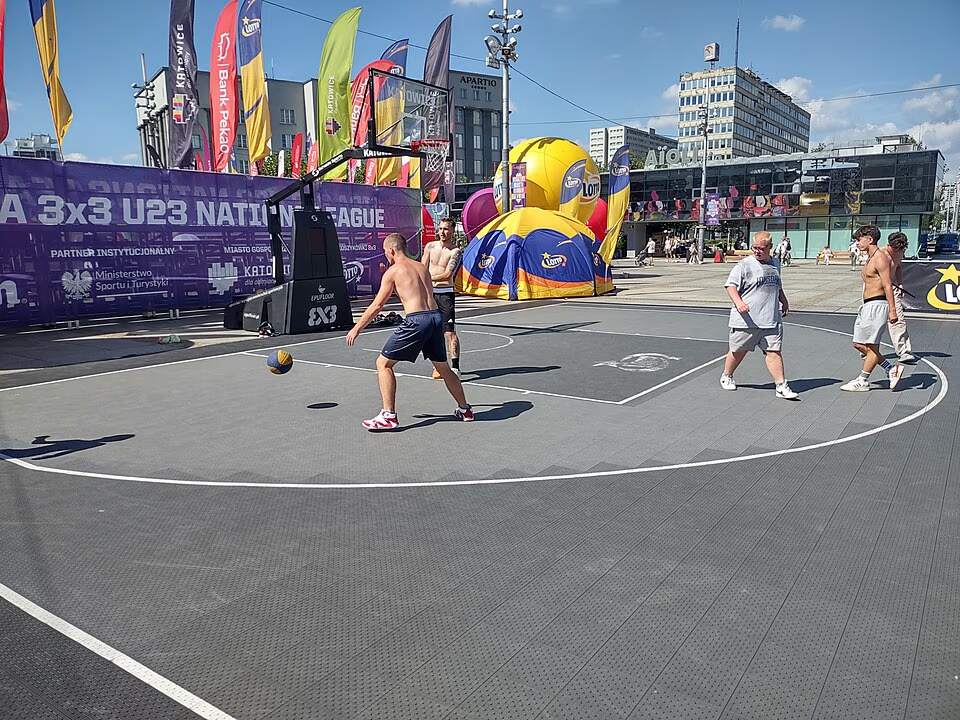
- FIBA-approved 3x3 World Tour events typically use pop-up synthetic flooring on a flat outdoor surface in city-center venues
Check-Ball Area
The check-ball restart area is the top of the arc at the half-court line opposite the basket. After a made basket and on out-of-bounds restarts in specific scenarios, the offensive team takes the ball at the check-ball spot and passes it to a defensive player, who passes it back (or "checks" it) before play resumes.
Section 4: Players & Officials
Team Composition
- Each team has a roster of 4 players total
- 3 players on the court at any time
- 1 substitute available throughout the game
- Substitutions are unlimited and made on a dead ball when the substituting team has possession of the ball; the player being replaced exits, the substitute taps in by physical contact
Officials
- One or two on-court referees
- Scorer/timekeeper at the table
- Shot-clock operator
- Commissioner/Technical Delegate for FIBA-sanctioned World Tour and World Cup events
Coaches and Bench
3x3 is unique among FIBA disciplines in that coaches are not permitted on the bench during play in standard FIBA 3x3 competition — the players themselves manage strategy, substitutions, and timeouts. The substitute and team officials sit in the designated bench area but may not direct play from the sideline during live action.
Game Start
The game starts with a coin toss to determine which team gets first possession (no jump ball). The team winning the toss may choose to start with the ball or to start on defense.
Section 5: Rules of Play
Game Length
- 10-minute game clock from the first check-ball start; the clock runs continuously and stops only on referee-signaled stoppages
- The clock stops on free throws, fouls being administered, timeouts, and stoppages for injury
- If neither team has reached 21 points when the clock expires, the team with more points wins
- 21-point target: if a team reaches 21 points before the 10 minutes expire, that team wins immediately — regardless of remaining time
Overtime
If the game is tied at the end of regulation (neither team reached 21 before time expired and both have equal points), untimed overtime is played: the first team to score 2 points in overtime wins. There is no overtime clock; play continues from the check-ball restart until a team scores its second overtime point.
Shot Clock
- 12-second shot clock — the offensive team must attempt a shot within 12 seconds of gaining possession
- A shot must hit the rim to satisfy the shot clock; an air ball that misses the rim entirely is a shot clock violation
- The shot clock resets on a change of possession and on offensive rebounds
Possession Rules
- After a made basket, the defending team becomes the offensive team and takes the ball at the check-ball area; no inbound pass required — the new offensive team can immediately begin the offensive sequence after the ball is taken behind the arc
- After a defensive rebound, the rebounding team must "clear" the ball — dribble or pass it to a teammate so that the ball goes outside the 3-point arc — before attempting a new shot
- After a steal, the same clearing requirement applies
- After an offensive rebound, no clearing is required — the offensive team can immediately attempt another shot
Check-Ball Restart
At the start of the game and after dead balls in specific scenarios, the offensive team starts at the check-ball area at the top of the arc. The ball is passed from offense to defense, then back from defense to offense ("checked"), and play resumes. Made-basket restarts (described above) do not require a check-ball pass — they are immediate.
Timeouts
- Each team has one 30-second timeout per game
- Timeouts are called by the players on the court (since coaches are not permitted to direct from the bench)
- The clock stops during the timeout
Free Throws
- Personal fouls in the act of shooting: free throws are awarded as in 5-on-5 basketball
- Free throw outside the arc: 2 free throws
- Free throw inside the arc: 1 free throw
- And-one (foul during a made basket): 1 additional free throw
Section 6: Scoring
Field Goals
- 1 point for a field goal made from inside the 6.75 m arc (a "deuce" worth 1 in 3x3, distinct from the 2-point deuce in 5-on-5)
- 2 points for a field goal made from beyond the 6.75 m arc (a "trey" worth 2 in 3x3, distinct from the 3-point trey in 5-on-5)
- The 1/2 scoring scale is the most distinctive 3x3 rule: every shot is worth one point less than its 5-on-5 equivalent
Free Throws
Each successful free throw is worth 1 point.
Match Result
- The team that reaches 21 points first wins, regardless of remaining time
- If neither team reaches 21 before the 10-minute clock expires, the team with more points at the end of regulation wins
- If the game is tied at the end of regulation, untimed overtime is played to "first team to score 2 points"
Tournament Scoring
FIBA 3x3 World Tour and World Cup events use bracket-format tournaments with pool play / group stages followed by single-elimination knock-out rounds. Tiebreakers in pool play (when multiple teams have the same win-loss record) include head-to-head record, point differential, and points scored, per the FIBA 3x3 competition regulations.
Section 7: Violations & Penalties
Personal Fouls
- Personal fouls in 3x3 are tracked at the team level (not per-player)
- Up to 6 team fouls per game are non-bonus fouls
- Starting with the team's 7th, 8th, and 9th team foul, the opposing team shoots 2 free throws
- Starting with the team's 10th team foul and beyond, the opposing team shoots 2 free throws AND retains possession after the second free throw
- Player-level foul-outs do not apply in 3x3 — players are not disqualified for accumulated personal fouls (though they may be disqualified for unsporting / disqualifying fouls)
Shot Clock Violation
If the offensive team fails to attempt a rim-contacting shot within 12 seconds, the defensive team gains possession at the check-ball area.
Clearing Violation
If the offensive team (after a defensive rebound or steal) attempts a shot or scores without first clearing the ball outside the 3-point arc, the basket does not count and the defensive team gains possession at the check-ball area.
Other Violations
- Traveling: same standard as 5-on-5 basketball; loss of possession
- Double dribble: same standard as 5-on-5; loss of possession
- Out of bounds: ball awarded to opposing team at check-ball area
- Goaltending / offensive interference: same standards as 5-on-5
- 3-second violation: same standard as 5-on-5 (offensive player in the lane for more than 3 seconds without leaving)
Technical and Disqualifying Fouls
- Technical foul: 1 free throw + possession to the offended team. A player charged with two technical fouls is disqualified from the game
- Unsporting foul: 2 free throws + possession. A second unsporting foul is a disqualifying foul
- Disqualifying foul: 2 free throws + possession + disqualification of the offending player from the game
Section 8: Safety Considerations
Outdoor Surface Safety
- 3x3 is often contested outdoors on asphalt, concrete, or synthetic tiles; surface inspection prior to play is the responsibility of the event organizer
- Heat absorption by dark surfaces in summer competition requires hydration management and, in extreme conditions, surface-temperature monitoring
- Loose debris, water, or surface defects must be addressed before play resumes
Pace and Conditioning
3x3 is a high-intensity, short-duration game — a typical 10-minute game can deliver a higher heart-rate load than a 5-on-5 game. Players are responsible for warming up adequately, managing hydration during play (the 30-second timeout can be used for water/electrolyte intake), and recognizing fatigue-related injury risk.
Concussion Protocol
FIBA follows the IOC consensus on concussion in sport: any player with a suspected concussion is removed from play and is subject to a graduated return-to-play assessment before being cleared for subsequent competition. Match-day diagnosis is the responsibility of the team medical staff or the event medical observer.
Heat and Weather
- WBGT-based heat thresholds for play modifications and postponement in outdoor events
- Lightning detection halts outdoor activity; play resumes only after the all-clear interval has elapsed
- High wind affecting ball trajectory may delay play in outdoor competitions; the decision is at the discretion of the Technical Delegate
Medical Coverage
- FIBA 3x3 World Tour and World Cup events have on-site medical staff including physicians and EMTs
- Emergency action plans cover on-field cardiac, head/neck, orthopedic, and heat-related emergencies
- Defibrillators (AEDs) are positioned at every FIBA-sanctioned 3x3 venue