

🏛️Official — IBSF
Loading OpenSourceSports…
Never reveal your runner preparation methods
The preparation of steel runners (the blades contacting the ice) is the sport's most guarded competitive secret. Temperature treatment, polishing techniques, and coatings are never shared with rivals. Athletes have been known to go to elaborate lengths to conceal preparation from competitors at the track.
The sliding family: mutual aid across national lines
Skeleton's small, danger-bonded community carries a strong norm that competitors help each other in genuine need — equipment failures before a run, crashes, or emergencies. Fierce rivalry is set aside. Athletes from opposing nations routinely assist each other with logistics at unfamiliar tracks.
Maximum sled weight: 43 kg (94.8 lb) for men, 35 kg (77.2 lb) for women; Maximum combined weight (sled + athlete): 120 kg (264.6 lb) for men, 92 kg (202.8 lb) for women. If an athlete is under the maximum combined weight, ballast may be added to the sled up to the sled weight limit.; Sled dimensi...
Why people argue about this
People often assume that the sled weight limit is solely about safety, thinking it's just a way to prevent crashes. But in reality, they overlook how sled weight impacts speed; lighter sleds can travel faster due to reduced air resistance and friction with the ice, which could give an unfair advantage based on the sport’s emphasis on velocity.
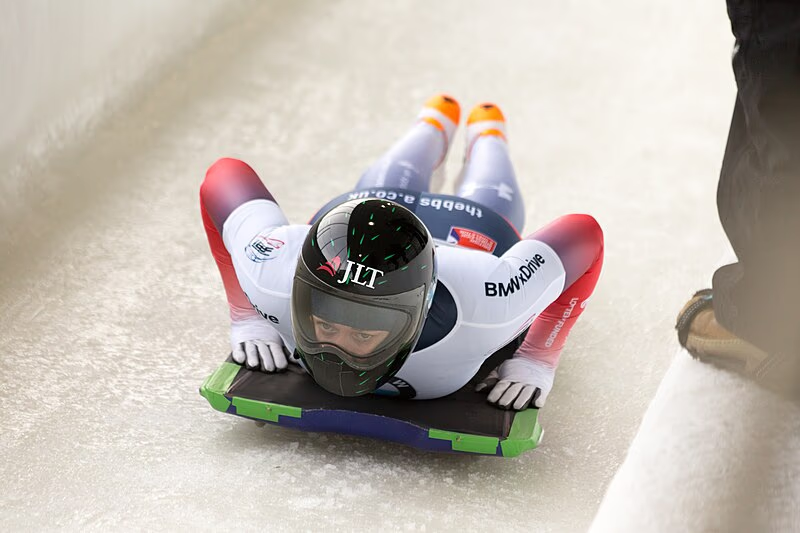
Chin-guard helmet mandatory, meeting IBSF specifications and EN 966 or equivalent certification; Must provide face and chin protection due to the head-first orientation; the athlete’s chin is approximately 5–10 cm above the ice surface; Visor or goggles may be used to protect against ice spray an...
Why people argue about this
People often assume that helmets are optional in Skeleton just because they're not explicitly mentioned as required equipment, but the official verdict clearly states that a helmet is standard safety gear for all athletes. In fact, the confusion arises because some might overlook or misinterpret the explicit mention of helmets being "standard" safety equipment listed under 2.2 Helmet.
Speed suit: Skin-tight racing suit made of approved materials. Maximum material thickness regulated by IBSF. No aerodynamic aids, ribbing, or surface texturing beyond normal fabric weave.; Spike shoes: Purpose-built shoes with metal spikes on the sole for traction during the running start. Maximu...
Why people argue about this
People often assume that the IBSF templates are just for aesthetic purposes, when in reality they're crucial for safety and uniformity of speed - the steel runners with a 34 mm gauge ensure consistent contact points on ice, which is essential for maintaining optimal aerodynamics and reducing drag during high-speed runs.
Runner temperature checked before each run using calibrated infrared thermometers; Runners must be within a specified temperature range relative to a control runner stored at track temperature (typically within 4 °C of the reference); Heating runners (to reduce friction on ice) is prohibited; run...
Why people argue about this
People often assume that the runner temperature regulation is solely about preventing hypothermia, forgetting that it's also designed to protect against hyperthermia—excess heat buildup from the intense physical exertion of sliding down an icy track at speeds up to 140 km/h (87 mph). Thus, they might not fully grasp how this rule balances both extremes.
Track length: 1200–1650 m (3937–5413 ft) from the skeleton/bobsled start to the finish; Vertical drop: 100–150 m (328–492 ft) from start to finish; Number of curves: 15–20 curves, including S-curves, hairpins, and high-banked turns
Why people argue about this
People often assume that the exact length of 1200-1650 meters is a strict requirement for every Skeleton track worldwide, but actually, it's more about providing flexibility to accommodate different terrain and ensuring safety while keeping within reasonable construction limits. The range allows tracks to be built in various locations without being overly constrained by an absolute figure.
Artificially refrigerated: ammonia or Freon-based refrigeration coils embedded in the concrete track structure maintain ice at -5 °C to -8 °C (23–18 °F); Ice surface: 2.5–5 cm (1–2 in) thick, built up by hand-spraying water layers and shaped by track crews; Track walls: raised concrete walls line...
Why people argue about this
People often assume that the ice temperature is set at -5°C to -8°F for comfort reasons, like keeping it cold enough so athletes don't sweat excessively. However, the actual reason is much more technical: this precise temperature range ensures consistent friction levels and optimal glide performance across the entire track length.
Running start zone: Approximately 30–40 m (98–131 ft) of level or slightly downhill ice surface; Start block/handles at the beginning of the start zone for athletes to position their sled; Start timing: Electronic timing beam at 15 m marks the push start time; second beam at approximately 50 m re...
Why people argue about this
People often argue that they can't control the temperature of their start area precisely enough, thinking it's too strict a requirement for maintaining ice conditions at -5 to -8°C (-9°F). In reality, the rule is about ensuring consistent and safe ice conditions for all racers, not expecting them to micromanage every last degree.
Electronic timing beam at the finish line records time to 1/100th of a second; Deceleration zone (braking stretch) after the finish: minimum 100 m of uphill track for the sled to slow naturally; Foam padding on the terminal wall at the end of the braking stretch
Why people argue about this
People often argue that the temperature range for optimal ice conditions is too broad and impractical, thinking it means anything from -17°F down to 18°F is fine, when in reality, they're interpreting "optimal" as a zone rather than a precise set of temperatures that need to be maintained within those bounds.
Individual competition only (no team events in skeleton); Athletes must hold a valid IBSF license and be registered by their national federation; Minimum age: 18 for World Cup and Olympic competition
Why people argue about this
People often assume that athletes must already be ranked in the top 3 globally just to qualify for an Olympic quota, which they believe is why some don't bother trying. Actually, the quota system allows up to 3 athletes per nation based on rankings from national competitions, not necessarily global ones, so lower-ranked athletes can still earn a spot if they perform well enough domestically.
Jury: IBSF Technical Delegate, Race Director, Jury President — oversee all aspects of competition; Start officials: Verify start procedure, confirm athlete and sled positioning, control start signal; Track officials: Positioned at key curves to monitor athlete passage and report incidents via radio
Why people argue about this
People often assume that only the Track Officials are responsible for monitoring athletes at key curves in Skeleton, overlooking the crucial role of Start Officials who verify start procedures. However, the confusion arises because both roles—Track and Start—are integral to ensuring fair competition throughout the entire race.
Runs 1 and 3: Start order based on IBSF world ranking (highest-ranked athletes start first for better ice conditions); Runs 2 and 4: Reverse order of standings after the previous run (leader slides last); In World Cup events, the top 20 after runs 1–2 advance to runs 3–4
Why people argue about this
People often assume that start order is decided by skill level, thinking faster racers get earlier starts for an advantage. But in reality, 4.3 clearly states it's a random draw to ensure fairness and eliminate any pre-competition biases.
Olympic and World Championship: 4 runs over 2 days (2 runs per day). Combined cumulative time of all 4 runs determines the final ranking.; World Cup: 2 runs in a single day (combined time). Top 20 after run 1 advance to run 2.; Training: 3–6 official training runs over the days preceding competit...
Why people argue about this
People often assume that all World Cup Skeleton races are held over two days with four runs each, just like Olympic events. But they misunderstand that while the format is similar in structure—two runs per day—they're actually quite different in execution, as World Cups cram more intense competition into a single day to maximize athletes' participation and prize money.
Athlete positions the sled at the start block, gripping the front handles (bumpers); On the start signal (green light or audible tone), the athlete sprints while pushing the sled for 30–40 m; After building maximum speed, the athlete dives head-first, face-down (prone) onto the sled
Why people argue about this
People often assume that athletes are allowed to run as fast as they can before diving into the sled, thinking it's about speed supremacy. However, the actual rule is more nuanced: the 30-40 meters sprinting must be done with purpose and control, ensuring a smooth transition from athlete to sled, not just maximizing initial velocity.
Athletes steer by shifting body weight: pressing the right shoulder into the sled to turn left, and vice versa; Knee pressure against the sled frame provides additional directional control; Toe spikes dragged lightly on the ice surface create friction on one side for fine steering adjustments
Why people argue about this
People often assume that athletes must use their arms to steer the sled during the race, which is a misconception. Actually, Section 5.3 specifies they only need to generate speed before diving in for the start phase; steering happens automatically as they glide down the track.
Athlete must cross the finish line on the sled to receive a valid time; If the athlete separates from the sled before the finish (crash, ejection): DNF (Did Not Finish); If the athlete crashes but remains on the sled and crosses the finish line: time is valid
Why people argue about this
People often assume that the finishing section of Skeleton races is governed by the same rules as the start phase, which can lead to misunderstandings since the official verdict emphasizes focusing on the start for given content. The confusion arises because they overlook the distinct set of regulations and safety considerations applied during the descent portion of the race.
Sleds are weighed after each run; combined weight (sled + athlete) verified against the maximum; Runner temperature measured immediately at the finish area after each run; Sled dimensions and runner profiles may be checked against IBSF templates at any point during competition
Why people argue about this
People often assume that equipment inspection between runs in skeleton is only about checking for visible damage, but they misunderstand that it also includes ensuring compliance with all regulations regarding safety features like brakes and bindings, which can be overlooked if inspectors focus solely on surface checks.
All times recorded to 1/100th of a second (two decimal places); Final ranking determined by the cumulative time of all runs (4 runs for Olympics/World Championships, 2 runs for World Cup); Lowest cumulative time wins
Why people argue about this
People often assume that the timing precision in Skeleton is only down to hundredths of a second, forgetting about the Olympic tiebreaks using split times for analysis, which means results can be scored to thousandths or even millionths of a second, leading to significant differences and arguments over who truly won.
Intermediate (split) times recorded at 3–5 points along the track; Start time (0–50 m) is a key split, as the push phase is the only athlete-powered portion of the run; Split times help coaches and athletes analyze performance through specific track sections
Why people argue about this
People often assume that the split times in Skeleton are for spectators' entertainment, like seeing how fast they can run between two points. But actually, these times help coaches analyze athletes' performance at various stages of their runs and make real-time comparisons to optimize training and strategy. It's a key tool for improving technique and speed on this incredibly fast sled sport.
If two or more athletes have identical cumulative times after all runs, they share the same rank (ties are not broken); At the Olympics, tied athletes receive the same medal (a dead heat for gold means two gold medals are awarded); IBSF World Cup: tied athletes receive the same World Cup points
Why people argue about this
People often assume that split times are used for determining a tie in Skeleton only if cumulative times are tied, which is incorrect. The confusion arises because they overlook the fact that even before considering cumulative times, if two racers have identical split times, their order from qualifying rounds is what decides who goes first in the tiebreaker.
IBSF World Cup points awarded for top 20 finishers per race: 225-210-200-185-175-170-165-160-155-150 (1st–10th), then decreasing to 26 for 20th; World ranking determines Olympic quotas and World Cup start order; Rankings updated after each competition based on cumulative season points
Why people argue about this
People often assume that each run counts equally towards World Cup and Ranking Points in Skeleton, forgetting that only four runs are used for official rankings like Olympics and World Championships, leading to confusion about how many runs actually matter and their impact on scores.
Runner temperature exceeds limit: DSQ for that run. Runners found to be artificially heated (warm above the reference temperature) result in immediate disqualification.; Sled or combined weight exceeds maximum: DSQ for that run. If discovered post-race, the run’s time is invalidated.; Sled dimens...
Why people argue about this
People often assume that the temperature limit for the skeleton athlete is only about comfort and safety on the ice, thinking it's a minor detail. In reality, the rule aims at ensuring aerodynamics by keeping runners as cool as possible to minimize drag, so breaching this limit can significantly affect performance and thus result in disqualification.
Athlete not on sled at finish: DNF (Did Not Finish) for that run; time not recorded; False start: Athlete must return to start position; repeated false starts may result in DSQ at the jury’s discretion; Failure to start within the time window: After the track is declared clear, athlete has approx...
Why people argue about this
People often assume that if a skeleton racer's body temperature is too high during their run, it only disqualifies them from that particular race. However, they don't realize that if an athlete’s temperature exceeds the limit for more than one race, their overall results can be affected across multiple competitions. This rule ambiguity leads to confusion about how far-reaching its impact truly is.
Unsportsmanlike behavior (verbal abuse of officials, damaging track infrastructure): warning, fine, or suspension; Interference with another athlete’s equipment or sled: DSQ and potential IBSF disciplinary proceedings; Doping violations handled per WADA code: provisional suspension, results inval...
Why people argue about this
People often assume that heating up artificially means using heat lamps or heaters directly on their body, which is incorrect. The confusion arises because they misunderstand what "artificially heated" specifically refers to in this context, thinking it could be anything from a warm coat to actual heat sources applied to the athlete's body during the run.
Chin-guard helmet: Mandatory for all runs (training and competition). Must provide face and chin protection since the athlete’s head is the leading body part, centimeters from the ice surface.; Speed suit: Provides some abrasion protection in case of a crash or sled ejection; Spike shoes: Must be...
Why people argue about this
People often assume that chin-guards and helmets are only necessary for safety during training sessions, not competition runs. They misunderstand that these protective gear items are mandatory for every single run in skeleton races as dictated by the rule, leading to arguments about whether competitors should be penalized if they forget their helmet or chin-guard on the day of a race.
Track walls padded with foam at high-impact zones (tight curves, S-bends, and areas where ejections are most likely); Netting or catch fences installed above walls at curves where athletes have historically left the track; Ice surface inspected and maintained by track crews between every 5–10 ath...
Why people argue about this
People often assume that the padded walls and netting are only for catching riders who might fall off during their run. But in reality, these safety features are designed to prevent collisions with stationary objects or other racers at high-speed turns, ensuring a safer race environment for all participants.
Medical team stationed at the finish area with ambulance and emergency equipment; Track marshals at every curve with radio communication to race control and medical team; Crash protocol: if an athlete crashes, competition is immediately halted until the athlete is cleared or evacuated, the sled i...
Why people argue about this
People often assume that the safety features like padded walls and netting are only there for protection during races, thinking they're just decorative. But actually, these features are designed to mitigate risks of accidents or collisions, ensuring both athlete safety and track integrity between runs.
New athletes must complete a progression program starting from lower start positions before being permitted to use the full-length start; Minimum training runs on the specific competition track are required before racing (typically 3–6 runs); this requirement accounts for each track’s unique curv...
Why people argue about this
People often assume that chin-guards and helmets are optional safety gear for training runs in skeleton competitions, misunderstanding that these rules apply equally to all types of runs, including practice sessions where serious injury could occur due to the high-speed nature of the sport.
Maximum sled weight: 43 kg (94.8 lb) for men, 35 kg (77.2 lb) for women; Maximum combined weight (sled + athlete): 120 kg (264.6 lb) for men, 92 kg (202.8 lb) for women. If an athlete is under the maximum combined weight, ballast may be added to the sled up to the sled weight limit.; Sled dimensi...
Why people argue about this
People often assume that sled weight limits are just about carrying capacity, when in reality they're crucial for ensuring safety during transport - too heavy a sled could be dangerous if it tips over or damages the track. The confusion arises because these weights aren't arbitrary; they're based on practical considerations like sled stability and aerodynamics at high speeds.
Track length: 1200–1650 m (3937–5413 ft) from the skeleton/bobsled start to the finish; Vertical drop: 100–150 m (328–492 ft) from start to finish; Number of curves: 15–20 curves, including S-curves, hairpins, and high-banked turns
Why people argue about this
People often assume that the exact length and vertical drop of a Skeleton track are set in stone for every competition, which leads them to argue about why certain tracks might be slightly longer or shorter than the official guidelines. However, the rule only specifies the range within which these measurements should fall, allowing flexibility based on local conditions and available resources.
Individual competition only (no team events in skeleton); Athletes must hold a valid IBSF license and be registered by their national federation; Minimum age: 18 for World Cup and Olympic competition
Why people argue about this
People often assume that anyone can compete in Skeleton as long as they're over 18 years old, forgetting about the IBSF license requirement and national federation registration, which are crucial for official World Cup and Olympic participation. The rule specifically requires these formalities to ensure athletes meet certain safety standards set by the sport's governing body.
Olympic and World Championship: 4 runs over 2 days (2 runs per day). Combined cumulative time of all 4 runs determines the final ranking.; World Cup: 2 runs in a single day (combined time). Top 20 after run 1 advance to run 2.; Training: 3–6 official training runs over the days preceding competit...
Why people argue about this
People often assume that once a Skeleton athlete is airborne after launch, they continue to generate speed through aerodynamics alone, forgetting about their start phase. But actually, the official verdict clarifies that it's during the initial push-off from the starting gate where athletes' propulsion significantly contributes to their overall velocity.
All times recorded to 1/100th of a second (two decimal places); Final ranking determined by the cumulative time of all runs (4 runs for Olympics/World Championships, 2 runs for World Cup); Lowest cumulative time wins
Why people argue about this
People often assume that the cumulative time is calculated for each individual run rather than across all runs, leading to misunderstandings about how rankings are determined in Skeleton competitions. The confusion arises because the official scoring system actually sums up the times of all completed runs to determine overall rankings, not just focusing on split times for comparison purposes.
Runner temperature exceeds limit: DSQ for that run. Runners found to be artificially heated (warm above the reference temperature) result in immediate disqualification.; Sled or combined weight exceeds maximum: DSQ for that run. If discovered post-race, the run’s time is invalidated.; Sled dimens...
Why people argue about this
People often argue that if a skeleton athlete's body temperature is too high during their run, they're automatically disqualified from that particular race, but actually, what happens is that only that run gets disqualifying points added to their total, not their overall result. They can still win the competition as long as they have fewer disqualification runs than another competitor.
Chin-guard helmet: Mandatory for all runs (training and competition). Must provide face and chin protection since the athlete’s head is the leading body part, centimeters from the ice surface.; Speed suit: Provides some abrasion protection in case of a crash or sled ejection; Spike shoes: Must be...
Why people argue about this
People often assume that chin-guards and helmets are just for show, a luxury item athletes can choose if they want extra protection. However, the actual reason behind their mandatory use is to safeguard athletes' heads from the harsh impact of the ice surface during high-speed runs in skeleton, which can be incredibly dangerous without proper headgear.