


🏛️Official — World Netball
Loading OpenSourceSports…
Never show dissent toward the umpire
Netball is particularly known among team sports for a culture of near-absolute deference to officials. Verbal argument, visible gesturing, or any form of challenging a call — even a clearly incorrect one — is considered a serious violation of the sport's ethos. Players and coaches routinely cite this as central to netball's identity and distinguish it from other sports.
Help an opponent who has fallen or is injured
If an opposing player falls during play or is hurt, nearby players — including opponents — are expected to stop and assist them up before the game resumes. Not doing so, especially when you were physically involved in the incident, is viewed as a clear failure of sportsmanship and is negatively remarked upon by teammates, opponents, and spectators alike.
Give three cheers for the opposition after the final whistle
A defining ritual of grassroots and school netball across Commonwealth countries: both teams line up at centre court and give three cheers — 'hip hip hooray!' — for each other. Failing to line up promptly or participate is considered a serious breach of respect and is often the clearest marker of a team's sportsmanship culture.
The umpire may apply advantage if penalising an infringement would penalise the non-offending team — the umpire calls "Advantage" and play continues. The 2024 Edition refined the wording around when advantage may be applied.
Why people argue about this
People often assume that if a ball touches anything outside the court, it's automatically out of play - which isn't entirely accurate in Netball. The key misunderstanding is that the ball only goes out when it hits the ground or a player/object outside the court; otherwise, it stays in play as long as it doesn't touch those external elements directly.
Each team has a designated captain who represents the team in dealings with the umpires and may request clarification of an umpire's ruling at the next available stoppage. The captain wears a captain's armband.
Why people argue about this
People often assume that coaches can freely direct their players from the bench at all times during a game, which leads to misunderstandings about when they're allowed to give instructions. The confusion arises because this specific netball rule restricts coaching only to "permitted breaks," not allowing continuous communication or interference with play throughout the entire game.
The match begins with a centre pass taken by the Centre of one team standing wholly within the centre circle; Centre passes alternate between the two teams thereafter, regardless of which team scored the previous goal; The centre pass must be received in the centre third
Why people argue about this
People often assume that the pivot must be done in one continuous motion without stopping, which leads to arguments about whether a brief pause during the pivot is allowed or if it breaks the rule. The confusion arises because the official intent emphasizes fluidity and immediate continuation of play rather than strict timing or pauses within the pivot itself.
Coaches, team officials, and substitute players occupy the team bench, located along one sideline outside the runoff. Coaching is permitted from the bench only during permitted breaks and must not interfere with on-court play.
Why people argue about this
People often assume that coaches can freely instruct players from the bench whenever they want during a match, which leads to misunderstandings about when coaching is allowed according to the official rules in Netball. The confusion arises because this rule specifically limits coaching to only permitted breaks, not throughout the entire game as some might expect.
World Netball follows the World Rugby/IOC consensus on concussion in sport: any player with a suspected concussion is removed from play and is subject to a graduated return-to-play assessment before being cleared for subsequent training and compet...
Why people argue about this
People often assume that if a player gets hit in the head during netball, they must always be immediately removed from play for a concussion check, but actually, it's based on whether they show signs of a suspected concussion - like showing confusion or dizziness - and then follows a specific medical assessment process.
Contact: Contact with an opponent that interferes with their play is an infringement, penalised by a penalty pass to the contacted player from where the contact occurred; Obstruction: A defending player must be at least 0.9 m (3 ft) from the landed foot of the player in possession before extendin...
Why people argue about this
People often assume that if a ball touches ground outside the court during play, it's automatically out of play without considering whether it hit a player or object first. They overlook the "contact with the ground outside the court" part, which is crucial for determining when to award a throw-in instead of declaring the ball dead.
The 3.05 m runoff around the court must be clear of obstacles; players regularly leave the court at high speed pursuing the ball; Goalposts must be padded to a minimum height of 2 m; The court surface must be firm and even; wet patches and debris must be cleared before play resumes
Why people argue about this
People often assume that if a player is suspected of having a concussion in Netball, they are immediately taken off the court for good, but actually, it's part of a graduated return-to-play assessment process to ensure their safety and prevent long-term issues. This gradual approach can lead to misunderstandings about how quickly or easily players might be allowed back into play.
Length: 30.5 m (100 ft) measured between the goal lines; Width: 15.25 m (50 ft) measured between the sidelines; Court is divided lengthwise into three equal thirds by two transverse lines: defensive third, centre third, attacking third (orientations relative to each team)
Why people argue about this
People often assume that any firm surface will do for Netball courts, forgetting about the nuances like 'sprung wooden floor' which provides crucial bounce control needed for ball movement. They overlook how an International match's specific requirements ensure consistent performance across different venues.
Goal lines (end lines) at each end of the court; Sidelines along each long edge; Two transverse third-lines dividing the court into three equal thirds
Why people argue about this
People often assume that entering a non-permitted area is just about stepping on grass outside their designated zone, which they think is pretty straightforward. But actually, it's more nuanced than that; the boundaries extend to the imaginary lines around each position, and players can be penalized for even brushing up against these invisible edges accidentally.
Caution: Verbal warning to a player for unsporting conduct; Suspension: A player may be suspended from the match for a defined period (typically 2 minutes) for repeated unsporting conduct or a serious infringement; the team plays short during the suspension; Ordering off: A player ordered off tak...
Why people argue about this
People often assume that a free pass for technical infringements means no penalty at all, which they misunderstand as completely waiving all consequences of their mistake. In reality, it's about avoiding interference penalties specifically, so players and coaches sometimes still feel penalized even when not directly interfering with the ball or opponent.
A player in possession of the ball may not let the landing foot touch the ground a second time after lifting it, while still in possession. The player may pivot on the landing foot or take a step on the other foot — effectively 1.5 steps before throwing or shooting.
Why people argue about this
People often assume that the footwork rule only applies when a player is in possession of the ball, forgetting that it also covers situations where they're about to receive a pass or are simply in control of the ball's movement. The confusion arises because this specific detail isn't always explicitly stated in explanations and can lead to misunderstandings during games.
A free pass is awarded to the non-offending team for technical infringements that do not involve interference with an opponent. The non-offending team takes the pass from where the infringement occurred.
Why people argue about this
People often assume that a free pass is only awarded for direct interference with an opponent, forgetting that it can also be given for technical infringements like incorrect ball handling or timing errors, which causes confusion about when and why such penalties are handed out in netball.
A goal is scored when the ball is thrown by either the Goal Shooter (GS) or the Goal Attack (GA) from any point within the shooting circle and passes through the ring. Only GS and GA may score; a shot taken by any other player, or a shot taken by ...
Why people argue about this
People often assume that only GS and GA can score a goal, forgetting that other players like Goal Middies (GM) are allowed to throw from outside the shooting circle but must hit within it for a goal to count. The confusion arises because they overlook the specific conditions allowing non-GS/GA players to score under certain circumstances.
The shooter's footwork must be legal at the moment of release; The ball must pass downward through the ring; The shot must be released within three seconds of receiving the ball
Why people argue about this
People often assume that a goal is scored simply by throwing the ball within the shooting circle, thinking it's enough for 1 point under World Netball Rules of Netball 2024 Edition. But actually, the ball must pass through the ring to be officially counted as a goal worth only 1 point. The confusion arises because they overlook this crucial detail about the ball passing through the ring.
Two upright goalposts, one at the centre of each goal line, height 3.05 m to the top of the ring; Each post supports a horizontal metal ring of 380 mm internal diameter, with a net attached; The ring projects 150 mm horizontally from the post
Why people argue about this
People often assume that the rings are just decorative hoops instead of functional goal posts, leading to misunderstandings about their role in scoring. The confusion arises because they're positioned right at the center of each goal line, which can be easily overlooked or misinterpreted as a design choice rather than a critical part of gameplay.
Indoor netball venues are typically climate-controlled, but outdoor competition (most often at school and club level) may face heat-related risks. World Netball recommends WBGT-based heat thresholds and play modifications; specific implementation ...
Why people argue about this
People often assume that netball doesn't need heat rules since it's played indoors, forgetting that outdoor games at school clubs can get dangerously hot. They overlook how World Netball’s recommendations for WBGT thresholds and play modifications are meant to protect players in potentially extreme conditions they might face.
Two umpires, one for each half of the court along the sideline; each umpire is responsible for one sideline and one goal line and shares responsibility for play that crosses between halves; One timekeeper; One scorer (and an assistant scorer in international competition)
Why people argue about this
People often assume that coaching from the bench is only strictly prohibited during actual breaks in play, forgetting that it's also forbidden at any point where players are on the court, leading to confusion about when they can provide guidance or adjustments.
The team with the higher goal total at the end of the fourth quarter wins the match; If scores are level at the end of the fourth quarter in a knock-out match, two 7-minute halves of extra time are typically played; a "first-to-two-clear-goals" sudden death may be applied per the competition regu...
Why people argue about this
People often assume that a goal scored from outside the shooting circle is worth less than one from inside, which they mistakenly believe is only half a point. However, under World Netball Rules of Netball 2024 Edition, all goals are indeed worth 1 point regardless of where in the circle they’re scored, so this common misunderstanding leads to arguments about scoring discrepancies.
International matches are played in four 15-minute quarters; Quarter-time and three-quarter-time intervals are 4 minutes; half-time interval is 12 minutes; The team scoring more goals at the end of the fourth quarter wins; tie-breaking procedures (typically two 7-minute halves of extra time) appl...
Why people argue about this
People often assume that pivoting only allows for a small rotation, thinking it restricts movement too much, but in reality, it simply means the player can't land flat-footed again — effectively giving them more freedom to move around with the ball than they might initially think.
The ball is moved exclusively by passing or shooting; players may not run or dribble with the ball; A pass must be released to a different player; a pass thrown by one player and caught by the same player is "replayed ball" and penalised; The ball must be touched by a player in each adjacent thir...
Why people argue about this
People often assume that if a ball touches the ground outside the court, it's automatically thrown in by the opposing team. However, they misunderstand that the ball must actually touch a player or an object on the ground outside the court to trigger a throw-in; simply touching the ground isn't enough for this rule to apply.
Whistles for each umpire; Stopwatches for the timekeeper; Match scoresheet and digital scoring/match management equipment in international competition
Why people argue about this
People often assume that the color of the ball doesn't matter as long as it's within size standards, but in Netball, the official color is crucial for visibility during gameplay, especially under different lighting conditions and to prevent confusion with other balls on court.
The ball is out of court when it touches the ground outside the court, or when it touches a player or any object in contact with the ground outside the court. The ball is brought back into play by a throw-in by a player from the opposing team to t...
Why people argue about this
People often assume that if a ball touches anything outside the court like a fence post or bench, it's automatically out of play. But actually, the key is whether the ball touches ground outside the court, and specifically, whether it hits a player or object in contact with the ground outside the court to be considered out. They miss the crucial detail about what constitutes 'touching the ground'.
A penalty pass is awarded to the non-offending team for infringements involving interference with an opponent — contact and obstruction. The penalty pass is taken from where the infringement occurred.
Why people argue about this
People often assume that a penalty pass can only be taken from where the infringement happened, which is incorrect. The actual rule states it's taken from "where the infringement occurred," but doesn't specify this must be exactly where the infraction was made. They overlook the flexibility in taking the penalty pass closer to their goal for strategic advantage or better shooting angles.
" The offending defender stands out of play.
Why people argue about this
People often assume that a penalty pass is just like a normal throw-in in Netball, forgetting that it's specifically designed for simultaneous infringements during play. The confusion arises because they overlook how crucial this quick restart is to maintaining game flow and fairness when players accidentally touch the ball at the same time.
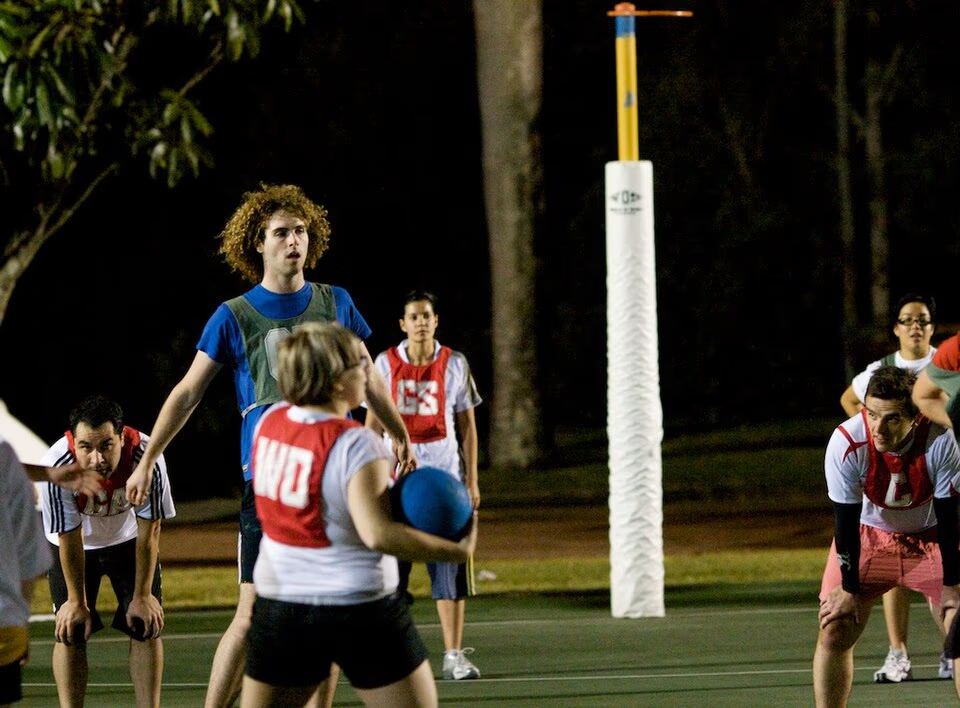
Team uniform (dress, top and skirt, or top and shorts) clearly distinguishing the two teams; Position bib worn on the front and back, displaying the position abbreviation (GS, GA, WA, C, WD, GD, GK); Footwear suitable for the playing surface; no spikes
Why people argue about this
People often assume that the only reason for clearly distinguishing player apparel is purely aesthetic, like team colors. But in Netball, where games can be fast-paced with players moving around a lot, having distinguishable uniforms helps referees and spectators keep track of which players belong to which team, especially during quick changes or when players are far from their usual positions.
Fingernails must be kept short and smooth — long or sharp nails are an injury risk to opponents during contests for the ball; Jewelry that may cause injury must be removed or, where permitted by the umpires (e.g., medical bracelets, religious items), securely covered; The 0.9 m obstruction distan...
Why people argue about this
People often assume that just because a player is removed for suspected concussion in World Netball, they're automatically out of the game until cleared. But actually, players are only removed from play temporarily while under medical supervision to ensure their safety and prevent further injury; they can still return later with clearance.
Each of the seven playing positions has a defined permitted area. A player who enters an area not permitted to that position commits an "offside" infringement and is penalized (Section 7).
— Section 7
Why people argue about this
People often assume that entering an offside area is just about crossing a line marked on the ground, but in reality, it's more nuanced - they fail to grasp how each position has its own specific, defined area where only players of that designated role are supposed to be at certain times during play.
Spherical, made of leather, rubber, or synthetic material; Circumference: 690–710 mm; Weight: 400–450 g
Why people argue about this
People often assume that the metal ring on goalposts is meant for players to grab while shooting, which leads them to argue about its size and placement, but in reality, it's purely functional - ensuring the ball hits the ring to score a goal, regardless of player reach.
The court must be a firm, even surface. International matches are played on a sprung wooden floor or an approved synthetic indoor surface.
— Section 7
Why people argue about this
People often assume that any type of wooden floor is acceptable for netball matches, forgetting about the crucial detail that it must be sprung, which adds cushioning to prevent injuries from falls. This oversight leads to misunderstandings and arguments when venues with non-sprung wooden floors are used for international competitions.
Coaches, team officials, and substitute players occupy the team bench, located along one sideline outside the runoff. Coaching is permitted from the bench only during permitted breaks and must not interfere with on-court play.
Why people argue about this
People often assume that coaches are allowed to communicate with players at their bench during play, thinking it's a standard part of coaching duties. However, the actual rule strictly prohibits coaching from the bench while the game is in progress, which can lead to misunderstandings and disputes among officials when they see seemingly off-the-bench communication.
A player in possession of the ball may not let the landing foot touch the ground a second time after lifting it, while still in possession. The player may pivot on the landing foot or take a step on the other foot — effectively 1.5 steps before throwing or shooting.
Why people argue about this
People often assume that the restriction means you can't touch the ground at all with your landing foot once it's in the air, but actually, they're allowed to pivot or take a step on their other foot as long as they don't let both feet leave the ground simultaneously when in possession of the ball.
A goal is scored when the ball is thrown by either the Goal Shooter (GS) or the Goal Attack (GA) from any point within the shooting circle and passes through the ring. Only GS and GA may score; a shot taken by any other player, or a shot taken by ...
Why people argue about this
People often assume that only GS and GA can score because of a misinterpretation of the term "Goal," thinking it refers directly to the Goal Area rather than the Goal Shooter and Goal Attack positions. The confusion arises because in Netball, scoring is tied to specific players (GS and GA) rather than just any player aiming at the goal area.
A free pass is awarded to the non-offending team for technical infringements that do not involve interference with an opponent. The non-offending team takes the pass from where the infringement occurred.
Why people argue about this
People often think that a free pass awarded for technical infringements means they get to choose where to shoot from, but in reality, it's always taken from exactly where the infraction happened, leaving no room for interpretation or negotiation.
World Netball follows the World Rugby/IOC consensus on concussion in sport: any player with a suspected concussion is removed from play and is subject to a graduated return-to-play assessment before being cleared for subsequent training and compet...
Why people argue about this
People often assume that the concussion protocol only applies in Netball if a player is knocked out, forgetting that it covers any suspected concussion, regardless of severity or whether they lose consciousness. This oversight leads to underreporting and delayed treatment for less severe injuries.
Under the World Netball Rules of Netball 2024 Edition, a goal is worth 1 point regardless of the position of the shooter within the shooting circle.
Why people argue about this
People often assume that a goal is worth 2 points under standard Netball rules, which leads to misunderstandings when they hear it's actually just 1 point regardless of where the shooter stands in the circle. The confusion arises because some elite competitions do indeed have a "Super Shot" feature allowing for double points, but this isn't part of World Netball Rules as stated.
Substitutions and position changes may be made at the quarter-time intervals, the half-time interval, and at the three-quarter-time interval; Additional substitutions are permitted for an injured player, a bleeding player, or an unwell player at any time, subject to the umpire authorizing a brief...
Why people argue about this
People often assume that coaches can freely direct their players from the bench during play, which is why they argue when rules strictly limit coaching to breaks only. The confusion arises because in Netball, substitutions are handled differently than in some other sports where coaches might be allowed to give real-time instructions while on-court.
The court must be a firm, even surface. International matches are played on a sprung wooden floor or an approved synthetic indoor surface.
Why people argue about this
People often assume that any type of wooden floor is acceptable for netball matches, forgetting about the crucial detail that it must be sprung to provide cushioning. This leads to misunderstandings because the official verdict specifies a sprung wooden floor or an approved synthetic indoor surface as mandatory, not just any old wooden floor.
Each team fields seven players on court at any time, drawn from a match squad of up to twelve.
Why people argue about this
People often assume that coaches can freely interact with players at the bench during play, thinking it's just a place for rest and substitution. However, the actual rule is quite strict: coaching is only allowed from the bench during specific breaks in play and must not interfere with on-court activities, which leads to confusion about when and how much interference is permitted.
Spherical, made of leather, rubber, or synthetic material; Circumference: 690–710 mm; Weight: 400–450 g
Why people argue about this
People often assume that the ball's weight range (400-450 g) is just for fun, but actually, it's crucial for maintaining consistent bounce and speed across different playing surfaces. They overlook how slight variations in weight can affect gameplay significantly.
A player in possession of the ball must throw or shoot within three seconds of receiving it. Failure to release within three seconds is "held ball" and is penalised by a free pass to the opposing team.
Why people argue about this
People often assume that if a player in possession of the ball doesn't pass within three seconds, it's just a warning; they don't realize it's actually an immediate penalty resulting in a free pass for the opposing team, which can be very frustrating and lead to arguments over whether the count was correct or if the timing was perceived as unfair.
The toss-up restart, in which the umpire put the ball into play between two opposing players after simultaneous infringement, was removed in the 2024 Edition. Restarts that previously used a toss-up are now resolved per the updated procedures specified in the Rules text.
Why people argue about this
People often assume that removing the toss-up means all restarts are now decided by coin tosses, which is incorrect. Actually, the new rule specifies other procedures for resuming play in cases of simultaneous infringement, so it doesn't revert to a simple coin flip but rather uses updated steps outlined in the official rules text.