


🏛️Official — IBU
Loading OpenSourceSports…
Absolute silence on the shooting range
During competition shooting stages, athletes, coaches, and spectators are expected to maintain complete silence near the range. Even when IBU rules mandate quiet in the lanes, the broader cultural norm extends this silence to all range-adjacent areas. Shouting or loud coaching near shooters is considered a serious breach of etiquette regardless of whether it technically violates written rules.
Do not move suddenly or unpredictably near a shooter
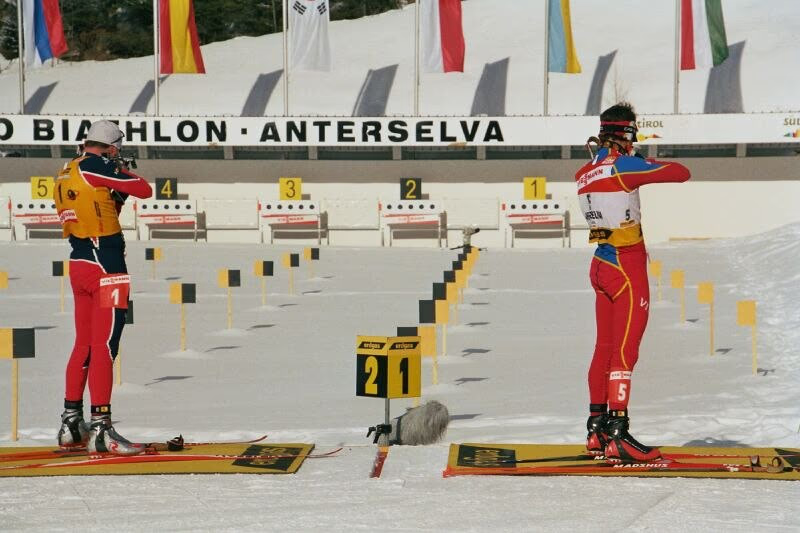
On or near the shooting range, you do not make sudden movements, step into a shooter's peripheral vision, or cross a lane while an athlete is in position. This extends beyond written safety rules to a cultural expectation that everyone — athletes, coaches, camera operators, volunteers — freezes or moves slowly near active shooters.
Aid a collapsed or injured competitor
Inherited from Nordic skiing's deep tradition, biathletes are expected to stop and assist a competitor who has collapsed due to medical distress — even at the cost of their own race result. Skiing past a seriously injured athlete is considered a profound breach of the sport's values. Officials also respond, but fellow competitors are expected to act first.
Keep the muzzle pointed downrange at all times on the range
While IBU regulations mandate safe rifle handling, the cultural expectation goes further: experienced biathletes never swing a muzzle across the range regardless of whether the weapon is loaded or flags are raised. Violating this — even accidentally — draws immediate informal rebuke from fellow athletes and is a reputational mark even if no written penalty is issued.
Accept missed targets and penalty loops without protest
A missed target is settled by the penalty loop — athletes do not argue with officials over whether a target was hit. The sport's culture holds that disputing a miss (outside a formal protest procedure) undermines the integrity of the competition. Athletes are expected to take their loops promptly and without visible frustration directed at officials.
Respect the pursuit and mass start range queue
In pursuit and mass start formats where multiple athletes arrive at the range simultaneously, athletes enter their assigned lanes without cutting off or crowding competitors mid-approach. Bumping, blocking, or forcing a competitor to break stride entering a lane is considered unsporting even when not explicitly penalized.
Calibre: .22 Long Rifle (LR) rimfire, 5.6 mm bore diameter. This is the only calibre permitted in biathlon competition.; Action: Bolt-action (straight-pull bolt is standard for speed). No automatic or semi-automatic actions permitted.; Minimum weight: 3.5 kg (7.7 lb) including the carrying harnes...
Why people argue about this
People often assume that different calibers are allowed in biathlon competitions for variety, but they misunderstand that the official rule specifically states only .22 Long Rifle is permitted, leading to arguments about whether other calibers should be included or not.
Type: .22 LR rimfire cartridges. Athletes select and test their own ammunition for optimal accuracy and reliability in cold conditions.; Quantity per stage: 5 rounds loaded in the magazine. In relay events, athletes carry 3 additional spare rounds per shooting stage (loaded manually one at a time...
Why people argue about this
People often assume that the .22 LR is just a standard caliber for all biathlon competitions, forgetting that it's specifically regulated in terms of its type—only bolt-action firearms are allowed due to safety concerns and environmental impact from other types.
Technique: Free technique (skating) is used in all biathlon events. Classical technique is not used in modern competition.; Ski specifications: Per FIS cross-country regulations. Minimum ski length based on athlete height.; Wax restrictions: Fluorocarbon waxes are banned (environmental regulation...
Why people argue about this
People often assume that any rifle caliber is acceptable as long as it's bolt-action with open sights, which leads them to misunderstand that only .22 Long Rifle in a bolt-action configuration with open sights can be used in Biathlon competitions per this rule. They overlook the specific mention of calibre and exact equipment requirements.
Rifle harness: Custom-fitted harness worn on the back. Rifle must be secured with the barrel pointing upward at all times during skiing. Quick-release mechanism for rapid transition to shooting position.; Shooting mat (prone): Athletes may use a personal shooting mat for prone stages. The mat pro...
Why people argue about this
People often assume that the 3.5 kg weight requirement applies only to the carrying harness itself, forgetting about the shooting mat. However, the official rule explicitly states it includes both items together, leading to misunderstandings and arguments over whether athletes are adhering strictly to the combined total weight limit or just focusing on one component.
Distance: 50 m (164 ft) from the firing line to the targets.; Lanes: Minimum 30 firing lanes for World Cup and Olympic competitions. Each lane is approximately 2.75 m (9 ft) wide.; Prone targets: 5 circular metal plates, each 45 mm (1.77 in) in diameter. The target falls (closes) when hit, provid...
Why people argue about this
People often assume that the shooting range distance is a fixed 50 meters based on the official verdict, but in reality, it can vary depending on the type of targets used and the specific competition setup, leading to misunderstandings about how far athletes actually have to shoot from.
Sprint course: Loops of 2.5 km (men) or 2.5 km (women), with the course passing through the stadium and shooting range area between loops.; Individual course: Loops of 4 km or 5 km depending on the venue, with 4 passes through the shooting range.; Terrain profile: Designed per IBU specifications ...
Why people argue about this
People often assume that manual backups are only for emergencies, thinking they're not necessary for regular competitions since electronic systems work perfectly fine. But actually, the rule mandates both for reliability—electronic systems must be used, but in case of failure or malfunction, a backup is always needed to ensure fair and safe scoring.
Penalty loop: 150 m (492 ft) circuit located adjacent to the shooting range. Athletes ski one loop for each missed target (in Sprint, Pursuit, Mass Start, and Relay events). Completing one loop adds approximately 20–25 seconds to the athlete's total time.; Stadium layout: Encompasses the start/fi...
Why people argue about this
People often assume that manual backup targets are only used as a last resort in case of electronic system malfunctions, forgetting that they're always present for every shooting event, ensuring accuracy regardless of technical issues. They overlook the fact that these backups are an integral part of the rule, not just a fallback option.
Individual events: Nations may enter up to 4 athletes per gender at the Olympics (based on IBU qualification rankings).; Mass Start: Limited to 30 athletes based on current World Cup or Olympic standings.; Pursuit: Top 60 from the Sprint qualify. Start intervals based on Sprint finish time gaps.
Why people argue about this
People often assume that a nation can enter up to 4 athletes per gender in Biathlon based solely on their IBU qualification rankings, but actually, it's limited by both gender and country, with no athlete being able to compete more than once in an event regardless of ranking.
Technical Delegate (TD): Appointed by IBU. Oversees rule compliance, course homologation, and equipment controls.; Chief of Competition: Manages the organising committee and event logistics.; Range Officer: Controls access to the shooting range, manages firing lane assignments, and ensures safety...
Why people argue about this
People often assume that the Technical Delegate's role is solely about enforcing penalties for infractions during races, when in reality, their primary responsibility is ensuring all safety protocols are followed throughout competitions, from proper equipment checks to emergency procedures readiness, which can extend long before and after race times.
Individual/Sprint: Interval start. Athletes start at 30-second or 1-minute intervals. Start order determined by bib number (often based on World Cup ranking).; Pursuit: Time-gap start based on Sprint results. The Sprint winner starts first; subsequent athletes start with their time deficit from t...
Why people argue about this
People often assume that the start intervals are strictly based on finishing times from previous races, thinking it's a fixed formula for all biathlon events. However, the official verdict clarifies that these intervals are determined by Sprint event finish gaps, which can vary depending on race conditions and other factors not directly related to past performance.
The longest and most traditional biathlon event. Athletes ski 5 loops (4 km each for men, 3 km each for women, though course loop lengths vary by venue) with 4 shooting stages in alternating order: prone, standing, prone, standing.
Why people argue about this
People often assume that the shooting stages are randomly assigned between prone and standing positions without considering the alternating pattern specified in the rule. But actually, athletes know they must alternate between prone and standing shooting phases, which can lead to strategic planning based on their performance strengths.
Three skiing loops with 2 shooting stages: first prone, then standing. Each missed target requires the athlete to ski one 150 m penalty loop (approximately 20–25 seconds per loop).
Why people argue about this
People often assume that the penalty loops are just for adding time to your score, forgetting that they're also a mandatory part of completing each missed target, requiring you to ski an extra 150 meters regardless of whether you hit or miss the next shot. This oversight leads to misunderstandings about how these penalties affect overall race times and strategy.
The top 60 finishers from the Sprint start at intervals corresponding to their time gaps from the Sprint winner. Five skiing loops with 4 shooting stages: prone, prone, standing, standing.
Why people argue about this
People often assume that the intervals between these skiers are based solely on their Sprint race times, which can lead to misunderstandings about how closely they matched up with the overall race winner. The truth is, the official rule specifies that these intervals are determined by time gaps from the Sprint event's fastest finisher, not just any participant in the Sprint.
All 30 athletes start simultaneously in a mass start. Five skiing loops with 4 shooting stages: prone, prone, standing, standing.
Why people argue about this
People often assume that athletes have unlimited spare rounds available at each shooting stage in case they miss their target, which isn't true according to Y, the official rules state they get 8 total rounds per stage (5 from the magazine plus 3 additional spare rounds), so missing a shot doesn't mean they're out of ammunition.
Each team of 4 athletes skis one leg consisting of 3 skiing loops and 2 shooting stages (prone, standing). In relay, athletes have 3 spare rounds per shooting stage in addition to the 5 in the magazine (8 total per stage).
Why people argue about this
People often assume that the spare rounds apply only during their own shooting stages in a relay race, forgetting they're available for all teammates throughout the entire event. The confusion arises because these extra rounds are meant to be used by each athlete at their discretion across all shooting stages, not just saved up for their specific turn.
Two women ski the first two legs (6 km each), followed by two men (7.5 km each). Same relay shooting rules apply: 5 loaded + 3 spare per stage.
Why people argue about this
People often assume that the mixed relay in Biathlon (IBU) means alternating between men and women for every leg, but actually it's structured so two women ski first legs of 6 km each, followed by two men skiing their respective 7. 5 km legs. This creates a bit of confusion about how the genders are distributed across the relay sequence.
Upon arriving at the range, athletes enter their assigned lane, remove the rifle from the harness, assume the shooting position (prone or standing), and engage 5 targets from left to right (or in a...
Why people argue about this
People often assume that they can only shoot left-to-right in a prone position, missing the understanding that they have full flexibility of shooting from either standing or prone positions as long as all 5 targets are hit in order. This confusion stems directly from the rule's lack of explicit mention of other shooting stances besides prone.
All biathlon events are determined by total elapsed time. The fastest time wins.
Why people argue about this
People often assume that only skiing times count in biathlon races, forgetting about the shooting segments entirely. But the official verdict clarifies that both skiing and shooting times are included in calculating total elapsed time, which is why the fastest overall time wins.
In the Individual event, each missed target adds 1 minute (60 seconds) to the athlete's total time. With 20 possible targets across 4 stages, a perfect shooting score adds 0 penalty minutes, while a worst-case scenario adds 20 minutes.
Why people argue about this
People think they can just shoot all 20 targets perfectly without realizing that missing even one adds a minute to their time, so they underestimate how critical precision shooting is in Biathlon's Individual event. The confusion arises because they fail to grasp the cumulative effect of those missed shots and how it impacts their overall race time significantly.
In Sprint, Pursuit, Mass Start, and Relay events, each missed target requires skiing one 150 m penalty loop. Elite athletes complete the loop in 20–25 seconds, depending on course conditions and fatigue.
Why people argue about this
People often assume that the penalty loop time is a fixed 20-25 seconds regardless of an athlete's speed or fatigue level during competition, but in reality, it adjusts based on course conditions and how tired they are at that moment, leading to varied penalties even for missed targets.
The team's total time is the elapsed time from the first-leg start to the final-leg finish. All penalty loop time is included.
Why people argue about this
People often assume that only the actual race times count towards scoring in a relay event, forgetting about penalty loops altogether. But the official verdict clarifies that all time spent, including penalties for missing checkpoints, is factored into the total score. This can lead to unexpected outcomes where teams with fewer actual race laps still end up ahead if they took more penalties.
, down to 40th = 1 point). ), and Nations Cup rankings used for Olympic quota allocation.
Why people argue about this
People often think that World Cup points are awarded based strictly on finishing order, forgetting that they're also influenced by a multiplier system tied to competition level (like different categories for elite vs. junior athletes). This leads to confusion about how their performance in one race affects the total points over multiple competitions.
Pointing rifle incorrectly: Rifle must be pointed downrange at all times when loaded and at the firing point. Violation results in immediate disqualification and potential competition ban.; Loaded rifle outside range: Carrying a loaded rifle outside the designated shooting area results in DSQ.; A...
Why people argue about this
People often assume that pointing a rifle incorrectly means holding it at an angle away from their body, thinking it's just about aiming wrong. In Biathlon, however, what really counts as "incorrect" is pointing the muzzle directly at another athlete or spectator, which can be interpreted more broadly than just a slight deviation from vertical.
Early start: Starting before the signal — 1-minute time penalty in interval-start events or restart.; Wrong shooting lane: Shooting at targets in the wrong lane — hits do not count, time penalty applied, and the athlete must complete the correct number of penalty loops for the actual misses.; Ski...
Why people argue about this
People often assume that violating "7.2 Competition Violations" in Biathlon means only starting early or shooting in the wrong lane will result in a time penalty, but actually, it includes ANY violation of these rules, such as not wearing proper safety gear or failing to follow race officials' instructions, which can lead to penalties ranging from warnings and fines to disqualification.
Yellow card: Warning for unsportsmanlike conduct, minor obstruction, or non-dangerous rule violations.; Red card: Immediate DSQ for repeated yellow-card offences or serious unsportsmanlike conduct.; IBU disciplinary proceedings: Serious violations (doping, deliberate safety breaches, equipment fr...
Why people argue about this
People often assume that just carrying a loaded rifle is enough for a penalty, forgetting that it must be used outside the designated range area. In Biathlon, they actually need to misuse it by firing or even aiming at something other than targets, which leads to disqualification and possible competition bans if they're caught breaking this rule.
Range Officer authority: The Range Officer has absolute authority to halt competition if any safety concern arises on the range. All athletes must comply immediately.; Barrel direction: When carrying the rifle on the harness, the barrel must point straight up at all times. When transitioning to/f...
Why people argue about this
People often assume that Range Officers can only halt a race if there's an immediate safety threat, but they forget that even routine checks like barrel direction and rifle inspections can be halted at their discretion for perceived safety issues, leading to misunderstandings about when exactly the authority kicks in.
Course marking: Entire course marked with coloured flags and directional arrows. Sharp corners and steep descents marked with additional caution signs.; Medical stations: Medical personnel positioned at regular intervals along the course with radio communication to the stadium medical facility.; ...
Why people argue about this
People often assume that keeping their rifle barrels pointed up is just a safety precaution against accidental discharges, but they misunderstand the full scope of what it means in Biathlon - specifically, how it applies to transitions where athletes need to move quickly between uphill and downhill sections without dropping their rifles, which could be dangerous if not handled properly.
Storage: Ammunition transported and stored per IBU safety regulations. Athletes are responsible for their own ammunition supply and must ensure no loose rounds are on the course.; Cold-weather reliability: Athletes test ammunition in competition-temperature conditions during training. Misfires mu...
Why people argue about this
People often assume that since Biathlon doesn't explicitly mention ammunition handling in its safety guidelines, it must be a non-issue. But actually, the lack of direct reference means athletes are expected to handle ammunition safely according to general sporting codes and firearm regulations, which can lead to misunderstandings about what specific protocols apply.
Calibre: .22 Long Rifle (LR) rimfire, 5.6 mm bore diameter. This is the only calibre permitted in biathlon competition.; Action: Bolt-action (straight-pull bolt is standard for speed). No automatic or semi-automatic actions permitted.; Minimum weight: 3.5 kg (7.7 lb) including the carrying harnes...
Why people argue about this
People often assume that biathlon rifles can be of any caliber as long as they're bolt-action, which leads them to misunderstand that automatic or semi-automatic actions are strictly prohibited, even though the official rule clearly states no such actions are allowed.
Distance: 50 m (164 ft) from the firing line to the targets.; Lanes: Minimum 30 firing lanes for World Cup and Olympic competitions. Each lane is approximately 2.75 m (9 ft) wide.; Prone targets: 5 circular metal plates, each 45 mm (1.77 in) in diameter. The target falls (closes) when hit, provid...
Why people argue about this
People often assume that the size of the metal targets doesn't matter since they're always hit by bullets in real races, but actually, the exact dimensions are crucial for consistent scoring across different biathlon events and even between shooting ranges. The 45 mm or 115 mm sizes ensure fair play regardless of where a shooter is competing.
Individual events: Nations may enter up to 4 athletes per gender at the Olympics (based on IBU qualification rankings).; Mass Start: Limited to 30 athletes based on current World Cup or Olympic standings.; Pursuit: Top 60 from the Sprint qualify. Start intervals based on Sprint finish time gaps.
Why people argue about this
People often assume that the 4-athlete limit per gender applies only to individual events, forgetting that it also includes Mass Start events, which are essentially a combination of sprint and distance races. This oversight leads to misunderstandings about how many athletes from each nation can compete in total across different event formats.
The longest and most traditional biathlon event. Athletes ski 5 loops (4 km each for men, 3 km each for women, though course loop lengths vary by venue) with 4 shooting stages in alternating order: prone, standing, prone, standing.
Why people argue about this
People often assume that the shooting stages are always in a fixed order of prone, standing, prone, standing, forgetting that they can vary based on venue layout, which leads to confusion about where each stage should be placed during the race.
All biathlon events are determined by total elapsed time. The fastest time wins.
Why people argue about this
People often assume that biathlon scores are based solely on shooting accuracy, thinking time spent skiing doesn't matter much since it's a short segment. But actually, the scoring system in Section 6 takes into account both the skiers' times and their shooting precision, with the overall fastest time winning, not just shooting hits or misses.
Pointing rifle incorrectly: Rifle must be pointed downrange at all times when loaded and at the firing point. Violation results in immediate disqualification and potential competition ban.; Loaded rifle outside range: Carrying a loaded rifle outside the designated shooting area results in DSQ.; A...
Why people argue about this
People often argue that they didn't mean to discharge their rifle during a practice session, thinking it's too strict for just accidental shots outside competition time. But actually, the rule is designed to prevent accidents in high-stress race conditions and ensure fair play by penalizing any misuse of firearms regardless of intent.
Range Officer authority: The Range Officer has absolute authority to halt competition if any safety concern arises on the range. All athletes must comply immediately.; Barrel direction: When carrying the rifle on the harness, the barrel must point straight up at all times. When transitioning to/f...
Why people argue about this
People often assume that Range Officers can only halt a race if there's an immediate safety threat, which they argue against since it could lead to unnecessary delays or cancellations. But in reality, the rule allows for inspections and halts based on safety concerns, even if those concerns aren't immediately life-threatening, ensuring all equipment is safe before use.