


🏛️Official — IBU
Loading OpenSourceSports…
Winter Sports
1 players
outdoor
ski, pole, firearm
10 essential rules
Biathlon combines cross-country skiing and precision rifle marksmanship into a single gruelling competition. The sport has been on the Olympic programme since 1960 (men) and 1992 (women). It is governed by the International Biathlon Union (IBU) under the IBU Event and Competition Rules (ECR). The...
Calibre: .22 Long Rifle (LR) rimfire, 5.6 mm bore diameter. This is the only calibre permitted in biathlon competition.; Action: Bolt-action (straight-pull bolt is standard for speed). No automatic or semi-automatic actions permitted.; Minimum weight: 3.5 kg (7.7 lb) including the carrying harnes...
Type: .22 LR rimfire cartridges. Athletes select and test their own ammunition for optimal accuracy and reliability in cold conditions.; Quantity per stage: 5 rounds loaded in the magazine. In relay events, athletes carry 3 additional spare rounds per shooting stage (loaded manually one at a time...
Technique: Free technique (skating) is used in all biathlon events. Classical technique is not used in modern competition.; Ski specifications: Per FIS cross-country regulations. Minimum ski length based on athlete height.; Wax restrictions: Fluorocarbon waxes are banned (environmental regulation...
Rifle harness: Custom-fitted harness worn on the back. Rifle must be secured with the barrel pointing upward at all times during skiing. Quick-release mechanism for rapid transition to shooting position.; Shooting mat (prone): Athletes may use a personal shooting mat for prone stages. The mat pro...
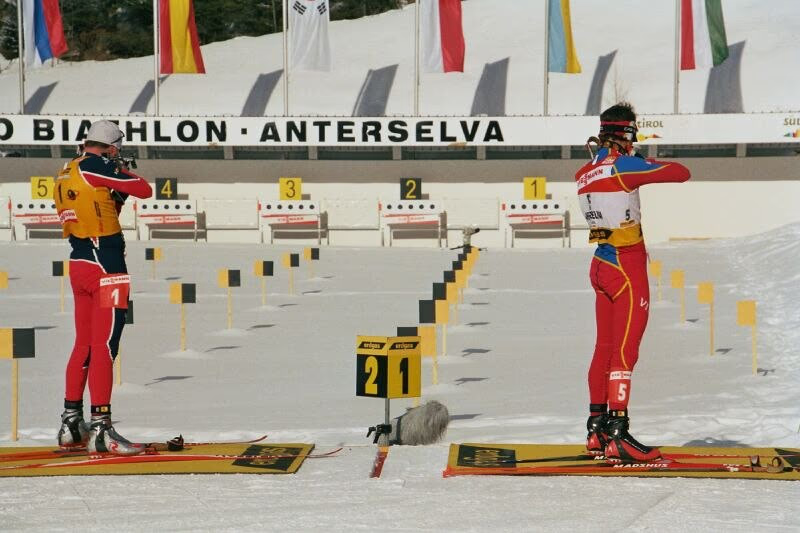
Distance: 50 m (164 ft) from the firing line to the targets.; Lanes: Minimum 30 firing lanes for World Cup and Olympic competitions. Each lane is approximately 2.75 m (9 ft) wide.; Prone targets: 5 circular metal plates, each 45 mm (1.77 in) in diameter. The target falls (closes) when hit, provid...
Sprint course: Loops of 2.5 km (men) or 2.5 km (women), with the course passing through the stadium and shooting range area between loops.; Individual course: Loops of 4 km or 5 km depending on the venue, with 4 passes through the shooting range.; Terrain profile: Designed per IBU specifications ...
Penalty loop: 150 m (492 ft) circuit located adjacent to the shooting range. Athletes ski one loop for each missed target (in Sprint, Pursuit, Mass Start, and Relay events). Completing one loop adds approximately 20–25 seconds to the athlete's total time.; Stadium layout: Encompasses the start/fi...
Individual events: Nations may enter up to 4 athletes per gender at the Olympics (based on IBU qualification rankings).; Mass Start: Limited to 30 athletes based on current World Cup or Olympic standings.; Pursuit: Top 60 from the Sprint qualify. Start intervals based on Sprint finish time gaps.
Technical Delegate (TD): Appointed by IBU. Oversees rule compliance, course homologation, and equipment controls.; Chief of Competition: Manages the organising committee and event logistics.; Range Officer: Controls access to the shooting range, manages firing lane assignments, and ensures safety...
Individual/Sprint: Interval start. Athletes start at 30-second or 1-minute intervals. Start order determined by bib number (often based on World Cup ranking).; Pursuit: Time-gap start based on Sprint results. The Sprint winner starts first; subsequent athletes start with their time deficit from t...
Absolute silence on the shooting range
During competition shooting stages, athletes, coaches, and spectators are expected to maintain complete silence near the range. Even when IBU rules mandate quiet in the lanes, the broader cultural norm extends this silence to all range-adjacent areas. Shouting or loud coaching near shooters is considered a serious breach of etiquette regardless of whether it technically violates written rules.
Particularly sensitive during prone shooting, where noise and vibration can disrupt concentration and trigger pull.
Do not move suddenly or unpredictably near a shooter
On or near the shooting range, you do not make sudden movements, step into a shooter's peripheral vision, or cross a lane while an athlete is in position. This extends beyond written safety rules to a cultural expectation that everyone — athletes, coaches, camera operators, volunteers — freezes or moves slowly near active shooters.
Violations are rare but treated as serious lapses in range culture, not just rule infractions.
Aid a collapsed or injured competitor
Inherited from Nordic skiing's deep tradition, biathletes are expected to stop and assist a competitor who has collapsed due to medical distress — even at the cost of their own race result. Skiing past a seriously injured athlete is considered a profound breach of the sport's values. Officials also respond, but fellow competitors are expected to act first.
Ready to dive deeper?
This norm is common across all Nordic disciplines and is part of the broader Nordic skiing code of conduct.
Keep the muzzle pointed downrange at all times on the range
While IBU regulations mandate safe rifle handling, the cultural expectation goes further: experienced biathletes never swing a muzzle across the range regardless of whether the weapon is loaded or flags are raised. Violating this — even accidentally — draws immediate informal rebuke from fellow athletes and is a reputational mark even if no written penalty is issued.
Part of the martial/military heritage of biathlon; strict muzzle discipline is cultural identity, not only compliance.
Accept missed targets and penalty loops without protest
A missed target is settled by the penalty loop — athletes do not argue with officials over whether a target was hit. The sport's culture holds that disputing a miss (outside a formal protest procedure) undermines the integrity of the competition. Athletes are expected to take their loops promptly and without visible frustration directed at officials.
Electronic target systems have reduced disputes, but the norm predates them.
Respect the pursuit and mass start range queue
In pursuit and mass start formats where multiple athletes arrive at the range simultaneously, athletes enter their assigned lanes without cutting off or crowding competitors mid-approach. Bumping, blocking, or forcing a competitor to break stride entering a lane is considered unsporting even when not explicitly penalized.
The most competitive flashpoint for this norm; has occasionally been scrutinized in close IBU World Cup races.