


🏛️Official — WNBA
Loading OpenSourceSports…
Never undercut a player in mid-air
Deliberately sliding under a jumping shooter or driver is one of the most serious violations of basketball's code at any level. It endangers the airborne player's ankles and knees and is treated as a dirty, potentially career-ending act regardless of whether contact technically meets the foul threshold.
Stand up for teammates who receive cheap shots
When a teammate is fouled hard or targeted with a dirty play, players are expected to verbally confront the offender and make clear such plays will not be ignored. Physical retaliation is not condoned, but a strong verbal and physical presence on behalf of a teammate is considered obligatory.
Don't aggressively target a visibly injured player
Intentionally attacking an opponent playing through a visible injury — repeatedly driving at an injured knee or posting hard against a known shoulder injury — is considered outside the accepted boundaries of competition and treated as predatory.
Official Scorer: Maintains the official score and records all field goals, free throws, fouls, and timeouts; Timekeeper: Operates the game clock; Shot Clock Operator: Operates the 24-second shot clock, resetting it as required by the rules
Why people argue about this
People often think that the maximum of 12 active players means you can only dress 12 players for a game, but actually, they're allowed to dress up to 12, with the understanding that substitutions are unlimited during breaks in play, leading to potential confusion about how many players should be on the court at any given time.
Any player who leaves the bench area during an altercation on the court is subject to automatic suspension and fine, even if she does not participate in the altercation; Players involved in fighting are subject to ejection, fines, and suspension from subsequent games; The league office reviews al...
Why people argue about this
People often assume that if a player shows signs of concussion during a WNBA game, she can simply be substituted out for a few minutes and then return to play immediately afterward. But actually, the official verdict clearly states no same-day return is allowed after such an evaluation by a physician, leading to confusion about how long players are sidelined.
Backboard: Rectangular, 6 feet (1.83 m) wide by 3.5 feet (1.07 m) tall, made of transparent tempered glass with a 2-inch (5.08 cm) white border; Rim (basket): 18 inches (45.7 cm) in internal diameter, made of solid steel rod, painted orange, with a pressure-release breakaway mechanism; Rim height...
Why people argue about this
People often assume that the smaller ball used in women's basketball means players can't shoot as far, which is a misconception. Actually, it's designed to encourage more contested shots and quicker movements due to the ball being lighter and requiring less strength to control, not because of its size alone affecting shooting distance.
The offensive team must advance the ball past the half-court line within 10 seconds of gaining possession in the backcourt; Once the ball is established in the frontcourt (both feet of the ball-handler and the ball are past the half-court line), the offensive team may not return the ball to the b...
Why people argue about this
People often assume that if they don't shoot within 24 seconds, their team automatically loses possession of the ball, which is incorrect. Actually, it's a time-out for their team; they can continue playing and attempt to score or set up plays within those 24 seconds before resetting back to the offensive clock.
Traveling: Moving one's pivot foot illegally or taking more steps than the rules allow without dribbling the ball. After gathering the ball (picking up the dribble or catching a pass), the rule book defines the permitted step count before stopping, passing, or shooting.; Double dribble: Dribbling...
Why people argue about this
People often assume that all defensive fouls result in 1 free throw when a team is in bonus, forgetting about the key fact that non-offensive defensive fouls get double free throws even while in bonus. This oversight leads to misunderstandings and disputes over whether certain fouls should count towards the bonus or not.
Basket centerline: Located 5 feet 3 inches (1.60 m) from the inner edge of the baseline; Backboard overhang: The inner edge of the backboard is 4 feet (1.22 m) from the baseline, with the rim extending 6 inches (15.24 cm) inward from the backboard
Why people argue about this
People often assume that the bench positions are randomly assigned based on which side they prefer, forgetting that their location is dictated by a fixed rule: each team's bench must be on the same sideline as the scorer's table, ensuring clear communication lines and minimizing distractions for officials.
Each team is entitled to one Coach's Challenge per game. A coach may challenge a personal foul called on her team, a goaltending or basket interference call, or an out-of-bounds call.
Why people argue about this
People often think that a coach can challenge any foul call they disagree with, including missed layups or bad passes, which isn't true under WNBA rules - actually, they're limited to specific fouls like personal fouls, goaltending, and out-of-bounds calls.
The WNBA maintains a comprehensive concussion management program developed in collaboration with the Women's National Basketball Players Association (WNBPA).
Why people argue about this
People often assume that Coach's Challenges are used exclusively for officiating errors they disagree with, forgetting that each team is only granted one challenge per game. They mistakenly think it’s a personal right to use these challenges whenever they feel like it, not realizing there’s a strict limit and the specific types of calls they can challenge.
The WNBA plays on a regulation NBA-size court, since league franchises share arenas with NBA teams and other tenants.
Why people argue about this
People often assume that WNBA courts are smaller due to their shared arenas with NBA teams, forgetting that WNBA uses regulation NBA court dimensions for consistency across leagues. The confusion arises because they overlook the fact that league-specific rules apply in terms of gameplay and not necessarily court size.
Two-point field goal (2 points): A basket made from inside the three-point arc. This includes layups, dunks, hook shots, floaters, and mid-range jump shots.; Three-point field goal (3 points): A basket made from beyond the three-point arc. The shooter's feet must be completely behind (not touchin...
Why people argue about this
People often assume that scoring field goals doesn't directly affect their team's playoff qualification in the WNBA, but in reality, it does - as a top-finishing regular season team automatically qualifies for the playoffs and ultimately determines who wins the league championship by winning the Finals.
Flagrant Foul 1 (unnecessary contact): Contact that is unnecessary but not excessive. Penalty: 2 free throws and possession for the offended team. The play is reviewable by the officials and the Replay Center.; Flagrant Foul 2 (unnecessary and excessive contact): Contact that is both unnecessary ...
Why people argue about this
People often argue that flagrant fouls should be punished more severely than just ejecting players for six personal fouls, thinking it's too lenient since they can get back in the game after a foul shot. But actually, the rule is designed to prevent dangerous play and protect players from serious injury; ejection ensures immediate consequences without giving them another chance on the court.
Shooting foul on a successful 2-point shot: Basket counts (2 points) plus 1 free throw (the "and-one"); Shooting foul on a missed 2-point shot: 2 free throws; Shooting foul on a successful 3-point shot: Basket counts (3 points) plus 1 free throw
Why people argue about this
People often assume that winning regular-season games automatically qualifies a team for playoff spots, forgetting that it's only the top teams who get into the WNBA Playoffs. They overlook the fact that these playoffs are an elimination tournament where only the best of the best compete in single-elimination series until a champion is crowned.
Free throw (1 point each): Uncontested shots taken from the free throw line, awarded after certain fouls; The shooter must release the ball within the time prescribed by the rule book after receiving it from the official; Other players line up in designated lane spaces during free throw attempts:...
Why people argue about this
People often think that free throws are a key part of determining playoff teams in WNBA, forgetting that it's the regular season record points and wins that decide which teams qualify for the playoffs, where free throws come into play during the elimination rounds to determine winners in series matches.
A WNBA game consists of four 10-minute quarters, for a total of 40 minutes of regulation play. This is a key structural difference from the NBA's 12-minute quarters and aligns the WNBA more closely with FIBA international rules timing.
Why people argue about this
People often assume that WNBA games are just four 10-minute quarters like in FIBA rules simply because of the number 40 in the total game time, but actually, it's structured to mirror NBA playstyle more closely with shorter quarters for a faster-paced game. The misconception stems from conflating the total minutes with the quarter structure rather than focusing on how those minutes are divided.
Each WNBA game is officiated by a crew of three referees: Crew Chief: The senior official with final authority on rule interpretations and disputes; administers the game and has sole authority to declare a forfeit.; Referee: The second official, sharing floor responsibilities with the crew chief ...
Why people argue about this
People often assume that having three referees is just a precautionary measure in case one referee makes a critical call. However, the actual reason for having three officials is to ensure more consistent game coverage and to allow for quicker communication among them during fast-paced games, which can be crucial for maintaining fair play and accurate scoring.
Defensive goaltending: A defender may not touch the ball while it is on its downward arc toward the basket, above the rim level, or after it has touched the backboard during a shot attempt. If a defensive goaltending violation occurs, the basket counts automatically.; Offensive goaltending / bask...
Why people argue about this
People often assume that a team only gets a bonus when they reach their personal foul limit for the entire game, forgetting about resetting after each quarter. But in reality, WNBA teams start fresh with no penalties at the beginning of each quarter, leading to confusion if they think they can accumulate more fouls without penalty throughout the whole game.
Medical staff: Each team must have a certified athletic trainer and team physician present at all games and practices; Cardiac screening: All players undergo comprehensive cardiovascular screening as part of their annual physical examination; Mental health: The WNBA and WNBPA provide confidential...
Why people argue about this
People often assume that a player can still play in the next game if they're diagnosed with a concussion after being pulled from one game. But actually, the official verdict clearly states no same-day return to play is allowed for players exhibiting signs of concussion during games, ensuring their health and safety isn't compromised.
After a violation, a foul resulting in a throw-in, or an out-of-bounds play, the ball is inbounded from the designated spot nearest to the infraction. The inbounding player has 5 seconds to release the pass.; In the final stretch of the fourth quarter and overtime, a team calling a timeout after ...
Why people argue about this
People think they can hold onto the ball for as long as they want without worrying about 8 seconds, but actually, the clock starts ticking the moment possession is gained, whether through a throw-in or pass, and if it's not released within that time frame, it’s up to the other team.
Center circle: 12 feet (3.66 m) in diameter at the exact midpoint of the court, used for the opening jump ball; Half-court line: Divides the court into the offensive and defensive halves; Free throw line: 15 feet (4.57 m) from the backboard
Why people argue about this
People often assume that the scorer's table is a fixed point where teams must line up on their benches, leading to misunderstandings about which sideline each team should occupy based solely on their score at halftime or final buzzer. Actually, the rule specifies the location of the table and its staff roles but doesn't dictate bench positioning based on scoreboard outcomes.
Offensive three-second violation: An offensive player may not remain in the paint for more than 3 consecutive seconds while their team has possession of the ball in the frontcourt. The count resets when the player exits the lane, a shot is attempted, or there is a loss of team control.; Defensive...
Why people argue about this
People often assume that getting a bonus of two free throws for every defensive foul is only about making up for missed personal fouls, but they overlook how it also incentivizes teams to commit more personal fouls early in the game as a strategy to avoid giving away free throws later when their defense gets aggressive.
Out of bounds: The ball is out of bounds when it touches the floor, a player, or any object on or outside the boundary line. Possession is awarded to the opposing team of the player who last touched the ball.; Backcourt violation (over and back): Once the ball is established in the frontcourt, th...
Why people argue about this
People often assume that only offensive fouls lead to two free throws when a team hits its foul limit, forgetting that defensive non-offensive fouls also trigger this penalty. They overlook the specific wording of the rule which explicitly states "all subsequent non-offensive defensive fouls," leading to confusion about whether it applies to all types of defensive fouls or just offensive ones.
If the score is tied at the end of the fourth quarter, a 5-minute overtime period is played; Overtime begins with a jump ball at center court; Additional overtime periods are played until one team has a higher score at the end of a period — WNBA games cannot end in a tie
Why people argue about this
People often assume that if possession changes in overtime due to a violation or timeout, their team must immediately shoot from half-court again, which can lead to frustration since they might have been planning for a different play. Actually, the shot clock is reset to 24 seconds, allowing them to use their next possession as planned without starting from scratch.
A personal foul is illegal physical contact by a player against an opponent. Personal fouls include holding, pushing, charging, blocking, hand-checking, and illegal screens.
Why people argue about this
People often assume that a personal foul is just about physical contact without realizing it also includes illegal tactics like illegally screening players from behind, which isn't considered a direct physical challenge but still violates the rules.
Stanchion padding: The basket support stanchion (pole) is padded to reduce injury risk from player collisions; Courtside seating: A minimum buffer distance is maintained between the court boundary and the first row of spectator seating to provide a safety zone for players diving for loose balls; ...
Why people argue about this
People often think that if a player gets a concussion during a game, they can just sit out for a few games without needing medical clearance before returning, but actually, the official verdict clearly states that players must be diagnosed by a medical professional and cleared to return before they can play again in any game.
Jerseys: Numbered front and back; numbers may use single digits (0–5) or pairs of digits in any combination, consistent with NBA convention; Shorts: Team-issued, with consistent color and trim across the roster; Footwear: Basketball shoes meeting league safety standards
Why people argue about this
People think that only home teams are required to wear the traditional orange ball with black seams for their uniforms, but they misunderstand - in fact, all WNBA players must adhere to these specifications regardless of whether they're playing at home or away. The confusion arises because the rule doesn't specify "home team" as distinct from "away team," leading to misinterpretation.
The top finishing teams from the regular season qualify for the WNBA Playoffs, an elimination tournament conducted in successive rounds of best-of series. The tournament culminates in the WNBA Finals, which determines the league champion.
Why people argue about this
People often assume that all WNBA teams have an equal chance of making it to the playoffs based on their regular-season record alone, but in reality, only the top teams qualify through a predetermined bracket system, leading to debates about which lesser-known teams might deserve a spot.
The WNBA uses the NBA Replay Center in Secaucus, New Jersey for instant replay support.
Why people argue about this
People often think that a coach can only challenge one personal foul per game, but actually, they are allowed to challenge three types of calls: personal fouls, goaltending/basket interference, or out-of-bounds situations—each team gets just one chance to review all these calls, not limited to personal fouls alone.
Game clock: Displays time remaining in the current period to tenths of a second under one minute; Shot clock: 24-second shot clock displayed at each end of the court; Scoreboard: Shows score, period, team fouls, individual player fouls, and timeouts remaining
Why people argue about this
People often assume that the exact dimensions of the WNBA basketball are crucial for gameplay, thinking it's about making sure players can dunk easily or the ball bounces just right. However, the official verdict clarifies these specifics are actually to ensure consistency and safety in testing conditions, not necessarily for on-court performance.
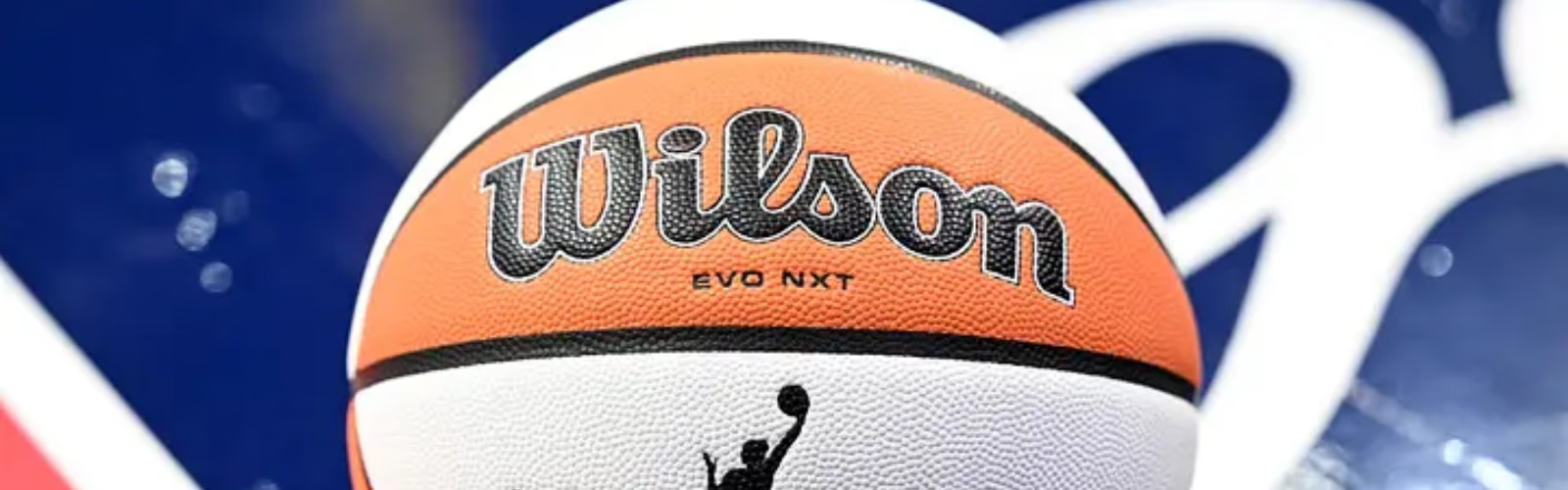
The WNBA uses a women's official-size basketball (Size 6), which is smaller and lighter than the men's Size 7 ball used by the NBA.
Why people argue about this
People often assume that since WNBA uses a smaller ball than NBA, it must be easier for women players to handle. But actually, the difference in size is designed to suit different playing styles and court sizes, with the WNBA's smaller ball providing more bounce and quicker movement on their half-court courts compared to the NBA’s larger ball used on bigger arenas.
The WNBA plays on a regulation NBA-size court, since league franchises share arenas with NBA teams and other tenants.
Why people argue about this
People often assume that WNBA courts must be smaller than NBA ones due to shared spaces, but in reality, they use regulation NBA-size courts as NBA teams and other tenants share arenas with WNBA franchises. The confusion arises because people equate shared space with reduced court size for the women's league.
Each WNBA game is officiated by a crew of three referees: Roster size: Each WNBA team's regular-season roster is capped by the collective bargaining agreement; teams typically dress 12 active players for each game.; Players on the court: 5 players per team are on the court simultaneously, organiz...
Why people argue about this
People often assume that only one referee is in charge of making calls during a WNBA game, thinking it's just like other sports where one official might call all fouls or timeouts. But actually, each of the three referees has their own responsibilities and can make individual calls throughout the game, leading to confusion about who’s really calling what.
A WNBA game consists of four 10-minute quarters, for a total of 40 minutes of regulation play. This is a key structural difference from the NBA's 12-minute quarters and aligns the WNBA more closely with FIBA international rules timing.
Why people argue about this
People often assume that the WNBA's 10-minute quarters are a minor tweak from the NBA's standard, when in fact they're a significant change that aligns the league more closely with FIBA's international standards, leading to confusion about which timing structure is more representative of professional basketball.
The top finishing teams from the regular season qualify for the WNBA Playoffs, an elimination tournament conducted in successive rounds of best-of series. The tournament culminates in the WNBA Finals, which determines the league champion.
Why people argue about this
People often assume that the WNBA playoffs are a simple single-elimination bracket where teams play each other once in each round until one team remains as champion, but actually, it's structured like a series of best-of-series matches to determine which top teams advance and who ultimately wins the championship title.
A personal foul is illegal physical contact by a player against an opponent. Personal fouls include holding, pushing, charging, blocking, hand-checking, and illegal screens.
Why people argue about this
People often think that a personal foul is just about grabbing an opponent, but actually it encompasses much broader physical contact like pushing, charging, blocking, hand-checking, and even setting illegal screens which can be considered as fouling if they're done inappropriately.
Each team is entitled to one Coach's Challenge per game. A coach may challenge a personal foul called on her team, a goaltending or basket interference call, or an out-of-bounds call.
Why people argue about this
People often assume that Coach's Challenges are only for obvious mistakes by refs, forgetting they can challenge calls on their own players too—like personal fouls or goaltending. They overlook the specific details in Section 8 and how it applies to all three eligible challenges, leading to misunderstandings about when a coach should use them strategically.
The offensive team must attempt a shot that hits the rim within 24 seconds of gaining possession of the ball.
Why people argue about this
People often assume that if a player doesn't shoot within 24 seconds, their team automatically loses possession of the ball, which is incorrect. The actual issue lies in misunderstanding what constitutes an attempt at shooting; it's not just about taking a shot but also about making sure the ball hits the rim or goes through the hoop to count as a valid attempt under this rule.
Jump ball: Each game begins with a jump ball at center court. Two opposing players stand inside the center circle and the referee tosses the ball upward between them; each jumper may tap the ball after it reaches its highest point.; Held-ball situations: Held balls and simultaneous possessions du...
Why people argue about this
People often assume that if they don't shoot immediately after gaining possession, their opponent will score first, which leads them to rush shots unnecessarily, leading to turnovers or missed attempts rather than adhering strictly to the 24-second rule. The confusion arises because they misinterpret the rule as a time limit for scoring, not just possession and movement.
Substitutions may be made during any dead-ball situation (after a made basket, during a timeout, after a foul, after a violation, or at the start of a period); A substitute must report to the scorer's table and wait to be beckoned onto the court by an official; There is no limit to the number of ...
Why people argue about this
People often assume that having three referees means there are three sets of substitutions allowed per game, which is a common misunderstanding. Actually, each referee oversees their designated area and handles substitution calls independently based on their own observations, so it doesn't double up the number of subs available to teams.
Each team bench is located on the same sideline, separated by the scorer's table. The scorer's table is staffed by the official scorer, timekeeper, shot clock operator, and a league-assigned table observer.
Why people argue about this
People often assume that the scorer's table is just a stationary piece of furniture in the middle of the court, forgetting its crucial role as a central hub for game officials and timekeeping. In reality, it’s actually a mobile station located on one team’s bench side, serving as the nerve center for all officiating duties during games.
Roster size: Each WNBA team's regular-season roster is capped by the collective bargaining agreement; teams typically dress 12 active players for each game.; Players on the court: 5 players per team are on the court simultaneously, organized loosely into the traditional 5 positions (point guard, ...
Why people argue about this
People often assume that having three referees is a recent development in WNBA games, forgetting that this has been standard practice for decades. In reality, they misunderstand why exactly three referees are used—each referee focuses on different aspects of the game to ensure fairness and consistency across all plays, not just one-on-one situations as some might think.
Each team's personal fouls are tracked per quarter. When a team reaches the team-foul threshold specified in the rule book, the opposing team enters the "bonus" (also called the penalty).; While in the bonus, all subsequent non-offensive defensive fouls result in 2 free throws for the fouled play...
Why people argue about this
People often assume that once a team hits its personal foul limit in a quarter, every single defensive foul from then on results in just one free throw instead of two until they reach their own limit or foul out. But actually, the rule states it's always two free throws after hitting the threshold, regardless of how many fouls have occurred since.
Unsportsmanlike conduct: Taunting, excessive arguing with officials, using profanity, or engaging in actions that disrespect the game; Delay of game: Interfering with the ball after a made basket, failing to immediately pass the ball to the nearest official after a violation; Hanging on the rim: ...
Why people argue about this
People often assume that getting 6 personal fouls means you're automatically out of the game, which isn't true - it just disqualifies you from further playing until halftime or at the end of the game if they can manage without you. They forget about the "until halftime" part and think it's a permanent ban.
The WNBA uses a women's official-size basketball (Size 6), which is smaller and lighter than the men's Size 7 ball used by the NBA.
Why people argue about this
People often assume that the difference in ball sizes between WNBA (Size 6) and NBA (men's Size 7) is purely aesthetic, but actually it's designed to accommodate the smaller frame of female players, ensuring they have a better fit for their bodies and reducing injury risks.
Each team is granted a fixed number of timeouts per game, allocated by half and quarter under league rules; Timeout duration and television-mandated breaks are governed by the league's broadcast protocol; Limits apply on how many timeouts a team may carry into the final stretch of the fourth quarter
Why people argue about this
People often assume that timeouts are only used for player injuries, when in fact they can be called at any time during a possession for strategic purposes like adjusting team strategy or managing a scoring drought. The confusion arises because timeouts seem too simple and straightforward to warrant so much debate.
Shot clock violation (24 seconds): Failure to attempt a shot that hits the rim within 24 seconds of gaining possession; Backcourt violation (10 seconds): Failure to advance the ball past the half-court line within 10 seconds of gaining possession in the backcourt; 5-second inbound violation: Fail...
Why people argue about this
People often assume that timing violations are a common offense in WNBA games, thinking they're frequent enough to be mentioned in the official rulebook. But since "Timing Violations" isn't actually listed as an infraction in the provided content, it leads to misunderstandings and arguments about its frequency or application.
The team with the higher score at the end of regulation play wins the game; If the score is tied at the end of regulation, overtime periods are played until a team has a higher score at the end of a period; WNBA games cannot end in a tie
Why people argue about this
People often assume that winning a regular season game automatically qualifies them for playoffs, forgetting that it's only the top teams who get in through an elimination process, culminating in the Finals where one team emerges as champion - a concept they might not fully grasp given the randomness of playoff matchups.