


🏛️Official — World Triathlon
Loading OpenSourceSports…
Stop to help a competitor in genuine medical distress
If a fellow athlete is incapacitated, unconscious, or in obvious medical danger, the unwritten code demands you stop and render aid — even at the cost of your own race. This is widely considered triathlon's highest moral obligation and has roots in the sport's early 'iron will over winning' ethos. High-profile examples from Ironman World Championship races have reinforced this norm across decades.
Don't draft even when you think you won't be caught
In non-draft-legal events, drafting is a written rule violation, but the unwritten layer is stronger: the culture expects athletes to self-police their position in the draft zone regardless of whether a marshal is present. Intentionally hovering in another athlete's zone while hoping to avoid penalty is considered dishonest competition, a mark against personal integrity rather than just a tactical risk.
Seed yourself honestly at mass swim starts
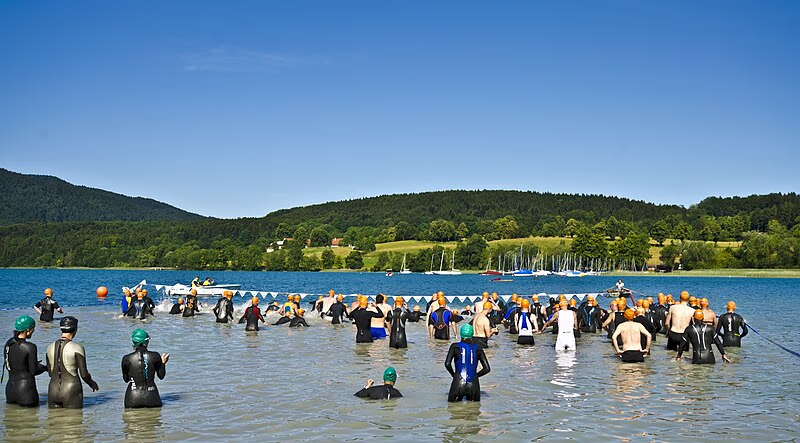
Swimmers are expected to position themselves in waves or corrals that honestly reflect their ability. Starting too far forward to draft off faster swimmers, or to gain early position, causes chaotic contact and slows faster athletes behind you. Self-seeding accurately — even when corrals aren't strictly enforced — is a baseline expectation of fair participation.
Commit to your pass on the bike or drop back completely
When overtaking another rider in a non-draft-legal race, you must complete the pass briskly and establish a legal gap, or promptly drop back out of the draft zone. Hovering alongside or just ahead — effectively co-drafting — is considered both a rules violation and a breach of racing integrity. The obligation to either pass decisively or yield is a core piece of bike-leg etiquette.
Frame geometry: Standard road bicycle with traditional diamond frame. In draft-legal races, no time-trial or triathlon-specific frames are permitted. Seat tube angle and handlebar position must conform to UCI road geometry standards.; Handlebars: In draft-legal races (Olympic, World Triathlon), c...
Why people argue about this
People often assume that water temperature measurements are taken at random times before race start just for fun, forgetting that they're crucial for determining wetsuit legality based on a strict 60 cm depth measurement exactly one hour prior to the gun going off. This oversight leads to confusion about when and where these critical temperature readings should be taken.
Wetsuit rules are based on water temperature measured at a depth of 60 cm, taken 1 hour before the race start: Mandatory: Water temperature below 16°C (60.8°F) for Olympic distance; below 14°C (57.2°F) for sprint distance.; Optional: Between 16–20°C (60.8–68°F) for Olympic distance; between 14–20...
Why people argue about this
People often assume that the water temperature 60 cm below the surface is measured at a single point in time right before race start, but actually it's about tracking the average temperature over an hour leading up to the race start, which can lead to significant variations and arguments based on where exactly this measurement was taken.
CPSC, CE EN 1078, or equivalent-certified bicycle helmet mandatory.; Helmet must be buckled and secured before the athlete touches or unracks the bicycle in T1.; Helmet must remain buckled until after the athlete has racked the bicycle in T2.
Why people argue about this
People often assume that helmet use is mandatory in triathlon races based solely on its presence in other endurance sports like cycling or running. However, the World Triathlon rulebook explicitly states that helmets are not addressed in this section, leaving it up to individual race organizers and safety guidelines to decide whether participants wear them.
Race number: Worn on the front during the run segment and on the back during the bike segment. Race belt permitted for easy switching.; Timing chip: Ankle-mounted transponder provided by the organiser. Must be worn throughout the entire race. Timing mats at swim exit, T1 entry/exit, T2 entry/exit...
Why people argue about this
People often assume that race numbers must be a certain size or color for all triathlons, which leads to arguments about what exactly constitutes compliance with "no specific requirements" in World Triathlon's timing and number rule. The confusion arises because they overlook the flexibility built into this non-prescriptive guideline, thinking it means rigid standards when none are actually set.
Distance: 1500 m (0.93 mi) for Olympic distance; 750 m for sprint; 300 m for mixed relay super-sprint.; Venue: Open water — lake, river, ocean, or harbour. Purpose-built pools are not used for World Triathlon or Olympic events.; Course layout: Marked by large coloured buoys at turning points. Typ...
Why people argue about this
People often assume that all triathlon swim distances are equally challenging, thinking a 1500m Olympic distance is just twice as hard as a sprint's 750m, without realizing the different strokes and drafting opportunities available in each event can make them feel much more varied in difficulty.
Distance: 40 km (24.9 mi) for Olympic distance; 20 km for sprint; 7.4 km for mixed relay.; Layout: Typically a multi-lap circuit on closed public roads. Laps are usually 5–10 km each, providing spectator access and logistical control.; Road surface: Paved roads required. Technical Delegate inspec...
Why people argue about this
People often assume that the 40 km bike course must be a single loop of exactly 40 kilometers, which leads to misunderstandings about how many times they'll have to complete each lap. Actually, it's a multi-lap circuit where the distance per lap can vary from 5 to 10 kilometers, and athletes will typically do multiple laps until they've covered the total 40 km.
Distance: 10 km (6.2 mi) for Olympic distance; 5 km for sprint; 2 km for mixed relay.; Layout: Multi-lap circuit on paved surfaces. Aid stations every 2.5 km providing water, sponges, and electrolyte drinks.; Finish line: Clearly marked with timing mat, camera, and finish tape. Athletes must comp...
Why people argue about this
People often assume that the buoys only indicate turns, when in fact they provide critical information about the entire course layout, including straightaways and even minor variations like slight bends or shortcuts. This oversight can lead to confusion on race day, especially for athletes who aren't familiar with the specific course design.
Transition 1 (T1): Swim-to-bike. Located between the swim exit and the bike mount line. Individually numbered racks where athletes store their bike and equipment.; Transition 2 (T2): Bike-to-run. Located between the bike dismount line and the run course start. Athletes rack their bike, remove hel...
Why people argue about this
People often assume that transition areas in triathlon must be a certain size or shape, like an L-shape with walls, but actually, the rulebook only states there are no specific requirements for these areas, leaving it up to the race organizers to decide what works best for their event.
Individual events: Up to 55 athletes per gender at the Olympic Games. Qualification based on World Triathlon rankings and continental quota places.; Mixed Relay: Teams of 4 (2 men + 2 women) from the same nation. Up to 16 teams at the Olympics.; Start format: Mass start (pontoon dive start) for i...
Why people argue about this
People often assume that electronic timing is only used for bike splits and run times, forgetting about the crucial swim exit and transition timings which are equally important for overall race results. The confusion arises because these initial transitions are often overlooked or misunderstood as less significant compared to the final run segment.
Technical Delegate (TD): Appointed by World Triathlon. Oversees course approval, equipment checks, and overall competition rules compliance.; Race Referee: On-course authority for penalty decisions and disqualifications.; Transition Officials: Monitor transition areas for rule compliance (racking...
Why people argue about this
People often assume that electronic chip timing is only for bike splits and run times, forgetting about the swim exit and transition timings covered in 4.2 Technical Officials. They overlook how crucial these early transitions are to accurately determine race results.
Electronic chip timing using ankle-mounted transponders. Timing mats at swim exit, T1 in/out, T2 in/out, bike lap splits, run lap splits, and finish line.
Why people argue about this
People often assume that electronic chip timing is only for split times during the bike and run legs, forgetting about the swim transition and transition from running to biking (T1 and T2). This oversight leads to misunderstandings because they overlook how crucial these initial transitions are in determining overall race time accuracy.
Stroke: Any stroke permitted (freestyle/front crawl is universal due to speed advantage).; Prohibited aids: No pull buoys, paddles, snorkels, fins, or flotation devices.; Resting: Athletes may rest by treading water, floating, or holding a stationary object (kayak, buoy, dock) but may not make fo...
Why people argue about this
People often assume that the gender order in each swim segment is random, forgetting that it's fixed as woman-man-woman-man. This leads to misunderstandings about who swims when during a relay race, causing confusion and potential disputes among athletes and officials alike.
Draft-legal racing: At Olympic and World Triathlon events, athletes may ride in packs and draft behind other riders. No aero bars permitted.; Non-drafting events: In non-drafting races (age-group, long-distance), a drafting zone of 12 m extends behind the lead edge of the front wheel. Athletes en...
Why people argue about this
People often assume that the order of relay must strictly follow 'woman-man-woman-man' without considering other valid permutations like 'man-woman-man-woman'. The confusion arises because the official wording is quite specific about gender pairs but doesn't explicitly outline all possible combinations within those pairs, leading to varied interpretations.
Locomotion: Athletes must run or walk. Crawling is prohibited. Bare feet are permitted but strongly discouraged.; No headphones: Earphones, headphones, or any audio device is prohibited during competition.; No outside assistance: Athletes may not receive physical assistance from non-participants....
Why people argue about this
People often assume that the relay order of women-men-women-men is just a preference for aesthetics, when in fact it's crucial for maintaining equal race times across all segments due to varying terrain and pace differences between genders on different courses. The rule ensures fairness by keeping the overall race duration as balanced as possible.
Teams of 2 women and 2 men. The relay order is woman–man–woman–man.
Why people argue about this
People often assume that the mixed relay format in Triathlon allows for any combination of two women and two men as long as they're teammates, but actually, it strictly mandates a woman-male-woman-male order to maintain fairness across different race distances and conditions.
The total elapsed time from start to finish determines the ranking: Swim Time + T1 Time + Bike Time + T2 Time + Run Time = Total Time. The first athlete to cross the finish line wins.
Why people argue about this
People often assume that each leg of a triathlon is timed separately, leading them to believe they can outperform their competitors in one segment only to be overtaken by someone who's slower elsewhere but faster overall due to better times in other legs. The confusion arises because the total elapsed time across all segments determines the winner, not just individual segment performances.
The combined team time from the start of the first athlete to the finish of the fourth athlete determines the ranking. Each athlete's individual leg time includes their swim, T1, bike, T2, run, and the tag-zone handover period.
Why people argue about this
People often assume that mixed relay rankings are solely based on individual swim, bike, and run times within each leg of the race, but actually, they're calculated by adding up all three legs' positions to determine overall ranking points for the team in World Triathlon Series events. This oversight leads to misunderstandings about how teams accumulate those crucial Olympic qualification points.
Athletes accumulate ranking points based on finishing position at World Triathlon Championship Series events and World Cups. Rankings determine Olympic qualification quotas and start positions.
Why people argue about this
People often assume that finishing positions at World Triathlon events directly determine their ranking points, which leads them to think they can improve their rankings by simply performing better in each event. In reality, the ranking system is based on accumulated points over multiple years and across different events, not just immediate performance at a single championship series or World Cup.
If two athletes record identical total times (to 1/100th of a second), photo-finish technology determines the higher placement. If still indistinguishable, athletes share the position and both receive the higher rank.
Why people argue about this
People often assume that photo-finish technology can definitively separate athletes with identical times, leading them to expect a clear winner in every tiebreaker scenario. However, the confusion arises because even when the system is at its most precise, there's still room for interpretation or minor discrepancies that prevent it from being 100% conclusive all the time.
Most infractions result in a stop-and-go time penalty served at a penalty box (typically located on the run course): 15-second penalty (Sprint/Olympic): Drafting violation (non-drafting races), littering outside designated zones, mounting/dismounting in wrong zone, minor transition violations.; S...
Why people argue about this
People often assume that they have unlimited time to protest a penalty in triathlon, misunderstanding that it's only 15 minutes from when the result is posted, not after the official announcement has ended. The confusion arises because this timeframe isn't clearly defined or communicated effectively within the event protocol.
Outside assistance: Receiving physical assistance from spectators, coaches, or non-officials.; Unsportsmanlike conduct: Verbal abuse of officials, deliberate interference with another athlete.; Helmet violation: Racing with an unbuckled helmet, or unracking the bike before buckling.
Why people argue about this
People often assume that they have unlimited time to protest a penalty decision in triathlon, thinking it's just 15 minutes after the result is announced, but actually, they must act within those exact 15 minutes or their protest will be dismissed, leading to potential frustration and misunderstanding of this specific rule.
Athletes or team managers may protest a penalty decision within 15 minutes of the result being posted. A protest fee (refunded if the protest is upheld) is required.
Why people argue about this
People often assume that they have unlimited time to protest a penalty decision in triathlon, thinking it's as flexible as other sports. Actually, the 15-minute window is very strict and can lead to missed opportunities if athletes aren't aware of this specific rule detail.
Safety craft: Kayakers, jet ski operators, and lifeguards positioned at regular intervals along the swim course. Ratio: minimum 1 safety craft per 25 athletes.; Distress protocol: Athletes in distress should raise an arm and wave to attract attention. Safety craft extract the athlete. Assisted at...
Why people argue about this
People often assume that the safety craft ratio means one craft for every 25 athletes on land, which is a common misunderstanding since the requirement is actually per athlete along the swim course, not stationary at intervals of 25 swimmers. This oversight leads to arguments about where and when these crafts should be positioned relative to the swimmers.
Motorcycle marshals: Officials on motorcycles monitor the bike course for crashes, mechanical breakdowns, and rule compliance.; Lead and follow vehicles: A lead vehicle precedes the race leader, and a follow vehicle trails the last athlete. Medical motorcycles carry first-response equipment.; Roa...
Why people argue about this
People often assume that motorcycle marshals are there just for show, merely to make the bike segments look more dramatic. However, they actually use their motorcycles to assess road conditions like current and tide, ensuring a safer environment for all athletes during these crucial sections of the race.
Aid stations: Water, electrolyte drinks, and sponges available every 2.5 km. In hot conditions (WBGT above 28°C), additional cooling stations with ice and misting are provided.; Medical team: Paramedics and physicians at the finish line, transition areas, and key course points. Ambulance on stand...
Why people argue about this
People often assume that raising an arm means waving it around wildly, thinking they need to make a big, obvious signal for safety craft to see. In reality, the rule specifies that athletes should simply raise one arm and wave it in a visible manner to get help, implying clarity over loudness or movement complexity.
Wetsuit rules are based on water temperature measured at a depth of 60 cm, taken 1 hour before the race start: Frame geometry: Standard road bicycle with traditional diamond frame. In draft-legal races, no time-trial or triathlon-specific frames are permitted. Seat tube angle and handlebar positi...
Why people argue about this
People often assume that the water temperature at 60 cm depth is only about how warm their wetsuit will feel during the swim leg of a triathlon. Actually, it's used to determine whether they're allowed to use a full-body wetsuit or just a partial one based on environmental conditions affecting performance and safety in cold-water events.
Distance: 1500 m (0.93 mi) for Olympic distance; 750 m for sprint; 300 m for mixed relay super-sprint.; Venue: Open water — lake, river, ocean, or harbour. Purpose-built pools are not used for World Triathlon or Olympic events.; Course layout: Marked by large coloured buoys at turning points. Typ...
Why people argue about this
People often assume that the size of the buoys used in open water triathlon swims is standardized across distances and events, but actually, Section 3's rules specify different course lengths for Olympic and sprint distances, which can lead to misunderstandings about what constitutes a "correct" swim setup.
Electronic chip timing using ankle-mounted transponders. Timing mats at swim exit, T1 in/out, T2 in/out, bike lap splits, run lap splits, and finish line.
Why people argue about this
People often assume that electronic chip timing is only about finishing times at the finish line, so they argue it's unnecessary for swim exit, transition checkpoints, and run splits. Actually, the transponders are crucial for accurately measuring athletes' performance segments, ensuring fairness in scoring across all race stages.
Teams of 2 women and 2 men. The relay order is woman–man–woman–man.
Why people argue about this
People often assume that the relay order must strictly alternate between women and men without regard for swim, bike, or run distances, leading to misunderstandings about how the teams should be structured in terms of athletes' strengths and preferences. The confusion arises because the rule specifies gender pairs but doesn't dictate which athlete from each pair takes on which leg of the race.
The total elapsed time from start to finish determines the ranking: Swim Time + T1 Time + Bike Time + T2 Time + Run Time = Total Time. The first athlete to cross the finish line wins.
Why people argue about this
People often assume that the order of swim, transition 1, bike, transition 2, and run times is irrelevant for determining a winner, but actually it's crucial - only the total elapsed time from start to finish is what matters in deciding who crosses the line first. They overlook how splits can be manipulated strategically across transitions to gain an advantage over others.
Most infractions result in a stop-and-go time penalty served at a penalty box (typically located on the run course): 15-second penalty (Sprint/Olympic): Drafting violation (non-drafting races), littering outside designated zones, mounting/dismounting in wrong zone, minor transition violations.; S...
Why people argue about this
People often assume that they have unlimited time to protest a penalty decision in triathlon, misunderstanding that they must act within just 15 minutes of the result being posted, or risk forfeiting their right to contest it. The specific confusion here is about the timing aspect - athletes think they can wait longer than 15 minutes before raising any issues, which isn't allowed under this rule.
Safety craft: Kayakers, jet ski operators, and lifeguards positioned at regular intervals along the swim course. Ratio: minimum 1 safety craft per 25 athletes.; Distress protocol: Athletes in distress should raise an arm and wave to attract attention. Safety craft extract the athlete. Assisted at...
Why people argue about this
People often assume that the safety craft ratio of 1 per every 25 athletes applies only during transitions, thinking it's a general safety guideline for all parts of the race. But in fact, this specific rule is meant to ensure there are enough support crafts like boats or kayaks available specifically during the swim segment to assist and monitor swimmers if needed.