


🏛️Official — World Triathlon
Loading OpenSourceSports…
Individual Sports
1 players
both
bicycle, helmet, wetsuit
10 essential rules
Triathlon became an Olympic sport at the 2000 Sydney Games. The sport is governed by World Triathlon (formerly the International Triathlon Union / ITU, rebranded in 2020) under the World Triathlon Competition Rules. Triathlon combines swimming, cycling, and running in continuous sequence, with at...
Frame geometry: Standard road bicycle with traditional diamond frame. In draft-legal races, no time-trial or triathlon-specific frames are permitted. Seat tube angle and handlebar position must conform to UCI road geometry standards.; Handlebars: In draft-legal races (Olympic, World Triathlon), c...
Wetsuit rules are based on water temperature measured at a depth of 60 cm, taken 1 hour before the race start: Mandatory: Water temperature below 16°C (60.8°F) for Olympic distance; below 14°C (57.2°F) for sprint distance.; Optional: Between 16–20°C (60.8–68°F) for Olympic distance; between 14–20...
CPSC, CE EN 1078, or equivalent-certified bicycle helmet mandatory.; Helmet must be buckled and secured before the athlete touches or unracks the bicycle in T1.; Helmet must remain buckled until after the athlete has racked the bicycle in T2.
Race number: Worn on the front during the run segment and on the back during the bike segment. Race belt permitted for easy switching.; Timing chip: Ankle-mounted transponder provided by the organiser. Must be worn throughout the entire race. Timing mats at swim exit, T1 entry/exit, T2 entry/exit...
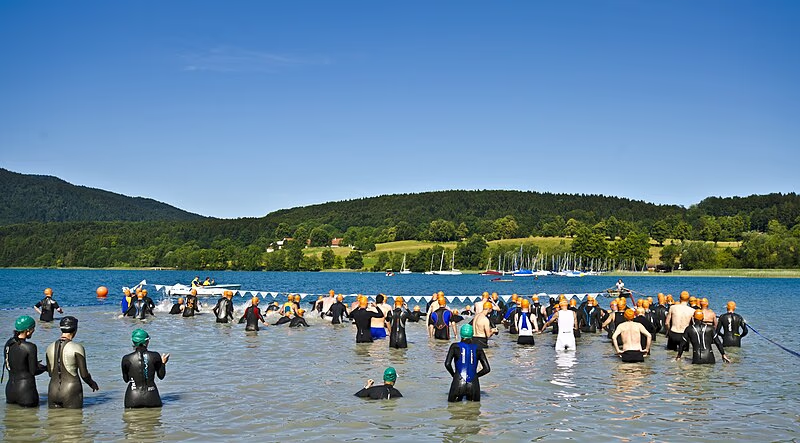
Distance: 1500 m (0.93 mi) for Olympic distance; 750 m for sprint; 300 m for mixed relay super-sprint.; Venue: Open water — lake, river, ocean, or harbour. Purpose-built pools are not used for World Triathlon or Olympic events.; Course layout: Marked by large coloured buoys at turning points. Typ...
Distance: 40 km (24.9 mi) for Olympic distance; 20 km for sprint; 7.4 km for mixed relay.; Layout: Typically a multi-lap circuit on closed public roads. Laps are usually 5–10 km each, providing spectator access and logistical control.; Road surface: Paved roads required. Technical Delegate inspec...
Distance: 10 km (6.2 mi) for Olympic distance; 5 km for sprint; 2 km for mixed relay.; Layout: Multi-lap circuit on paved surfaces. Aid stations every 2.5 km providing water, sponges, and electrolyte drinks.; Finish line: Clearly marked with timing mat, camera, and finish tape. Athletes must comp...
Transition 1 (T1): Swim-to-bike. Located between the swim exit and the bike mount line. Individually numbered racks where athletes store their bike and equipment.; Transition 2 (T2): Bike-to-run. Located between the bike dismount line and the run course start. Athletes rack their bike, remove hel...
Individual events: Up to 55 athletes per gender at the Olympic Games. Qualification based on World Triathlon rankings and continental quota places.; Mixed Relay: Teams of 4 (2 men + 2 women) from the same nation. Up to 16 teams at the Olympics.; Start format: Mass start (pontoon dive start) for i...
Technical Delegate (TD): Appointed by World Triathlon. Oversees course approval, equipment checks, and overall competition rules compliance.; Race Referee: On-course authority for penalty decisions and disqualifications.; Transition Officials: Monitor transition areas for rule compliance (racking...
Stop to help a competitor in genuine medical distress
If a fellow athlete is incapacitated, unconscious, or in obvious medical danger, the unwritten code demands you stop and render aid — even at the cost of your own race. This is widely considered triathlon's highest moral obligation and has roots in the sport's early 'iron will over winning' ethos. High-profile examples from Ironman World Championship races have reinforced this norm across decades.
Distinguished from general fatigue or struggle — you are not obligated to stop for someone who is merely suffering. Applies when someone is visibly collapsed, unconscious, or calling for help.
Don't draft even when you think you won't be caught
In non-draft-legal events, drafting is a written rule violation, but the unwritten layer is stronger: the culture expects athletes to self-police their position in the draft zone regardless of whether a marshal is present. Intentionally hovering in another athlete's zone while hoping to avoid penalty is considered dishonest competition, a mark against personal integrity rather than just a tactical risk.
Applies specifically to non-draft-legal formats (most IRONMAN, 70.3, and age-group sprint/Olympic events). Draft-legal World Triathlon Series racing has different norms.
Seed yourself honestly at mass swim starts
Swimmers are expected to position themselves in waves or corrals that honestly reflect their ability. Starting too far forward to draft off faster swimmers, or to gain early position, causes chaotic contact and slows faster athletes behind you. Self-seeding accurately — even when corrals aren't strictly enforced — is a baseline expectation of fair participation.
Ready to dive deeper?
Most relevant in mass wave starts and rolling-start formats. Pro fields are seeded officially, so this norm is primarily an age-group code.
Commit to your pass on the bike or drop back completely
When overtaking another rider in a non-draft-legal race, you must complete the pass briskly and establish a legal gap, or promptly drop back out of the draft zone. Hovering alongside or just ahead — effectively co-drafting — is considered both a rules violation and a breach of racing integrity. The obligation to either pass decisively or yield is a core piece of bike-leg etiquette.