















Section 1: Introduction
The Unified Rules of Mixed Martial Arts (MMA) provide a comprehensive and consistent regulatory framework governing professional MMA competition across the jurisdictions of various athletic commissions and regulatory bodies. The framework was proposed and agreed upon by athletic commissions throughout the 2000s and was unanimously adopted by the Association of Boxing Commissions (ABC) on July 30, 2009.
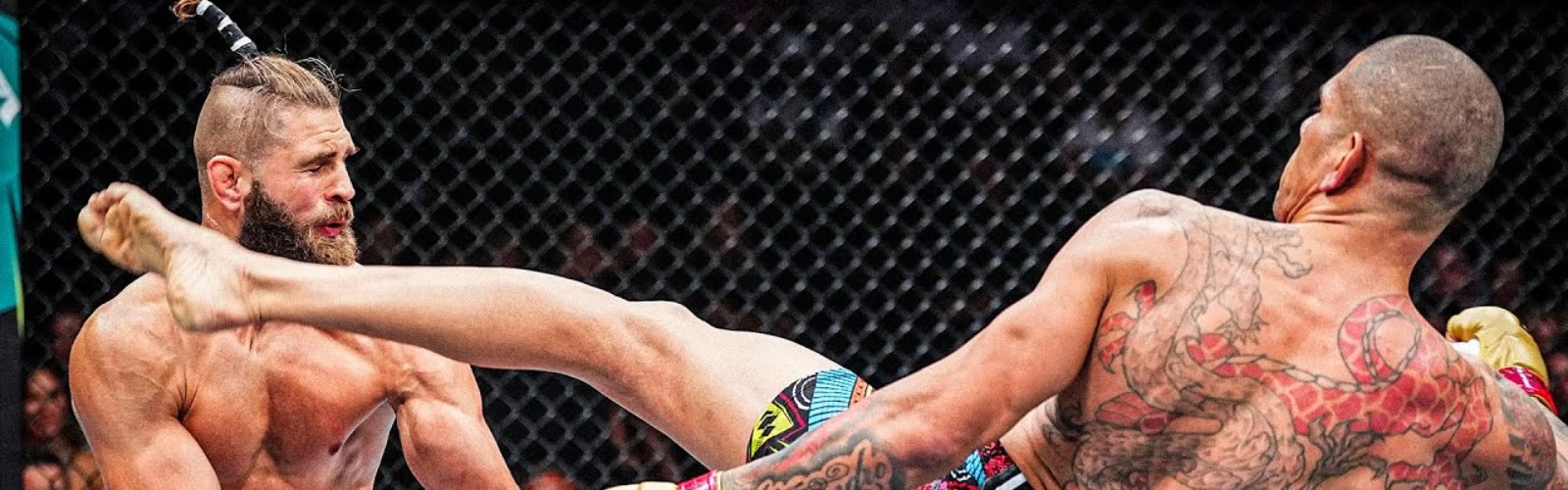
Mixed martial arts is a full-contact combat sport that allows a wide variety of fighting techniques and skills from a mixture of other combat sports and martial arts to be used in competition. The rules permit the use of both striking and grappling techniques, both while standing and on the ground.
The Unified Rules of MMA govern the following areas of competition:
- Judging criteria and scoring methodology
- Fouls and prohibited conduct
- Prohibited substances (Note: UFC not only complies with the prohibited substances requirements of the Unified Rules of MMA, but also far exceeds these requirements with the UFC Anti-Doping Policy, the most comprehensive in professional sport)
- Number of rounds per bout and round duration
- Weight classes and weigh-in procedures
- Medical requirements for athlete safety
- Athlete attire and equipment standards
UFC has consistently embraced more thorough regulation of MMA and formally adopted the Unified Rules of MMA in November 2000. These rules help ensure athlete safety and fair competition by providing a consistent regulatory standard — something that was absent in the early days of mixed martial arts. All UFC bouts are now governed with full adherence to the provisions set forth in the Unified Rules of MMA. UFC continues to support athletic commissions as they work to update and improve upon the Unified Rules of MMA in line with the evolving landscape of the sport.
Significant rule changes took effect on November 1, 2024, including the removal of the long-standing ban on 12-to-6 elbow strikes and an updated definition of a "grounded" opponent. In August 2025, the Association of Boxing Commissions (ABC) approved revised scoring criteria that prioritize damage as the primary judging criterion.
Section 2: Equipment
All athletes competing in sanctioned MMA bouts are required to wear and use approved equipment that meets the standards established by the relevant athletic commission and the Unified Rules of MMA. Equipment requirements are intended to protect athletes while preserving the integrity and nature of the competition.
Mandatory Equipment
- Gloves: Competitors must wear approved MMA gloves that allow the fingers to be free for grappling. Gloves typically weigh between 4 and 6 ounces. No competitor may hold or grab an opponent's gloves during competition.
- Mouthpiece: All competitors are required to wear a mouthpiece during competition. The bout may be paused for the referee to reinsert a dislodged mouthpiece, but intentionally or consistently dropping the mouthpiece may be penalized as timidity.
- Groin Protection: Male competitors are required to wear a groin protector (cup). Female competitors are required to wear a chest protector where required by the sanctioning athletic commission.
- Athletic Shorts or Approved Fight Attire: Competitors must wear approved athletic shorts, board shorts, or similar fight attire as approved by the athletic commission. Board shorts must not have pockets, buttons, or zippers that could be hazardous to either competitor.
- No Shoes: Competitors compete barefoot. Footwear of any kind is not permitted unless medically required and approved by the relevant athletic commission.
Prohibited Equipment
- Headgear of any kind (professional bouts)
- Shoes or boots
- Shirts or additional padding not approved by the athletic commission
- Any equipment deemed by the referee or commission to provide an unfair advantage or to pose a danger to either competitor
- Jewelry, piercings, or any object that could injure the opponent
Hand Wrapping
Competitors may use approved hand wraps beneath their gloves. The amount and type of hand wrapping material are regulated by the athletic commission. Wraps must be applied in a manner that does not add striking surface or create a hardened pad across the knuckles.
Section 3: Playing Area
MMA competition takes place inside an enclosed fighting area, most commonly an octagonal cage (commonly referred to as "The Octagon" in UFC events) or a traditional boxing ring. The specific dimensions and requirements for the fighting area are established by the sanctioning athletic commission.
The Octagon (UFC Standard)
- The UFC Octagon is a padded, fenced fighting area in the shape of a regular octagon.
- The Octagon measures approximately 30 feet (9.1 meters) in diameter across the interior.
- The fence surrounding the Octagon stands approximately 6 feet (1.8 meters) in height.
- The canvas floor is padded and stretched tightly to provide a firm, safe surface for competition.
- The fence is constructed of chain-link or similar material with a padded top rail to protect athletes from injury during contact with the fence.
General Fighting Area Standards
- The fighting area must be enclosed to prevent competitors from falling or being thrown out of the competition area during the bout.
- The floor must be padded and free of obstructions that could cause injury.
- The fighting area must be large enough to allow competitors to move freely and to safely conduct all phases of competition, including standing striking and ground grappling.
- Competitors are not permitted to throw or force an opponent out of the fighting area. Doing so constitutes a foul.
- The fence or ropes surrounding the fighting area may not be grabbed, held, or used for leverage by competitors during the bout. Holding the fence or ropes with fingers or toes is a foul.
Corners
Each competitor is assigned a designated corner of the fighting area where their coaching corner and seconds are stationed between rounds. Interference with the bout by a competitor's corner or seconds constitutes a foul and may result in disqualification of the competitor.
Section 4: Players/Officials
Competitors
Each MMA bout involves two competitors who have been matched in the same weight class. Competitors must meet all medical, licensing, and eligibility requirements established by the sanctioning athletic commission prior to competing. Competitors must comply with all instructions issued by the referee before, during, and after the bout.
The Referee
A single referee is positioned inside the fighting area and has sole authority over the conduct of the bout. The referee's primary responsibilities include:
- Ensuring the safety of both competitors throughout the bout
- Enforcing the rules of competition and assessing fouls
- Starting, pausing, and stopping the bout as necessary
- Issuing instructions and warnings to competitors
- Stopping the bout when a competitor is unable to intelligently defend themselves or when a submission is locked in and the competitor is in danger
- Only the referee has the authority to assess fouls and deduct points. Judges may not assess fouls independently.
Judges
Three judges are positioned at ringside and are responsible for scoring the bout in the event it goes the full scheduled distance. Judges score each round independently using the 10-Point Must System. Judges are strictly responsible for scoring based on the effectiveness of strikes, grappling, control, aggression, and overall performance. They must not assess fouls themselves, and may not factor any act into their scoring that was not identified as a foul by the referee.
The Official Scorekeeper
The official scorekeeper is responsible for tabulating judges' scorecards and calculating the true scores after factoring in any point deductions assessed by the referee. The scorekeeper does not score the bout but manages the administrative recording of scores and deductions.
Corners and Seconds
Each competitor is permitted a designated number of corner personnel (seconds) as permitted by the athletic commission. Corners may provide coaching and assistance between rounds only. Interference by corner personnel during active competition is a foul attributable to the competitor and may result in penalties up to and including disqualification.
The Physician
A licensed physician (ringside doctor) is present at all sanctioned bouts and has the authority to recommend or require the stoppage of a bout on medical grounds. The referee and physician work in concert to protect competitor safety. A competitor who is under the care of the referee or physician may not be legally struck by their opponent.
Section 5: Rules of Play
Bout Structure
Non-championship UFC bouts consist of three rounds. UFC championship bouts and main events designated by UFC consist of five rounds. Each round is five minutes in duration, with a one-minute rest period between rounds.
Weight Classes
Competitors are matched within established weight classes. The Unified Rules of MMA recognize the following weight classes for professional male and female competition:
- Strawweight: Up to 115 lbs (52.2 kg)
- Flyweight: Over 115 lbs up to 125 lbs (56.7 kg)
- Bantamweight: Over 125 lbs up to 135 lbs (61.2 kg)
- Featherweight: Over 135 lbs up to 145 lbs (65.8 kg)
- Lightweight: Over 145 lbs up to 155 lbs (70.3 kg)
- Welterweight: Over 155 lbs up to 170 lbs (77.1 kg)
- Middleweight: Over 170 lbs up to 185 lbs (83.9 kg)
- Light Heavyweight: Over 185 lbs up to 205 lbs (93.0 kg)
- Heavyweight: Over 205 lbs up to 265 lbs (120.2 kg)
- Super Heavyweight: Over 265 lbs (120.2 kg) — open weight
Permissible Techniques
MMA permits a broad range of techniques from standing and ground positions. Permissible techniques generally include:
- Punches, open-hand strikes, and hammer fists to legal target areas
- Elbow strikes, including downward-pointing strikes (the 12-to-6 elbow ban was officially removed effective November 1, 2024)
- Knee strikes to standing opponents (subject to grounded opponent restrictions)
- Kicks to standing and grounded opponents (subject to restrictions on head kicks to grounded opponents)
- Takedowns and throws
- Clinch work and dirty boxing
- Ground-and-pound (strikes to a grounded opponent within legal parameters)
- Submission holds, including joint locks and chokeholds
Grounded Opponent Definition (Updated November 2024)
A fighter is considered "grounded" when any part of their body other than their hands or feet is touching the canvas. This updated definition, effective November 1, 2024, replaced the previous rule under which merely placing a hand on the mat was sufficient to be considered grounded. The change eliminates the tactic of fighters placing a single hand on the mat to protect themselves from knees and kicks to the head. Specific restrictions apply to strikes against grounded opponents, including prohibitions on kneeing and kicking the head of a grounded opponent.
Starting and Stopping the Bout
The referee starts each round with the command "Fight!" and pauses or stops action with the command "Stop!" Competitors must cease action immediately upon the referee's command. Failure to do so upon the sounding of the bell or the referee's command constitutes a foul.
Ways a Bout May End
- Knockout (KO): A competitor is rendered unconscious or unable to continue due to strikes.
- Technical Knockout (TKO): The referee stops the bout because a competitor cannot intelligently defend themselves, or the ringside physician or corner stops the fight.
- Submission: A competitor verbally or physically "taps out," or the referee stops the bout because a submission hold is locked in and the competitor is in danger of serious injury.
- Judge's Decision: The bout goes the scheduled distance and is decided by the judges' scorecards (unanimous decision, split decision, or majority decision).
- Draw: The judges' scores are equal at the end of the bout.
- No Contest: The bout is stopped due to an accidental foul that renders a competitor unable to continue, or due to other circumstances that prevent the bout from reaching a fair conclusion.
- Disqualification: A competitor is disqualified for committing fouls as determined by the referee.
Section 6: Scoring
The 10-Point Must System
All bouts are scored using the 10-Point Must System. Under this system, the winner of each round receives 10 points and the loser receives 9 points or fewer. A round that is scored even results in both competitors receiving 10 points, though even rounds are discouraged and should be rare.
Judging Criteria (Updated August 2025)
In August 2025, the Association of Boxing Commissions (ABC) approved revised scoring criteria that prioritize damage as the primary judging criterion. Judges evaluate each round based on the following criteria, in order of priority:
- Damage: The primary scoring criterion. Damage encompasses the visible and measurable impact of strikes and submissions, including cuts, bruising, swelling, knockdowns, and impairment of an opponent's ability to continue. Damage is now weighted above volume of strikes.
- Effective Striking: The total number of legal strikes landed with significant impact, including punches, kicks, elbows, and knees. Quality and impact of strikes are weighted over sheer volume.
- Effective Grappling: Successful execution of takedowns, sweeps, reversals, and submission attempts that demonstrate control and damage. Takedowns that lead to dominant positions or submission attempts are scored more heavily than those that are immediately reversed.
- Aggression: Moving forward and pressuring the opponent, attempting to finish the fight, and taking the initiative. Aggression is only considered a factor when the other criteria are equal and must be distinguished from wild or reckless forward movement.
- Control of the Fighting Area: Dictating the location and tempo of the bout. This is the lowest-priority tiebreaker and is only considered when all other criteria are equal.
Under the updated criteria, a 10-8 round now requires "significant damage," and a 10-7 round requires "overwhelming damage and domination." Duration of dominance (percentage of round spent establishing dominance) is also considered.
Point Deductions
When the referee assesses a foul, they may instruct the official scorekeeper to deduct one or more points from the offending competitor's score for that round. The scorekeeper, not the judges, is responsible for calculating the true score after factoring in point deductions. Judges do not assess or apply point deductions independently.
Judge Independence
Judges must not communicate with one another or with ringside personnel during the bout. Each judge scores the bout independently. Judges must not factor fouls into their scoring unless the foul has been officially called and communicated by the referee.
Scorecards
At the conclusion of each round, judges submit their scorecards to the scorekeeper. At the conclusion of the bout, all scorecards are collected and tabulated. The competitor with the higher aggregate score on a majority or greater of the judges' scorecards is declared the winner by decision.
Section 7: Violations/Penalties
The following acts constitute fouls in a contest or exhibition of mixed martial arts and may result in penalties, at the discretion of the referee, if committed:
- Butting with the head
- Eye gouging of any kind
- Biting or spitting at an opponent
- Fish hooking (inserting a finger or fingers into the mouth or nostrils of a person and pulling away from the centerline of the body)
- Hair pulling
- Spiking an opponent to the canvas on their head or neck
- Strikes to the spine or the back of the head
- Throat strikes of any kind, and/or grabbing the trachea
- Fingers outstretched toward an opponent's face or eyes
- Downward-pointing elbow strikes (the "12-to-6" elbow ban was removed effective November 1, 2024 — these strikes are now legal)
- Groin attacks of any kind
- Kneeing and/or kicking the head of a grounded opponent
- Stomping a grounded opponent
- Holding an opponent's gloves or shorts
- Holding or grabbing the fence or ropes with fingers or toes
- Small joint manipulation (targeting and manipulating the fingers or toes of the opponent)
- Throwing an opponent out of the ring or fighting area
- Intentionally placing a finger into any orifice, cut, or laceration of an opponent
- Clawing, pinching, or twisting the flesh of the opponent
- Timidity, including avoiding contact with an opponent, intentionally or consistently dropping the mouthpiece, or faking an injury
- Using abusive language in the fighting area
- Flagrant disregarding of the referee's instructions
- Unsportsmanlike conduct that causes injury to an opponent
- Attacking an opponent after the bell has sounded the end of the period of unarmed combat
- Attacking an opponent on or during the break
- Attacking an opponent who is under the care of the referee
- Interference from a mixed martial artist's corner or seconds
Foul Assessment and Penalties
- Disqualification: Disqualification may occur after any combination of fouls or after a single flagrant foul, at the discretion of the referee.
- Point Deductions: Fouls may result in a point being deducted by the official scorekeeper from the offending competitor's score. The scorekeeper, not the judges, is responsible for calculating the true score after factoring in any point deduction.
- Referee Authority: Only a referee can assess a foul. If the referee does not call the foul, judges must not make that assessment on their own and should not factor such conduct into their scoring calculations.
Accidental Fouls
When a foul is determined to be accidental (unintentional), the referee may pause the bout to allow the injured competitor time to recover. The amount of recovery time granted is at the discretion of the referee and the ringside physician. If the injured competitor cannot continue due to an accidental foul, the bout may be declared a No Contest or decided by the judges' scorecards depending on how many rounds have been completed, as determined by the applicable athletic commission's rules.
Section 8: Safety Considerations
Athlete safety is the foremost priority in all aspects of regulated MMA competition. The Unified Rules of MMA and UFC's organizational policies include numerous provisions designed to protect competitors before, during, and after bouts.
Medical Requirements
- All competitors must undergo a pre-fight medical examination conducted by a licensed physician prior to competing in a sanctioned bout.
- A licensed ringside physician must be present at all sanctioned bouts and has the authority to stop a bout on medical grounds at any time.
- Competitors with certain medical conditions or recent injuries may be prohibited from competing at the discretion of the athletic commission and ringside physician.
- Post-fight medical examinations are required for all competitors, with particular attention given to competitors who have sustained significant strikes or injuries.
- Medical suspensions may be issued to competitors following bouts, during which the competitor is prohibited from training or competing until cleared by a licensed physician.
Referee Stoppages
The referee has the authority and obligation to stop the bout at any time when a competitor is deemed unable to intelligently defend themselves, when a submission hold presents a danger of serious injury, or when the ringside physician recommends stoppage. Referees are trained to intervene quickly to prevent unnecessary harm while allowing competitors sufficient opportunity to defend themselves and recover.
Anti-Doping Policy
UFC transitioned from its partnership with the United States Anti-Doping Agency (USADA) in early 2024 and now operates an in-house anti-doping program. The current program includes both random out-of-competition testing and in-competition testing for all athletes on the UFC roster. The anti-doping policy goes beyond the prohibited substances requirements of the Unified Rules, and violations may result in suspension, fines, and loss of fight results.
Weigh-In and Hydration Safety
All competitors must make weight at the official weigh-in held the day before the event. Competitors who miss weight may be subject to a financial penalty and may not be eligible to compete for a title. Athletic commissions have adopted hydration testing protocols to discourage extreme weight cutting practices that can endanger competitor health.
Equipment Safety
The referee inspects both competitors' equipment before the start of each bout to ensure compliance with equipment rules. Improperly fitted or non-compliant equipment may be adjusted or replaced before the bout begins. The use of prohibited substances on the body (such as excessive lubricants) that could affect the ability of an opponent to apply grappling techniques is prohibited and constitutes a foul.
Prohibited Conduct and Fighter Safety During the Bout
The extensive foul system defined in the Unified Rules of MMA exists primarily as a safety framework. Prohibitions against strikes to the spine, back of the head, throat, groin, and eyes, as well as against certain techniques such as spiking, stomping, and small joint manipulation, are specifically designed to reduce the risk of catastrophic injury during competition. Referees are empowered to stop the action at any moment to enforce these protections.
Corner and Second Responsibilities
Corners and seconds play an important role in competitor safety. They must have towels available to signal the surrender of their competitor if the competitor is unable or unwilling to do so themselves. Corners must not interfere with the bout during active competition. They are responsible for ensuring their competitor is in acceptable medical condition to continue between rounds and must not allow a compromised competitor to return to competition.