


🏛️Official — IIHF
Loading OpenSourceSports…
Never Run the Goalie
Deliberately targeting an opposing goaltender with a big hit — especially when they're set in the crease — is one of hockey's most serious code violations. Even when technically legal, going out of your way to hit the goalie signals disrespect for the game and guarantees immediate retaliation from the opposing team.
Protect Your Goalie — Or Someone Answers
If an opponent runs your goaltender, at least one teammate must immediately confront the offender. Allowing your goalie to be hit without response is considered a failure of team character and signals the team can be intimidated. This duty often falls to the team's enforcer or toughest player.
The Playoff Handshake Line Is Sacred
After a playoff series, both teams line up at center ice and shake hands with every opponent. Refusing to participate, going through it half-heartedly, or skipping players is considered one of hockey's gravest sportsmanship failures. The tradition is observed from youth playoffs through the Stanley Cup Finals and IIHF tournaments.
No Cheap Shots After the Whistle
Continuing to hit, slash, cross-check, or agitate an opponent after the referee blows the whistle is a serious breach of the code beyond whatever penalty it may draw. It is widely seen as cowardly — attacking when the player is no longer defending themselves — and guarantees a retaliatory response.
The Code of Fighting: Consent, Fairness, One-on-One
Staged fights follow implicit rules: both players must agree (drop gloves together), fight fairly (no sucker punches, no hitting a downed opponent), and teammates stand clear. Jumping someone from behind, attacking a player already engaged, or continuing to punch a fallen opponent are serious violations within the fighting code.
Don't Run Up the Score
When a team holds a commanding lead late in the game, they are expected to ease off — pulling star players, cycling the puck rather than shooting, avoiding additional scoring. Aggressively pursuing goals in a lopsided game is seen as showing up the opposition and will be remembered in the next meeting.
Enforcers Protect Stars — They Are Off Limits for Cheap Shots
Skilled players are understood to be under the implicit protection of the team's enforcer. Taking unnecessary runs at a star player signals willingness to escalate and the enforcer is expected to respond. Teams without a credible physical presence are seen as vulnerable to opponents targeting their top players.
No Diving or Embellishment — Play Through Contact
Embellishing contact to draw a penalty is widely condemned in hockey culture. Players are expected to absorb physicality and demonstrate toughness. Being labeled a diver carries lasting reputational damage — officials and opponents give less benefit of the doubt on all future plays, making it strategically self-defeating as well as culturally scorned.
Maximum shaft length: 163 cm (64 in) from the heel of the blade to the end of the shaft.; Blade length: 25–32 cm (9.8–12.6 in).; Blade width: 5–7.5 cm (2–3 in).
— Rule 32
Why people argue about this
People often assume that the stick width limit is solely about preventing illegal hits, forgetting that it's also meant to ensure players can't use their sticks as weapons by making them too wide or sharp. They overlook how this rule maintains a balance between safety and competitive play in ice hockey.
Helmet: IIHF-approved helmet with full face protection (cage or full visor) mandatory for all skaters. Chin strap must be fastened at all times on ice.; Body protection: Shoulder pads, elbow pads, hockey gloves, shin guards, hockey pants (breezers), and athletic cup/jock. All protective equipment...
Why people argue about this
People often assume that only goalies need full face protection, so they argue why other skaters don't have to wear them. Actually, the rule mandates all skaters use helmets with full face protection for safety, regardless of position or perceived risk level.
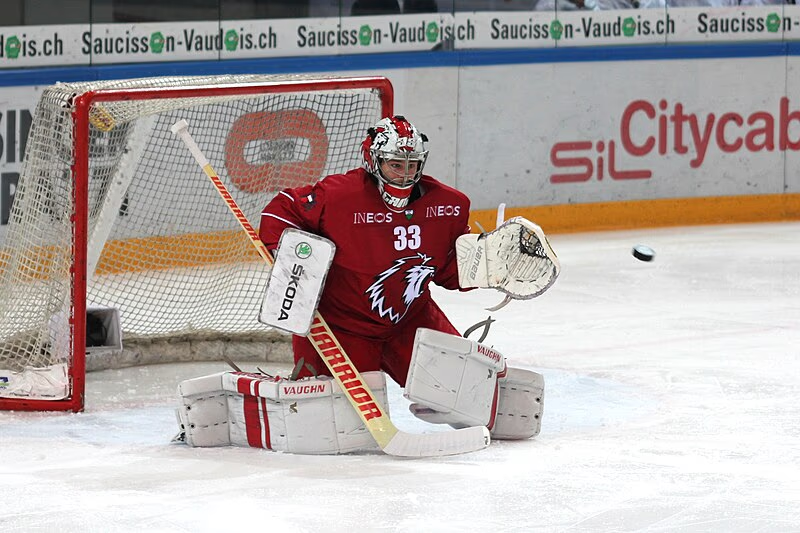
Leg pads: Maximum width 28 cm (11 in). Maximum length measured from centre of the knee to the boot: proportional to the goalkeeper's body. No rigid external attachments that extend the blocking surface beyond pad dimensions.; Catching glove (trapper): Maximum width 23 cm (9 in) measured across th...
Why people argue about this
People often assume that the 9 cm stick width limit is only for aesthetic reasons, thinking it's a silly restriction meant to make goalies look less intimidating. In reality, the rule aims to ensure fair play by preventing overly aggressive or dangerous stick widths that could give goaltenders an unfair advantage over skaters.
Material: Vulcanised rubber, solid black.; Diameter: 7.62 cm (3 in).; Thickness: 2.54 cm (1 in).
Why people argue about this
People often assume that the 7.5 cm width limit applies to the entire blade of a goalie's stick, including the upper part above the shaft. However, the IIHF specifically states it only limits the lower shaft portion, which can lead to misunderstandings and disputes about where exactly this measurement starts on the stick.
Overall size: 60 m × 30 m (197 ft × 98.4 ft) for international/Olympic play. The wider surface compared to NHL rinks (200 ft × 85 ft) emphasises skating speed, passing, and positional play over physical forechecking.; Corner radius: 7–8.5 m (23–28 ft).; Boards: Height 1.07–1.22 m (42–48 in) above...
Why people argue about this
People often argue that the blue lines are too far from the goals, thinking they should be closer so it's easier for players to reach the other end of the rink quickly. But actually, the distance is set by the IIHF to ensure there’s a strategic buffer zone where defenders can position themselves effectively against an attacking player.
Centre red line: Divides the rink in half. 30 cm (12 in) wide. Used for icing determination.; Blue lines (2): 30 cm (12 in) wide, positioned 22.86 m (75 ft) from each goal line. Blue lines divide the ice into three zones: defending zone, neutral zone, and attacking zone.; Goal lines (2): 5 cm (2 ...
Why people argue about this
People often assume that the centre red line only divides the ice into two zones for defensive positioning, forgetting its crucial role in icing determination, which is based on whether a player shoots from behind it or not. The rule's focus on this detail can lead to misunderstandings about its primary function.
Goal frame: 183 cm (6 ft) wide × 122 cm (4 ft) high, measured from inside of the posts. Constructed of metal tubing, painted red. Net attached to the rear of the frame.; Goal crease: Semi-circular area in front of the goal with a radius of 1.8 m (5.9 ft), painted blue. The crease defines the goal...
Why people argue about this
People often assume that the goal crease radius is a fixed 7 meters all around, which leads to misunderstandings about where exactly it extends from the centre red line to the goal posts. The confusion arises because the rule states it's "from the centre red line to the goal posts," implying an arc extending outward rather than a straight line.
Team benches: Located on the same side of the rink, one for each team, separated by the penalty boxes at centre ice.; Penalty boxes: Two boxes at centre ice (one per team) for penalised players. A third box (timekeeper's box) sits between them.; Bench gates: Must open away from the ice surface fo...
Why people argue about this
People often assume that the safety glass extending above the boards is there purely for aesthetic reasons, when in reality it's crucial for player safety during rough collisions or accidental falls off the bench. They overlook how this glass can prevent serious head injuries by acting as a barrier to incoming pucks and other players.
On-ice: 6 players per team — 5 skaters (typically 3 forwards + 2 defencemen) and 1 goalkeeper.; Roster: Maximum 22 skaters (20 skaters + 2 goalkeepers) dressed for a game. A third goalkeeper may be available but not dressed.; Extra attacker: Teams may pull the goalkeeper for a 6th skater (empty n...
Why people argue about this
People often assume that having two goaltenders means they can both be on the ice at once, which is incorrect according to the IIHF rules where only one goaltender (netminder) is allowed per team at any given time. The confusion arises because this rule isn't always obvious from casual observation and requires a clear understanding of how goalies are managed in play.
4-official system (major tournaments): 2 referees + 2 linesmen. Both referees can call all penalties. Linesmen handle icing, offside, and face-offs, and may report certain infractions to the referees.; 3-official system: 1 referee + 2 linesmen. Used at lower-level IIHF events.; Referee authority:...
Why people argue about this
People often assume that linesmen have as much authority as referees in calling penalties, which they don't under IIHF rules for major tournaments; actually, linesmen only handle icing, offside, and face-offs, while it's the job of the on-ice referees to call all penalties. This leads to misunderstandings about their roles and responsibilities during games.
Goal judges: Positioned behind each goal to signal when the puck crosses the goal line (advisory; referee makes final determination).; Timekeeper: Controls the game clock, records penalties, and manages intermission timing.; Penalty timekeeper: Tracks penalty duration and signals when penalised p...
Why people argue about this
People often assume that Rule 4.3 Off-Ice Officials in the IIHF handbook means there are strict guidelines for what off-ice officials can do, but actually, it's a catch-all section where no specific rules are provided about off-ice officials' roles or actions, leading to confusion and arguments over their responsibilities.
Regulation: 3 periods × 20 minutes of running time (clock stops on whistles). 15–18 minute intermissions between periods with ice resurfacing.; Overtime (preliminary rounds): 5 minutes of 3-on-3 sudden-death play. If still tied, a shootout determines the winner.; Overtime (elimination/medal games...
Why people argue about this
People often assume that as long as their player touches the puck first in their zone, they're safe from offside, but actually, it's about when their skates enter the zone before the puck crosses the blue line - not just who touched it last. They overlook the timing aspect and focus too much on who initiated contact with the puck.
An attacking player may not precede the puck into the attacking zone (beyond the blue line). If an attacking player's skates are in the attacking zone before the puck completely crosses the blue line, offside is called.
Why people argue about this
People often assume that offside is called based solely on a player's position in the zone before the puck crosses the blue line, but actually it’s about whether their skates are in the zone when the puck leaves the defense. They overlook the crucial moment when the puck moves past the line, focusing instead on where players were at any point during the play.
Icing occurs when a team shoots the puck from their own side of the centre red line across the opposing team's goal line without it being touched. Under IIHF rules, no-touch icing is in effect: the whistle blows automatically when the puck crosses...
Why people argue about this
People often think that icing only applies when a player directly shoots the puck from behind their own blue line, forgetting that under IIHF rules, as soon as the puck crosses the goal line without being touched by an opposing player, it's considered icing regardless of who shot it or how many touches it had.
Face-offs restart play after stoppages. The visiting team's centre places their stick first.
Why people argue about this
People often assume that in a face-off, the player from the visiting team places their stick on the ice first purely for tradition or preference, but actually, it's about maintaining continuity - ensuring play doesn't start with the home team having an advantage every time.
Men's hockey: Body checking is permitted. A legal body check requires shoulder-to-shoulder or hip-to-body contact on an opponent who possesses or has just played the puck.; Women's hockey: Body checking is prohibited under IIHF rules. Incidental contact is permitted, but deliberate checking resul...
Why people argue about this
People think that fighting is just a regular penalty like tripping, but they misunderstand how severe it can be under IIHF rules - actually, fighting results in an automatic ejection and minimum 1-game suspension for the player, plus additional suspensions for instigators, which often leads to heated debates about its severity.
Under IIHF rules, fighting is treated as a match penalty: the player is ejected from the game and receives an automatic minimum 1-game suspension. Instigators receive additional suspensions.
Why people argue about this
People often assume that fighting in ice hockey is just a normal part of play, so they're surprised when it results in an automatic ejection and suspension. But actually, the rule's intent is to prevent violence and protect players from serious injury by removing fighters from the game entirely.
A goal is scored when the entire puck crosses the goal line between the posts and below the crossbar by legal means. The puck may deflect off any player (including an attacking player's skate, provided there is no distinct kicking motion) and still count.
Why people argue about this
People often assume that a goal can only be scored if the puck crosses the line cleanly without deflecting off another player's equipment. But actually, they misunderstand that as long as the puck legally enters the net via deflection by any player (including an attacker whose skate touches it), it counts as a valid goal.
All goals at IIHF major tournaments are subject to video review. The video review supervisor may initiate a review for: Puck crossing the goal line (did the entire puck cross?); High stick (was the puck contacted above the crossbar?); Kicking motion (was the puck deliberately kicked into the net?)
Why people argue about this
People often assume that only goals scored in crucial moments are reviewed under video review, which leads them to misunderstand how frequently it's used. Actually, all goals at IIHF major tournaments are subject to this review, regardless of the game’s outcome or importance, creating confusion about its application and frequency.
When a goal is scored against a short-handed team (due to a minor or bench minor penalty), the penalised player is released from the penalty box and returns to full strength. Major penalties (5 minutes) are not terminated by a goal — the penalised...
Why people argue about this
People often assume that a major penalty's clock doesn't stop when a goal is scored against their team, leading them to believe their player will remain in the box for 5 minutes regardless of what happens on the ice. However, the rule clearly states that major penalties aren’t terminated by a goal, so the penalized player gets released as soon as the goal is scored.
In group-stage play, teams earn 3 points for a regulation win, 2 points for an overtime/shootout win, 1 point for an overtime/shootout loss, and 0 points for a regulation loss. Tiebreakers include: head-to-head record, goal difference, goals scored, and IIHF World Ranking.
Why people argue about this
People often assume that in case of a tie after all these points are distributed, teams simply play another game to break it, forgetting about the head-to-head record, goal difference, goals scored, and ranking factors which are used as tiebreakers right from the start. They overlook how crucial these additional criteria can be when deciding who moves forward or loses a playoff spot.
The penalised player sits in the penalty box for 2 minutes of playing time. , 5-on-4).
Why people argue about this
People often assume that if a player gets two 2-minute penalties in quick succession, both penalties always apply regardless of scoring. But actually, if the opposing team scores within those first 2 minutes, only one penalty is enforced for the second one, making it seem like more time is served than what's actually applied.
Two consecutive 2-minute penalties served by the same player. If the opposing team scores during the first 2 minutes, the first penalty is terminated, but the second 2-minute period remains.
Why people argue about this
People often assume that if a player gets two 2-minute penalties in quick succession, they automatically get an additional 4 minutes for both, but actually, only one penalty (the first) is enforced for up to 2 minutes; if the opposing team scores within those 2 minutes, the second penalty doesn't start.
Five minutes served in full regardless of goals scored. Often accompanied by a game misconduct (ejection). Common major penalties include: Boarding (violent check into the boards), charging (excessive strides before a check), checking from behind, fighting (IIHF: match penalty instead)
Why people argue about this
People often assume that a major penalty is automatically called if an offensive player interferes with the puck-carrier's vision, but in reality, it requires a clear scoring opportunity being illegally denied by the defense to trigger this rule. The confusion arises because the definition of 'clear scoring opportunity' can be subjective and varies based on context.
Misconduct (10 minutes): The player serves 10 minutes, but the team does NOT play short-handed (a substitute serves any concurrent minor/major). Typically for unsportsmanlike conduct or abusive language.; Game misconduct: Player is ejected for the remainder of the game. Substitute may take their ...
Why people argue about this
People often assume that the Misconduct penalty is awarded for denying a clear scoring opportunity, which isn’t quite accurate. Actually, it’s reserved for more egregious infractions like fighting or intentionally interfering with an opponent during play, not just for missing out on a goal-scoring chance. The rule is meant to address significant disruptions rather than every missed shot.
Awarded when a clear scoring opportunity is illegally denied, typically: Fouling a player on a breakaway from behind; Displacing the goal during a scoring attempt; A defending player (other than the goalkeeper) covering the puck in the crease
Why people argue about this
People often think that a penalty shot is awarded simply for denying an obvious goal-scoring opportunity, but actually, it's only given if such a denial occurs during a stoppage in play when the goalie has control of the puck or if the defender handling the puck makes contact with another player before shooting. They miss that there are specific conditions under which this rule applies.
Full face protection: Mandatory for all IIHF skaters (cage or full visor). This differs from the NHL, which only requires a visor. Greatly reduces facial and dental injuries.; Neck guard: Mandatory for goalkeepers at all levels. Following an IIHF Council decision, on recommendation of the IIHF Me...
Why people argue about this
People often assume that full face protection is only for goaltenders in ice hockey, but the official IIHF rule states it's mandatory for all skaters, regardless of position. This leads to misunderstandings because many players and coaches believe only goalies need to wear full masks or cage visors due to the high risk they face.
Head contact rule: Any check where the head is the principal point of contact is penalised, regardless of whether the checker intended head contact. Penalties range from minor + misconduct to match penalty depending on severity.; Concussion protocol: Any player suspected of a concussion must imme...
Why people argue about this
People often assume that just calling it a "head check" automatically means it's penalized under this rule, but in reality, the key is whether the head was the principal point of contact during the hit, regardless of what you call it verbally. The confusion arises because the intent behind the action and its physical execution are scrutinized differently than the terminology used to describe it.
Blood rule: Any player with visible bleeding must leave the ice immediately and may not return until the bleeding is controlled and all blood-stained equipment is cleaned or replaced.; Emergency equipment: A defibrillator (AED) and emergency medical equipment must be immediately accessible at all...
Why people argue about this
People often assume that if a player's blood is visible during play, they must be removed immediately under the Blood Rule, but actually, it’s about significant blood loss requiring medical attention, not just visible blood itself — so players might think they can keep playing with minor cuts or abrasions that aren’t causing them pain.
Safety glass: Tempered glass or polycarbonate shielding above the boards protects spectators from errant pucks while allowing visibility. Higher sections behind the goals (typically 2.4 m / 8 ft above boards).; Netting: Protective netting above the safety glass behind both goals to prevent pucks ...
Why people argue about this
People often assume that only goalies need neck guards because they're in a more vulnerable position, forgetting that all players are required by the rule to wear full face protection, which includes their neck area for safety. This leads to misunderstandings about who needs what kind of gear and why it's important for everyone.
Maximum shaft length: 163 cm (64 in) from the heel of the blade to the end of the shaft.; Blade length: 25–32 cm (9.8–12.6 in).; Blade width: 5–7.5 cm (2–3 in).
— Rule 32
Why people argue about this
People often assume that all ice hockey equipment must be exactly the same size as long as it's safe, forgetting that there are strict dimensional requirements set by the IIHF. They might think anything as long as it doesn't hurt anyone works, but in reality, every piece of gear has specific measurements to ensure fair play and safety across the board.
Overall size: 60 m × 30 m (197 ft × 98.4 ft) for international/Olympic play. The wider surface compared to NHL rinks (200 ft × 85 ft) emphasises skating speed, passing, and positional play over physical forechecking.; Corner radius: 7–8.5 m (23–28 ft).; Boards: Height 1.07–1.22 m (42–48 in) above...
Why people argue about this
People often assume that the blue lines are 22.86 meters from each goal line, which is why they argue about it; however, the actual distance between the center red line (not the blue one) and each goal line is precisely 22.86 meters, with the blue lines being parallel to the boards at that distance, not directly adjacent to the goal lines themselves.
On-ice: 6 players per team — 5 skaters (typically 3 forwards + 2 defencemen) and 1 goalkeeper.; Roster: Maximum 22 skaters (20 skaters + 2 goalkeepers) dressed for a game. A third goalkeeper may be available but not dressed.; Extra attacker: Teams may pull the goalkeeper for a 6th skater (empty n...
Why people argue about this
People often assume that an Ice Hockey team can have up to 23 players on ice at once, including their two goalkeepers, which is why they argue; however, the official limit is actually 6 players per side, with no more than 5 skaters and one goalie active at any given time.
An attacking player may not precede the puck into the attacking zone (beyond the blue line). If an attacking player's skates are in the attacking zone before the puck completely crosses the blue line, offside is called.
Why people argue about this
People often assume that as long as their player's skates are in the zone before the puck crosses the blue line, they're fine — but actually, it’s only if the player precedes the puck into the zone that offside is called. The rule specifically states the attacking player can’t be the first to enter the zone with the puck; just having their skate there isn't enough for offside.
A goal is scored when the entire puck crosses the goal line between the posts and below the crossbar by legal means. The puck may deflect off any player (including an attacking player's skate, provided there is no distinct kicking motion) and still count.
Why people argue about this
People often think that a goal is only scored if the puck crosses the line cleanly without touching any player's equipment at all, but actually, as long as it legally enters the net by deflecting off a player (even their skate), it counts as a valid goal. The rule allows for some creative scoring scenarios where players can use their bodies to help move the puck into the net.
Two consecutive 2-minute penalties served by the same player. If the opposing team scores during the first 2 minutes, the first penalty is terminated, but the second 2-minute period remains.
Why people argue about this
People often assume that if a player gets two 2-minute penalties in quick succession, both must be served consecutively, but actually, if the opposing team scores during the first penalty's time, only the initial one is nullified and the second starts immediately after. This oversight leads to misunderstandings about how scoring by the opponent affects the sequence of penalties.
Full face protection: Mandatory for all IIHF skaters (cage or full visor). This differs from the NHL, which only requires a visor. Greatly reduces facial and dental injuries.; Neck guard: Mandatory for goalkeepers at all levels. Following an IIHF Council decision, on recommendation of the IIHF Me...
Why people argue about this
People often assume that full face protection is only for goaltenders in ice hockey, but the official verdict clarifies it's mandatory for all skaters. This leads to misunderstandings because they overlook how facial injuries can occur from high-speed collisions and slap shots without this crucial safety gear.